
An AV receiver should be selected around the room, speaker layout and connected sources rather than channel count alone.
A large immersive system may justify extensive amplification and advanced room correction, while a smaller installation can benefit more from a slim chassis, straightforward calibration or an alternative that reduces the number of components.
This guide intentionally extends beyond conventional receivers. The Onkyo TX-RZ70 and Marantz CINEMA 70s Series 2 serve clearly defined home-cinema roles, while JBL offers a broader family covering several channel configurations. The remaining entries include receiver-free systems, expansion amplification, speakers, room-correction software and practical setup advice. That distinction matters when comparing use cases. Onkyo is the ambitious option for a large multichannel installation, Marantz addresses restricted equipment space, and the JBL MA line provides a range of starting points. A soundbar, active monitors or immersive headphones may be more appropriate when a complete receiver-and-speaker system would be unnecessarily complex.

1. Yamaha NX N500: Active near-field monitors
Yamaha NX-N500 active near-field monitors designed for home digital-music playback.
The Yamaha NX-N500 addresses a different requirement from a multichannel AV receiver.
Its active near-field format is intended for home listening and suits music libraries stored on computers and smartphones, providing a stereo alternative to a compact wireless monoblock or a larger system assembled from separate electronics.
Yamaha MusicCast also allows compatible audio products, including AV receivers and wireless speakers, to be combined within a wider ecosystem.
Best for: Receiver-free near-field music systems
- Active near-field design intended for home use
- Suited to computer and smartphone music libraries
- Compatible with Yamaha MusicCast
Verdict: A focused alternative for listeners who want an active stereo system rather than a conventional multichannel receiver installation.

2. Denon DHT-S517: Soundbar with Dolby Atmos, eARC and proprietary dialogue enhancement
The Denon DHT-S517 combines a 3.1.2 soundbar with a wireless subwoofer and HDMI eARC connectivity.
The Denon DHT-S517 is a simpler television-audio alternative to an AV receiver and separate speaker package.
Its 3.1.2 arrangement combines up-firing Dolby Atmos speakers with a wireless subwoofer, while HDMI eARC, an additional HDMI connection and an optical input provide several ways to connect a television and source equipment.
Adjustable Dialogue Enhancer settings, Cinema, Music and Night modes, Bluetooth and Pure Mode broaden its usefulness without introducing receiver-level complexity.
Best for: Straightforward Dolby Atmos television sound
- 3.1.2 Dolby Atmos configuration with up-firing speakers
- Wireless subwoofer included
- HDMI eARC, additional HDMI and optical connections
- Adjustable dialogue enhancement and Night mode
Verdict: A practical choice when dialogue clarity, immersive processing and simple TV connectivity matter more than the flexibility of a component AV system.

3. Onkyo TX-RZ70: Flagship 11.2 receiver
Onkyo’s TX-RZ70 is an 11.2-channel flagship receiver with HDMI 2.1 and Dirac Live room correction.
The TX-RZ70 is the most ambitious conventional AV receiver in this selection.
Its 11.2-channel architecture supports extensive speaker layouts, while Dolby Atmos, DTS:X, IMAX Enhanced and THX certification cover the principal immersive-cinema formats identified in the source.
HDMI 2.1 connectivity, 8K and 4K support and high-refresh-rate functionality address current game consoles. Dirac Live handles room correction, with Dirac Live Bass Control available as an upgrade for more advanced low-frequency optimization.
Best for: Large immersive cinema and gaming systems
- 11.2-channel architecture
- Dirac Live room correction
- HDMI 2.1 with 8K, 4K and high-refresh-rate support
- Dolby Atmos, DTS:X, IMAX Enhanced and THX certification
Verdict: The TX-RZ70 is the receiver to consider when a high channel count, modern video connectivity and comprehensive room correction are central requirements.
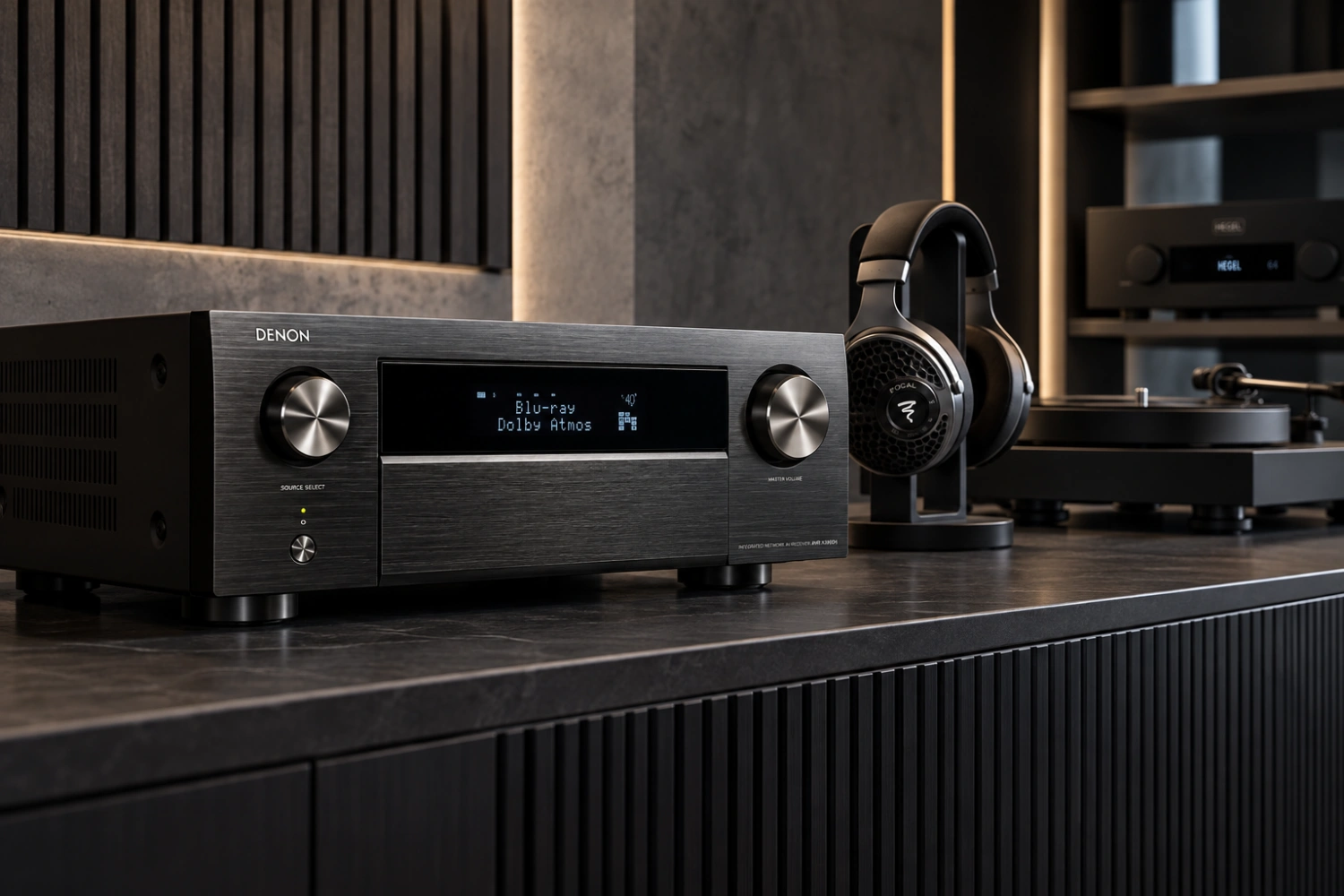
4. How to Set Up an AV Receiver for Better Sound and Fewer Problems
Careful speaker placement, connection checks and calibration form the basis of a reliable AV receiver installation.
Receiver performance depends as much on installation as it does on the hardware.
This setup guide prioritizes the fundamentals: establishing the main listening position, placing and aiming speakers sensibly, checking signal paths and carrying out calibration carefully.
Its approach applies to both compact 5.1 systems and larger Dolby Atmos installations, while recognizing that room correction cannot fully compensate for poor speaker placement.
Best for: New installations and system troubleshooting
- Applicable to compact 5.1 and larger Dolby Atmos systems
- Prioritizes speaker placement before electronic correction
- Covers signal paths and careful calibration
- Addresses common sources of configuration problems
Verdict: This is the most relevant entry for readers who already own a receiver but need to improve setup quality, reliability and calibration.

5. JBL Launches MA Line of Five AV Receivers
The JBL MA receiver family ranges from the 5.2-channel MA310 to the 9.2-channel MA9100HP.
JBL’s MA family provides a range of receiver configurations rather than a single one-size-fits-all model.
The line begins with the 5.2-channel MA310 and extends to the 9.2-channel MA9100HP, allowing buyers to match the receiver more closely to the planned speaker layout.
Every model uses Class D amplification, supports Dolby and DTS decoding and includes a 24-bit/192 kHz DAC. JBL’s EZ Set EQ app provides mobile-device room equalization, while the MA7100HP and MA9100HP can use Dirac Live after the required licence is purchased.
Best for: Choosing channel capacity within one receiver family
- Five-model range spanning 5.2 to 9.2 channels
- Class D amplification across the line
- Dolby and DTS decoding with 24-bit/192 kHz DACs
- EZ Set EQ on every model and optional Dirac Live on the two top models
Verdict: The MA range is useful for buyers who want a consistent set of core features with channel counts extending from a basic surround system to a larger home cinema.

6. Yamaha XDA-AMP5400RK: Amplifier with eight channels of audiophile-quality
The Yamaha XDA-AMP5400RK places eight amplification channels in a slim 1U enclosure for custom installations.
The XDA-AMP5400RK is not a source-switching AV receiver but an eight-channel expansion amplifier for custom installations.
It can complement Yamaha’s XDA-QS5400RK or work with Yamaha AV receivers equipped with zone pre-outs, adding speaker support, output capacity or coverage in another zone.
Its slim 1U chassis accommodates four amplification zones, and bridge operation is available when a zone needs increased output.
Best for: Custom multiroom and zone expansion
- Eight amplification channels in a 1U chassis
- Supports as many as four sources and amplification zones
- Works with compatible Yamaha receiver zone pre-outs
- Bridge mode and powered-subwoofer connection options
Verdict: A specialized rack-friendly amplifier for expanding a compatible Yamaha installation rather than replacing the AV receiver itself.

7. JVC XP-EXT1: Headphones that offer immersive 7.1.4 audio
The JVC XP-EXT1 pairs wireless closed-back headphones with a compact processor offering HDMI, optical and analogue inputs.
The JVC XP-EXT1 offers immersive 7.1.4 audio through wireless closed-back headphones instead of a room full of speakers.
Its separate XP-EXT1P processor functions as a compact control unit, providing four HDMI sockets, including a monitor output with 4K transmission, as well as optical and analogue stereo inputs.
JVC uses a proprietary radio connection rather than Bluetooth A2DP, and the headphones carry a stated battery life of 12 hours.
Best for: Immersive headphone-based film and game audio
- Immersive 7.1.4 headphone presentation
- Proprietary wireless connection designed to avoid delay
- Four HDMI sockets with 4K monitor output
- Rated for up to 12 hours of battery operation
Verdict: A distinctive alternative for listeners who want multichannel processing without installing a conventional surround-speaker system.
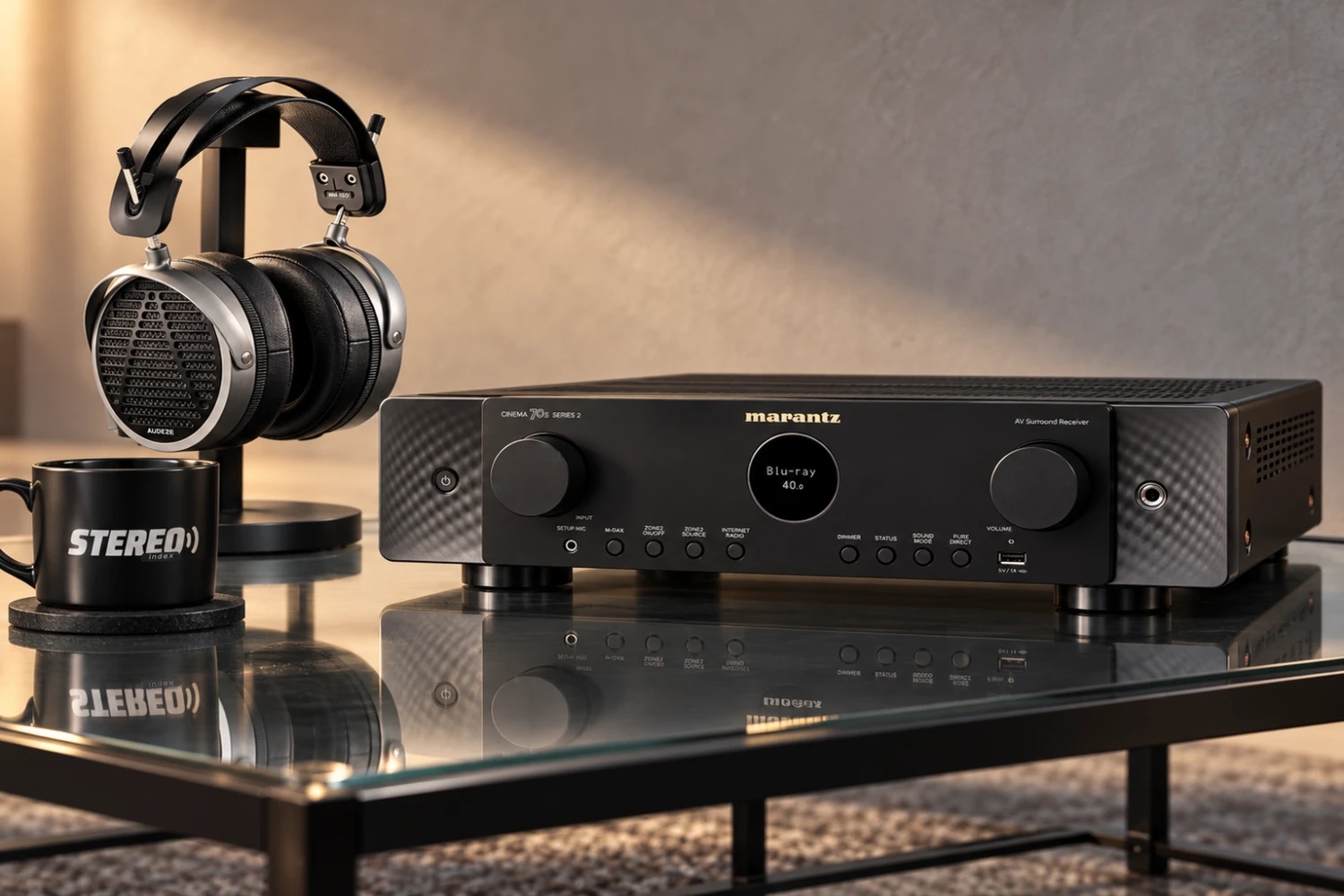
8. Marantz CINEMA 70s Series 2 Fits Seven-Channel AV Into a Slim Chassis
The low-profile Marantz CINEMA 70s Series 2 supports seven-channel cinema sound in an 11 cm-tall chassis.
At 11 cm tall, the Marantz CINEMA 70s Series 2 is designed for installations where a full-height receiver is difficult to accommodate.
Its seven discrete amplification channels can run either a 7.2 speaker arrangement or a 5.2.2 Dolby Atmos system.
Marantz specifies 50 watts into 8 ohms with two channels driven, while a 7.2-channel pre-out section permits the addition of external power amplifiers. Optional Dirac Live room correction, HEOS streaming and three 8K-capable HDMI inputs extend its scope beyond the slim enclosure.
Best for: Space-limited seven-channel installations
- Seven-channel amplification in an 11 cm chassis
- Supports 7.2 or 5.2.2 Dolby Atmos layouts
- Optional Dirac Live room correction
- 7.2-channel pre-outs for external amplification
Verdict: A strong fit where chassis height matters and seven channels are sufficient, with comprehensive pre-outs preserving an external-amplifier upgrade path.

9. DALI Spektor 2: Affordable yet impressive bookshelf speakers
The DALI Spektor 2 is an affordable bookshelf model using the company’s wood-fibre-reinforced driver technology.
The DALI Spektor 2 is a bookshelf speaker rather than an AV receiver, but speaker choice remains fundamental to any receiver-based system.
The Spektor range was developed as a more affordable entry point to DALI’s designs and uses proprietary drivers produced in-house.
Its reinforced paper diaphragms incorporate wood fibres to increase rigidity and reduce unwanted surface resonances, according to the source. The available material does not provide the amplifier-matching information required for a specific receiver recommendation.
Best for: Budget-conscious bookshelf-speaker systems
- Affordable entry point to the DALI range
- Proprietary drivers designed in-house
- Wood-fibre-reinforced paper diaphragms
- Developed using technical evaluations and listening sessions
Verdict: A relevant speaker candidate for an affordable AV system, although further matching data is needed before selecting the receiver and amplification.

10. DIRAC helps Denon and Marantz master bass with Live Bass Control
Dirac Live Bass Control adds advanced subwoofer correction to selected Denon and Marantz receivers and processors.
Dirac Live Bass Control is a paid software extension rather than a receiver, intended to improve subwoofer integration in eligible Denon and Marantz hardware.
It corrects uneven frequency and phase behaviour by coordinating subwoofer operation and is presented as particularly relevant in rooms with difficult layouts, furniture and other acoustic complications.
The compatible products named in the source include Denon A1H, X3800H, X4800H and X6800H models, plus the Marantz AV 10, CINEMA 40 and CINEMA 50. A separate licence and suitable measurement microphone are required.
Best for: Compatible systems in acoustically difficult rooms
- Targets frequency and phase irregularities in bass response
- Coordinates subwoofer operation
- Single-subwoofer and multiple-subwoofer versions available
- Designed for eligible Denon and Marantz hardware
Verdict: A targeted bass-management upgrade for eligible receivers and processors, provided the additional licence and measurement-microphone requirements are factored into the system plan.

Sound Off
0Join the discussion if you have something to add.