
An amplifier is often treated as the heart of a hi-fi system, but that does not necessarily make it the right place to spend your next upgrade budget. A new amplifier can bring more clean headroom, better control of demanding speakers, quieter backgrounds or a more practical set of connections. It can also leave the system sounding much the same if the real limitation is speaker positioning, room acoustics, source quality or simply listening at modest levels.
The useful question is not whether a more ambitious amplifier exists. It is whether your current amplifier is running out of capability in the way you actually listen. The examples below cover very different solutions: high-power integrated amplification, separate stereo power amps, a valve-based living-room hub and an installation-focused multi-channel design. Their differences are more instructive than a simple hierarchy of ‘better' and ‘worse'.
Should you upgrade this first?
Start by identifying the symptom rather than shopping by amplifier type. If music becomes hard, compressed or aggressive when the volume rises, the amplifier may be approaching clipping. If bass loses definition with demanding loudspeakers, the issue may be limited current delivery, insufficient power-supply reserves or an awkward interaction between the speaker's impedance and the amplifier. If the system is quiet and composed but inconvenient to use, connectivity may be the reason to upgrade rather than sound quality alone.
Clipping is especially important. An amplifier rated at a particular wattage does not deliver that power continuously in normal music, but musical peaks can demand considerably more than average listening levels suggest. A larger room, inefficient loudspeaker, long listening distance or music with wide dynamic swings all increase the need for clean headroom. If you regularly hear strain, do not assume that a different tonal balance will solve it; first check speaker placement, listening volume and whether the amplifier is being asked to drive a difficult load.
On the other hand, an amplifier is less likely to be the first upgrade if your speakers are badly positioned, the room has severe bass problems or the source is adding obvious noise. Moving speakers away from walls, adjusting toe-in and dealing with strong room modes can produce a larger change than swapping electronics. A turntable that is poorly isolated, a worn stylus or an incorrectly set tracking force can also obscure the benefits of a new amplifier. So can a digital source whose output level or settings are wrong.
A practical test is to borrow a suitable amplifier and compare it at matched volume. Louder almost always sounds more impressive, so level matching matters. Listen for specific improvements: does bass remain controlled at higher levels, do vocals stay stable in the image, and do complex passages remain separated rather than flattening into congestion? If the difference is small after careful setup, your money may be better directed elsewhere.
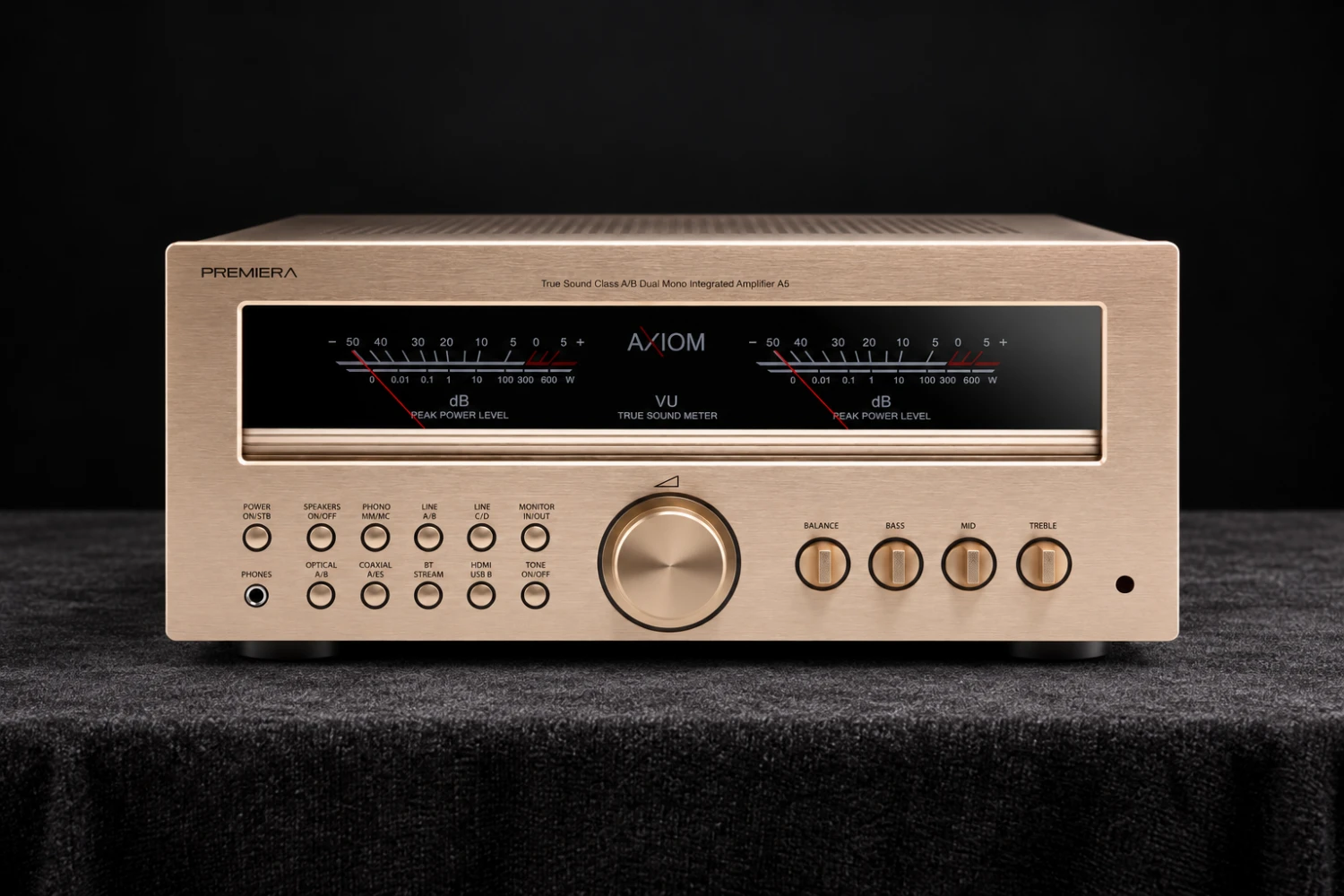
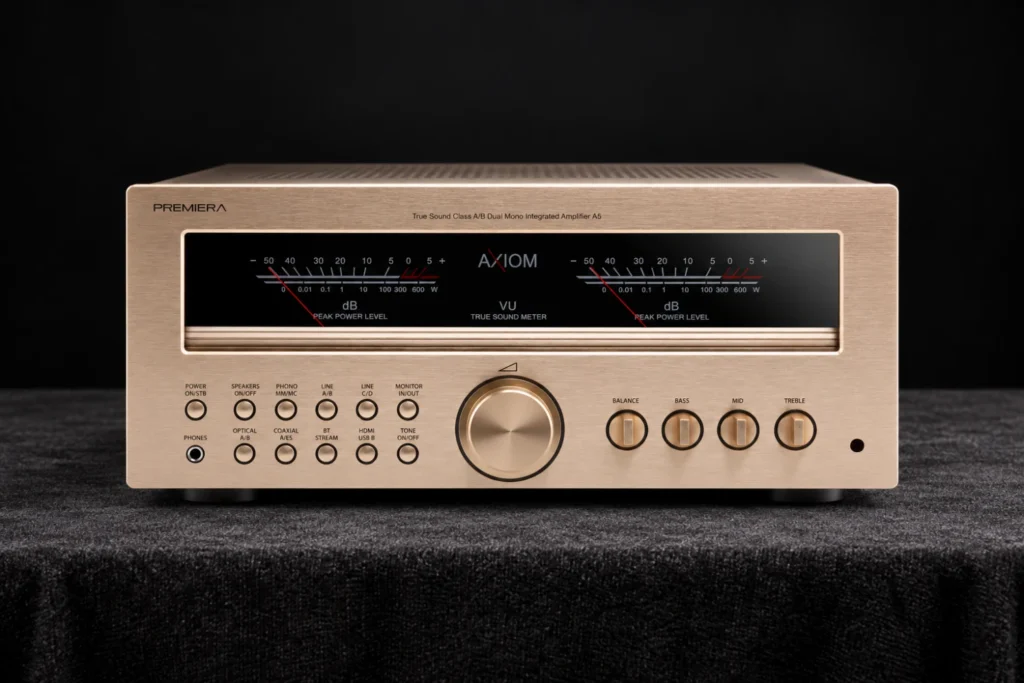
One broad approach is represented by the Premiera A5 Axiom. It combines a Class AB integrated amplifier with substantial rated output—170 watts per channel into 8 ohms and 275 watts into 4 ohms—with an ESS ES9038Pro DAC, HDMI ARC, MM/MC phono support and both RCA and XLR facilities. That does not make it automatically the correct choice, but it illustrates when an integrated amplifier can be the most rational upgrade: when you need more power and want to consolidate several boxes without abandoning analogue sources.
What to match
Match power to the speakers and room. Loudspeaker sensitivity, nominal impedance and impedance minima all matter, but none tells the whole story in isolation. A speaker with a nominal 8-ohm rating may still present a difficult phase angle or dip lower in parts of the frequency range. Conversely, a reasonably sensitive design in a small room may not need a huge amplifier. Look for an amplifier that can provide clean output into the load, then leave sensible headroom rather than chasing the largest number on the specification sheet.
Power figures should be compared carefully. The A5 Axiom's 170 watts into 8 ohms and 275 watts into 4 ohms suggest an amplifier designed to retain substantial output as the load becomes more demanding. The Musician GEMINI is specified at 120 watts per channel into 8 ohms and 220 watts into 4 ohms, while Grimm Audio's PA1 is rated at 150 watts into 8 ohms and 200 watts into 4 ohms. These figures are useful indicators, not a complete prediction of sound quality. Test conditions, distortion limits, power-supply behaviour and speaker impedance all influence the result.
Check the connection architecture. An integrated amplifier is usually the simplest route for a conventional system: source components, amplifier and passive speakers. A preamplifier output can be valuable if you may later add a more powerful external amplifier or a subwoofer system with the appropriate inputs. The A5 Axiom, for example, provides RCA and XLR preamp outputs as well as mono subwoofer outputs. The ELAC Tube 100 also includes a preamplifier output, which gives its control section a possible role in a future system even though its internal valve output power has not been disclosed.
If you already own a separate preamplifier, DAC with volume control or network player, a power amplifier may be the more sensible upgrade. Avoid paying for an integrated amplifier's duplicate input and conversion stages unless you genuinely want them. Also check whether the source offers a suitable output level and whether the amplifier's input sensitivity and impedance are appropriate; these are straightforward electrical checks, but they can prevent gain and noise problems.
The GEMINI is a clear example of a dedicated stereo power-amplifier route. It uses a fully balanced, discrete Class AB design with XLR inputs, a 600VA toroidal transformer and four pairs of high-current output transistors per channel. Its XLR-only input arrangement means it should be considered alongside the rest of the system's connection plan, not bought simply because balanced circuitry sounds more advanced on paper.

Balanced connections are useful, but not automatically superior. A balanced connection can reject induced noise, particularly over longer cable runs or in complex systems with multiple mains-powered components. It is most valuable when both the source and amplifier use a genuinely balanced signal path and the installation has a reason to need that noise immunity. Short RCA runs in a quiet domestic system may work perfectly well. Do not choose an amplifier solely because it has XLR sockets.
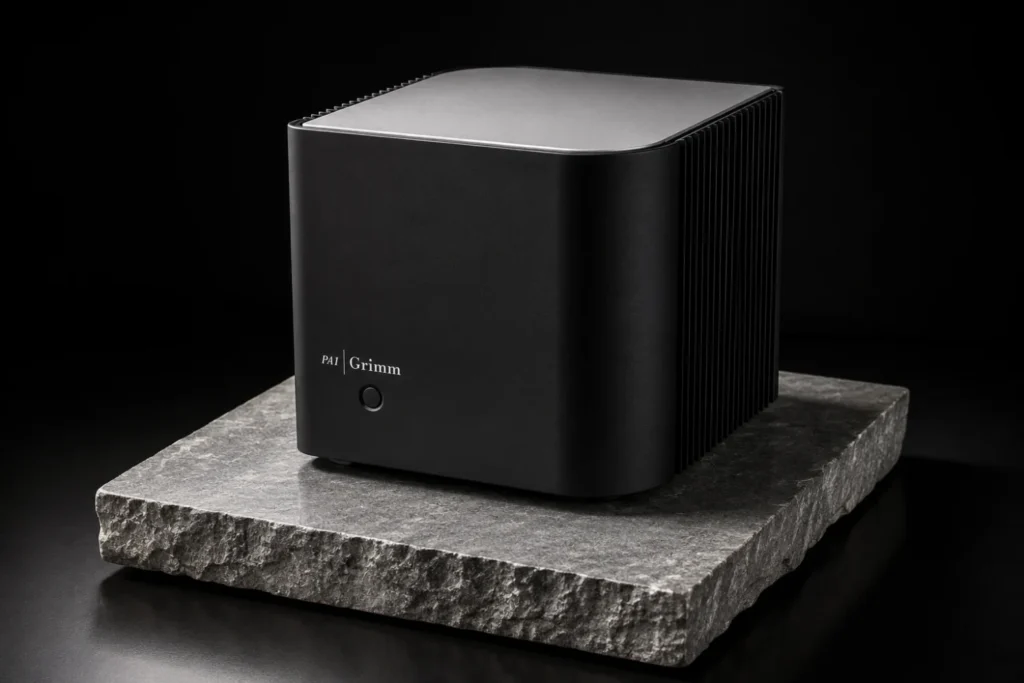
Gain matching deserves attention when using separates. Grimm Audio's PA1 offers selectable gain settings of 26dB or 18dB, allowing closer integration with different preamplifiers and source components. That is the kind of practical adjustment that can help with usable volume range and system noise. The PA1 is a monoblock, so a stereo pair is required for normal two-channel listening; each chassis powers one channel. Its fully balanced architecture and 150-watt 8-ohm rating make it a distinctly different upgrade path from replacing an all-in-one integrated amplifier.
Think about heat, space and electricity. Class AB amplifiers generally dissipate more heat than efficient Class D designs, especially at idle or when used hard. They need ventilation and should not be enclosed tightly. A large integrated amplifier may also be physically deeper and heavier than its front-panel appearance suggests. The A5 Axiom measures 434mm wide, 195mm high and 423mm deep, weighs 20.1kg and lists maximum power consumption of 1000W. Those are installation considerations as much as specification curiosities.
Separate amplifiers multiply the requirements for shelf space, mains outlets and interconnects. Monoblocks can improve physical channel separation and simplify placement near the speakers, but they also require a preamplifier and two units. The PA1's 250 x 250 x 240mm dimensions and 15kg weight per amplifier are manageable compared with some large monoblocks, but a stereo pair still occupies more space than a single integrated amplifier.
Where upgrades make the biggest difference
1. When your speakers are power-hungry. The clearest case for an amplifier upgrade is a loudspeaker that sounds controlled at low volume but becomes congested or thin when asked to play loudly. More capable amplification can provide headroom and preserve bass control. The GEMINI's 220-watt specification into 4 ohms and the PA1's monoblock configuration show two ways of pursuing this goal, although suitability still depends on the speaker's actual impedance behaviour and the preamplifier arrangement.
Do not assume that high power is only for large floorstanders. A compact speaker with low sensitivity can also benefit from an amplifier that remains composed during peaks. Conversely, a high-sensitivity design may not need hundreds of watts. The best match is the one that operates comfortably at your normal listening distance and volume without forcing you to pay for unused capability.
2. When your system has outgrown a simple two-channel layout. If you want records, television, digital sources and wireless headphones handled by one central component, a feature-rich integrated amplifier can remove boxes and switching complications. The A5 Axiom includes HDMI ARC, a dedicated MM/MC phono stage, Bluetooth 5.4 with receive and transmit modes, USB Audio, optical and coaxial inputs, AES/EBU and an optional slot for a future streaming module. Its output options also allow the system to evolve rather than ending at the speaker terminals.
HDMI ARC can be particularly useful in a living-room system, but it should not be confused with a full AV receiver. ARC routes compatible television audio to the amplifier; it does not by itself establish support for every television control function or surround format. Check the specific television and remote-control requirements before making it the deciding feature.
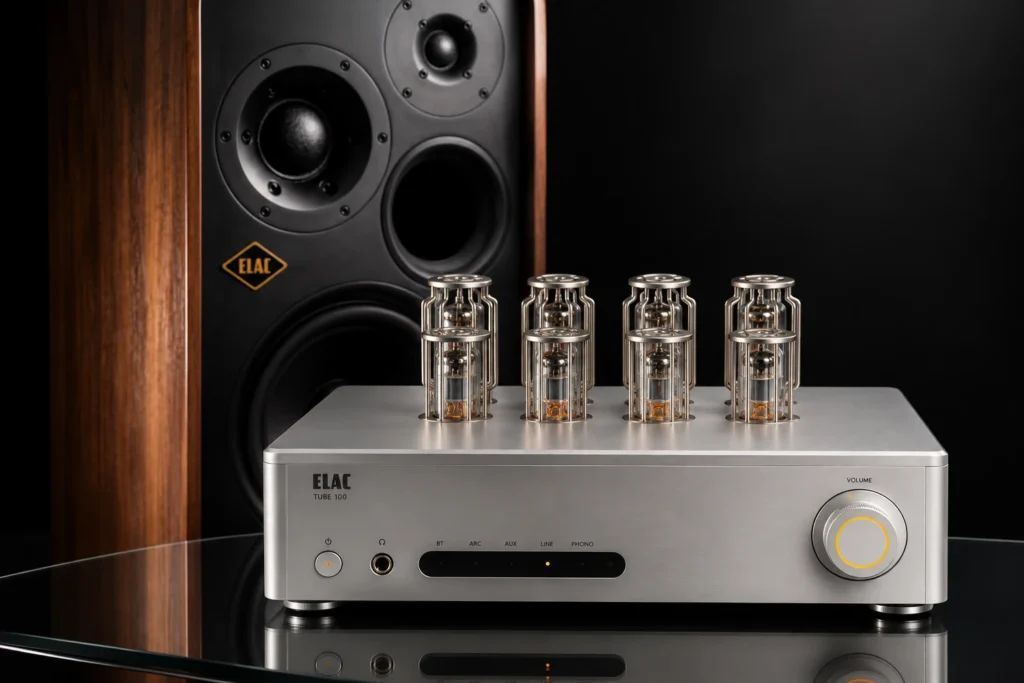
The ELAC Tube 100 takes a more distinctive version of this living-room approach. It places HDMI ARC alongside Bluetooth, a phono input, line-level analogue inputs and a preamplifier output, while retaining visible valves and a front headphone connection. However, ELAC has not disclosed the amplifier's rated output or exact tube complement. That missing information is critical: valve amplifiers can be excellent partners for suitable speakers, but power and load matching cannot responsibly be inferred from appearance alone.
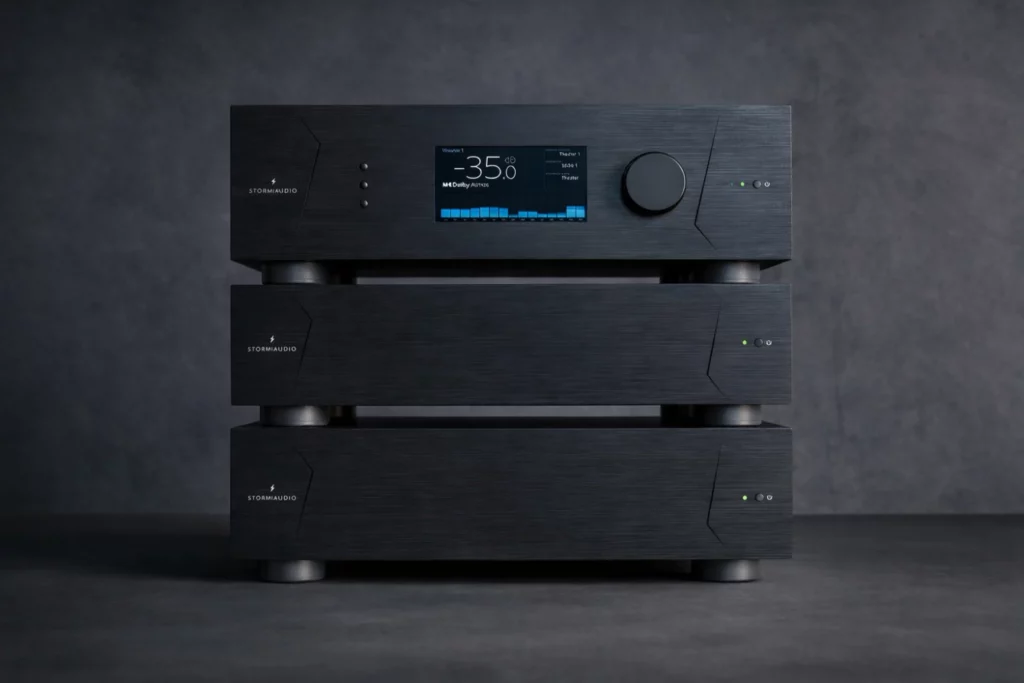
3. When the system is becoming an installation rather than a conventional hi-fi. A multi-channel amplifier is not a logical upgrade for a normal stereo system simply because it has more channels. It makes sense when the system needs distributed audio, immersive cinema, networked signal routing or centralised control. StormAudio's Impulsion 8 is aimed at that environment, with eight channels of Class D amplification, AES67 and Dante Audio-over-IP connectivity, a 2U chassis and a stated maximum of 200 watts per channel at 8 ohms. In bridge mode, the manufacturer specifies up to 800 watts across eight ohms or 1,200 watts across four ohms.
The Impulsion 8 also shows why future features need to be treated as future features. StormAudio says full DSP functionality— including parametric equalisation, FIR filters, limiters and per-channel gain control—will be added later in 2026. Its value today should therefore be judged on the documented amplifier, networking and integration features, not on assuming that every announced software capability is already available.
4. When you need a platform for later expansion. A good upgrade does not have to solve every future problem, but it should avoid closing off sensible options. Preamp outputs, trigger connections, subwoofer outputs and a suitable number of analogue and digital inputs can extend the useful life of an amplifier. The A5 Axiom includes RCA and XLR preamp outputs, recording outputs, mono subwoofer outputs, trigger connections and external IR control. That makes it more adaptable than a minimalist integrated, provided its size and feature set suit the owner.
Separate power amplification can also be a staged upgrade. If your existing preamplifier is still quiet, reliable and easy to use, replacing only the power amplifier may produce the desired increase in headroom. Later, you can reassess the preamplifier or source. But this only makes financial and technical sense when the existing preamp has the connections, gain structure and output drive needed by the new amplifier.
When not to upgrade
Keep your current amplifier if it drives your speakers cleanly at the levels you use, offers the connections you need and does not introduce audible noise or operational frustration. A bigger transformer, lower distortion figure or more dramatic casework is not a reason by itself to replace a functioning component. Published specifications are valuable for checking capability, but they do not remove the need to consider the whole system.
Do not upgrade the amplifier to compensate for a room problem. Boomy bass is usually more effectively addressed with speaker placement, listening position or carefully applied room correction than with a new power stage. A dull presentation may reflect speaker toe-in, room absorption or source settings. If the system sounds harsh only at high levels, check for clipping and fatigue before assuming that a warmer amplifier is the answer.
It is also sensible to wait when a key specification is unavailable. The ELAC Tube 100's undisclosed output power is not a minor omission for anyone choosing speakers around it. Wait for confirmed figures, or buy only through a dealer who can demonstrate the intended combination. Similarly, a prototype or forthcoming software feature should not be treated as an immediate reason to replace working equipment.
Finally, be wary of upgrading away from a system you already enjoy. If your current amplifier has the right power, noise performance and functionality, a speaker upgrade, source improvement or better setup may be more meaningful. The best amplifier upgrade is not the most powerful or technically elaborate model; it is the one that removes a demonstrable limitation without creating new compromises in heat, complexity, connectivity or speaker matching.


Sound Off
0Join the discussion if you have something to add.