
Five DACs Compared: Which One Fits Your System Best?
These five DACs are aimed at very different listeners: desktop users, headphone enthusiasts, digital purists and owners of advanced hi-fi systems. Here is what separates them in real-world use.

The Weiss DAC205 MK2, Schiit Modi 5, SPEC RMP-DAC3X, Fiio KA5 and TOPPING Centaurus take fundamentally different approaches to digital conversion. One is deliberately stripped back, another is built around value, one prioritises instrument timbre, one is a pocket-sized headphone DAC and the most versatile model combines R2R conversion with extensive control and connectivity.
That makes this less a contest of identical products than a question of system fit. The most meaningful differences are not simply chip names or supported resolutions: they are inputs, output options, portability, control, power architecture and the way each DAC is intended to be used.
Quick verdict
Best Overall: TOPPING Centaurus. It is the most complete all-rounder here, combining balanced and unbalanced outputs, USB and Bluetooth, R2R-based PCM conversion, multiple processing modes, parametric EQ, preamplifier operation and a 12V trigger.
- Best Value: Schiit Modi 5. The clear choice when price and practical connectivity matter most.
- Best Portable DAC: Fiio KA5. A compact USB dongle with a screen, 3.5mm and 4.4mm outputs, gain control and useful accessories.
- Best for a Purist Digital System: Weiss DAC205 MK2. A specialist converter for users who already have a suitable digital transport or streamer.
- Best for Instrumental Tonality: SPEC RMP-DAC3X. Its design is centred on preserving timbre and expressive detail, while also adding headphone outputs and volume control.
Comparison table
| Model | Most distinctive strength | Inputs and formats | Outputs and control | Best suited to |
|---|---|---|---|---|
| TOPPING Centaurus | R2R architecture with extensive system features | USB, IIS and Bluetooth 5.1; up to PCM 768 kHz/32-bit and DSD512 via USB/XMOS path | XLR and RCA, preamp mode, 10-band parametric EQ, 12V trigger, display | Main hi-fi systems needing flexibility |
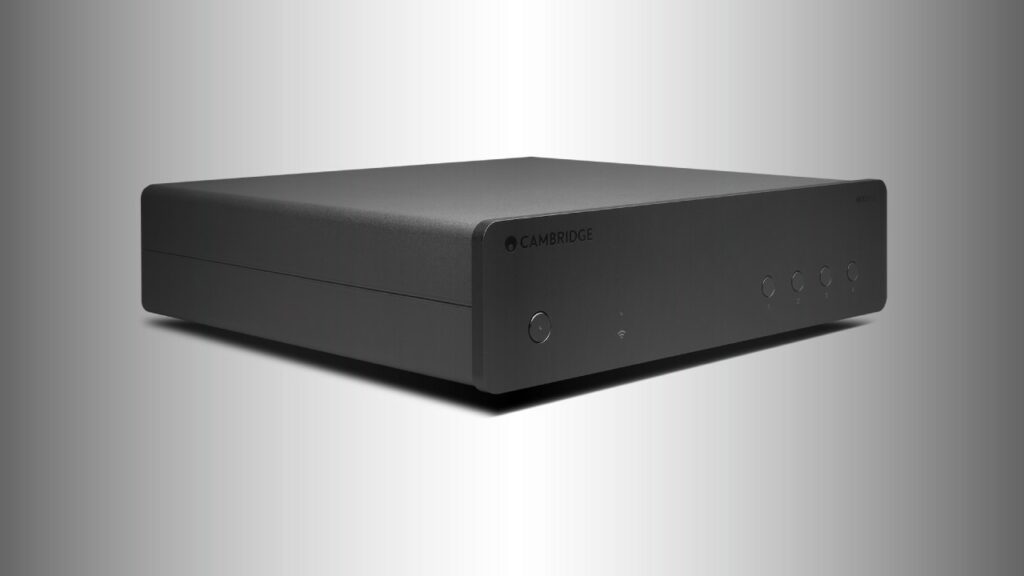
| Weiss DAC205 MK2 | Focused, low-complexity digital conversion | Coaxial and optical; up to 24-bit/192 kHz; no USB | Balanced XLR and RCA; four selectable output levels | Dedicated transports, streamers and studio systems |
| SPEC RMP-DAC3X | Emphasis on realistic instrumental tonality | USB-A and USB-B up to PCM 32-bit/384 kHz, DSD Native 256 and DoP 128; other inputs up to 24-bit/192 kHz | RCA, XLR and two headphone outputs; volume control | High-end systems and headphone users wanting a full-size DAC |
| Schiit Modi 5 | Low price with USB, optical and coaxial inputs | USB, optical and coaxial; Unison 384 USB interface | External power supply option with Linear Override mode | Affordable desktop and entry-level hi-fi systems |
| Fiio KA5 | Portable headphone-focused flexibility | USB-C; PCM 32-bit/768 kHz and DSD256 | 3.5mm and 4.4mm outputs, OLED screen, gain and filter controls | Phones, laptops, portable listening and IEMs |
TOPPING Centaurus
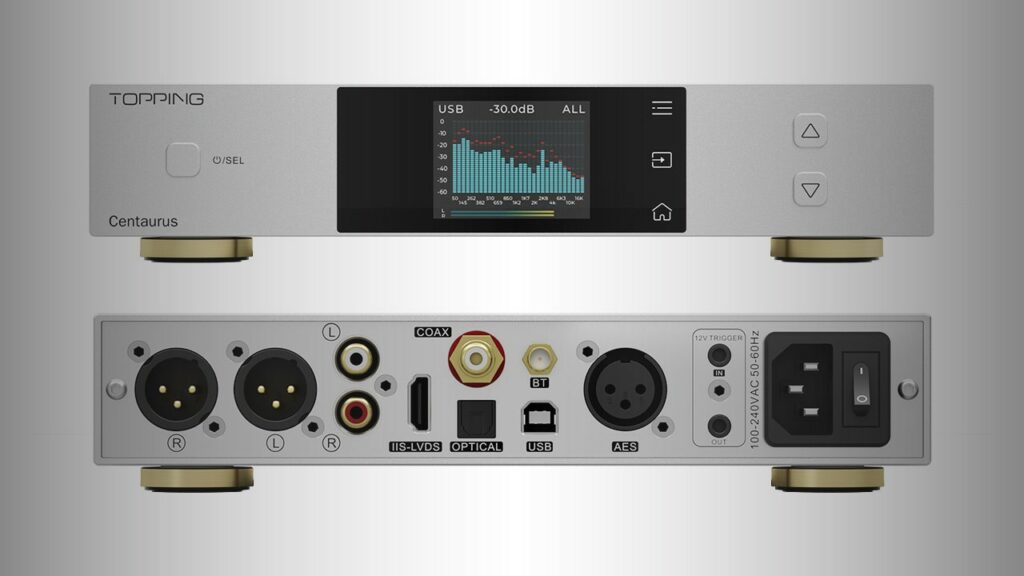
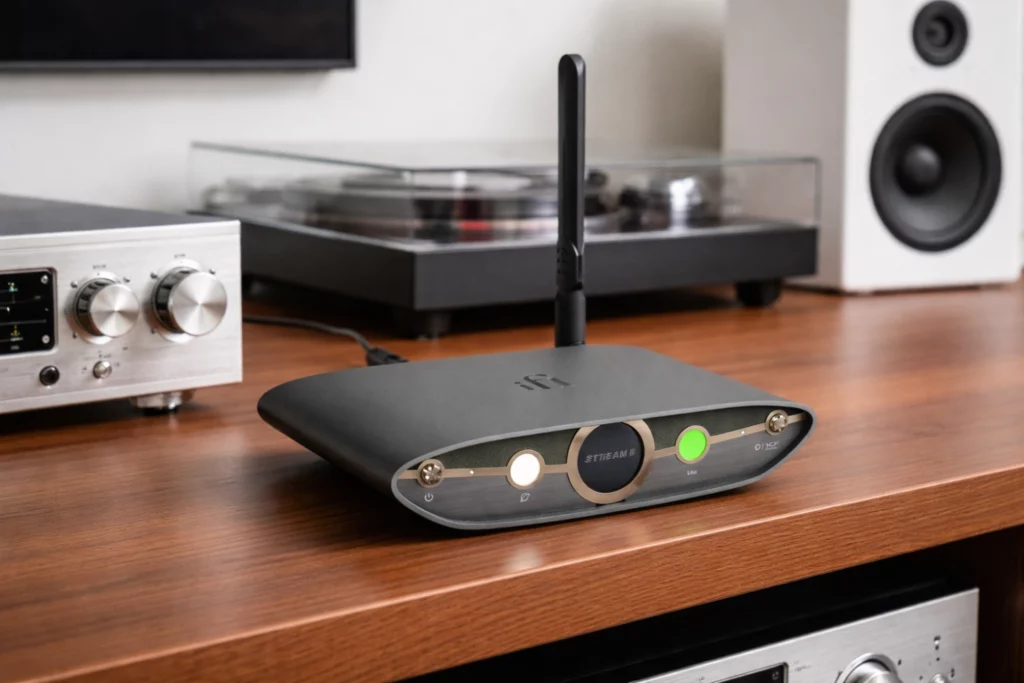
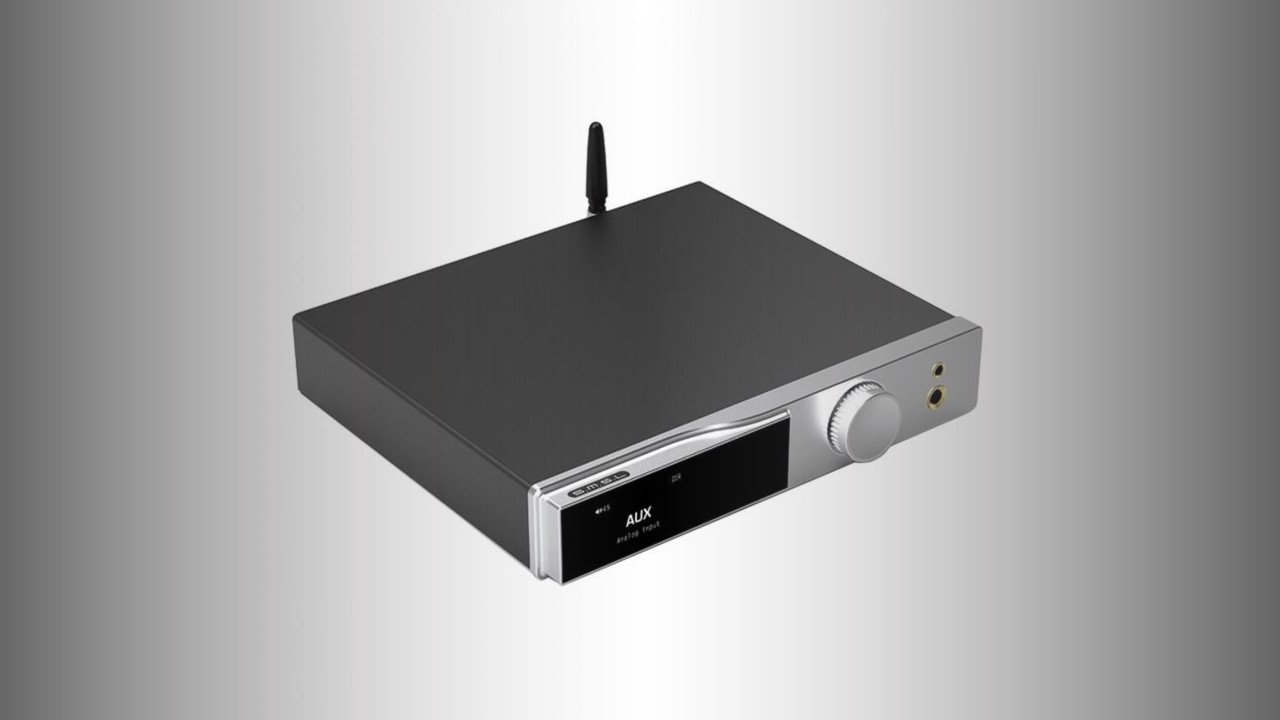
The Centaurus is the strongest all-round choice because it covers more real-world system requirements than the other four DACs. Its central technical distinction is an R2R architecture developed in collaboration with HOLO Audio. PCM uses a traditional R2R scheme, while DSD is handled by Vector Step Resistance Network technology. A CPLD manages the decoding, and the user can choose between NOS, OS and Best processing modes.
That flexibility is only part of the appeal. The Centaurus can operate as a conventional DAC with both XLR and RCA outputs, or as a preamplifier connected directly to active speakers or an amplifier. Output voltage is adjustable: the source specifies 4V and 5V options for XLR and 2V and 2.5V for RCA. A 12V trigger can synchronise connected equipment.
It is also the most accommodating model for modern sources. USB connectivity through the XMOS XU316 and Thesycon driver supports PCM up to 768 kHz/32-bit and DSD512, while Bluetooth 5.1 adds LDAC, aptX Adaptive, aptX HD, AAC and SBC. Windows, macOS, Linux, iOS and Android are supported. The IIS input also accepts PCM up to 768 kHz/32-bit and DSD512.
The 2-inch colour display and touch controls make the Centaurus more interactive than the minimalist Weiss or Schiit designs. Its 10-band parametric equaliser is a particularly meaningful feature: it allows frequency, gain and bandwidth adjustments, as well as user profiles. That makes it useful not only for purist conversion but also for systems where room, speaker or headphone correction matters. At $999, it is not the low-cost option, but it offers the broadest combination of conversion choices, connectivity and system control.
Weiss DAC205 MK2
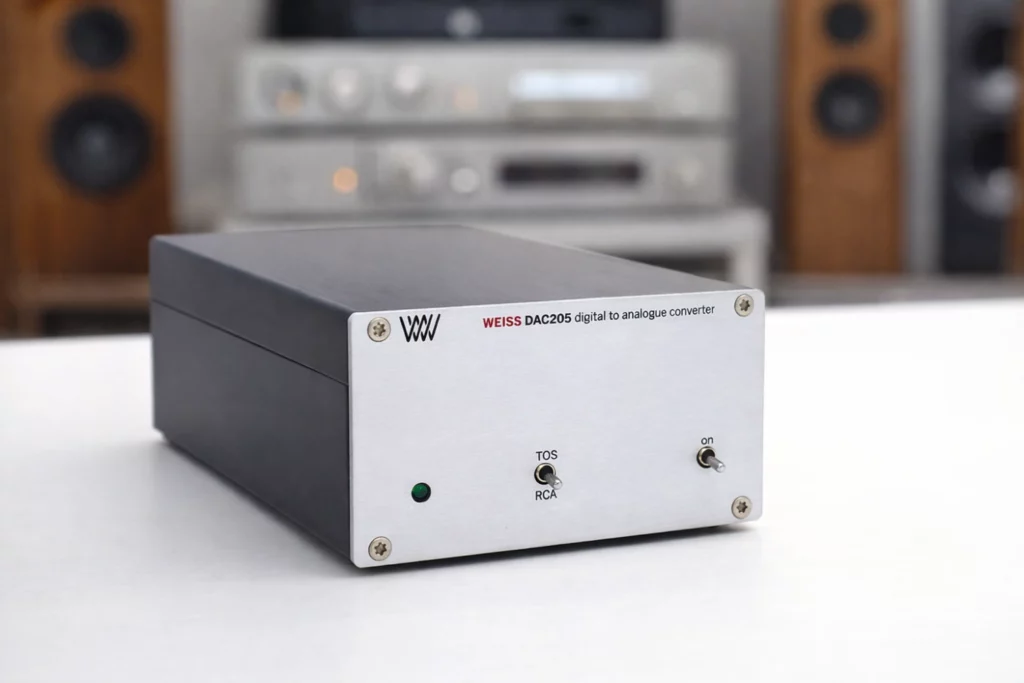
The Weiss is almost the opposite of the Centaurus. It omits USB, streaming, multiple processing modes and extensive user controls. Its two digital inputs are coaxial and optical, with support up to 24-bit/192 kHz. That makes it a poor match for someone who wants to connect a computer directly, but a logical match for a system built around a dedicated transport, a streamer with suitable digital outputs or AES/EBU-equipped studio equipment. The source specifically notes that AES/EBU-equipped gear is a target, although the DAC205 MK2's listed inputs are coaxial and optical.
Its appeal is concentration rather than breadth. The DAC uses an ESS ES9028PRO, with four DAC cores per channel running in parallel. The source describes this implementation as intended to average errors, lower distortion and improve signal-to-noise performance. The analogue stage has been reworked for the MK2, and its near-zero output impedance is intended to keep behaviour predictable with different connected equipment and long cable runs.
Balanced XLR and unbalanced RCA outputs make it suitable for both domestic and professional-style systems. Four selectable output levels, in 10 dB steps, help with gain matching when feeding active monitors, a preamplifier or a power amplifier. An external power supply keeps heat and electrical noise away from the main circuitry, while the optional Weiss PSU102 linear upgrade is available for users who want to pursue that route.
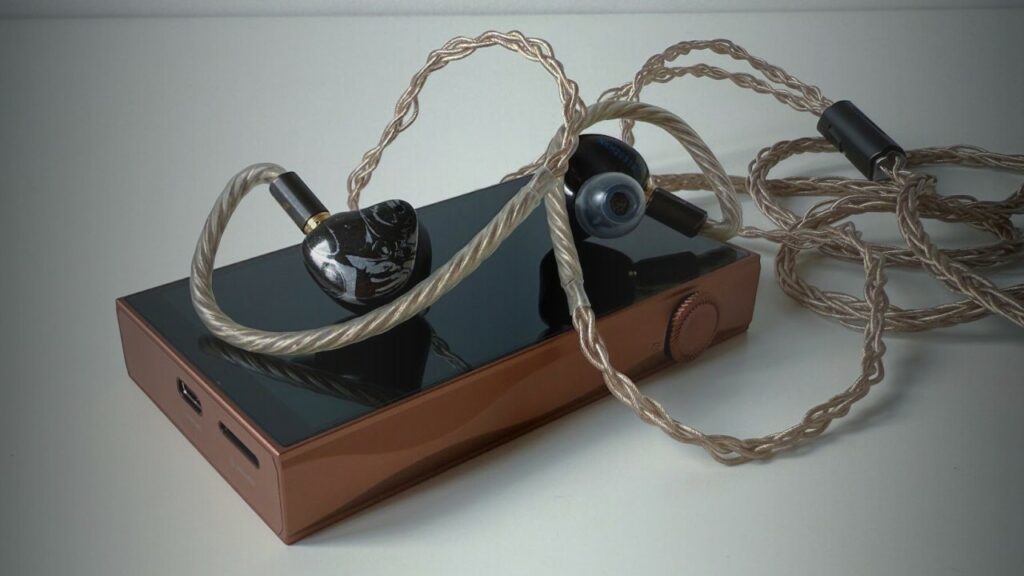
The DAC205 MK2 is the specialist pick. Its attraction is a controlled signal path and the absence of unnecessary interfaces, not feature count. Choose it when your digital source is already sorted and you want the DAC itself to remain compact and focused. Do not choose it if USB, Bluetooth, streaming or extensive format support are priorities.
SPEC RMP-DAC3X

The SPEC RMP-DAC3X occupies a more traditional high-end position than the portable Fiio or affordable Schiit, but it is not simply a digital input box. Its design places unusual emphasis on realistic tonality and the preservation of the timbral identity of instruments. The source highlights subtle signals, overtones and the expressive qualities of violins, oboes and other instruments as central concerns.
Its hardware presentation is distinctive too. The DAC uses a dual-case design with a separate external power supply. The source describes a specialised R-core transformer for the output stage, careful capacitor selection and a housing incorporating multiple types of wood, including spruce used for the base panel. Whatever a buyer makes of those design choices, the important practical point is that the power supply is a substantial separate unit: the DAC weighs three kilograms and the external supply four kilograms.
Connectivity is stronger than the Weiss's, especially for computer audio. USB-A and USB-B handle PCM up to 32-bit/384 kHz, DSD Native 256 and DoP 128. Other inputs are limited to PCM up to 24-bit/192 kHz. Analogue outputs are available on both RCA and XLR, and the front panel adds 6.35mm and 3.5mm headphone sockets. There is also a volume control that can be disabled with a dedicated button.
That combination makes the SPEC particularly interesting for someone who wants a serious full-size DAC with both preamplifier-style control and headphone access, while placing musical tonality ahead of extensive digital processing. It is less obviously flexible than the Centaurus and less convenient than the KA5 for portable use, but it offers a distinctive focus on timbre and a substantial dual-box construction.
Schiit Modi 5
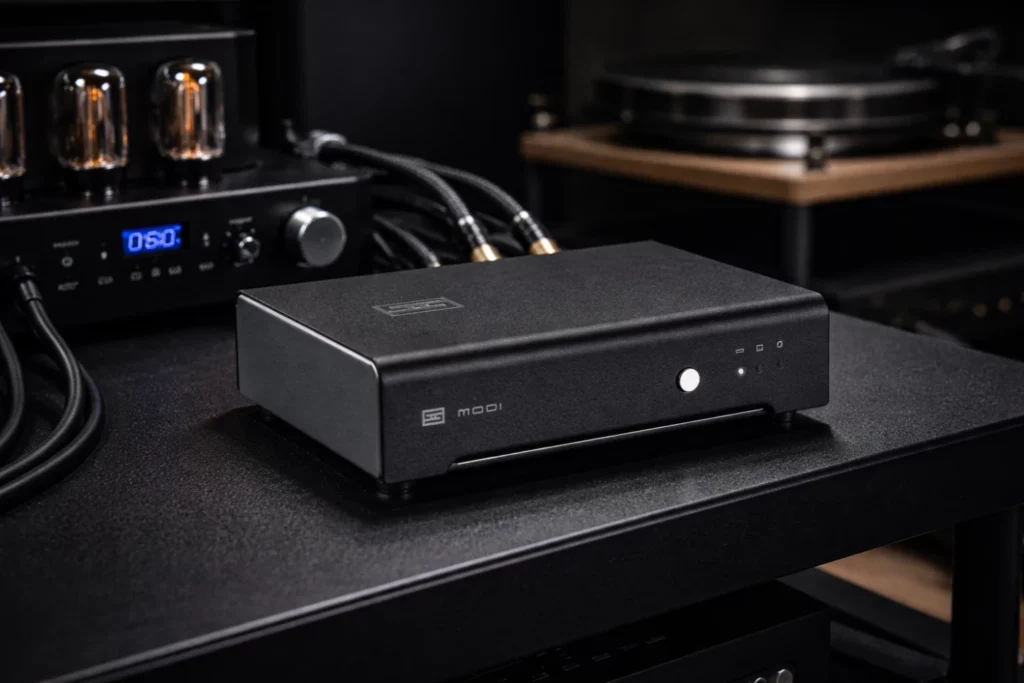
The Modi 5 is the value proposition in this group. Its stated suggested retail price is $149 in black and $159 in silver, putting it in a completely different buying conversation from the Weiss, SPEC and Centaurus. Yet its feature set is not reduced to a single basic input. USB, optical and coaxial connections cover the most common desktop and hi-fi sources.
Its Unison 384 USB interface and Schiit's custom Mesh digital filter are the main points of differentiation. Mesh is described as being optimised in both the time and frequency domains, running on a 32-bit Microchip processor alongside an ESS delta-sigma modulator. The source positions this technology as something drawn from Schiit's more expensive models while keeping the Modi 5's cost low.
Power options are unusually practical at this price. The unit can be powered directly through USB for a simple desktop arrangement. Add an external power supply and it switches to Linear Override mode, bypassing the switching supply and using a higher-voltage regulated linear rail. The source says this provides higher output levels, more headroom and better dynamics.
The Modi 5 is therefore a sensible choice for anyone who wants a straightforward DAC without paying for a large chassis, a display or advanced preamplifier functions. It cannot match the Centaurus for processing, Bluetooth or system integration, and the source does not give it the Weiss's specialist output-level controls or the SPEC's headphone facilities. But at its stated price, its mixture of inputs, custom filtering and upgradeable power is difficult to ignore.
Fiio KA5
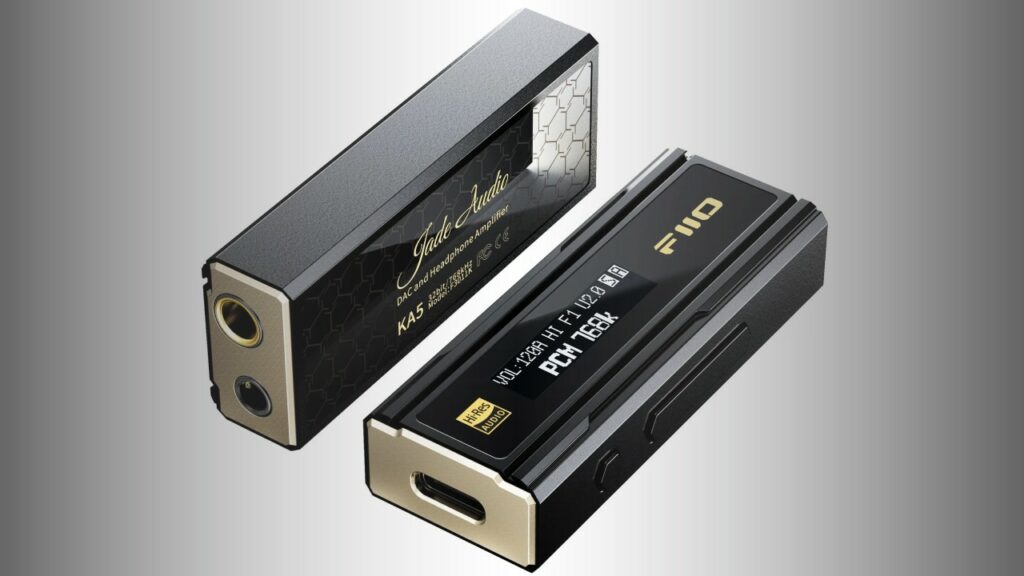
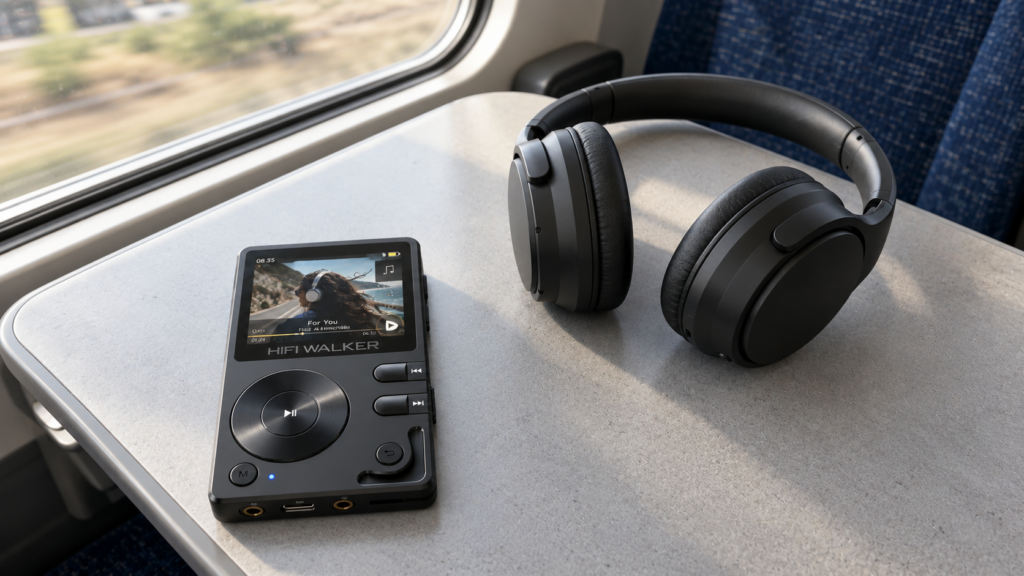
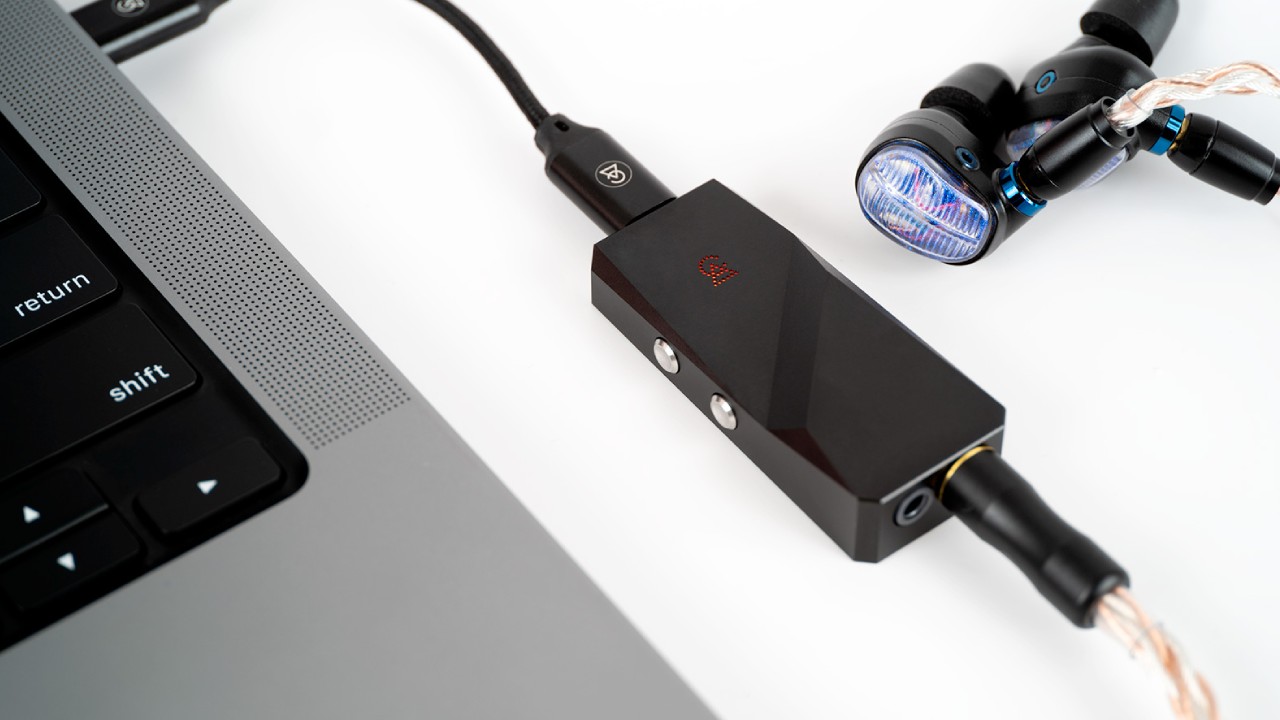
The KA5 is the only genuinely portable model here. It is a USB dongle designed around headphone and IEM use, rather than a conventional hi-fi component with RCA or XLR line outputs. That distinction matters more than any resolution figure: the KA5 belongs beside a phone, laptop or portable source, while the other four are primarily intended for a fixed system.
Its compact case includes an OLED display and a multifunction control system. Users can adjust screen brightness and timeout, select a DAC filter, change channel balance, enable S/PDIF, choose low or high gain and select between class AB and class H amplification. The unit has USB-C, 4.4mm Pentaconn and 3.5mm headphone connections. It also includes USB-C and Lightning cables, plus a USB adapter for connection to a computer.
The internal design uses two Cirrus Logic CS43198 DACs, with support for PCM 32-bit/768 kHz and DSD256, alongside two Texas Instruments LM8261 op-amps. The source gives output power of 265 mW from the balanced output and 122 mW from the single-ended output, while cautioning that the balanced figure does not make the KA5 ideal for full-size headphones. It is better suited to in-ear monitors and dynamic or hybrid earphones.
The source characterises the KA5's presentation as relatively smooth and analytically focused, with a midrange emphasis, strong timbral range and a little warmth, while noting that bass textures are somewhat simplified and that it may not suit bass enthusiasts. In buying terms, the KA5 makes sense when portability, two headphone output standards, a screen and control over gain matter more than line-level integration.
How they differ
Connectivity is the first major dividing line. The Weiss is intentionally limited to coaxial and optical, while the Modi 5 adds USB to those two inputs. The SPEC offers USB-A and USB-B alongside other digital inputs, and the Centaurus goes further with USB, IIS and Bluetooth. The KA5 is built around USB-C and portable device connection.
System role is the second. The Centaurus can work as a DAC or preamplifier and can connect directly to active speakers or an amplifier. The SPEC also includes volume control and both line and headphone outputs. The Weiss provides flexible XLR/RCA line outputs and selectable levels but deliberately avoids a wider control ecosystem. The Modi 5 is a simple source component, while the KA5 is a headphone dongle rather than a main-system preamp.
Sound-design priorities also differ in the source descriptions. Weiss emphasises precision, low output impedance and a controlled signal path. SPEC puts realistic instrumental timbre and expressive overtones at the centre. The KA5 is described as smooth, accurate rather than warm and midrange-focused. The Centaurus is built around an R2R approach, with NOS, OS and automatic processing options. Schiit focuses on its proprietary Mesh filter and the value of bringing that technology to a low-cost model.
Format support ranges from deliberately limited to extremely broad. Weiss stops at 24-bit/192 kHz and does not offer USB. Schiit provides its Unison 384 USB interface, while SPEC reaches PCM 32-bit/384 kHz and DSD Native 256 over USB. Fiio supports PCM 32-bit/768 kHz and DSD256. Centaurus reaches PCM 768 kHz/32-bit and DSD512 through its USB/XMOS path. Those figures should not be treated as a ranking by themselves, but they do show how differently these products are intended to integrate.
Which one should you buy?
- Buy the TOPPING Centaurus if you want one DAC to serve a modern, flexible main system. It is the best overall choice because no other model combines R2R processing, Bluetooth, USB and IIS support, selectable modes, parametric EQ, preamplifier operation, balanced outputs and a 12V trigger.
- Buy the Schiit Modi 5 if your priority is value. It covers USB, optical and coaxial sources at $149 in black or $159 in silver, and its external-power Linear Override mode provides a clear upgrade path.
- Buy the Fiio KA5 if you listen mainly through IEMs or portable headphones. Its screen, gain settings, 3.5mm and 4.4mm outputs, supplied cables and small form factor are more relevant than the line-level features of the larger DACs.
- Buy the Weiss DAC205 MK2 if you already own a good digital transport or streamer and want a compact, focused converter with XLR/RCA outputs and precise output-level matching. Its lack of USB is a feature only if it suits your system.
- Buy the SPEC RMP-DAC3X if realistic instrumental tonality, a substantial separate power supply, USB support and built-in headphone outputs are more important to you than Bluetooth, EQ or extensive user-interface features.
Final verdict
The TOPPING Centaurus is the Best Overall because it offers the widest range of useful functions without being limited to one type of source or system. The Schiit Modi 5 is the smarter low-cost buy, the Fiio KA5 is the obvious portable option, the Weiss DAC205 MK2 is the purist specialist and the SPEC RMP-DAC3X is the most compelling choice for listeners focused on instrumental tonality and a full-size headphone-capable design. The right purchase depends less on chasing a universal “best” sound than on choosing the DAC whose architecture and controls match the system you actually use.





 VS
VS VS
VS VS
VS VS
VS VS
VS VS
VS VS
VS VS
VS

Comments 0
Share your experience, questions and perspective with other hi-fi enthusiasts.