
Five Turntables Compared: The Right Deck for Every Listener
These five turntables take very different approaches to vinyl, from fully automatic plug-and-play simplicity to high-end manual designs. Here is which model best fits each listener, system and priority.
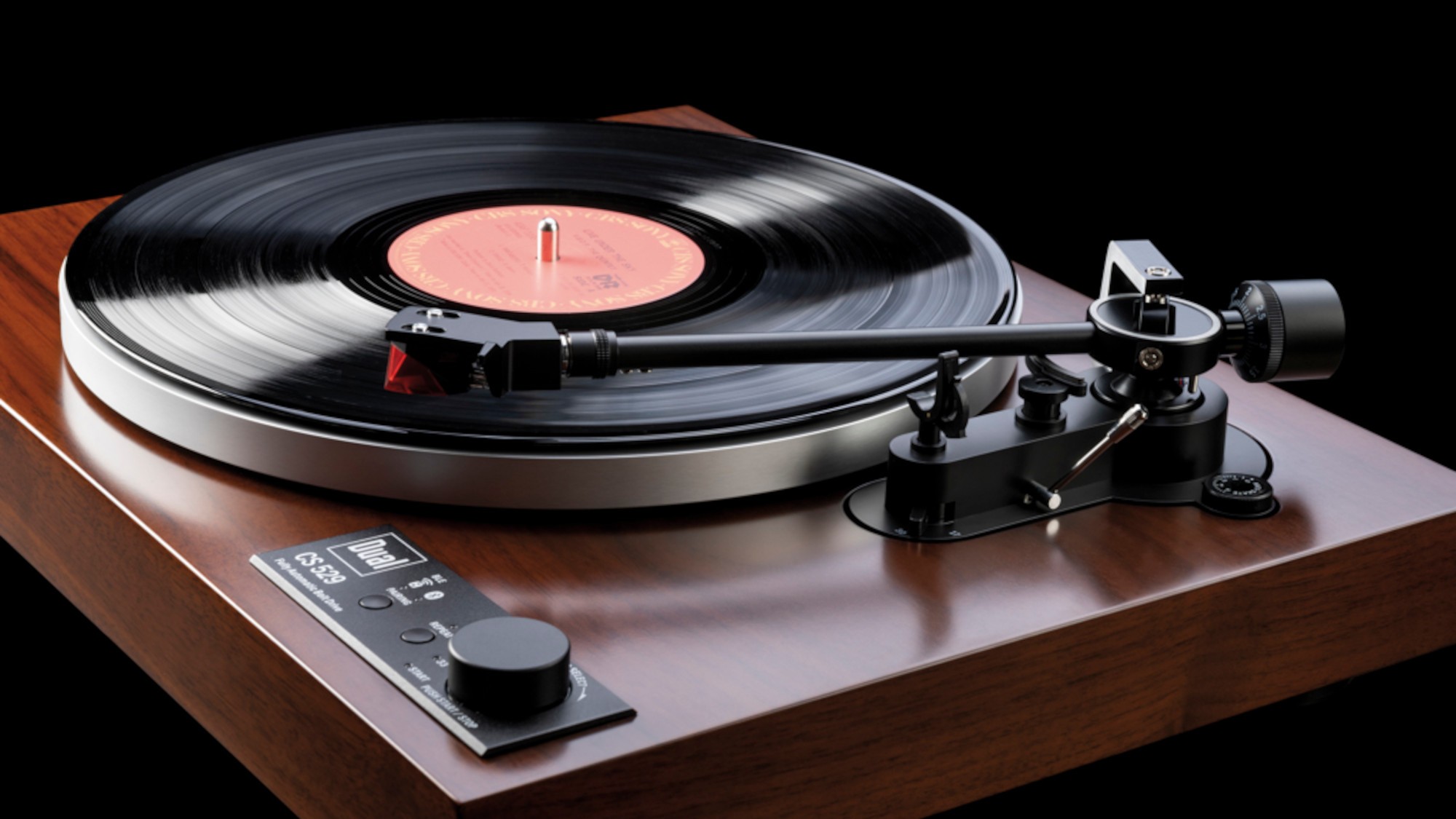
The five turntables compared here are not direct substitutes. The REKKORD Audio F110P and Pro-Ject E1.2 are designed to make vinyl straightforward, while the Pro-Ject T2 Super Phono adds more ambitious hi-fi engineering without abandoning plug-and-play convenience. At the other end, the T+A G 2000 R and Music Hall Stealth are aimed at listeners who want more control, higher-end construction or greater cartridge flexibility.
That difference matters more than a simple ranking. A fully automatic deck can be the better purchase for a first-time record owner, while a removable headshell or adjustable VTA may be more valuable to an experienced enthusiast. Since prices are supplied for only the two Pro-Ject E1.2 versions, this guide compares the products by design, features and intended use rather than inventing a price hierarchy.
Quick verdict
- Best Overall: Pro-Ject T2 Super Phono. It combines factory-matched, ready-to-use operation with a more serious tonearm, cartridge, platter and built-in phono stage than the usual plug-and-play design.
- Best for beginners: REKKORD Audio F110P. Its fully automatic operation, factory-set tracking force and anti-skating, forgiving cartridge and built-in phono preamp remove the most intimidating parts of vinyl setup.
- Best Value: Pro-Ject E1.2 Phono. At the supplied suggested retail price of €359, it offers a handcrafted, ready-to-play turntable with a built-in phono amplifier. The standard E1.2 is listed at €329 if an external phono stage or amplifier input is already available.
- Best Features: Music Hall Stealth. Its removable headshell, on-the-fly VTA adjustment, direct drive and auto-stop make it the most adaptable choice for enthusiasts who change cartridges or records.
- Best high-end choice: T+A G 2000 R. Its substantial construction, DSP-controlled speed correction, optional adjustable phono stages and supplied MC-2 cartridge place it in a different class of design ambition.
| Turntable | Best suited to | Key approach | Phono stage | Automation and flexibility |
|---|---|---|---|---|
| REKKORD Audio F110P | First-time vinyl listeners | Fully automatic belt drive with floating sub-chassis | Built in | Fully automatic; factory-set cartridge and tracking |
| Pro-Ject T2 Super Phono | Plug-and-play listeners seeking a more serious hi-fi design | Large MDF chassis, 9-inch tonearm and glass platter | Built in, disconnectable | Factory-coordinated; supports future external phono use |
| T+A G 2000 R | High-end system owners | 14 kg MDF-and-aluminium belt-drive design with DSP speed correction | Optional MM or MC modules | Manual, factory-fitted cartridge and tonearm options |
| Music Hall Stealth | Cartridge experimenters and mixed record collections | Direct drive with damped platter and isolating feet | External phono preamp required by the supplied information | Removable headshell, adjustable VTA and auto-stop |
| Pro-Ject E1.2 / E1.2 Phono | Affordable plug-and-play buyers | Handcrafted belt drive with 730 g die-cast aluminium platter | E1.2 Phono built in; standard E1.2 does not state one | One-button 33⅓/45 rpm selection; factory tuned |
REKKORD Audio F110P
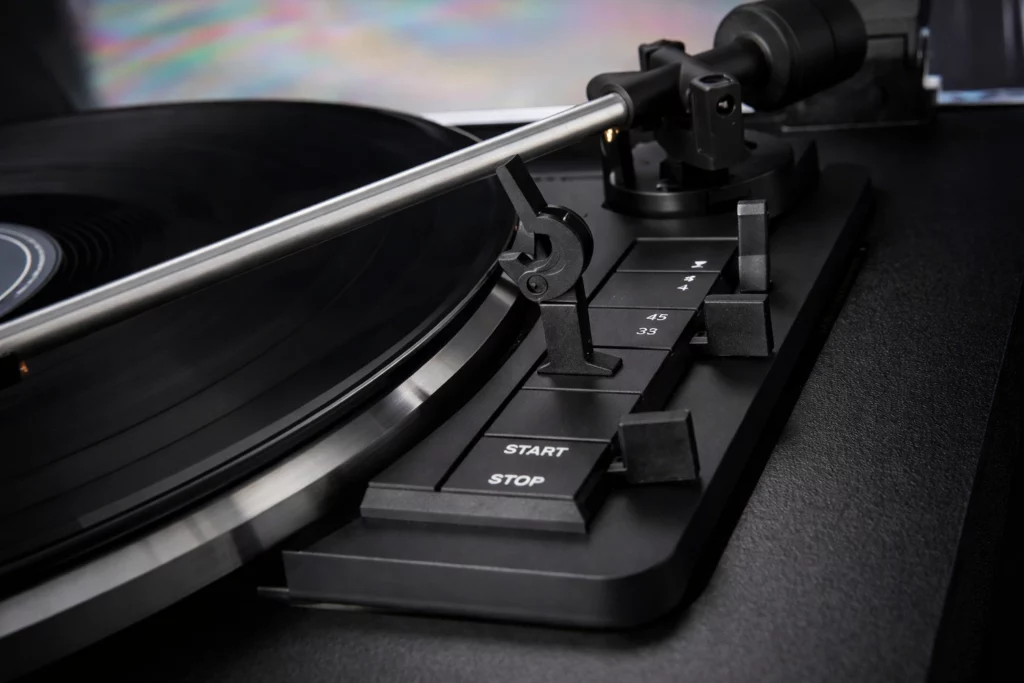
The F110P is the least demanding turntable here in day-to-day use. It is a belt-drive, fully automatic model: press Start and the platter spins, the tonearm moves into position and lowers itself. At the end of the record, the arm lifts, returns home and the platter stops. A lift switch is also provided for manual track cueing, but the important point is that manual handling is optional.
That makes the REKKORD a particularly strong match for a newcomer who is worried about alignment, lowering the stylus or leaving the arm at the end of a side. Tracking force and anti-skating are factory-set, and the supplied Audio-Technica AT3600L MM cartridge is described as forgiving, reliable and inexpensive to re-tip. Those choices favour confidence and convenience over future experimentation.
The F110P also includes a built-in phono preamp, so the connection process is simple: use the included RCA cables with an amplifier or active speakers. Its floating sub-chassis isolates the platter, tonearm and automatic mechanism from the MDF plinth, an arrangement intended to reduce the effects of footsteps, speaker energy and room vibration. The deck supports 33⅓ and 45 rpm, includes a dust cover, mat and 7-inch adapter, and is hand-assembled and checked in Germany according to the source article.
Its limitation is not a defect so much as a clear design priority. The F110P is a finished, low-stress product rather than a platform for extensive cartridge or tonearm experimentation. Choose it when easy, repeatable playback matters more than adjusting every parameter yourself.
Pro-Ject T2 Super Phono
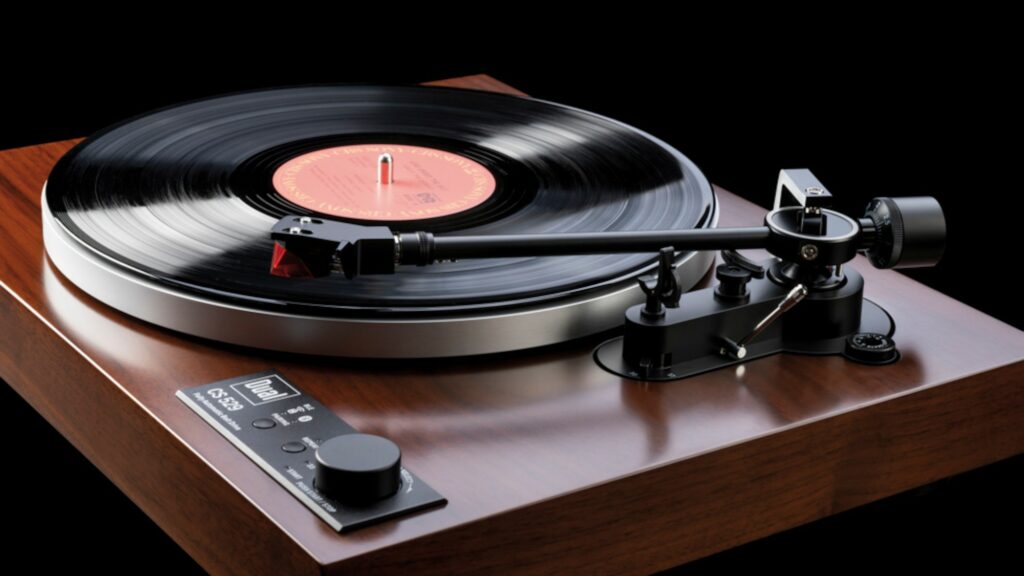
The T2 Super Phono is the most convincing all-rounder in this group because it addresses the central weakness of many plug-and-play turntables: convenience does not always come with ambitious hi-fi engineering. Pro-Ject gives this model a larger MDF chassis with damping supports, a 9-inch tonearm, a Sumiko Rainier cartridge and a substantial glass platter on a belt-driven sub-platter.
The cartridge is factory fitted and the components are presented as a coordinated system, so the buyer does not have to spend time matching an arm, cartridge and phono stage. That is exactly the sort of integration a new listener needs, but it is also useful for an experienced listener who wants a complete turntable rather than a project.
The built-in phono corrector is the major differentiator. The source describes a two-channel design with separate RIAA correction for each channel, low-noise components and factory adjustment for accurate frequency response. It can also be disconnected, allowing an external phono stage to be used later. This gives the T2 Super Phono a more credible upgrade path than a deck whose electronics are permanently part of the signal chain.
It is our Best Overall because it occupies the most useful middle ground in this comparison. It retains plug-and-play operation, but its 9-inch tonearm, Sumiko cartridge, damped chassis, glass platter and more sophisticated phono stage give it a stronger technical proposition than a basic entry-level deck. It is not the right choice for someone who wants full automatic operation, nor for someone seeking the specific cartridge-swapping features of the Music Hall, but it is the best fit for the broadest range of serious vinyl listeners.
T+A G 2000 R
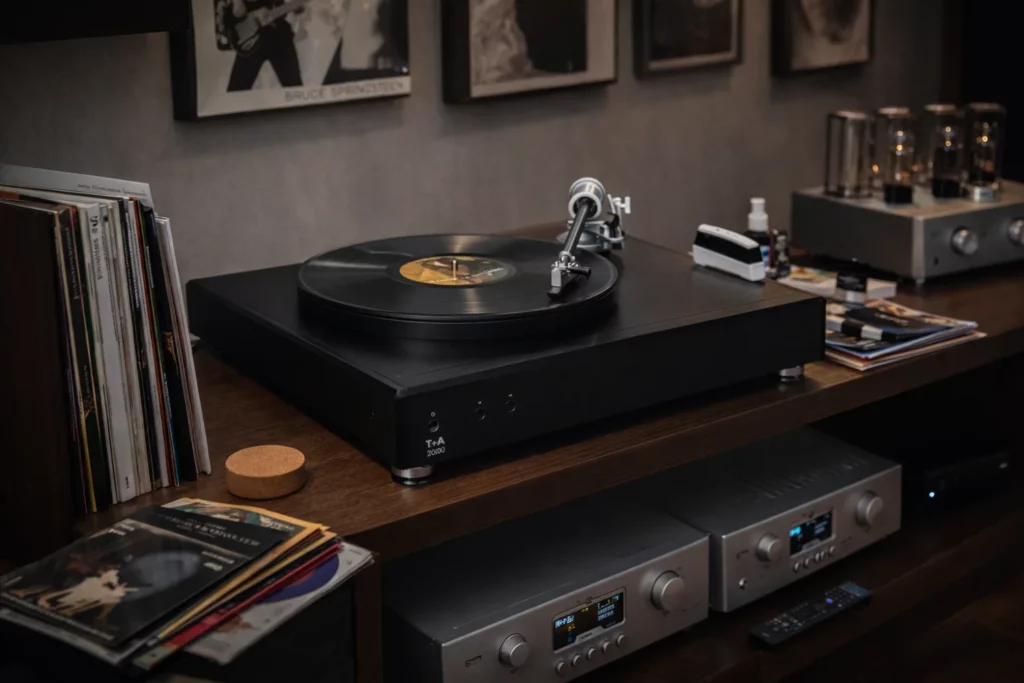
The T+A G 2000 R is the most clearly high-end product here. It is a 14 kg belt-drive turntable with an MDF plinth covered by aluminium plates, adjustable feet, a substantial bronze-cup main bearing and a 3.8 kg aluminium platter. Its motor uses quartz stabilisation and DSP correction for rotation speed, with electronic selection of 33.3 and 45 rpm.
This is a design for an established hi-fi system rather than a first purchase made with minimal preparation. The deck needs proper levelling and cartridge alignment, although the supplied unit arrives with the cartridge pre-installed and the source says assembly and connection take no more than five minutes. The tonearm is not intended to be casually replaced, and the turntable is described as a complete product that does not require significant user intervention.
Buyers can choose between two factory tonearm and cartridge configurations. One uses a custom T+A version of the Rega RB202 with an Ortofon 2M Bronze MM cartridge; the other uses a Clearaudio Satisfy Carbon tonearm with T+A's MC-2 moving-coil cartridge. Optional internal phono stages are available in MM and MC versions, with adjustments for gain and capacitance or gain and impedance respectively.
The G 2000 R is therefore the strongest choice for someone prioritising construction, speed control and integration into a high-end T+A system. It is less suitable for a listener who wants to change tonearms, swap cartridges frequently or avoid the cost and complexity associated with a high-end configuration. Its strength is that the complete package is carefully specified from the factory.
Music Hall Stealth
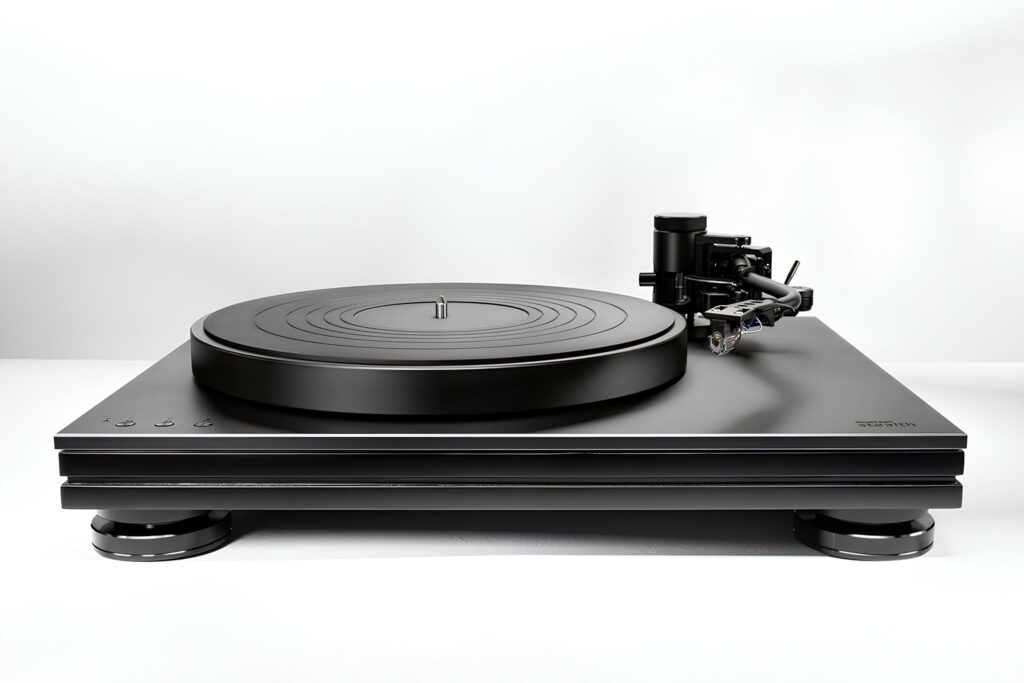
The Music Hall Stealth takes a different route from the belt-drive models. Its direct-drive motor is intended for audiophile listening, with the source highlighting quiet rotation and stable speed. The aluminium platter is damped with elastomer material, while vibration-isolating feet are used to reduce unwanted feedback and environmental noise.
Its most important advantage is flexibility. The S-shaped tonearm has a removable headshell and on-the-fly VTA adjustment. That combination is unusually practical for listeners who use more than one cartridge, want to tune cartridge geometry or plan to play different kinds of records. The source specifically points to the convenience of changing to a cartridge suitable for old 78 rpm shellacs. Additional pre-mounted headshells are planned for that purpose.
The Stealth comes with an Ortofon 2M Blue cartridge already mounted and is intended for 33⅓ and 45 rpm records. The source describes its presentation as having crisp treble, natural midrange and punchy bass. It also includes auto-stop, which lifts the arm at the end of a record, and a high-quality RCA cable for connection to a phono preamp. Instead of a conventional plastic dust cover, Music Hall supplies a velvet slipcover.
This is the best choice for the enthusiast who values hands-on control more than automatic operation. It is not the simplest deck in the comparison: the supplied information does not identify a built-in phono stage, so the buyer should plan around an appropriate external phono preamp. In return, the Stealth offers the most useful cartridge and setup flexibility of the five.
Pro-Ject E1.2 and E1.2 Phono
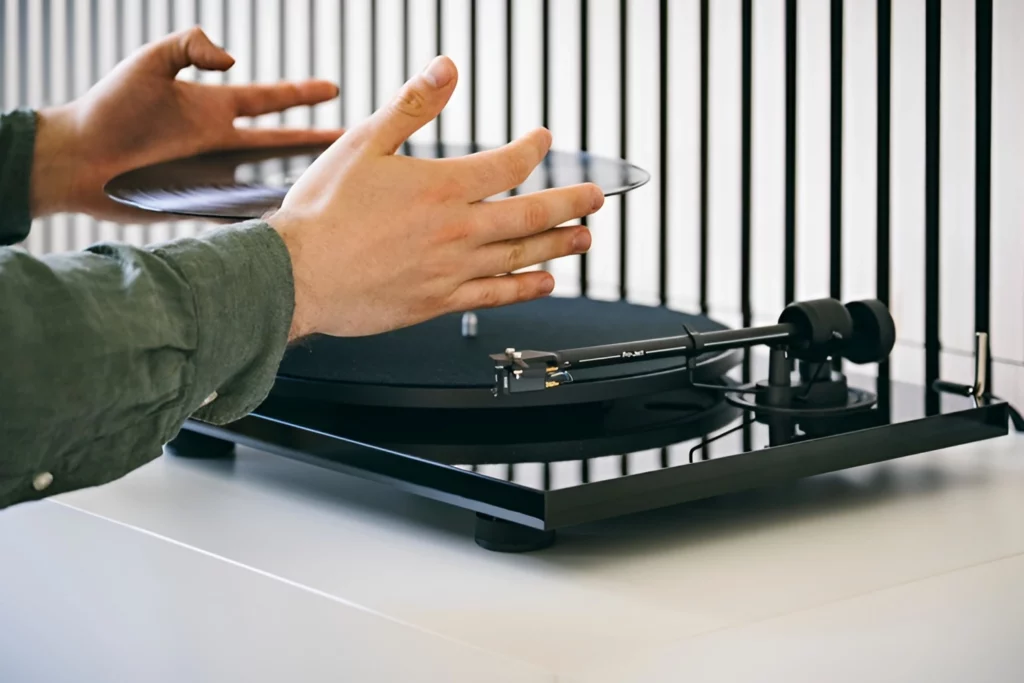
The E1.2 is Pro-Ject's straightforward plug-and-play option, and the E1.2 Phono adds a built-in phono amplifier to the same basic design. Both versions include a tonearm, MM cartridge and dust cover, and both are handcrafted in Europe and factory tuned for immediate use.
The deck uses a 730-gram die-cast aluminium platter intended to suppress resonance and provide stable rotation. Its CNC-machined composite plinth is made without voids, while the tonearm uses a heavy-duty gimbal bearing design, a carbon-fibre-reinforced headshell and a positioned counterweight intended to support tracking and reduce vibration. The supplied Pick-it MM E cartridge uses a lightweight neodymium magnet and conical diamond stylus; the manufacturer describes its sound as warm and clear with minimal noise.
Operation is deliberately simple. A single button selects 33⅓ or 45 rpm, and the turntable arrives ready to play without complicated setup. The standard E1.2 is listed at a suggested retail price of €329, while the E1.2 Phono is listed at €359. The standard model is the logical choice when the system already has a suitable phono input or external phono stage; the Phono version is more convenient for an amplifier or active-speaker setup that needs the turntable to provide the phono amplification.
Compared with the T2 Super Phono, the E1.2 range is the more accessible and simpler proposition in the supplied material. Compared with the fully automatic REKKORD, it still requires more hands-on record handling. It is the strongest value-focused choice when the stated prices and ready-to-play design are the deciding factors.
How they differ
Automation: The REKKORD is the only fully automatic model in the group. The T2 Super Phono and E1.2 are plug-and-play designs, but the supplied information does not describe them as automatic. The T+A and Music Hall place more emphasis on manual control, although the Stealth adds auto-stop.
Phono connectivity: The REKKORD and T2 Super Phono include built-in phono stages. The E1.2 Phono does as well, while the standard E1.2 description does not state that it does. The T+A offers optional internal MM or MC modules. The Music Hall is supplied with an RCA cable for connection to a phono preamp, and no built-in stage is identified in the source.
Cartridge and tonearm flexibility: The Music Hall is the clear specialist choice, with its removable headshell and adjustable VTA. The T2 Super Phono allows the built-in phono stage to be disconnected and is designed as a coordinated system. The T+A offers factory configuration choices but is not designed for significant user intervention. The REKKORD and E1.2 prioritise factory setup and ease of use.
Drive and isolation: The REKKORD, T2 Super Phono, T+A and E1.2 use belt-drive designs according to the supplied material. The Music Hall uses direct drive. Isolation is addressed in different ways: the REKKORD uses a floating sub-chassis, the T2 uses damping and its larger chassis, the T+A uses mass and construction, the Stealth uses a damped platter and isolating feet, and the E1.2 uses its platter and composite plinth design.
System ambition: The REKKORD and E1.2 are the least intimidating routes into vinyl. The T2 Super Phono is the strongest bridge between convenience and serious hi-fi design. The Music Hall is aimed at an enthusiast who wants control, while the T+A is the most specialised high-end component.
Which one should you buy?
- Choose the REKKORD F110P if this is your first turntable, you want to use active speakers or a simple amplifier connection, and you value fully automatic playback above experimentation.
- Choose the Pro-Ject T2 Super Phono if you want one complete, carefully matched deck that can serve both a newcomer and a more serious hi-fi system. Its disconnectable phono stage also leaves room for a future external upgrade.
- Choose the T+A G 2000 R if you are building around a high-end system and want substantial construction, DSP-controlled speed and the choice of factory MM or MC configurations. It is the least appropriate option for casual, low-intervention vinyl use.
- Choose the Music Hall Stealth if changing cartridges, adjusting VTA or playing different record formats is central to your listening. Its removable headshell makes it the most adaptable deck here, provided your system has a suitable phono preamp.
- Choose the Pro-Ject E1.2 if you want the supplied €329 plug-and-play model and already have phono amplification. Choose the €359 E1.2 Phono instead if built-in phono amplification is important and you want the same ready-to-play design.
Final verdict
The Pro-Ject T2 Super Phono is the Best Overall because it gives the widest group of listeners a convincing balance of convenience and serious hi-fi engineering. The REKKORD F110P is easier for a complete beginner, the E1.2 Phono is the clearest value-led option at its supplied price, the Music Hall Stealth is better for cartridge experimentation, and the T+A G 2000 R is the most ambitious high-end choice. The right purchase depends less on a universal ranking than on how much control, simplicity and system integration you actually want from vinyl.








 VS
VS VS
VS VS
VS VS
VS VS
VS VS
VS VS
VS VS
VS

Comments 0
Share your experience, questions and perspective with other hi-fi enthusiasts.