

Adding HDMI ARC to a valve integrated amplifier is the defining decision behind the ELAC Tube 100. Rather than treating tubes as the preserve of vinyl-led, two-channel systems, ELAC is designing this model to sit between a television, traditional analog sources and passive hi-fi speakers. That broader role is reinforced by Bluetooth, a phono input and preamplifier output, yet important engineering details—including output power and the exact tube complement—remain undisclosed. The central question is therefore not whether the Tube 100 is unusual, but whether its documented architecture can make valve amplification easier to integrate without obscuring the fundamentals of system matching. ELAC’s accompanying Baltic EL 100 speakers add another retro-modern option, though their technical picture is similarly incomplete.

HDMI ARC redraws the valve amplifier’s job description
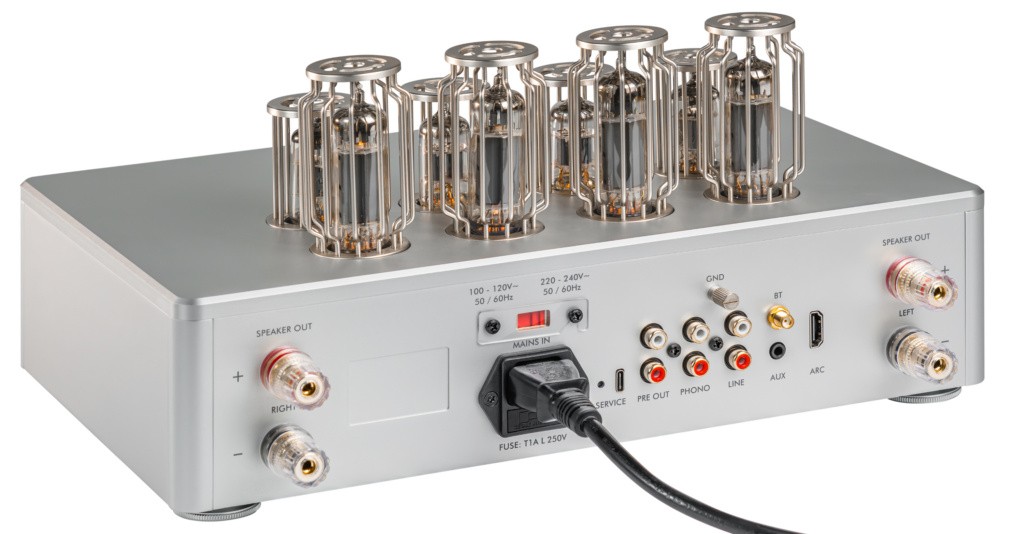
The Tube 100’s HDMI ARC connection is more consequential than a routine input addition. ARC allows compatible televisions to send audio back through an HDMI cable, giving a conventional pair of passive speakers a direct role in everyday TV viewing. For buyers who want one stereo system for records, music and television rather than a separate soundbar, that can remove a meaningful setup barrier.
Valve amplifiers are commonly associated with narrowly focused analog systems, so ELAC’s choice suggests a different intended environment: the main living room. The documented specification does not establish the full HDMI control implementation or identify support beyond ARC, but the basic arrangement should simplify TV-audio routing. Whether television remotes can control every relevant function has not yet been detailed, so ARC should not be interpreted as confirmation of a complete AV-receiver-style feature set.
A visible tube layout, but unanswered electrical questions
Images show four smaller tubes and four larger output tubes, indicating a substantial conventional valve complement rather than a design that uses tubes merely as decoration. The precise tube types and circuit topology have not been confirmed. Although the larger devices visually resemble familiar output valves, identifying them from appearance alone would be speculation.
More importantly, ELAC has not disclosed rated power. That figure will heavily influence speaker matching because valve amplifiers can provide less output than similarly positioned solid-state designs. Low power does not determine sound quality, but it can limit attainable volume with insensitive speakers or in larger rooms. Until power, impedance behavior and other electrical specifications are published, prospective owners should resist assuming compatibility from the Tube 100’s size or number of output tubes.
The preamplifier output provides an escape route
A dedicated preamplifier output broadens the Tube 100’s usefulness. It permits connection to an external power amplifier, allowing the ELAC to remain the source selector and control center when additional output capability is needed. That could also make the amplifier easier to retain if a future speaker change creates more demanding power requirements.
This flexibility matters because the unknown output rating is presently the product’s largest technical uncertainty. The pre-out does not eliminate the need to choose suitable speakers for the internal valve stage, but it reduces the risk of the entire unit becoming redundant. It also suggests that ELAC sees the Tube 100 as more than a self-contained retro object: its control section is intended to participate in a system that may evolve.
Five sources bridge records, wireless audio and television
The input roster covers a line-level RCA source, a turntable through the phono input, a mini-jack source, Bluetooth and HDMI ARC. Together, those five options address many contemporary listening habits without abandoning the analog connections expected of a valve integrated amplifier. A large headphone socket on the front adds private listening, although no specifications for the headphone stage have been supplied.
Source selection takes place through a front-panel touch area, an uncommon contrast with the amplifier’s otherwise traditional visual language. A compact remote with a brushed-aluminum appearance is also included. The arrangement should reduce the need to approach the amplifier during routine use, particularly when it is connected to a television, but the exact remote functions and Bluetooth specification remain unknown. No optical, coaxial or USB digital inputs have been documented.
Individual tube guards replace the usual metal cage
Instead of placing the valves beneath one large rectangular cover, ELAC gives each tube its own shaped protective guard. This preserves much of the exposed-tube appearance while introducing a physical barrier around every valve. The concept is visually lighter than a full-width cage, though it should not be taken to remove the normal heat and placement considerations associated with valve equipment.
The chassis appears to use thick, machined aluminum sections, while the touch interface gives the front panel a more contemporary character than the exposed valves initially suggest. That tension is central to the Tube 100’s identity: the industrial design celebrates its valve hardware, but the controls and HDMI connection are aimed at a room where convenience matters as much as nostalgia. Final construction details, dimensions and weight have not yet been provided.
Baltic EL 100 extends the idea to the loudspeakers
ELAC’s Baltic EL 100 is a three-way passive speaker inspired by studio monitors from the 1980s. Its wide, relatively low cabinet sits between conventional stand-mount proportions and a full-height floorstander. Matching stands can angle the enclosure toward the listening position, indicating that the geometry has been considered as part of the installation rather than as an optional visual accessory.
The driver arrangement departs from ELAC’s better-known JET tweeter technology. A conventional fabric-dome tweeter is paired with a much larger dome midrange unit, while a bass driver and substantial front-firing reflex port occupy the lower portion of the baffle. A front port can offer more placement latitude than a rear vent, although room interaction will still matter. Dark real-wood veneer and an optional yellow fabric grille complete the period-influenced treatment without turning the speaker into a literal reissue.
System matching remains the decisive unknown
On paper, the Tube 100 and Baltic EL 100 form a coherent aesthetic and functional system: a studio-influenced three-way speaker paired with an amplifier that connects analog sources, wireless devices and a television. Yet ELAC has not published the speaker’s sensitivity, frequency range, impedance behavior or dimensions. Without those figures and the amplifier’s power rating, there is no basis for concluding how comfortably the two products will operate together at different listening levels.
Both products are planned for release in spring 2027 as part of ELAC’s centenary-era introductions. A USD price has not been specified, preventing a firm value judgment at this stage. The concept is nevertheless clear. The Tube 100 targets listeners drawn to valve amplification who do not want their main system isolated from television sound, while the Baltic EL 100 addresses buyers who prefer broad-baffle, studio-inspired loudspeakers over slimmer modern towers.
A thoughtfully modernized valve-amplifier concept whose HDMI ARC, phono stage and pre-out address real system needs, but its ultimate suitability cannot be judged until ELAC publishes the missing power, speaker-matching and pricing details.
The ELAC Tube 100 is most interesting not because it combines old and new styling cues, but because HDMI ARC changes where a valve amplifier can reasonably be used. Its documented input selection accommodates a turntable, an analog component, a portable source, Bluetooth playback and television audio, making it plausible as the control center of a shared living-room system. The preamplifier output is an equally sensible inclusion, providing a route to external amplification if the internal valve stage proves unsuitable for a particular speaker or room.
There are still too many open specifications for an unconditional recommendation. Output power, tube types, Bluetooth details and the wider HDMI implementation have not been published. The Baltic EL 100’s sensitivity and impedance are also unknown, leaving the relationship between ELAC’s amplifier and speaker difficult to assess beyond their coordinated presentation. With no stated USD price, value must remain an open question as well.
Even so, the intended buyer is easy to identify: someone attracted to visible valves and analog playback who also wants television sound and wireless audio handled by the same stereo system. The Baltic EL 100 adds a distinctive three-way, broad-baffle alternative for listeners interested in 1980s studio-monitor design. Both merit attention ahead of their planned spring 2027 release, but the Tube 100 in particular needs a complete technical specification before buyers can make responsible decisions about speaker matching and room suitability.



Sound Off
1Join the discussion if you have something to add.
Pass. I don't need the disaster that is HDMI compliance anywhere near my tube equipment. This is an unnecessary and overly complicated solution for an invented problem. Yes, some people will buy it and probably sing its praises but its the floating car of the audio world.