

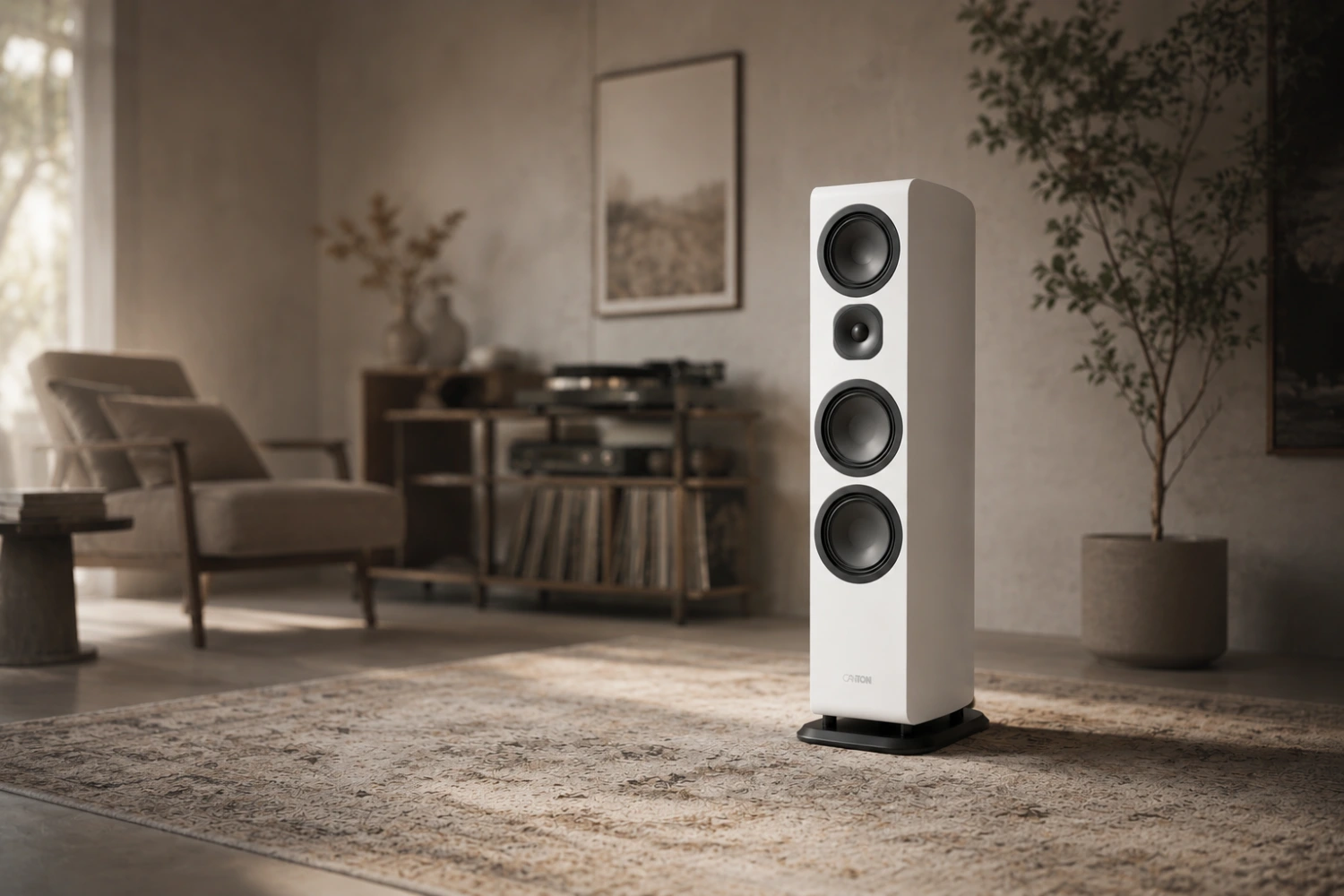
A loudspeaker range becomes considerably more useful when it offers more than a choice between a standmount and a floorstander. Canton’s updated Vento series is conceived as a complete family, covering compact monitor models, three floorstanding speakers, a wall speaker, a center channel, a subwoofer, and a dedicated Dolby Atmos model. That breadth gives prospective owners room to build anything from a focused two-channel setup to a visually and technically coordinated home cinema system. Just as importantly, the models share a recognizable design language and a common set of engineering priorities. Curved multilayer MDF cabinets, ceramic tweeters, aluminum titanium diaphragms, internal driver chambers, and carefully managed dispersion form the foundation of the range. The result is a product family whose appeal lies not in any single headline feature, but in the way its construction, appearance, and system flexibility have been developed together.
A softer approach to loudspeaker design
The name Vento comes from the Italian word for “wind,” and Canton has translated that theme into cabinets intended to suggest lightness and movement. The front and rear surfaces are softly rounded, giving the speakers an arched profile rather than the familiar appearance of a conventional rectangular enclosure. It is an aesthetic decision with a practical acoustic purpose: minimizing prominent cabinet edges can help reduce potential diffraction around the drivers.
This approach should make the Vento models easier to integrate into living spaces where a large, sharply outlined loudspeaker might appear visually dominant. Canton has also used magnetically attached fabric grilles, preserving a clean front surface without visible mounting points when the grilles are removed. Owners can therefore choose between a more discreet presentation and an exposed-driver appearance without changing the underlying design.
The styling is consistent across a notably broad range of speaker formats. That matters in multichannel installations, where mismatched cabinet shapes and finishes can make individual speakers look like unrelated additions. Vento’s shared proportions, curves, and driver aesthetic provide a more cohesive foundation for systems that may include front, center, wall, height, and subwoofer channels.
Cabinet engineering beneath the curves
The sculpted exterior is supported by multilayer curved MDF construction. MDF is widely used for loudspeaker enclosures because it can provide a dense, stable structure, while Canton’s layered and curved implementation is intended to minimize unwanted cabinet resonances. In practical terms, the enclosure is designed to contribute as little as possible beyond providing a controlled environment for the drive units.
Inside, Canton employs a chamber system that decouples individual drivers from one another. Separating the operating environment of the drivers can reduce unwanted interaction within the cabinet, particularly in speakers containing several drive units. Targeted internal damping is also used to control reflections. These measures show that the curved enclosure is not simply a styling exercise; its internal structure has been developed around the same objective of reducing interference and maintaining precision.
The floorstanding models and compact monitors naturally serve different room and placement requirements, but the shared construction principles help preserve the identity of the series. Buyers can select a cabinet size appropriate to their system without stepping outside the Vento engineering concept.

Ceramic high frequencies with controlled dispersion
Every loudspeaker family needs a consistent high-frequency platform if its models are to work together convincingly. For Vento, Canton uses a black ceramic-dome tweeter incorporating the company’s BC technology. The ceramic material is specified for detailed reproduction, while its black surface also complements the understated visual treatment of the other drivers.
A newly developed square waveguide surrounds the tweeter. Its purpose is to manage dispersion so that high-frequency output is distributed in a controlled and uniform manner. Dispersion behavior is relevant beyond the central listening position: it influences how a speaker interacts with the room and how consistently it covers a seating area. That is particularly useful in a home cinema, where several listeners may be spread across a sofa rather than occupying a single tightly defined position.
Canton describes the Vento series as being designed for balanced, natural reproduction, with clear differentiation of voices and accurate spatial presentation of instruments. Those are manufacturer-stated performance goals rather than listening findings here, but the combination of a common ceramic tweeter and controlled waveguide indicates how Canton intends to maintain tonal and spatial consistency across the range.
ATB diaphragms for midrange and bass duties
The midrange and low-frequency drivers use Canton’s aluminum titanium black, or ATB, diaphragms. Their engineering premise is straightforward: high stiffness combined with low weight allows a diaphragm to follow the input signal accurately while resisting unwanted deformation. Canton associates this construction with detailed, low-distortion reproduction.
The black ATB cones also give the entire range a unified appearance. That may seem secondary to performance, but it is relevant in a premium loudspeaker family designed to be used with or without its grilles. The ceramic tweeter, square waveguide, and dark mid/bass diaphragms form a coherent front baffle rather than a collection of visually unrelated components.
Bass output is managed through a tuned bass-reflex system, which Canton has designed to provide controlled pressure and definition. The source information does not specify identical bass extension or output for every model, so prospective owners should still match the chosen Vento’s size and format to their room. The useful point is that the same core diaphragm technology and bass-reflex philosophy extend across the family.
From a compact stereo pair to Dolby Atmos
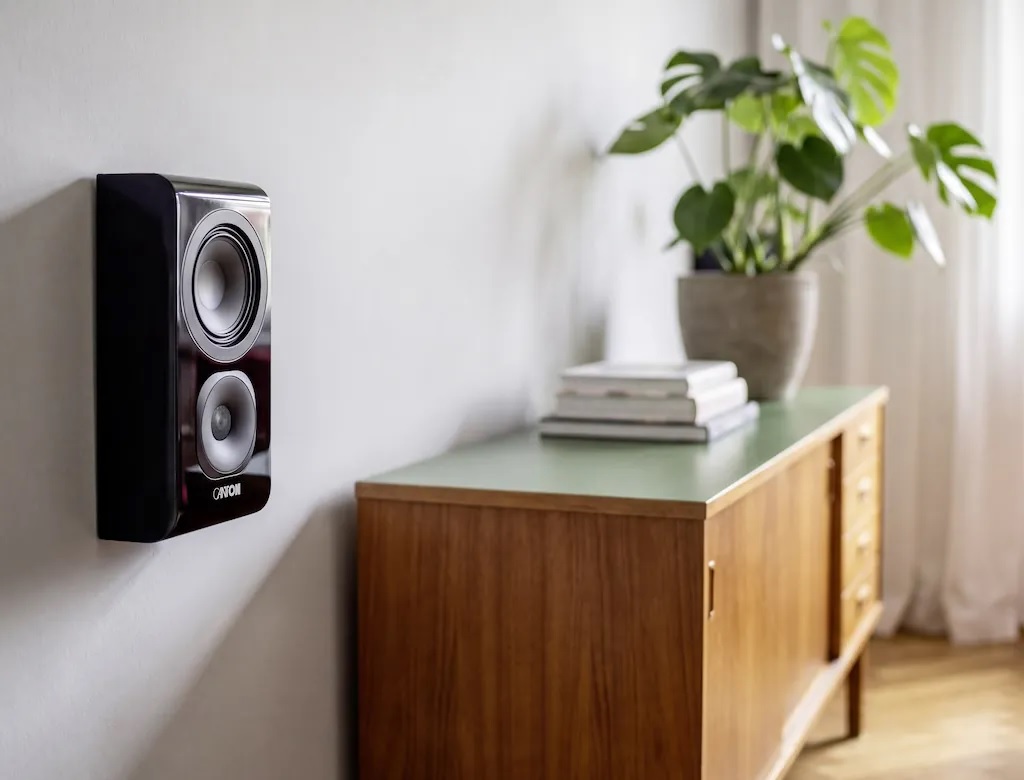
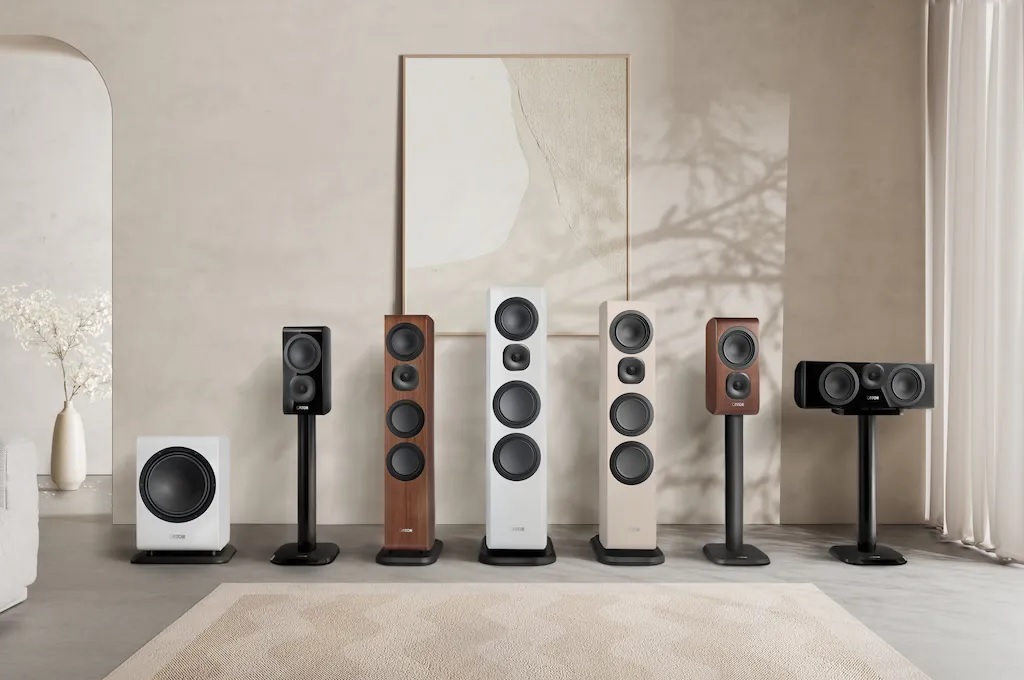
The strongest practical argument for Vento may be the range of available configurations. The Vento 21 and Vento 31 are monitor models for listeners who prefer compact enclosures or need more placement flexibility. The Vento 81, 91, and 101 are floorstanders, offering three physical steps for systems in which a larger cabinet is appropriate. The Vento 11 wall speaker provides another option where floor or stand space is limited.
For multichannel use, the Vento 51 center speaker supplies the dedicated center-channel role, while the Vento Sub 1 handles the subwoofer position. The Vento AR 1 adds a dedicated Dolby Atmos model. Together, these products allow a cinema system to remain within one design and technology family rather than mixing speakers developed around different drivers and dispersion approaches.
This modular structure also supports gradual system development. An owner could begin with a stereo pair and later add the matching center, subwoofer, wall, or Dolby Atmos models as requirements change. No upgrade path is automatically simple—room layout, amplification, and installation still require consideration—but Canton’s model coverage removes one common obstacle: finding corresponding speakers from the same series for each channel role.
Who the Canton Vento series is for
Vento is most suitable for buyers who value a consistent balance of furniture-conscious design and specialized enclosure engineering. Its rounded cabinets and hidden grille attachments should appeal to listeners who want substantial loudspeakers to look considered in a domestic setting rather than overtly utilitarian. The range is also relevant to anyone planning a matched stereo and home cinema environment, especially where center, wall, subwoofer, and Dolby Atmos options may be needed.
The compact monitors and wall speaker provide alternatives for spaces that cannot accommodate floorstanders, while the three floorstanding models offer choices for owners able to use larger enclosures. The series is therefore not tied to one room type or a single system architecture.
Prospective owners seeking detailed published specifications for sensitivity, impedance, frequency response, dimensions, or amplifier requirements will need to consult Canton or an authorized dealer, as those figures are not documented in the supplied product information. Room size, placement freedom, and amplifier compatibility should remain part of the selection process. Vento’s broad model range is a strength, but choosing the appropriate model still depends on the practical demands of the intended system.
Conclusion
The updated Canton Vento series is distinguished by the way its design and engineering choices support one another. Softly curved multilayer MDF cabinets create a refined visual profile while addressing resonance and potential edge diffraction. Internally separated driver chambers and targeted damping further emphasize enclosure control, while ceramic-dome tweeters with square waveguides and lightweight, rigid ATB diaphragms provide a shared technical foundation. Its greatest practical strength is breadth: monitor, wall-mounted, floorstanding, center, subwoofer, and Dolby Atmos models allow owners to assemble a coordinated system for music, cinema, or both. Vento is consequently best suited to listeners who want premium construction, understated contemporary styling, and the flexibility to expand within one consistent speaker family.


Sound Off
0Join the discussion if you have something to add.