

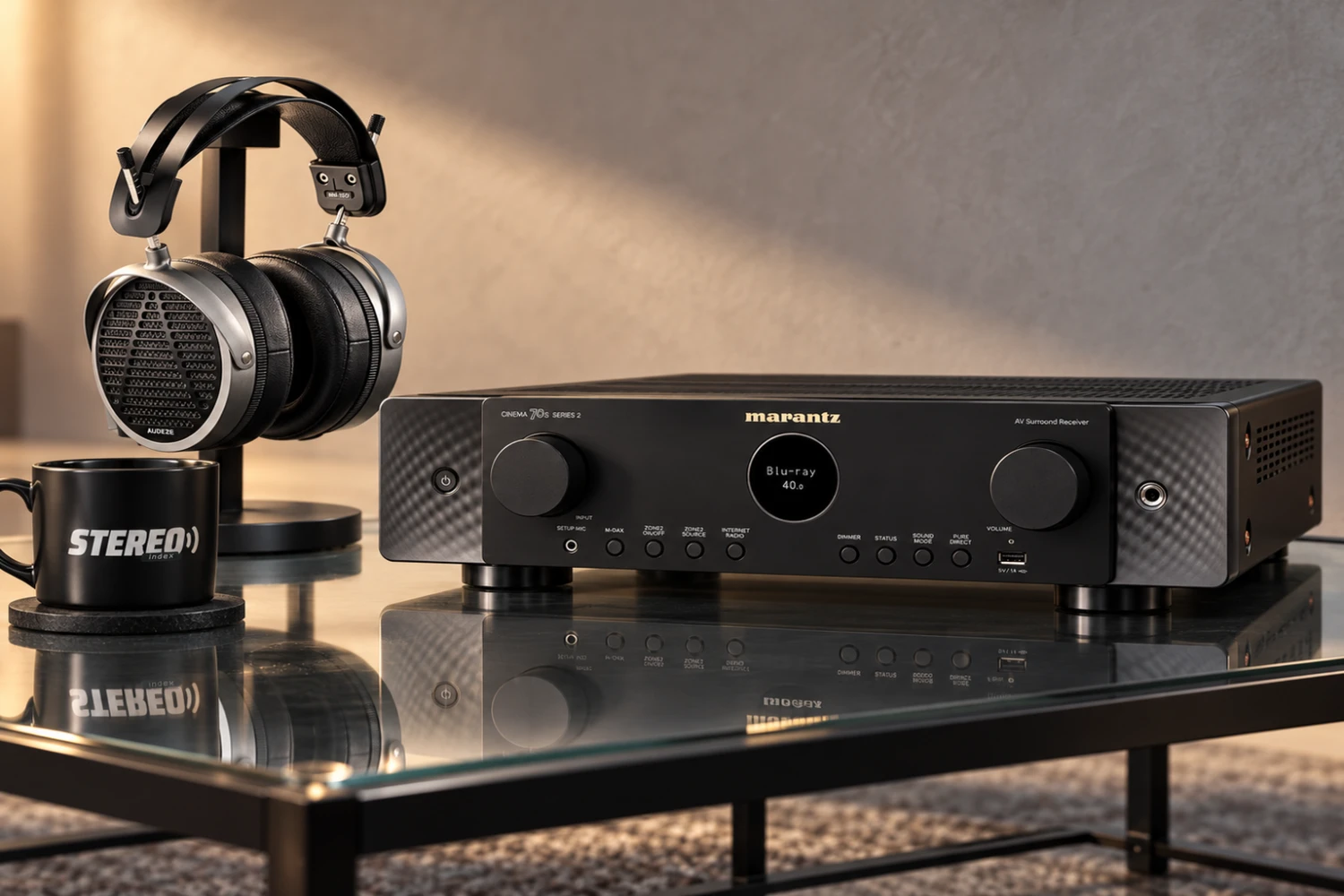
Marantz has introduced the CINEMA 70s Series 2, a slim seven-channel AV receiver designed for home cinema, music and gaming systems where equipment space is limited. The revised model adds updated digital audio processing, optional Dirac Live room correction and broader gaming support while retaining the distinctive circular display and low-profile Marantz design.
Seven-channel cinema sound in an 11 cm chassis
At just 11 cm tall, the CINEMA 70s Series 2 is substantially slimmer than a conventional full-size AV receiver. Its seven discrete amplification channels are rated at 50 watts into 8 ohms from 20 Hz to 20 kHz with two channels driven. Marantz also specifies 90 watts under a one-channel, 1 kHz measurement.
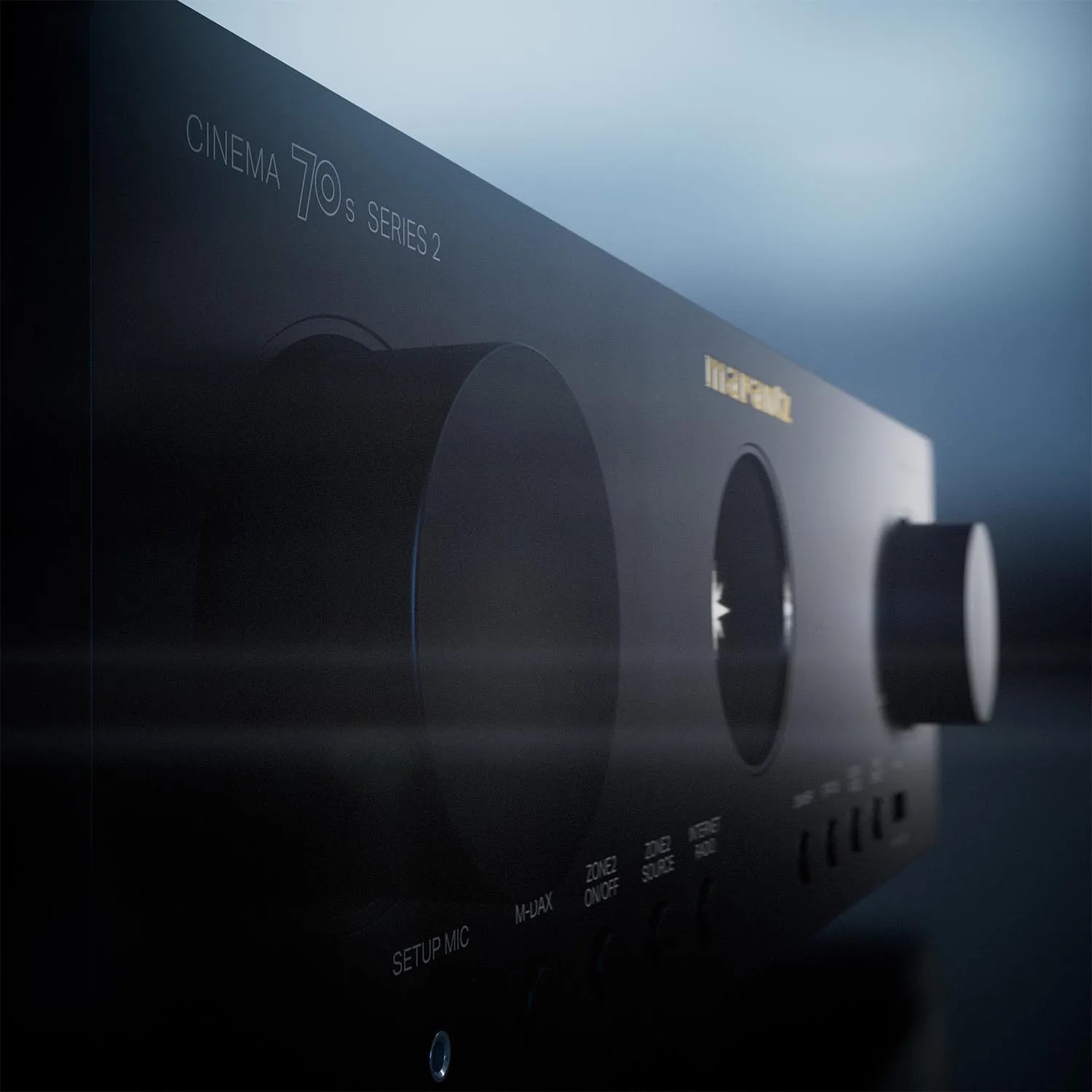
The receiver can power either a conventional 7.2-channel speaker arrangement or a 5.2.2 Dolby Atmos system with two height speakers. Dolby Atmos and DTS:X decoding are included, along with Dolby Atmos Height Virtualization and DTS Virtual:X for systems without dedicated height channels.
Two subwoofer connections are provided, although the outputs cannot be calibrated independently. A 7.2-channel pre-out section also allows the receiver to be connected to external power amplifiers. Marantz includes a backlit remote control, while the front panel retains the brand’s compact circular display and symmetrical styling.

New DAC architecture and two room-correction options
The Series 2 revision introduces a 32-bit, eight-channel DAC that processes all channels simultaneously. This replaces the two-channel DAC arrangement used in the original CINEMA 70s. Two selectable DAC filters are available, with Filter 1 set as the default Marantz tuning.
Audyssey MultEQ-XT room correction is included and supports measurements from as many as eight positions using the supplied calibration microphone. Audyssey Dynamic Volume can reduce large changes in playback level, while Dynamic EQ adjusts tonal balance during lower-volume listening.
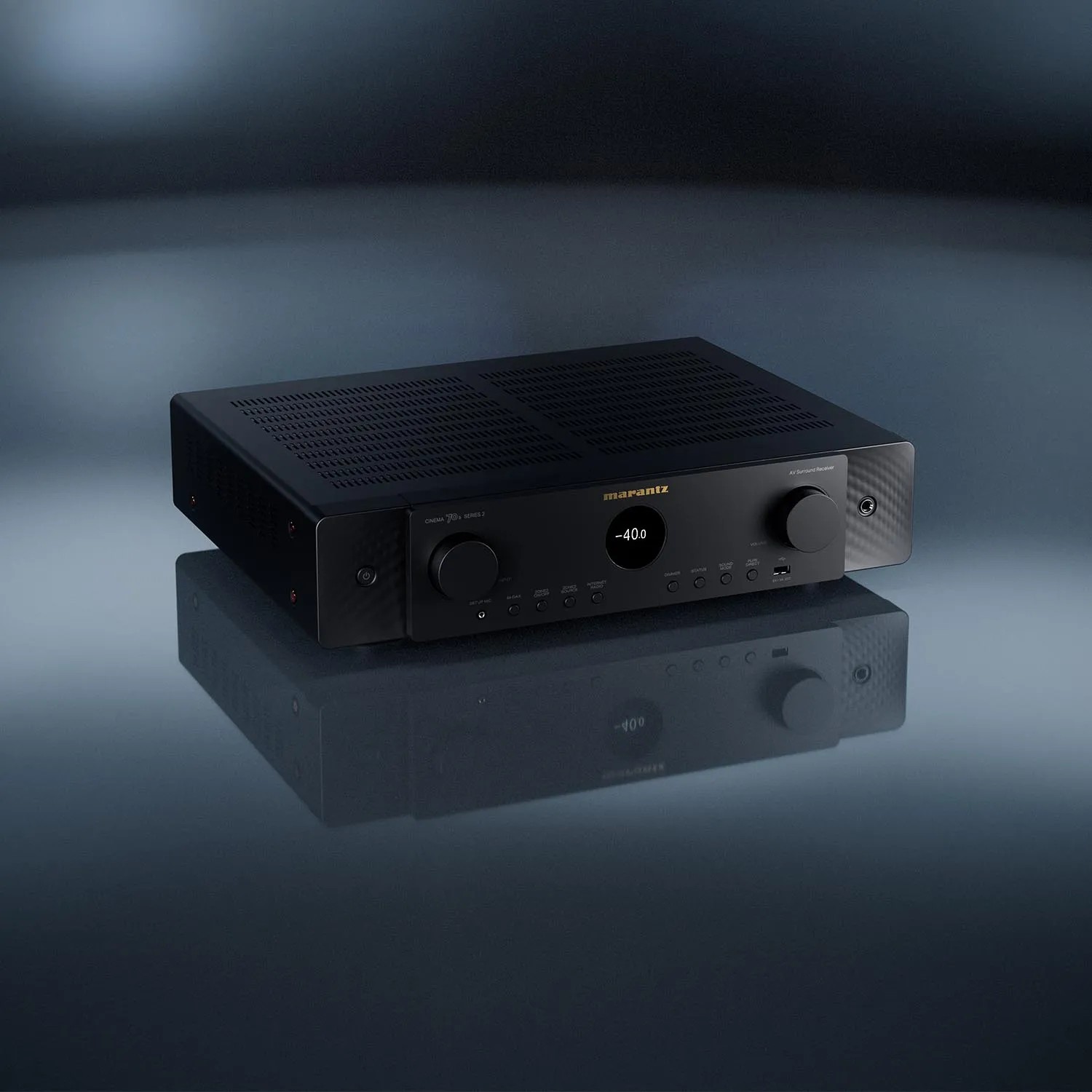
The receiver is also ready for Dirac Live Room Correction, with the required Limited Bandwidth or Full Bandwidth license sold separately. Dirac Live Bass Control and Active Room Treatment are not supported. One Audyssey configuration and one Dirac configuration can be stored, allowing users to switch between them from the remote control.
For analog music sources, Marantz has included an MM phono input. The receiver does not use the company’s HDAM circuitry, a distinction from some larger Marantz components.
Six HDMI inputs with 8K and gaming features
The rear panel carries six HDMI inputs and one HDMI output. Three inputs support 8K at 60 Hz and 4K at 120 Hz, while the remaining HDMI inputs do not offer the same high-bandwidth video modes. The HDMI output also supports 8K, and the receiver can upscale 1080p and 4K signals to 8K.
Gaming-oriented features include Variable Refresh Rate, Auto Low Latency Mode, Quick Frame Transport, 1440p pass-through and AMD FreeSync. The 8K, 4K at 120 Hz and AMD FreeSync functions are available through HDMI inputs four through six when used with compatible equipment.
Video format support covers Dolby Vision, HDR10+, Dynamic HDR and HLG. The eARC connection can return compatible high-resolution and immersive audio, including Dolby Atmos, from a television over the same HDMI cable used for video output. There is no front-panel HDMI input and no provision for analog video connections.

HEOS streaming, AirPlay 2 and two-way Bluetooth
Built-in HEOS supplies network streaming, internet radio and multiroom playback with compatible HEOS products. Direct service integration includes Spotify Connect, TIDAL Connect and Qobuz Connect, while the receiver is also Roon Ready.
Apple AirPlay 2 provides another route for wireless playback and multiroom use with compatible Apple devices. Wi-Fi and conventional Bluetooth are built in, and the two-way Bluetooth implementation can transmit audio from the receiver to compatible wireless headphones. An FM tuner with RDS is also included for terrestrial radio reception.
Marantz has announced Bluetooth LE Audio and Dolby Atmos playback from Apple Music over AirPlay 2 as future firmware additions. LE Audio will require compatible source devices or headphones, while Dolby Atmos music can already be received from a suitable player connected through HDMI.
Guided setup and flexible system presets
A 1080p graphical interface and Setup Assistant guide users through speaker configuration, network access, room correction and source connections. Horizontally arranged, color-coded speaker terminals are intended to simplify installation, and cable labels are supplied.
Two Speaker Preset memories can store different system configurations, such as separate settings for films and music. Four Smart Select memories provide quick access to frequently used combinations of inputs and operating settings.
Control options include the Marantz AVR Remote app, the HEOS app and Web UI 2.0 through a browser on a phone or computer. Channel Level Monitoring displays which speaker channels are active, while HDMI Diagnostics 2.0 provides additional tools for checking connections and troubleshooting an HDMI setup.
The CINEMA 70s Series 2 is offered in multiple finishes, with the black version listed as a special-order model carrying an expected lead time of three to four weeks. Availability may vary by market.
With its low-profile enclosure, seven amplified channels and extensive HDMI and streaming support, the Marantz CINEMA 70s Series 2 targets installations that need a capable AV hub without the bulk of a traditional receiver. The new DAC platform, optional Dirac Live support and expanded gaming compatibility are the principal changes over the original model.