

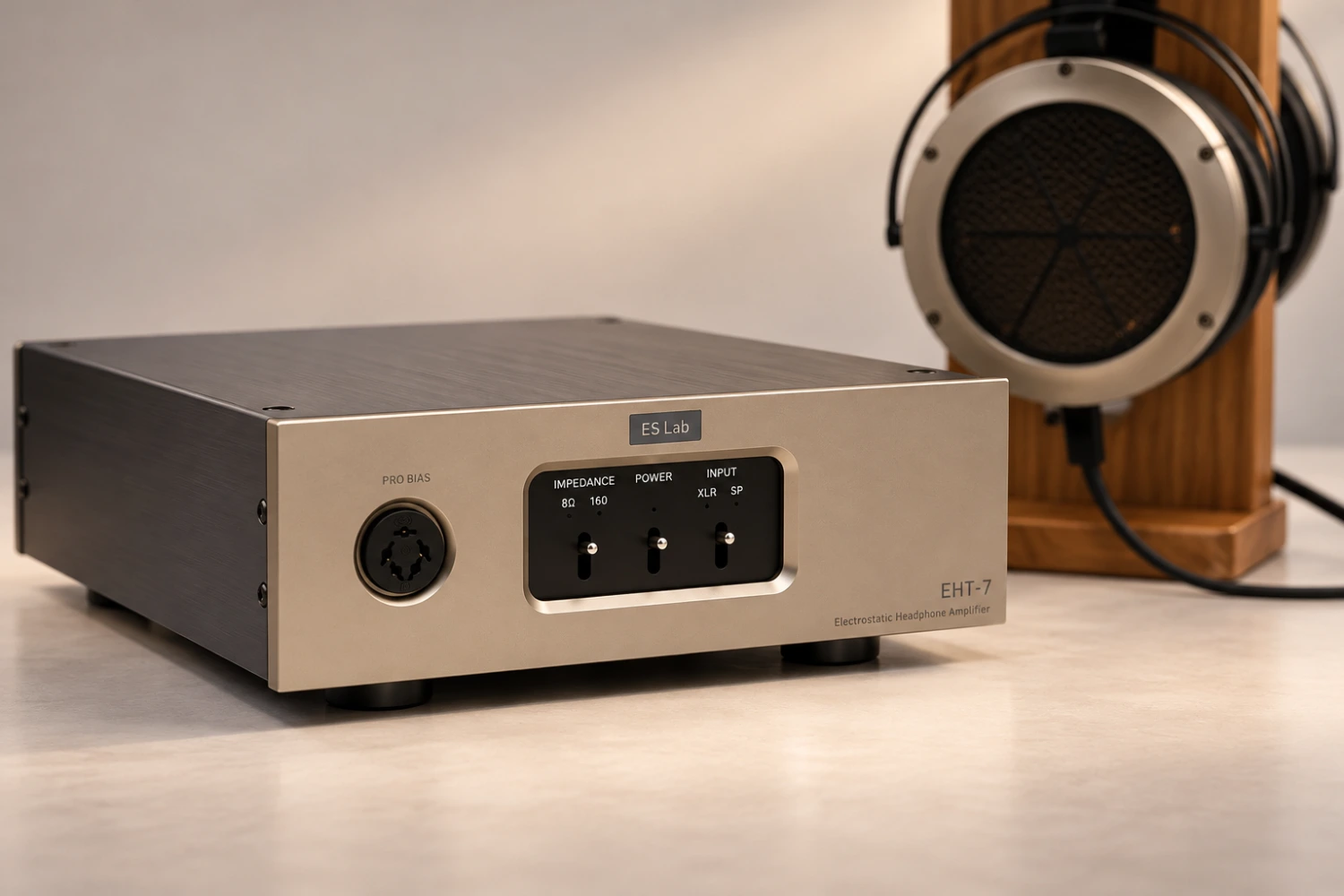
ES Lab has introduced the EHT-7, a transformer-based energizer designed to connect Pro Bias electrostatic headphones to an existing speaker or headphone amplifier. The unit combines a 580V bias supply with selectable input impedance, two amplifier connection options and multiple protection systems. Prices start at $850.
Two transformer configurations
The standard EHT-7 uses audio-grade step-up transformers made in Japan. Their cores are formed from grain-oriented silicon-iron steel supplied by Nippon Steel Corporation, while individual units are assembled by technicians. This version provides 31.1 dB of gain with the 8-ohm input setting and 27.8 dB with the 16-ohm setting.

ES Lab specifies a frequency response of 10 Hz to 55 kHz for the Japanese-transformer model, measured at 50V RMS into a 120pF load. Recommended amplification ranges from 5W to 100W into 8 ohms when using a speaker amplifier. A headphone amplifier should provide at least 10V into 16 ohms.
An upgraded model replaces the Japanese transformers with Lundahl LL1630 units. These use Lundahl’s audio C-core construction and a highly sectioned, low-capacitance winding arrangement. The LL1630 version has 23 dB of gain and a specified frequency response of 10 Hz to 65 kHz under the same voltage and load conditions. Its recommended speaker-amplifier range is 10W to 100W into 8 ohms.
A dedicated 580V Pro Bias supply
Rather than relying on a conventional voltage-multiplier circuit, the EHT-7 employs several stages of power processing to generate the bias supply required by compatible electrostatic headphones. Power arrives through an external 15V DC, 0.2A supply before passing through an LT3045 low-noise regulator circuit.

The regulated voltage then feeds a low-ripple, high-voltage DC-to-DC converter that produces the 580V Pro Bias output. Headphones connect through a Stax-type five-pin Pro Bias socket. The audio signal itself is stepped up by the selected transformer pair, allowing the EHT-7 to operate as an interface between the source amplifier and electrostatic drivers.
Speaker-level and balanced XLR inputs
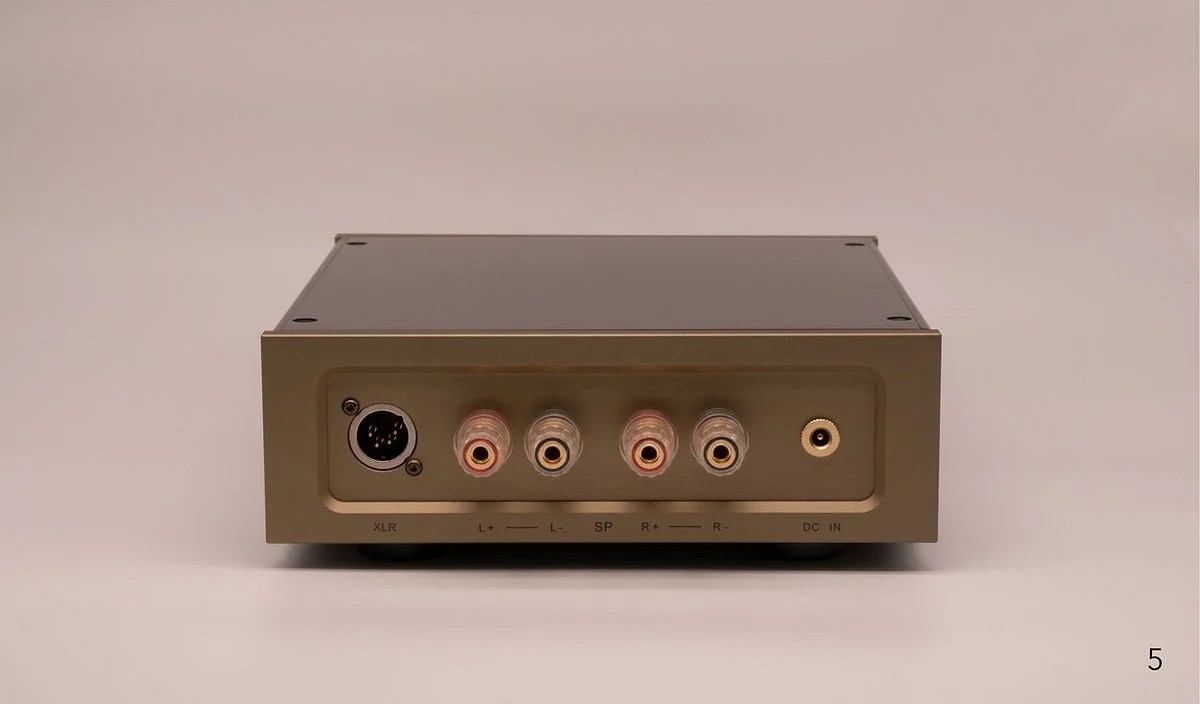
The EHT-7 can be incorporated into systems built around either a conventional speaker amplifier or a sufficiently capable headphone amplifier. Speaker terminals accept the output from a power amplifier, while balanced XLR inputs provide an alternative connection for headphone amplifiers.
Selectable 8-ohm and 16-ohm primary impedance settings allow the transformer input to be matched to the connected amplifier. Input switching is handled by five sealed relays with silver-alloy contacts, specified for high current capacity and a long operating life. The input circuitry is disabled whenever the energizer is switched off.
Protection circuitry and physical specifications
Several safeguards address the high signal and bias voltages involved in electrostatic headphone operation. A zener-diode clipping network prevents signals above 1,150V peak, measured stator to stator, from reaching the headphones. Matched Jantzen Audio load resistors are connected in series with the transformers to help protect against excessive direct current and impedance changes.
A 4.7-megohm Vishay high-voltage ballast resistor limits current before the bias supply reaches the headphone output. Short-circuit protection is also incorporated into both the low-voltage regulator and the high-voltage converter.
The chassis measures 215 x 235 x 80 mm and weighs 3.1 kg. ES Lab covers the EHT-7 with a two-year warranty. The model with Japanese transformers is listed at $850, while the Lundahl LL1630 configuration is priced at $1,250. Both configurations are offered as selectable product variants.
With two transformer choices, flexible amplifier connections and a carefully managed Pro Bias supply, the EHT-7 gives electrostatic headphone owners a route to using amplification they may already have. Its adjustable impedance and layered protection circuitry also address the practical demands of integrating a high-voltage energizer into an existing system.




Sound Off
0Join the discussion if you have something to add.