

ARCAM has refreshed the core of its Radia hi-fi range with three new integrated amplifiers: the A5+, A15+ and A25+. Rather than replacing the established Radia concept with an entirely new generation, the British manufacturer has taken its existing three-amplifier structure and upgraded it with revised circuitry, enhanced power supplies, expanded wireless capabilities and, on the two larger models, HDMI eARC connectivity.
The new models follow directly from the A5, A15 and A25 introduced with the original Radia series. The hierarchy remains familiar, with the A5+ occupying the entry position, the A15+ providing additional power and connectivity, and the A25+ sitting at the top of the conventional Radia integrated amplifier range.
ARCAM describes the new generation as building on the same underlying design philosophy while improving internal circuitry, components and power management. All three amplifiers also receive a significantly more advanced Bluetooth platform, giving the update considerably more substance than the addition of a Plus symbol to the model names.
Radia Evolves Rather Than Starting Again
The original Radia range represented a substantial change for ARCAM when it appeared. The company moved away from the more traditional styling of earlier generations and adopted the black surfaces, yellow accents and minimalist front panels that now identify the Radia family.
At launch, the range consisted of the A5, A15 and A25 integrated amplifiers alongside the CD5 CD player and ST5 streamer. ARCAM subsequently expanded the family with the ST25 streamer and the SA35 and SA45 streaming amplifiers, turning Radia into a considerably broader ecosystem rather than simply a trio of stereo amplifiers.
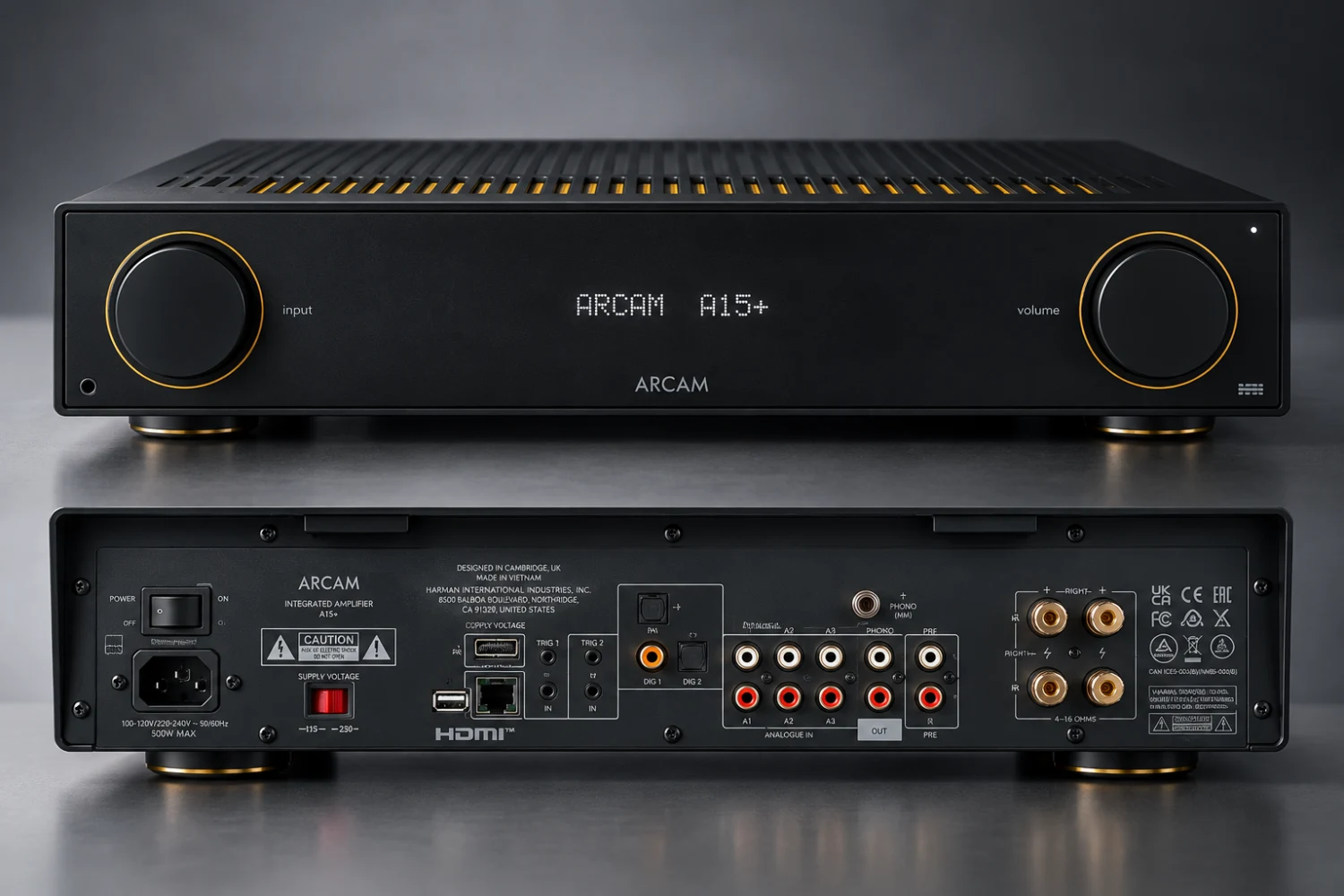
The A5+, A15+ and A25+ therefore represent an evolution of products positioned at the heart of that ecosystem.
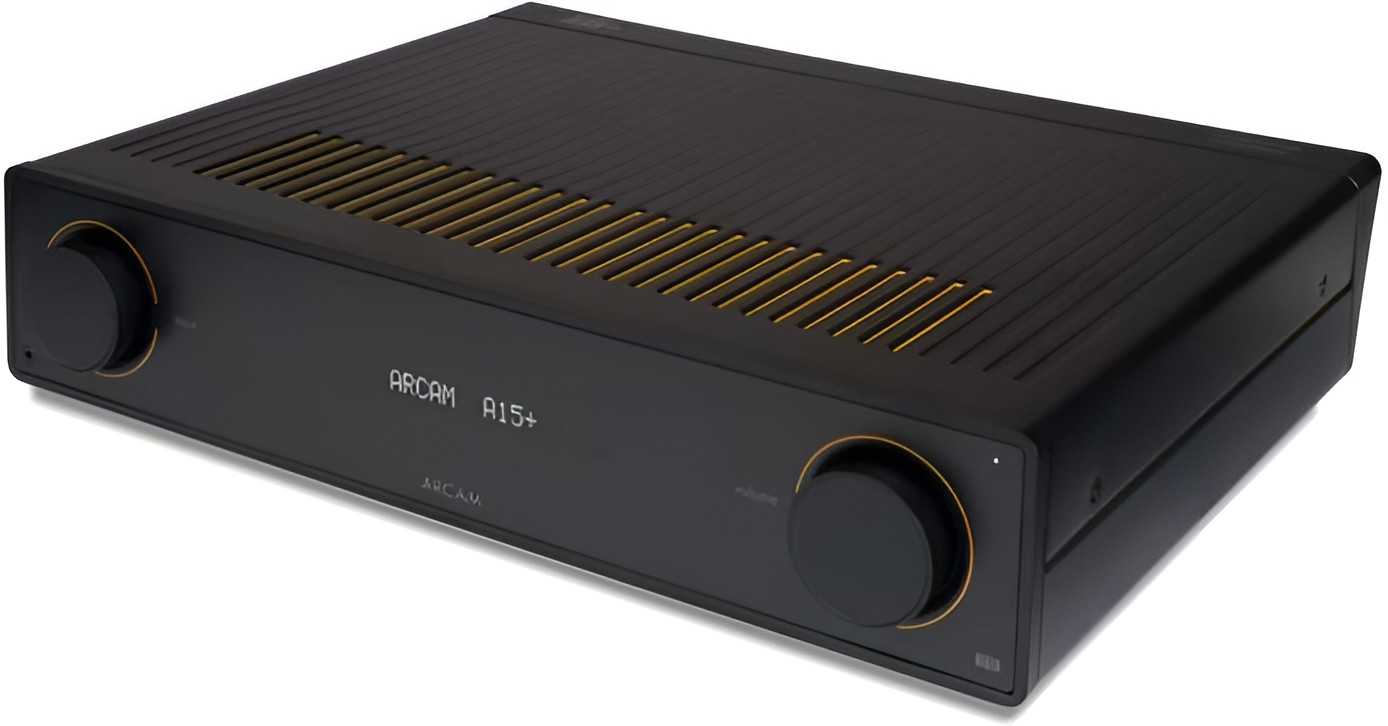
Visually, ARCAM has not abandoned the design language of the outgoing models. The Plus amplifiers remain recognizably Radia components, making them natural partners for existing CD5, ST5 and ST25 source components.
The larger changes are found in connectivity and inside the chassis.
Bluetooth 5.4 Comes to All Three Amplifiers
One of the most significant common upgrades is ARCAM's new Bluetooth implementation.
All three Radia+ amplifiers support Bluetooth 5.4 together with Snapdragon Sound, aptX Lossless, LE Audio and Auracast. Conventional SBC, AAC, aptX and aptX HD support are also included.
That makes Bluetooth much more important to the new generation than simply providing a convenient way of playing something from a phone.
Snapdragon Sound and aptX Lossless are intended to improve the quality available from compatible wireless sources, while Auracast introduces a different type of functionality altogether. Auracast can broadcast audio to multiple compatible receiving devices rather than relying exclusively on the traditional one-source-to-one-device Bluetooth connection.
In practical terms, the amplifier can therefore become part of a much more flexible wireless listening setup, particularly as Auracast support becomes more common in headphones and speakers.
It also reflects a broader change occurring in integrated amplifier design. Bluetooth was once treated largely as a secondary convenience feature on serious stereo equipment. Increasingly, manufacturers are trying to make wireless playback good enough that it can function as a legitimate everyday source alongside a streamer, turntable or digital transport.
ARCAM A5+ Remains the Entry Point
The A5+ continues as the most accessible integrated amplifier in the three-model lineup.
It uses Class AB amplification and is rated at 50 watts per channel into 8 ohms with both channels driven. Output rises to 75 watts per channel into 4 ohms under ARCAM's specified measurement conditions.
The internal digital section continues to use an ESS ES9018-family DAC, while digital inputs support sample rates up to 192kHz. ARCAM also provides analogue connectivity and an integrated moving-magnet phono stage, allowing the A5+ to form the centre of a system combining modern digital sources with a turntable.
The important change is that ARCAM has not simply carried the original A5 electronics into a new enclosure with upgraded Bluetooth.
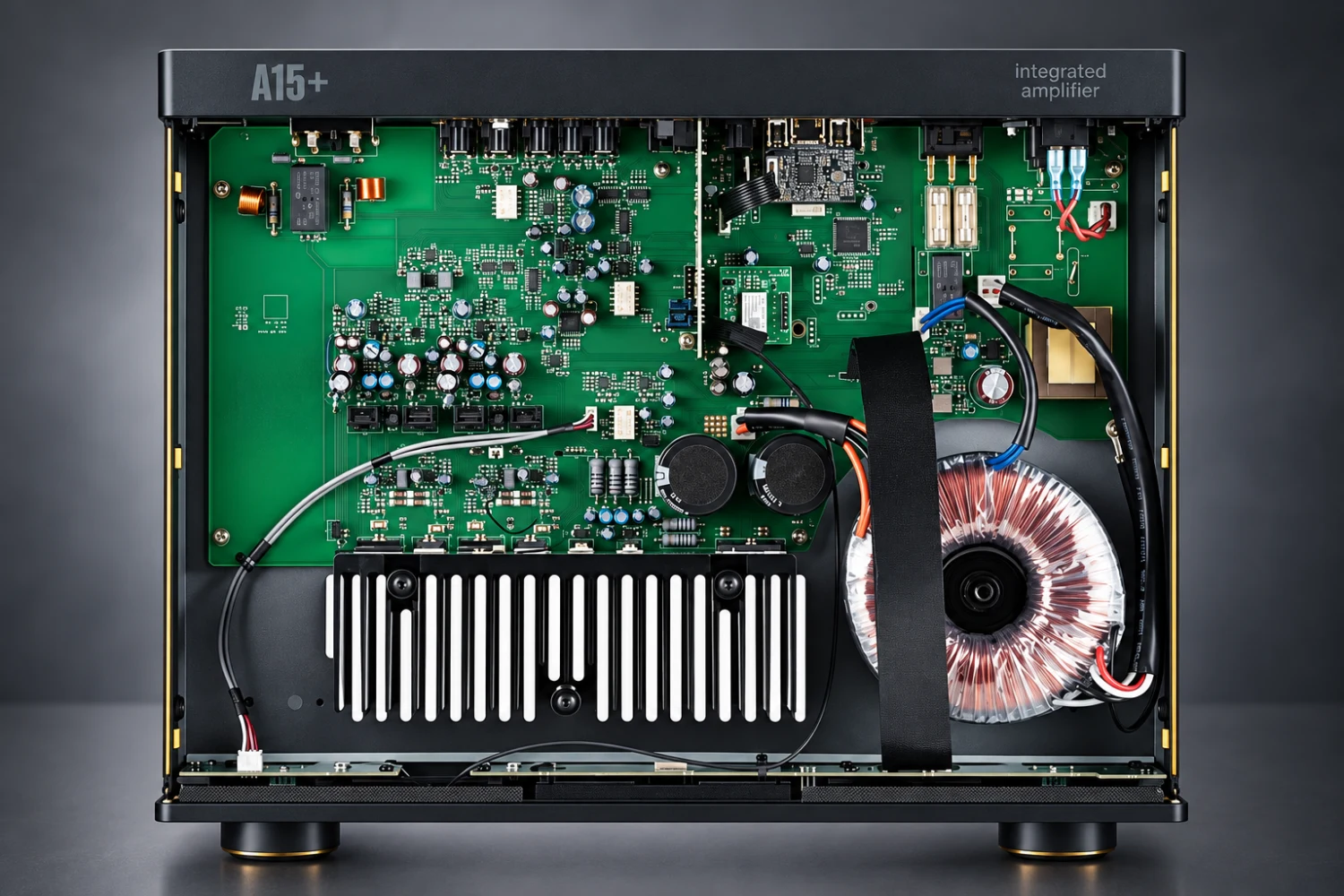
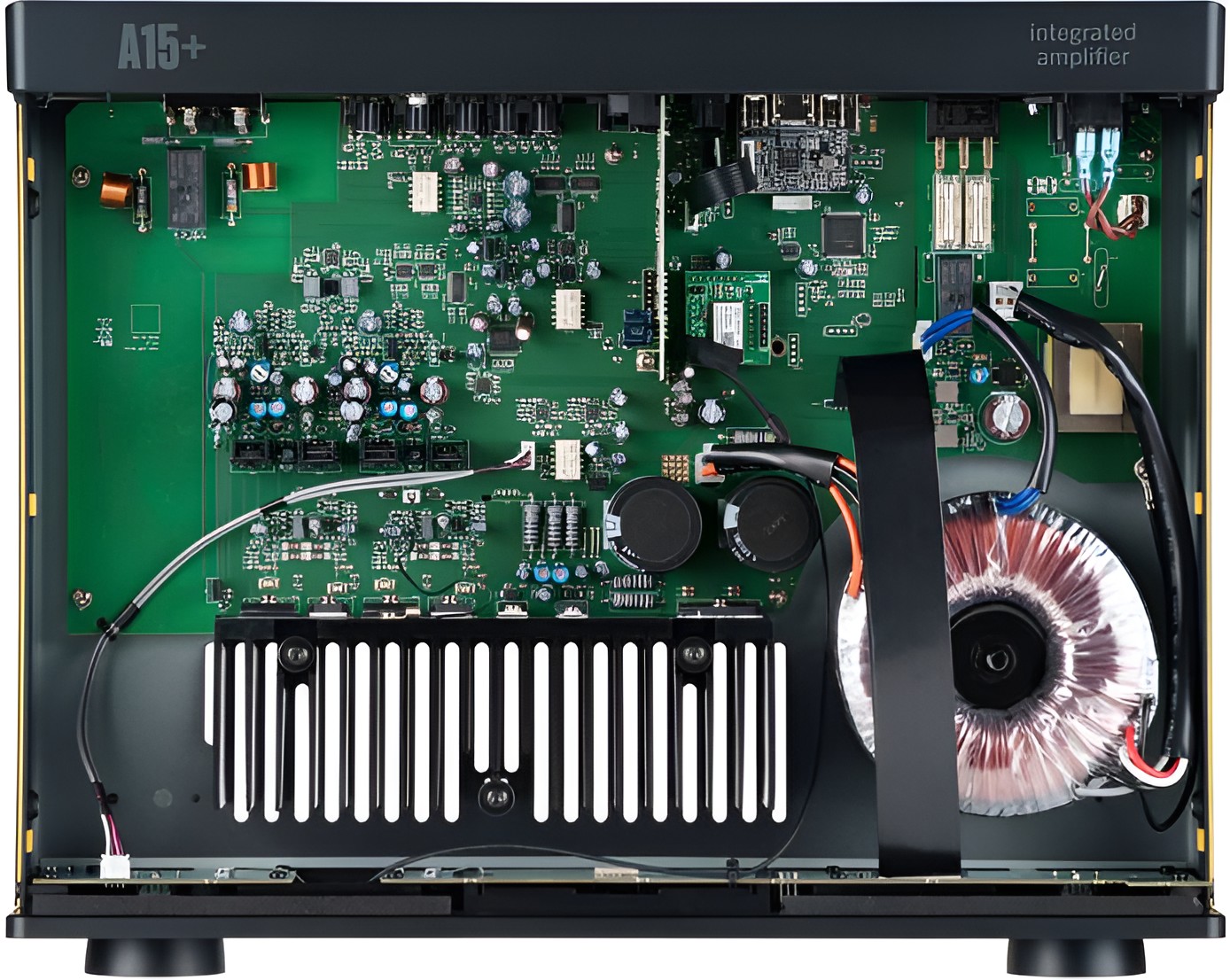
The company says the A5+ incorporates an enhanced power-supply design, while refinements have also been made to the circuitry. The objective is to reduce interference and improve the conditions under which the analogue and digital sections operate.
Power output remains deliberately moderate compared with the two amplifiers above it. That should keep the A5+ most relevant to systems built around reasonably sensitive standmount speakers or floorstanders in small to medium-sized listening rooms.
What it does not gain is HDMI eARC.
That distinction becomes important when moving to the A15+.
A15+ Adds More Power and HDMI eARC
The A15+ occupies what may be the most interesting position in the refreshed range.
It remains a Class AB integrated amplifier but increases output to 80 watts per channel into 8 ohms, rising to 120 watts into 4 ohms at 1kHz under ARCAM's published specification.
That extra output gives the A15+ more headroom for larger loudspeakers, less efficient designs and rooms where higher playback levels are required.
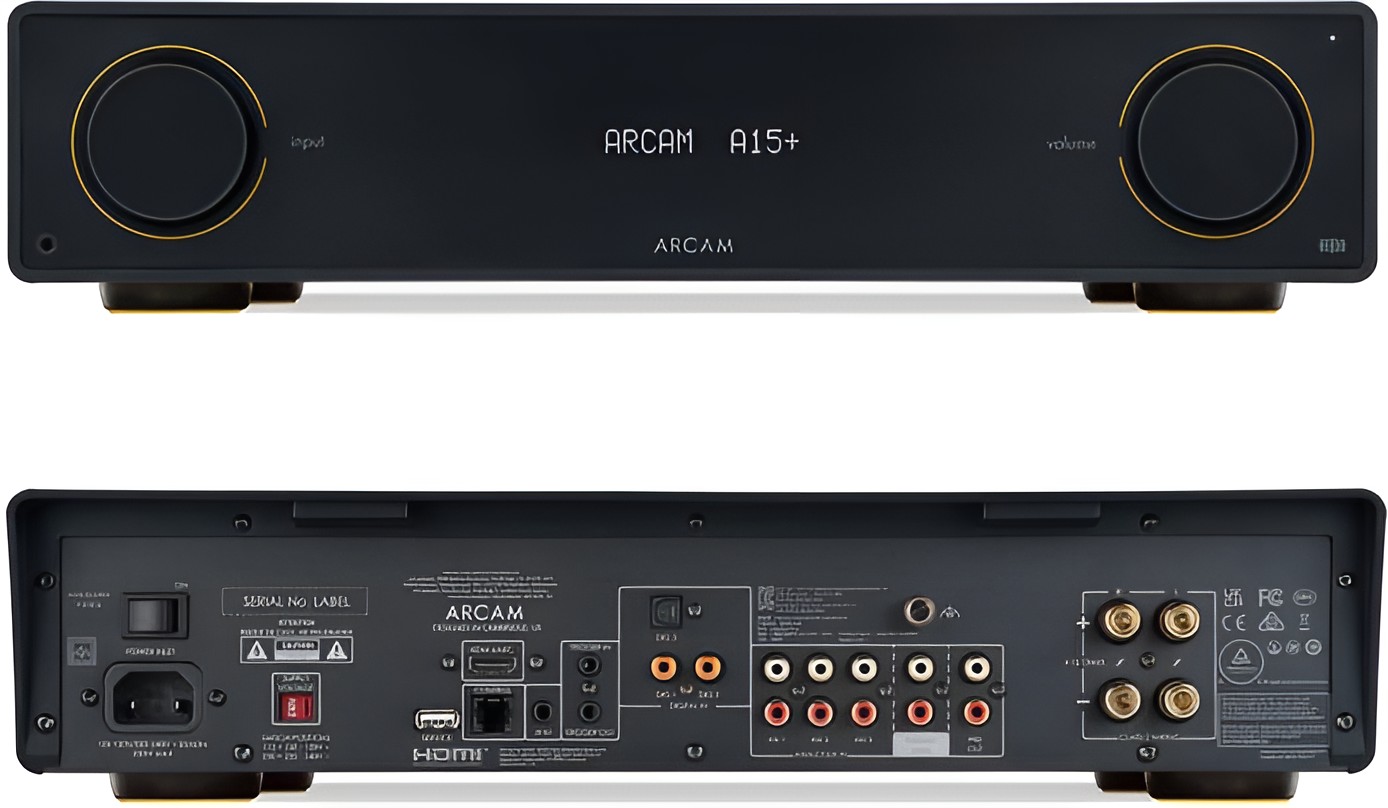
More important for many systems, however, is the addition of HDMI eARC.
This allows a compatible television to connect directly to the amplifier through HDMI, making the A15+ much easier to integrate into a combined music and television system.
That may sound like a small addition, but HDMI connectivity has become increasingly useful in conventional stereo systems. Many listeners now want their main loudspeakers to handle television, movies and streaming services as well as dedicated music sources without introducing an AV receiver into the setup.
The A15+ therefore sits somewhere between a traditional audiophile integrated amplifier and a modern living-room amplifier.
It still provides the ingredients expected from a conventional stereo component — analogue inputs, digital conversion, a phono stage and substantial Class AB amplification — while HDMI eARC and the upgraded wireless platform broaden the number of sources that can be connected easily.
The DAC remains based around the ESS ES9018 architecture, while Bluetooth 5.4, Snapdragon Sound, aptX Lossless, LE Audio and Auracast are shared with the A5+ and A25+.
A25+ Remains the Flagship of the Trio
The A25+ receives the most extensive specification of the three.
As before, the amplifier differentiates itself from the A5+ and A15+ through ARCAM's Class G amplification rather than a conventional Class AB output stage.
ARCAM rates the A25+ at 100 watts per channel into 8 ohms with both channels driven, increasing to 165 watts per channel into 4 ohms at 1kHz.
Class G has been closely associated with ARCAM's higher-performance amplifiers for years. The principle uses multiple power-supply rails, allowing the amplifier to operate efficiently during normal listening while accessing a higher-voltage supply when the musical signal demands greater output.
For the A25+, ARCAM describes the implementation as its fifth-generation Class G design.
The company has also concentrated heavily on the power supply. The updated design incorporates changes intended to improve the isolation and regulation of different circuit sections, with refinements to power and mains filtering forming part of the broader internal upgrade.
The result is a model that remains clearly related to the original A25 but receives more than just additional connectivity.
HDMI eARC and USB-C Give the A25+ a Broader Role
Like the A15+, the A25+ now includes HDMI eARC.
It also retains another important advantage further down the digital signal path: USB-C.
The USB input supports PCM resolutions up to 32-bit/384kHz, while the other digital inputs support rates up to 192kHz.
This makes the A25+ particularly flexible for listeners who want to connect a computer directly to their main amplifier rather than use a separate USB DAC.
A system could therefore combine a turntable through the MM phono input, a television through HDMI eARC, a computer through USB-C and additional digital or analogue sources through the remaining connections.
Add Bluetooth 5.4 for casual wireless listening and the A25+ covers a substantial number of use cases without integrating a complete network streaming platform into the amplifier itself.
That last distinction remains important within the Radia range.
ARCAM already offers the SA35 and SA45 for listeners looking for integrated amplification and network streaming in a single chassis. The A5+, A15+ and A25+ retain the more traditional amplifier-first approach, leaving owners free to add a dedicated streamer such as the ST5 or ST25 if required.
Vinyl Has Not Been Forgotten
Despite the increasing emphasis on digital connectivity, ARCAM has retained a moving-magnet phono stage throughout the new range.
That decision keeps each model relevant to systems built around both analogue and digital playback rather than forcing turntable users to add an external phono preamplifier immediately.
ARCAM describes the phono sections as carefully tuned, and all three models use the standard 47-kilohm MM input arrangement.
For many buyers, that combination may be more valuable than simply adding more streaming services inside the amplifier.
A modern integrated amplifier increasingly has to sit between several generations of audio hardware. It may need to accommodate a turntable and CD player while also dealing with a television, smartphone, computer and network streamer.
The Radia+ trio has clearly been developed with that mixed-source environment in mind.
Familiar Power Ratings, More Attention to What Is Around Them
Interestingly, ARCAM has resisted the temptation to use the Plus refresh primarily as an opportunity to advertise dramatically larger power figures.
The hierarchy remains straightforward:
- A5+ — 50 watts per channel into 8 ohms, Class AB
- A15+ — 80 watts per channel into 8 ohms, Class AB
- A25+ — 100 watts per channel into 8 ohms, Class G
The emphasis instead appears to be on improving the supporting architecture: power supplies, circuitry, digital integration and wireless connectivity.
That is arguably a more meaningful direction for an amplifier range that was already relatively new.
Rather than changing the basic identity of each model, ARCAM has maintained the familiar separation between the three amplifiers while addressing areas where the first generation could be modernized.
The A15+ Could Be the Sweet Spot
On specification alone, the A15+ may emerge as the particularly interesting model for many systems.
Its 80-watt Class AB output gives it substantially more power than the A5+, while HDMI eARC turns it into a considerably more versatile amplifier for a living-room system.
Listeners who do not require USB-C or ARCAM's Class G topology may find that the middle model provides much of the practical functionality of the A25+ while maintaining a simpler amplifier architecture.
The A5+, meanwhile, retains a clear role as the straightforward entry point into the Radia range.
Its 50-watt output, MM phono stage, integrated DAC and upgraded Bluetooth system cover the essentials without pushing the amplifier toward the more complex role occupied by the A15+ and A25+.
A25+ Is the Model for More Ambitious Systems
The A25+ sits more clearly apart.
Its 100-watt Class G output stage gives it the strongest amplification specification, but the combination of USB-C, HDMI eARC and a more extensive digital architecture also makes it the easiest of the three to use as the central component in a more ambitious mixed-source system.
That makes the comparison between the models more interesting than simply choosing between 50, 80 and 100 watts.
The A5+ represents the most traditional interpretation of the modern integrated amplifier.
The A15+ adds the connectivity that makes integration with a television considerably easier.
The A25+ combines that flexibility with Class G amplification, USB audio and ARCAM's most extensive internal engineering of the three.
A More Mature Radia Range
When ARCAM introduced Radia, the range represented more than a routine product refresh. It established a new visual identity for the company and created a platform that has subsequently grown to include dedicated streamers and more sophisticated streaming amplifiers.
The A5+, A15+ and A25+ suggest that ARCAM is now moving into the refinement stage of that platform.
There is no dramatic change in appearance and no attempt to reinvent the hierarchy. Instead, the company has concentrated on areas that can have a practical impact on how these amplifiers are used: revised circuitry, improved power-supply arrangements, modern Bluetooth support and better integration with televisions and digital sources.
For existing A5, A15 and A25 owners, the value of upgrading will therefore depend heavily on which of those additions matter in a particular system. The new models do not suddenly make the original Radia amplifiers obsolete as conventional stereo amplifiers.
For someone buying into Radia for the first time, however, the Plus versions are clearly the more complete proposition.
Bluetooth 5.4 with aptX Lossless and Auracast modernizes wireless playback across all three amplifiers. HDMI eARC substantially improves the versatility of the A15+ and A25+, while the flagship's Class G amplification and USB-C connection preserve a meaningful performance and connectivity gap at the top of the lineup.
Rather than replacing the basic Radia formula, ARCAM appears to have concentrated on finishing it.
The A5+, A15+ and A25+ remain recognizably the amplifiers they replace, but the Plus designation now represents a useful collection of changes rather than a cosmetic model-year update.



Sound Off
0Join the discussion if you have something to add.