MK Analogue has made its first move into digital-to-analog conversion with the DA-CON, a DAC that draws on the Slovenian company’s experience with moving-coil transformers and phono components. Rather than treating conversion as the whole story, the design gives particular attention to the analog circuitry that follows it. The DA-CON also uses a dual-mono converter arrangement and a power supply built around six toroidal transformers. Multiple digital inputs and both balanced and single-ended outputs make it a dedicated component for connecting digital sources to an existing audio system.
A digital source with a phono-inspired output stage
The most distinctive link between the DA-CON and MK Analogue’s earlier products is its analog filter. Its topology is modeled on playback through a moving-coil transformer and a moving-magnet phono amplifier. That does not make the DAC a phono stage; instead, it applies an idea from the company’s analog work to the circuitry handling the converted signal.
MK Analogue’s stated goal is a natural, dynamic and accurate presentation, with the filter intended to contribute to a relaxed analog character. Those are design objectives rather than independently established listening results. The company also describes the DA-CON as aiming to combine qualities associated with R2R and delta-sigma converters, including fullness and precision.
The analog section is fully balanced and combines operational amplifiers with discrete components, including silver-mica capacitors. In a DAC, this stage matters because conversion is only one part of the journey: the resulting analog signal still has to be filtered and delivered to the next component in the system. MK Analogue’s emphasis is on that complete path, not just the converter chip.
Six transformers and separate supply paths
The power supply is another defining part of the design. Six encapsulated toroidal transformers are fitted, with three assigned to each channel. The analog section, digital input section and converters each have their own supply, while 48 diodes handle rectification.
Separate secondary windings also feed the input section and the analog current outputs of each PCM1794 converter. This division shows how extensively MK Analogue has separated the DAC’s supply arrangements: digital input handling, conversion and analog output circuitry are not all drawing on one undifferentiated supply path.
The approach adds hardware and helps explain why the DA-CON is a substantial 12 kg component. The supplied information does not establish how much audible difference the arrangement makes, but it is central to the manufacturer’s design priorities.

Dual-mono conversion and clock control
Conversion uses PCM1794 chips in a dual-mono architecture. MK Analogue has kept the signal paths between the sample-rate converter, clock generator and DAC chip very short, and employs multiple stages of galvanic isolation. These measures are intended to limit interference and jitter rather than serving as a guarantee of a particular measured result.
Clock generation uses a phase-locked loop circuit, and the clock generators have a specified frequency accuracy of ±2.5 parts per million. Together with the isolation and short paths, that puts timing and signal integrity alongside the analog output stage in the DA-CON’s engineering brief.
The supported format is linear PCM at 16 to 24 bits and sampling rates from 44.1 to 192 kHz. Those figures describe the stated PCM range; they do not establish support for other digital formats.

Inputs for several digital components
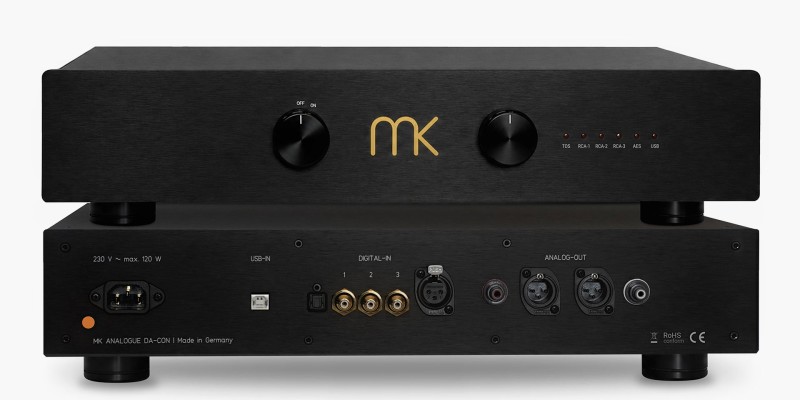
The DA-CON accepts AES/EBU, three coaxial S/PDIF connections, optical Toslink and USB. That selection allows it to serve as a central converter for several digital sources rather than being tied to a single connection type. Bistable-relay muting is intended to make switching between sources and sampling frequencies noise-free.
Analog output is available simultaneously through rhodium-plated Furutech XLR connectors and WBT-0210-Cu-nextgen RCA connectors. The two output formats give owners a choice when matching the DAC to the inputs of the next component, although the supplied details do not specify every possible system configuration.
A solid aluminum chassis sits on four bfly-Audio Pure feet selected for the unit’s weight. The DA-CON is available only in black, and a 1.5-meter Supra LoRAD Excalibur power cable is included.
The DA-CON appears intended for listeners building a dedicated digital front end around an existing system, particularly those interested in the analog circuitry and power supply as much as the conversion stage. Its input selection accommodates several sources, while its PCM specification gives prospective owners a clear compatibility range to check. What remains open is how MK Analogue’s phono-inspired filter and elaborate supply sound in use: the manufacturer’s descriptions are design aims, not a substitute for an audition. No USD price or US availability information was supplied, so buyers interested in the DAC will need to confirm those details separately.