

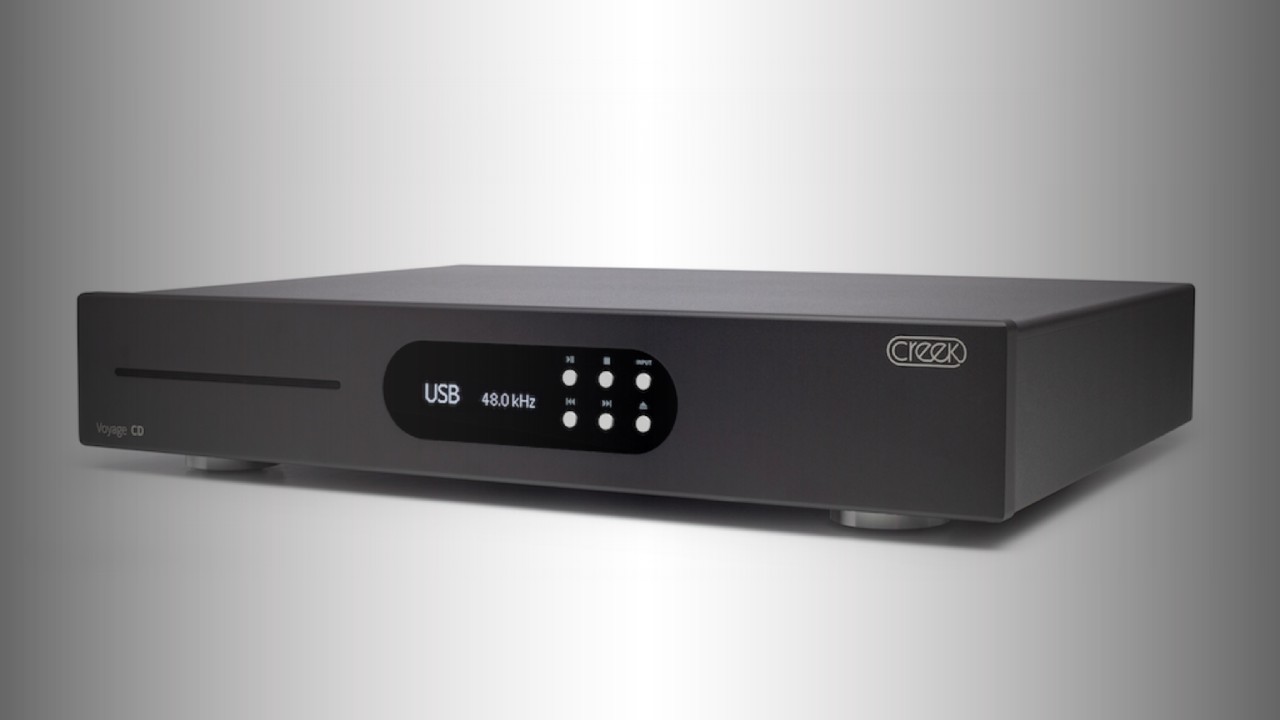
The Creek Voyage CD is designed for listeners who still value compact discs but want their source component to play a broader role. It can serve as a conventional CD player, process audio from five external digital sources, feed another DAC through its digital outputs, or operate as a volume-controlled digital preamplifier. It is also visually and functionally matched to Creek Audio’s Voyage i20 amplifier, although its standard connections allow it to be used in many other systems. That combination makes the Voyage CD relevant not only to established disc collections, but also to systems that need a central point for several digital components.
A Dedicated Transport for Existing CD Collections
At the heart of the disc-playing section is a Stream Unlimited CD80 slot-loading transport. Using a specialist audio transport rather than treating disc playback as an incidental feature reflects the Voyage CD’s focus on owners with substantial CD libraries. The slot-loading mechanism also contributes to a clean front-panel design by removing the need for a projecting tray.
The transport is complemented by coaxial SPDIF and optical TOSLINK digital outputs. These connections allow the Voyage CD to operate purely as a CD transport with an external DAC, an amplifier that has digital inputs, or another compatible digital processor. Owners can therefore use the internal conversion stage immediately while retaining the option to reorganize the digital side of their system later. This separation between transport and conversion is particularly useful in systems that evolve over time.
An AKM DAC for Discs and External Sources
Digital-to-analog conversion is handled by an AK4493EQ, a 32-bit AKM converter incorporating the company’s VELVET SOUND architecture. Creek specifies a dynamic range and signal-to-noise ratio of 123 dB for the Voyage CD. The DAC chip itself is identified as a 32-bit, 768 kHz device, while the player’s supported incoming PCM rate extends from 8 kHz to 384 kHz, depending on the connection and source format.
The use of the DAC is not restricted to compact discs. Two transformer-isolated coaxial SPDIF inputs and two optically isolated TOSLINK inputs accept signals up to 24-bit/192 kHz. These can accommodate common digital sources such as televisions, network streamers, media players, and legacy components with compatible outputs. Isolation on the SPDIF and optical connections is intended to limit unwanted electrical interaction between connected products.
An asynchronous USB Class 2 input adds computer-based playback and higher-resolution format support. Through USB, the Voyage CD accepts PCM up to 32-bit/384 kHz and native DSD streams up to 22.4 MHz. This makes the unit capable of handling both everyday digital audio and high-resolution libraries without requiring a separate USB DAC.
Six Digital Sources in One Component
Creek describes the Voyage CD as being able to switch among six digital sources. That total comprises the internal CD transport plus five external inputs: two coaxial SPDIF, two optical TOSLINK, and one asynchronous USB connection. In practical terms, the player can become the digital control center of a system rather than occupying an input solely for disc playback.
This arrangement can simplify systems built around multiple digital devices. A television could use one optical input, a network transport another, while coaxial inputs remain available for compatible media players or other digital hardware. A computer can have a dedicated connection through USB. Source selection and conversion then take place within one component, reducing dependence on an amplifier with a large digital-input section.
Optional Volume Control Expands System Choices
A rear-panel switch activates the Voyage CD’s built-in volume control, allowing it to function as a digital preamplifier. With volume adjustment enabled, its analog outputs can be connected directly to a power amplifier or a pair of active loudspeakers. This creates the possibility of a compact system consisting of the Voyage CD, amplification, and speakers, while still supporting several external digital sources.
The switchable arrangement also preserves its role as a source component in a conventional integrated-amplifier or preamplifier-based system. Users who already have analog volume control elsewhere in the chain do not need to structure their system around the player’s preamplifier function. This dual-purpose design is one of the Voyage CD’s most useful attributes: it can fit into a traditional component system or act as the digital front end of a more streamlined installation.

Balanced and Unbalanced Analog Integration
Analog audio is available through both unbalanced RCA and fully balanced Neutrik XLR connections. The RCA outputs are specified at 2.0 V RMS, while the XLR outputs provide 4.0 V RMS. Including both formats broadens compatibility with integrated amplifiers, preamplifiers, power amplifiers, and active loudspeakers.
The balanced outputs are especially relevant when pairing the Voyage CD with equipment that provides corresponding XLR inputs. RCA remains the more widely encountered domestic connection, so its inclusion ensures that the player does not require specialized partnering hardware. Owners can select the interface appropriate to their existing system rather than using adapters or an additional conversion stage.
Within the analog filtering circuitry, Creek uses tightly specified WIMA polypropylene capacitors and MELF surface-mount resistors. These parts are employed to address residual aliasing artifacts after digital conversion. This is a less visible aspect of the design, but it demonstrates that attention has been given to the analog stage following the DAC rather than focusing only on digital format compatibility.
Power Supply and Physical Design
Creek developed a specialized high-frequency power supply for the DAC and CD transport circuitry. Its purpose is to deliver stable voltage despite variations in mains quality, frequency, or voltage across different regions. For a component combining mechanical disc playback, digital processing, and analog output circuitry, dedicated attention to power delivery is a meaningful engineering choice.
The Voyage CD measures 430 mm wide, 80 mm high, and 350 mm deep, with a weight of 6.8 kg. Its full-width footprint is suited to a conventional equipment rack, while the relatively low enclosure helps it maintain a restrained profile. The dimensions should still be considered when planning shelf depth, cable clearance, and ventilation around other components.

Who the Creek Voyage CD Is For
The Voyage CD is most suitable for listeners who want to retain convenient access to a CD collection while consolidating several digital sources. It is particularly relevant to owners assembling a system around the matching Voyage i20, but its RCA, XLR, SPDIF, TOSLINK, and USB connections make it adaptable to equipment from other manufacturers.
It also makes sense for active-speaker users or anyone building a system around a power amplifier, since the switchable volume control can remove the need for a separate preamplifier when all sources are digital. Conversely, listeners who use mostly analog sources will still require an amplifier or preamplifier with suitable analog inputs. The Voyage CD’s control-center role is specifically focused on digital playback rather than comprehensive management of vinyl, tape, or other analog components.
Those who no longer use discs and already own a capable multi-input DAC may not need its transport section. Its stronger proposition is for the listener who considers CD playback essential but does not want to purchase separate components for discs, USB audio, digital source switching, conversion, and potentially volume control.
Conclusion
The Creek Voyage CD stands out through the breadth of roles supported within a single full-width component. Its Stream Unlimited CD80 transport addresses dedicated disc playback, while the AK4493EQ DAC, five external digital inputs, high-resolution USB support, and coaxial and optical digital outputs provide room for a wider digital system. Balanced XLR and unbalanced RCA outputs ease equipment matching, and the switchable volume control enables direct use with active speakers or a power amplifier. It is therefore best suited to CD owners who want a modern digital hub without abandoning the physical format, particularly those seeking either a partner for the Voyage i20 or a flexible front end for a streamlined digital system.

Sound Off
0Join the discussion if you have something to add.