A hi-fi system once implied a stack of separate components and a pair of speakers large enough to dominate the room. Yet from the 1960s onward, manufacturers repeatedly challenged that picture. Some brought the essential parts together in a single enclosure; others made individual components small enough to arrange almost like objects on a desk or shelf. The aim was not always to make hi-fi cheaper or simpler. Often it was to give serious music equipment a place in homes where a conventional equipment rack felt out of place. These experiments took different forms as the market changed. Braun treated audio as part of a carefully ordered living environment. Bang & Olufsen made an integrated music system a statement of modern domestic design. Japanese makers explored both technically ambitious compact separates and conspicuous, self-contained systems. By 2000, a small CD system could be designed specifically for a workplace rather than a living room. The examples below do not form a single product category. Some needed only speakers; others were collections of separate components, and one was conceived for a wall. That variety is the point. Compact hi-fi was never just a question of dimensions: it was a continuing attempt to reconcile equipment, music and the spaces in which people lived.
Braun and the system as an interior
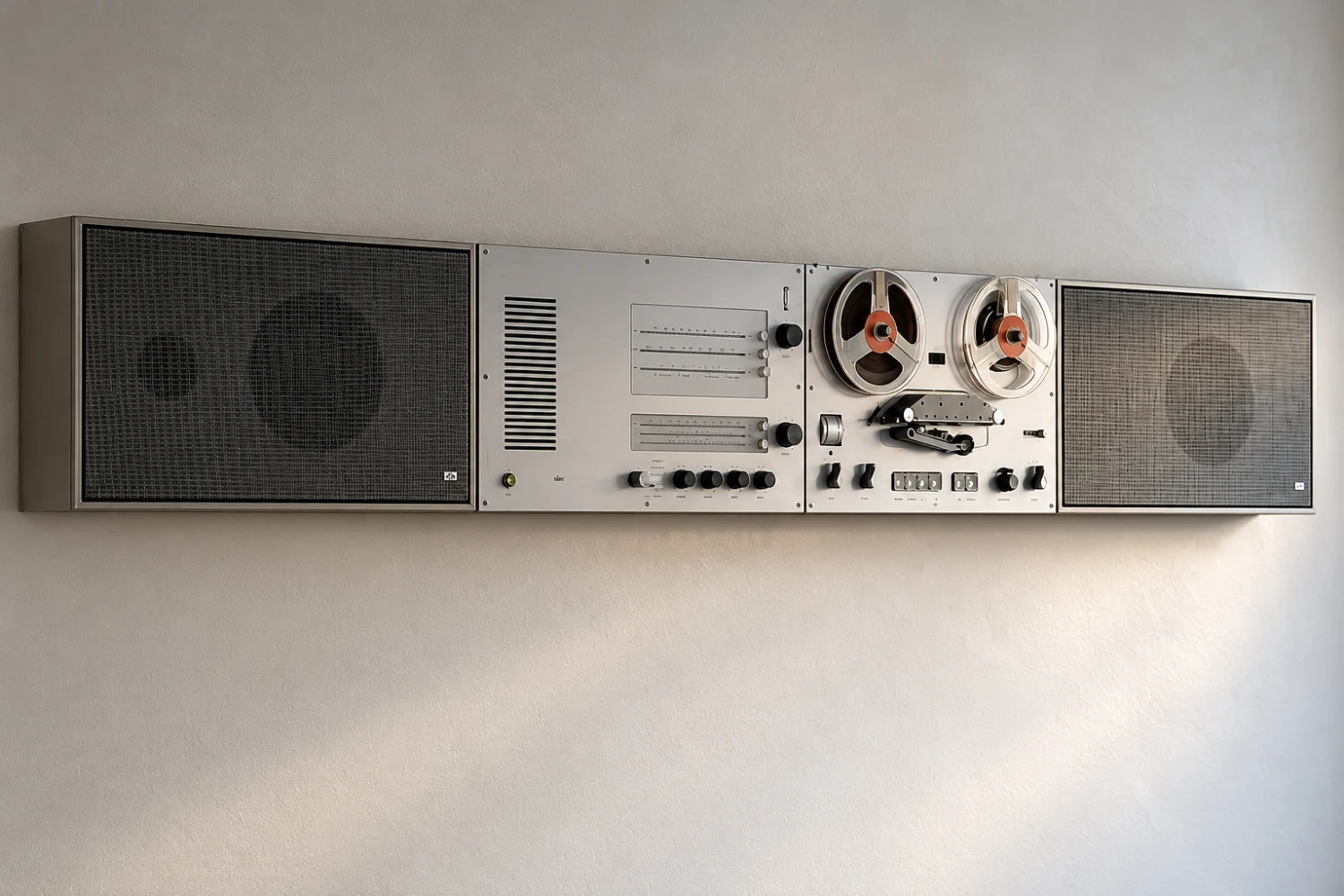
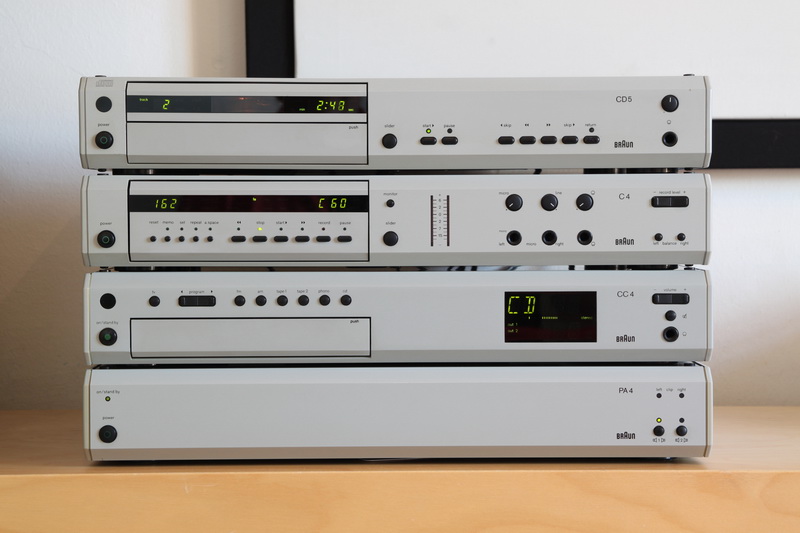
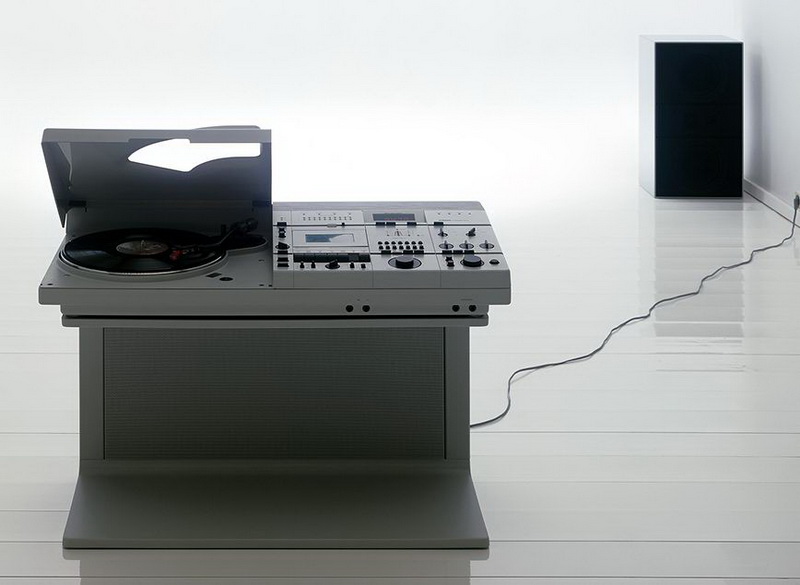
Braun’s wall-mounted audio system from the 1960s offers an early answer to a problem that still concerns equipment designers: how can a complete music system occupy a room without appearing to take it over? Its small reel-to-reel tape recorder, receiver and loudspeakers formed a coordinated arrangement rather than a conventional pile of boxes. Mounting the system on a wall changed both its footprint and the way its parts were seen together. Dieter Rams was responsible for the appearance of Braun’s equipment in this period. His approach gave controls, surfaces and proportions a common visual language, making the different functions legible without turning each component into a separate visual event. The wall system shows why compact hi-fi could be a design proposition as well as a technical one: its configuration made audio equipment part of the architecture of everyday life. Braun’s later Atelier range pursued a related goal through compact, coordinated components rather than a wall installation. It arrived toward the end of the company’s involvement in high-quality audio, making it both a continuation of Braun’s design principles and a late expression of them in hi-fi. The distinction matters. Atelier did not eliminate separate components; it made their relationship to one another—and to the room—look deliberate.
Small components, full-scale ambitions
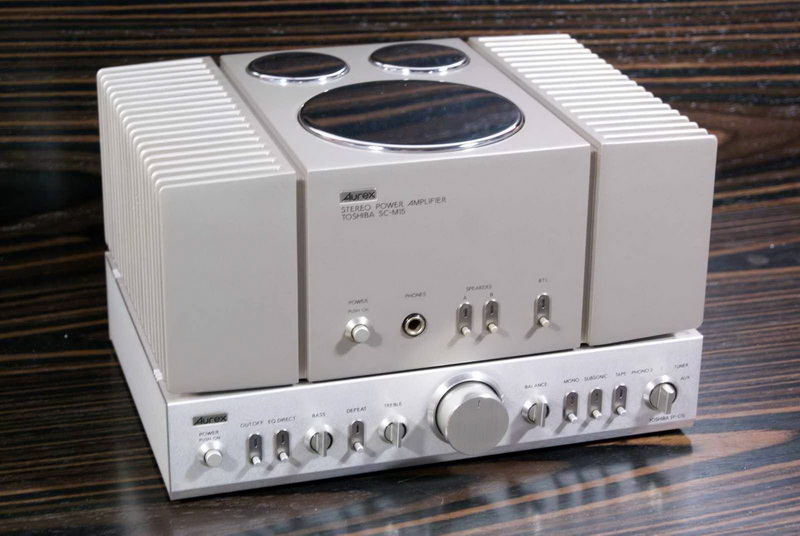
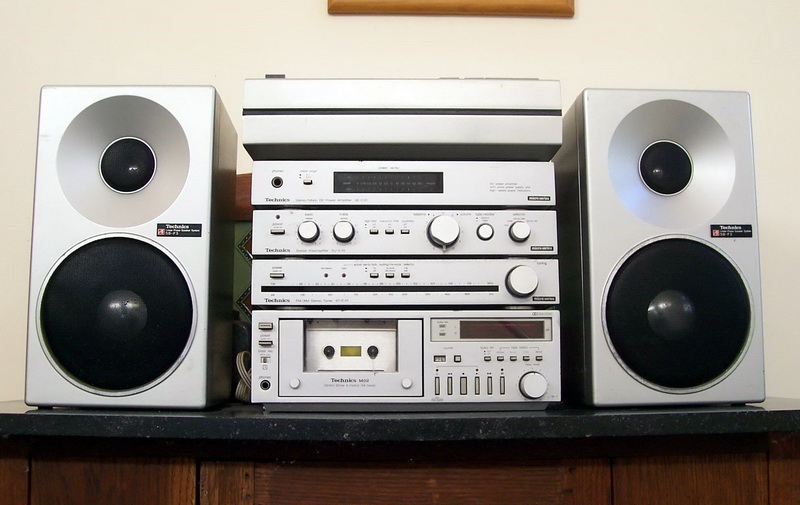
Compactness did not necessarily mean combining every function in one cabinet. Technics’ Concise system, introduced in 1978, used separate components whose reduced dimensions were central to their appeal. It retained the familiar logic of a component system while questioning how much physical space that system needed. At a time when hi-fi ownership was strongly associated with individual units for different tasks, this was a different route to a less imposing installation. One technically notable part was the SE-C01 power amplifier, which used a switching power supply. Such supplies were unusual in audio equipment at the time. The detail is worth noting not because it establishes how the amplifier sounded, but because it shows that a compact format could prompt choices inside the enclosure as well as changes to its exterior. Technics later returned to the Concise name in 1994 with gold-finished components identified by the letter G. The System 15 range offered another variation on compact separates. Its M15 power amplifier was rated at 40 watts per channel and weighed nearly six kilograms: a reminder that a modest-looking component could still contain substantial hardware. Buyers could choose an integrated amplifier or a separate preamplifier and power amplifier arrangement. A cassette deck, equalizer and digital tuner extended the range. These were not simply miniature music centres; they preserved the option to assemble a system around particular needs.
Bang & Olufsen makes integration visible
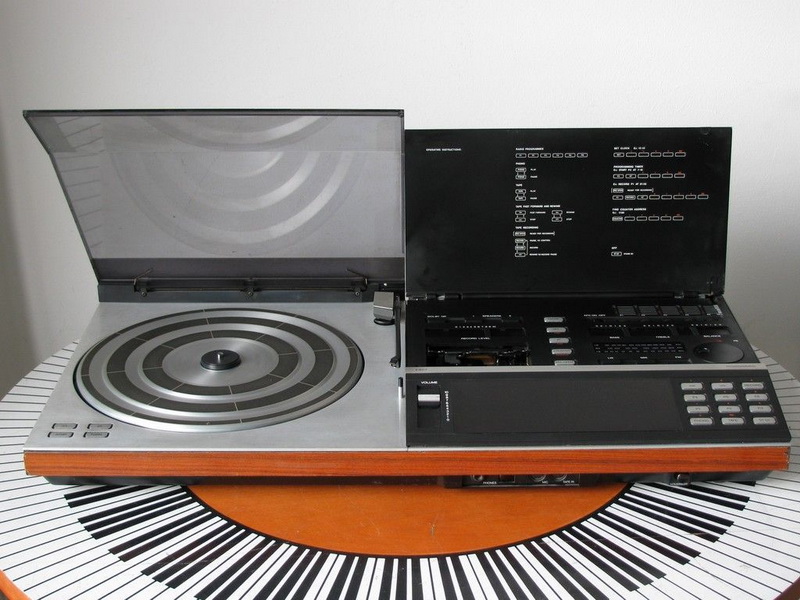
Bang & Olufsen’s BeoCenter 7000, introduced in 1979, approached the domestic-audio problem from the opposite direction. Instead of presenting a group of small components, it gathered the system’s principal functions into a compact central unit. Add suitable loudspeakers, and the owner had a complete hi-fi arrangement. Remote control further changed the relationship between listener and equipment: operation no longer had to begin at the front panel. That combination of integration and presentation helps explain why the BeoCenter 7000 was more than an exercise in styling. A conventional separates system invited its owner to see each source and amplifier as a distinct purchase. Bang & Olufsen offered a coordinated object designed to be understood and used as a whole. Its inclusion in the collection of New York’s Museum of Modern Art reflects the cultural standing of that design, not a claim that appearance mattered more than audio. Later Bang & Olufsen systems developed increasingly distinctive forms, but the 7000 already expressed an enduring principle: reducing the visible complexity of a hi-fi system need not mean treating music playback as an afterthought. Its historical importance lies in making integration itself a premium idea.
Sony’s compact system as a statement
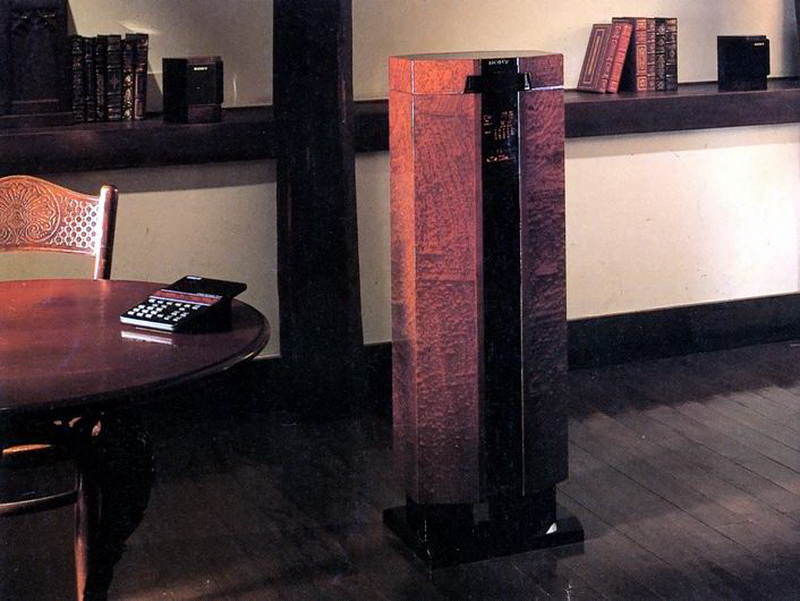
The Sony CDZ-1 demonstrates how differently the same broad idea could be interpreted in the 1980s. Its tall central unit was intended to be noticed rather than visually absorbed into a room. The system combined a CD player and radio with three-way loudspeakers, and its wood-finished version was priced at $2,500. At a reported total weight of 33 kilograms, it was compact in arrangement, not especially slight in physical presence. The CD player placed the CDZ-1 in the era when the compact disc was helping redefine expectations of a modern music system. Sony’s design also treated the system as a complete, coordinated purchase rather than a set of components to be selected independently. Its commanding appearance made sense as an alternative to the conventional stack, even if it asked a great deal of the buyer’s room and budget. The model reportedly sold poorly. That outcome is useful historical context, not a verdict on the validity of its design. A distinctive form could attract attention without finding a broad market, particularly when customers at this price could also consider traditional separates. The CDZ-1 shows that the history of compact hi-fi includes commercial risks as well as successful design ideas.
Marantz keeps the separates philosophy
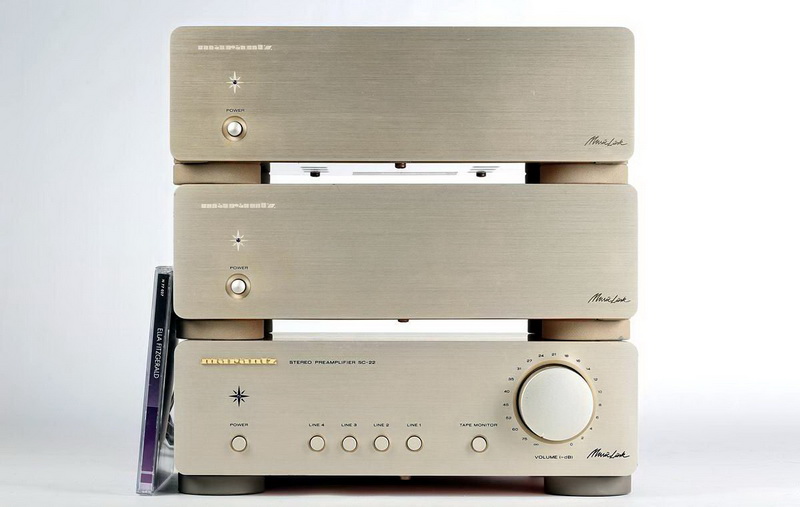
From the late 1980s to the mid-1990s, Marantz’s MusicLink range showed that small components could address listeners who valued the flexibility of specialist hi-fi. Rather than offering one fixed combination of sources and amplification, the series encompassed digital-to-analogue converters, CD transports, preamplifiers, monophonic power amplifiers, phono stages and loudspeakers. Its compact dimensions did not erase the distinctions between those functions. This was a different proposition from an all-in-one music centre. A listener could build a system around a chosen source and amplification arrangement, while giving up less space to the hardware. Separating a CD transport from a converter, or using dedicated phono amplification, belonged to an established high-end way of thinking about system building. MusicLink placed that approach in smaller cases. The range illustrates a limit to any simple account of miniaturisation. Some buyers wanted fewer boxes; others wanted the freedom that separate boxes provided, only without their usual scale. Compact hi-fi could serve both ambitions. MusicLink’s place in this story rests on treating reduced size as compatible with a serious, configurable component system.
From graphic clarity to the desktop
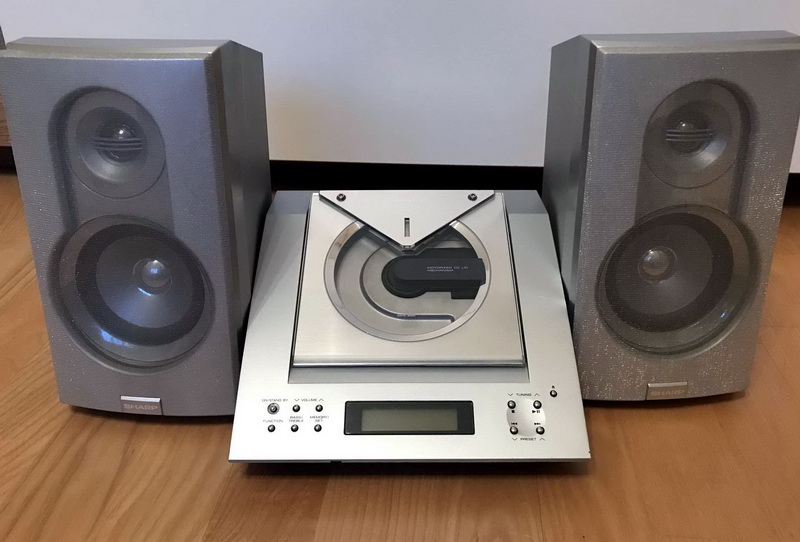
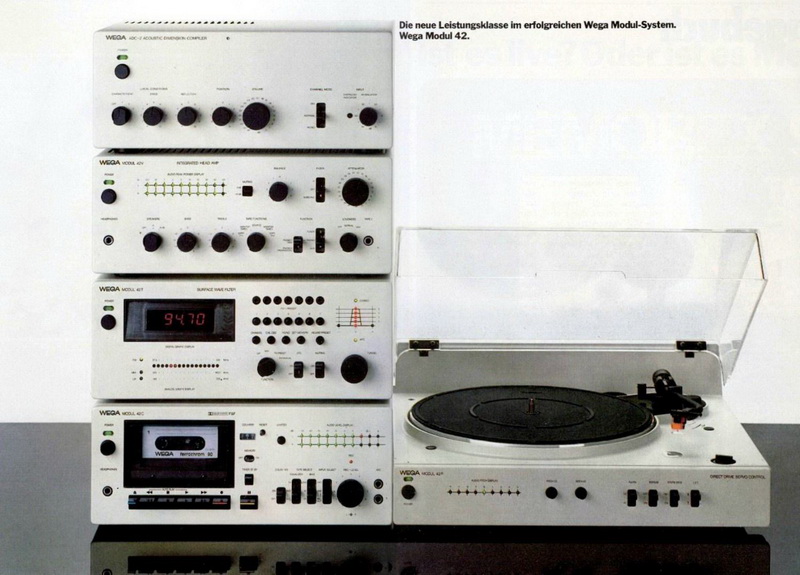
The Esslinger-designed Modul 42 components made a different case for compact hi-fi: controls could be arranged clearly, the units could share a disciplined appearance, and the result could still have substantial amplifier output. The amplifier was rated at up to 90 watts per channel. Several colour finishes existed, including white and black, reinforcing how much the system’s identity depended on the appearance of the whole arrangement. Hartmut Esslinger later became closely associated with Apple’s design history, but Modul 42 deserves attention on its own terms. It demonstrates that the presentation of controls and the visual coherence of components were functional decisions, not merely decoration. A system could be made easier to understand at a glance while retaining the format and capabilities of component hi-fi. By 2000, the Sharp XL-1100 addressed a more specific setting: listening at work. It incorporated a CD player with a one-bit digital-to-analogue converter, an amplifier rated at 10 watts per channel, a digital tuner with 30 station presets and a headphone output. Small two-way loudspeakers were available separately. These details describe a system intended for close-at-hand use rather than to anchor a large room. Its significance is the change in setting: compact audio was no longer only a way to make a living-room system less obtrusive. It could put a self-contained source and amplifier beside the listener during the working day.
The lasting place of compact hi-fi
Taken together, these systems show why compact hi-fi cannot be reduced to one invention or one aesthetic. Braun moved equipment onto the wall and later refined the look of small separates. Technics and System 15 retained component choice in reduced formats. Bang & Olufsen made integration elegant and accessible from a central unit. Sony tested the market for a more conspicuous complete system, while Marantz kept specialist system-building alive on a smaller scale. Sharp adapted the idea to the desktop. What changed over these decades was not simply the size of the box. Designers reconsidered where a system could live, how its controls should communicate their purpose, which functions belonged together and how much choice a listener should retain. The answers sometimes conflicted. That is why the less commercially successful examples still matter: they reveal possibilities that the market did not necessarily adopt. The legacy of these systems is a broader understanding of what hi-fi equipment can be. Sound reproduction requires sources, amplification and loudspeakers, but it does not prescribe a tower of matching full-width components. Compact-system history records the many ways manufacturers tried to make those essentials fit the habits and spaces of their own time.
A different measure of progress
The most enduring idea behind compact hi-fi was not that smaller must be better. It was that a music system could be designed around the listener’s environment without surrendering its identity as hi-fi. These varied machines made room for that idea, whether or not their particular shapes endured.