

Naim has taken its Mu-so concept into markedly more ambitious territory. The Mu-so Utopia is a self-contained music and home-entertainment system built around 15 Focal drivers, 720 watts of hybrid amplification and processing for Dolby Atmos playback up to 7.1.2. Its significance extends beyond scale: this is the first Naim-branded product to adopt the Utopia designation previously associated with Focal’s flagship loudspeakers. High-resolution streaming, room correction and multiroom operation are integrated, but the defining idea is the combination of Naim’s electronics platform with Focal’s driver technology in a single aluminum enclosure.
The Utopia name establishes a new Mu-so tier
Applying the Utopia badge to a Mu-so system clarifies where this model sits in the shared Focal and Naim portfolio. The designation has previously been reserved for Focal’s flagship loudspeakers, including the Scala Utopia Evo M. Its appearance on a Naim product reflects the long-running relationship between the two brands while placing this all-in-one above the more familiar expectations of the Mu-so line.
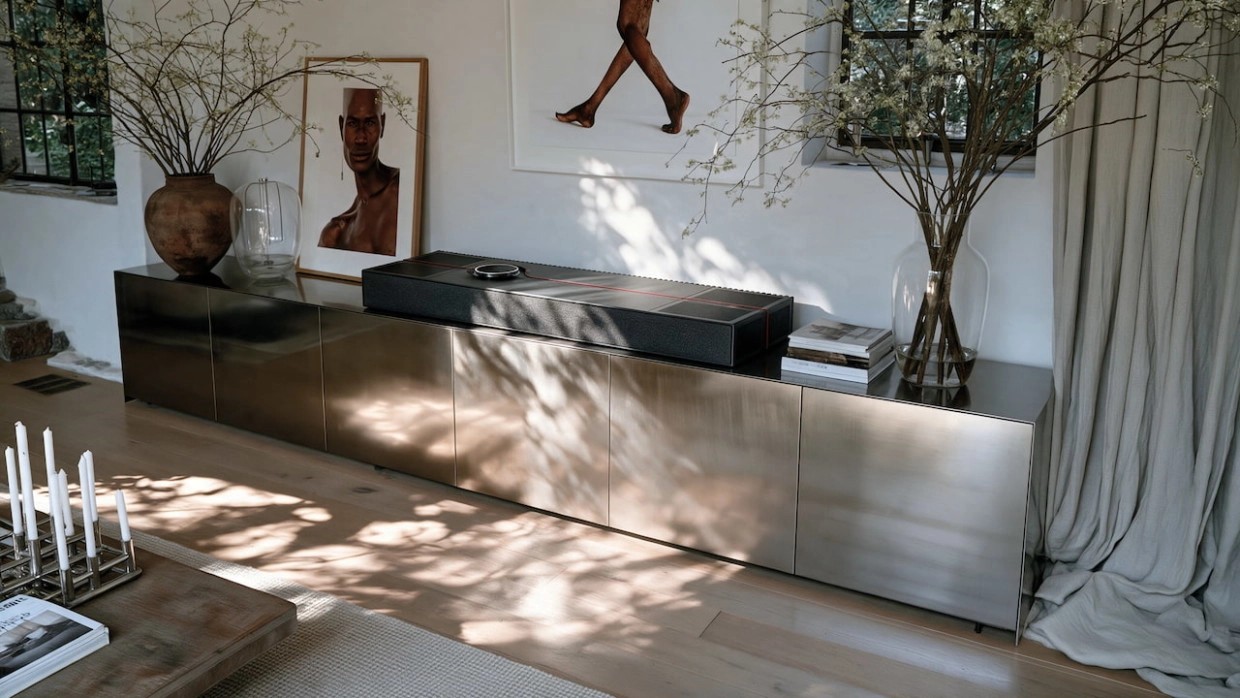
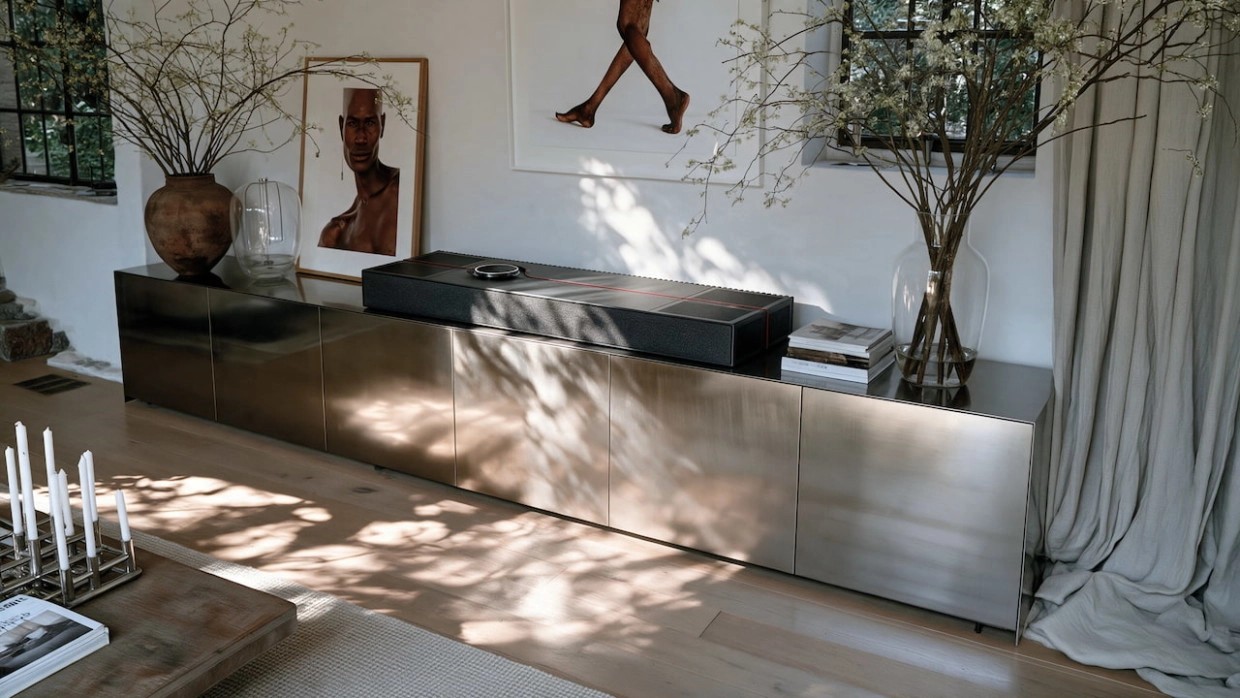
There is also a useful distinction between the Mu-so Utopia and the Focal-branded Mu-so Hekla. The Utopia is positioned as the more music-focused, audiophile-oriented sibling, although its HDMI input and Dolby Atmos processing still give it a substantial television and movie role. That hierarchy suggests a product intended to serve as a primary audio system rather than merely a supplementary wireless speaker or conventional soundbar.
Fifteen Focal drivers meet two amplifier classes
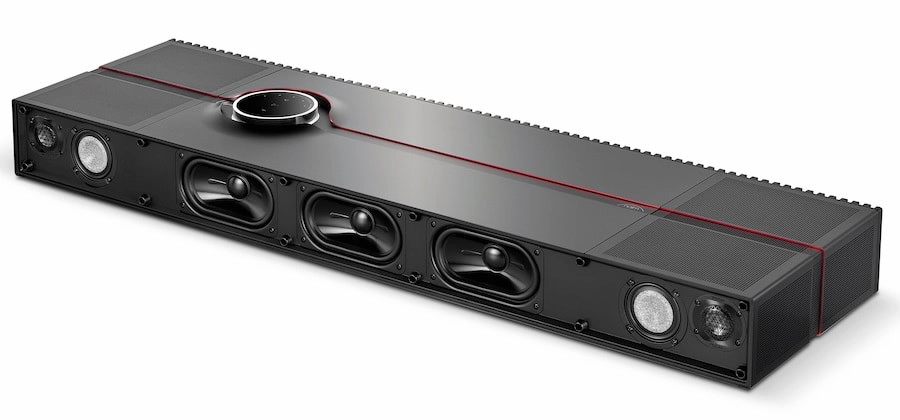
The acoustic architecture is the central hardware story. Across the front are three 6-by-3-inch woofers, two 2.75-inch M-profile W-cone midrange drivers and a pair of 1-inch PRISM tweeters. Additional full-range drivers fire from the sides and top of the cabinet, allowing the system to address both direct stereo reproduction and spatial audio without separate surround or height speakers.
Naim specifies 720 watts of total amplification, delivered through a hybrid design. Class D amplification handles most of the system, while the high-frequency channels use Class AB. That division combines the efficiency needed for a dense, actively driven multi-driver array with a dedicated amplifier approach for the tweeters. Each section can therefore be managed as part of the system’s broader digital signal-processing architecture rather than relying on a passive crossover network alone.
The stated frequency response runs from 30Hz to 20kHz, with bass extension reaching 25Hz at the minus-6dB point. Maximum output is listed as 109dB SPL at one meter. Those figures indicate that the cabinet is designed to operate without a subwoofer in many installations, although a stereo RCA subwoofer output is provided for owners who want to expand the low-frequency section.
Sphere processing turns the cabinet into an Atmos system
Dolby Atmos support up to 7.1.2 is enabled through HDMI eARC and optical TOSLINK connections. Side- and upward-firing drivers use nearby walls and the ceiling to create reflected sound, reducing the number of separate loudspeakers required for an immersive arrangement. The result remains dependent on room geometry and placement, but the documented design makes spatial reproduction a core function rather than an added decoding mode.
Naim and Focal call the underlying processing system Sphere. It combines beamforming with crosstalk cancellation to manage how sound is directed from the enclosure. Dedicated presets include Dolby Movie, Dolby Music, Sphere Music, Sphere Movie, Sphere Video Game, Sphere Podcast and Night Mode. The range of profiles acknowledges that dialogue, stereo music and cinematic effects place different demands on the same driver array.
This processing-led approach is what allows the Mu-so Utopia to move between two-channel material and screen-based entertainment. It also introduces a trade-off inherent to any single-cabinet immersive system: placement and reflective surfaces become part of the acoustic setup. Naim addresses the room itself through a separate calibration system rather than leaving adjustment entirely to fixed factory presets.
Pulse handles high-resolution streaming and multiroom audio
The Naim Pulse Platform provides streaming, digital signal processing and multiroom coordination. Supported files extend to 32-bit/384kHz PCM as well as DSD64 and DSD128. Network access is available through Wi-Fi 6 or Gigabit Ethernet, while Bluetooth 5.1, AirPlay, Google Cast and UPnP cover direct playback and local network libraries.
Service integration includes Spotify Connect, TIDAL Connect, Qobuz Connect, Presto Music and internet radio. QQ Music through QPlay is supported in China. The breadth of these options reduces dependence on a single control method: listeners can work from compatible service apps, cast from mobile devices or use Naim’s own software for system-level functions.
Multiroom operation supports as many as 32 compatible Focal and Naim products. The Focal & Naim app manages those groups, installs wireless updates and provides widgets for quicker access. Control is also supported through Apple Watch, Android Wear, Google Home and Siri, extending basic operation beyond the main app.
ADAPT calibration and an installation-ready rear panel
ADAPT room correction is configured in the Focal & Naim app and is designed to optimize reproduction for the room and listening position. That is particularly relevant here because the system combines direct-radiating front drivers with reflected side and height information. Calibration cannot change the physical layout of a room, but it gives the platform a documented method for adjusting its output to the installation.
Alongside HDMI eARC with CEC, optical audio and Ethernet, the rear panel allows the Mu-so Utopia to connect with televisions, game consoles, CD players and Blu-ray players. Integration with Control4, Savant and Crestron also makes it suitable for professionally configured smart-home systems, an unusual degree of installation support for a one-box audio product.
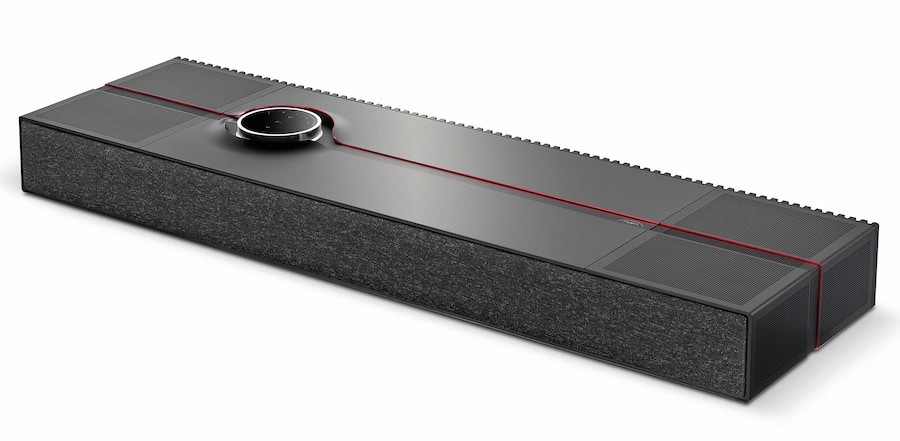
The electronics and drivers are housed in brushed, anodized aluminum with Naim’s familiar heat-sink profile. A deep-black finish is accented by red Utopia details, while the front uses a perforated aluminum grille. Primary controls are available from a touch-sensitive rotary dial. The enclosure measures 11.8 by 100 by 29.5 centimeters and weighs 14.1 kilograms, so its all-in-one format should not be mistaken for a compact tabletop design.
The Mu-so Utopia appears aimed at listeners who want one principal system to cover serious music streaming, television sound and multiroom playback without assembling separate amplifiers and loudspeakers. Its most consequential elements are not the long service list but the interaction between the 15-driver layout, hybrid amplification and Sphere processing. Those are also the areas that will determine how strongly room placement influences the result and how convincingly the cabinet moves between stereo and Atmos material. ADAPT calibration and the optional subwoofer output provide some flexibility, while smart-home integration broadens its role in custom installations. USD pricing and market-specific availability were not detailed, leaving those points—as well as the real-world behavior of its reflected spatial channels—for later clarification.



Sound Off
0Join the discussion if you have something to add.