
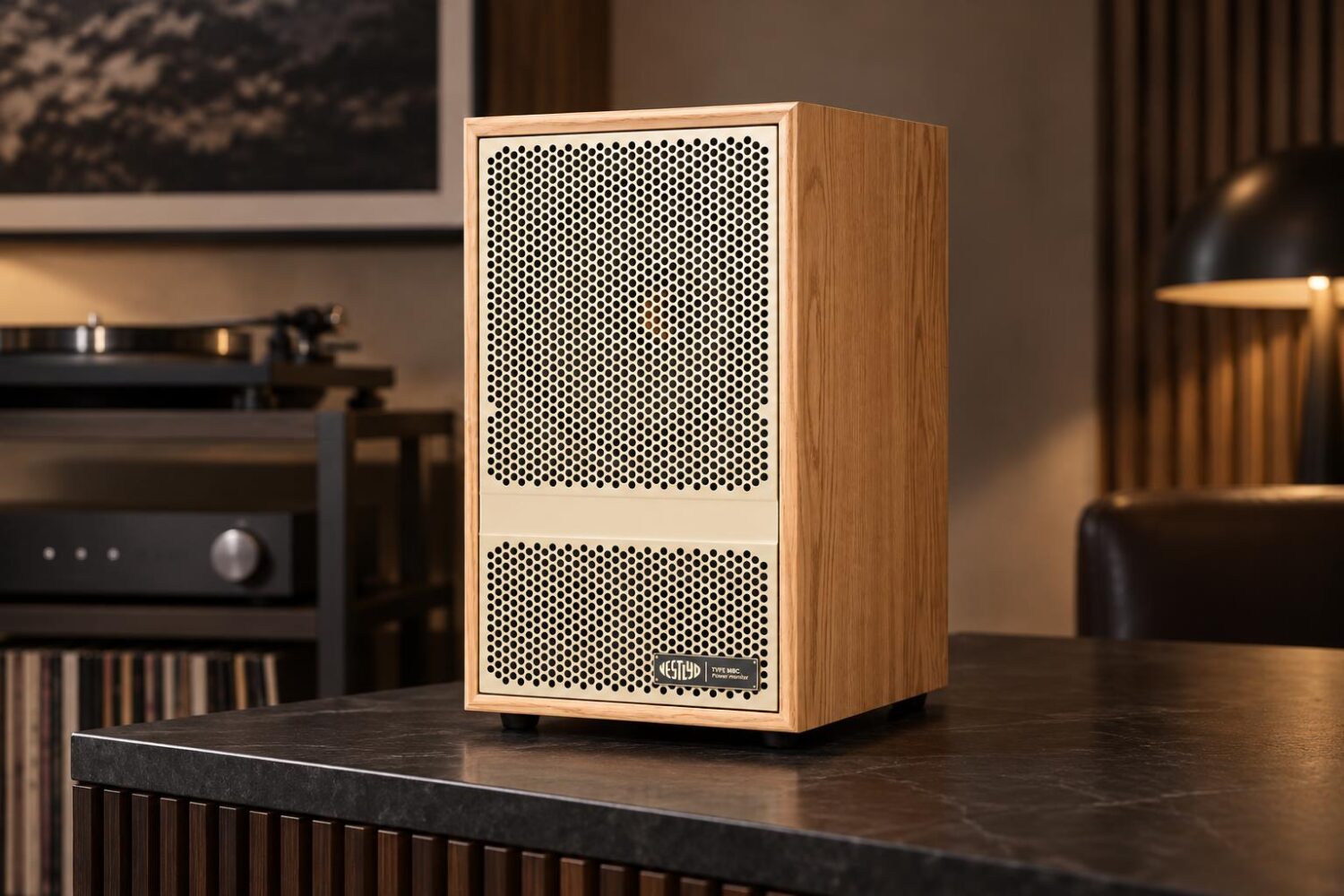
For listeners who want fewer boxes without restricting their choice of sources, Vestlyd has positioned the M8C Active as more than a powered version of a conventional compact speaker. The two-way system combines four channels of Class D amplification, DSP and 8-inch coaxial drivers with connections for a television, computer, turntable, streamer and studio equipment. Its 1970s monitor-inspired appearance links the speaker to Vestlyd’s Power Monitor concept, but the operating model is distinctly current: one pair is intended to take over duties that would otherwise require an amplifier, phono stage, DAC and several source-specific interfaces.
The larger all-purpose model in Vestlyd’s active range
The M8C Active sits above the smaller M6C Active and is intended for rooms or users requiring the greater scale associated with its 8-inch driver and larger enclosure. Vestlyd gives both models the same broad set of functions, so the distinction is not about gaining a particular input or control feature. Instead, the M8C is the option built around greater bass extension and output capability.
That positioning explains why Vestlyd has not treated the speaker as a minimalist wireless product. Television sound, vinyl playback, desktop audio, gaming and music production are all included in its remit. A buyer can therefore begin with a relatively simple living-room system and retain enough physical inputs to add dedicated sources later.
The pair measures 29 by 44.3 by 27 centimeters per speaker and uses bass-reflex cabinets. Those dimensions still place it in the stand-mount category, although this is a substantial design rather than a small desktop speaker. Matching Vestlyd M-Stands are offered separately, while a standard 3.5-centimeter mounting socket allows installation on compatible PA stands or wall brackets. That second option reflects the M8C’s monitor-inspired design and potential use beyond a conventional hi-fi rack.
Four amplifier channels meet an 8-inch coaxial driver
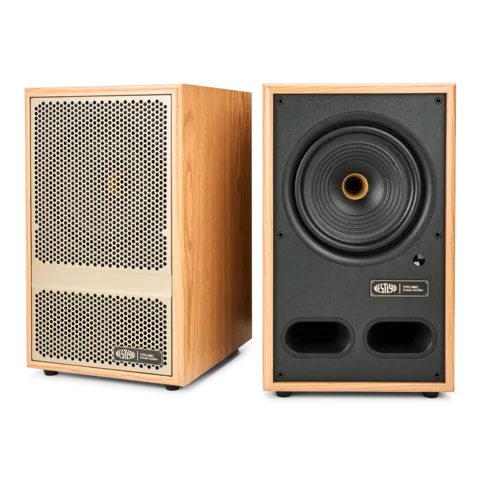
Amplification is integrated into the system, with four 75-watt RMS PWM Class D channels driving the two-way stereo pair. DSP is also built in, allowing Vestlyd to manage the relationship between the amplifiers, drivers and available equalization settings within one controlled architecture. Digital sources can be accepted at resolutions up to 24-bit/192kHz.
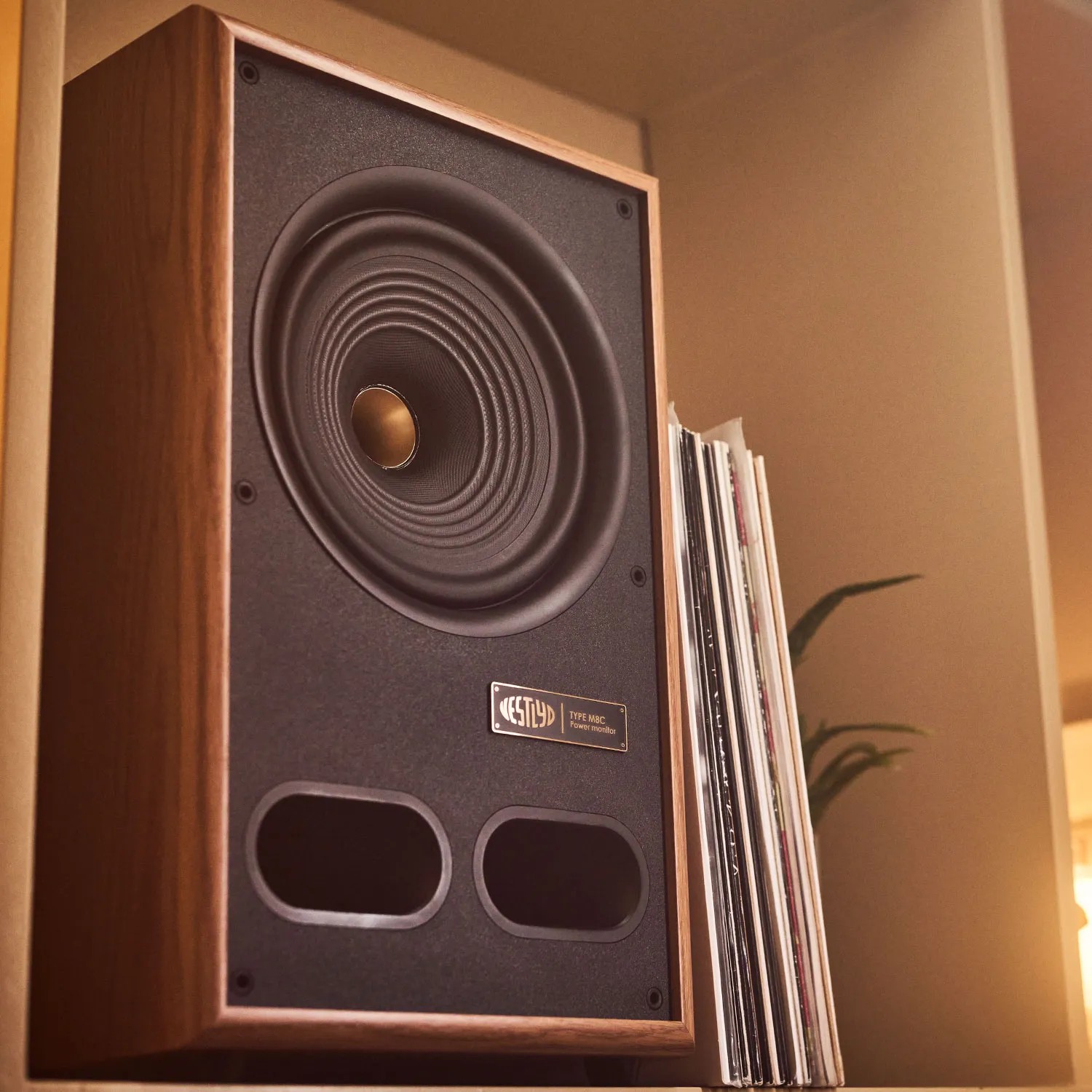
Each cabinet uses an 8-inch bass-midrange driver with a 1-inch titanium-dome tweeter mounted at its center. This coaxial arrangement places the high-frequency unit within the larger cone rather than above or beside it. As a result, the two sections radiate from the same physical area, while the bass-midrange cone also forms a horn around the tweeter. The documented frequency response is 40Hz to 22kHz at the minus-3dB points, extending to 36Hz and 24kHz at minus 6dB.
A subwoofer output remains available for systems that need additional low-frequency support. Its presence is useful even though the M8C is intended to operate as a full-range stereo pair: room size, placement and playback requirements can all affect whether a separate subwoofer is desirable. Vestlyd does not force that expansion at the outset, but it leaves a straightforward route to it.
HDMI eARC makes the television part of the stereo
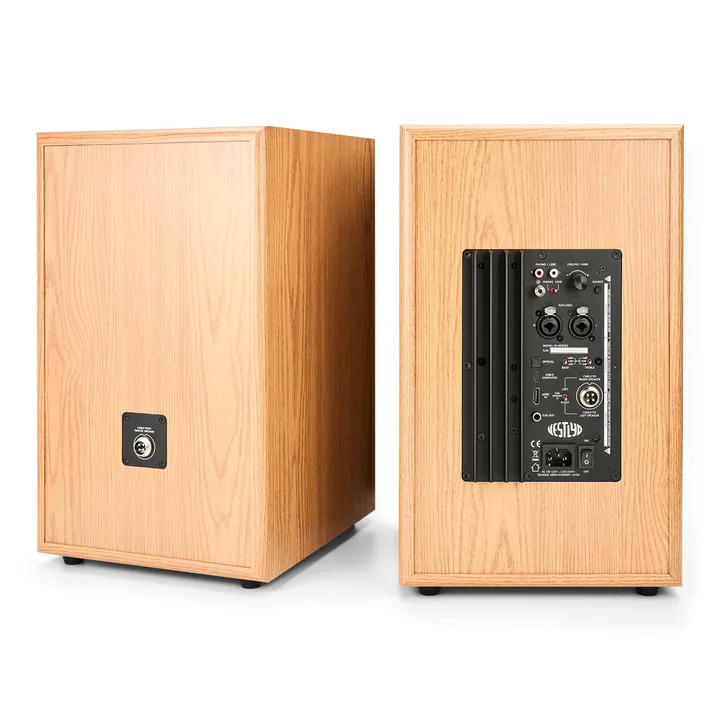
HDMI eARC is central to the M8C Active’s role as a living-room system. It provides a direct digital path from a compatible television and allows the speakers to replace the TV’s internal audio system without requiring an AV receiver. An optical input offers another digital connection, making it possible to keep a separate streamer or other source attached alongside the television.
USB-C extends the same system toward computer audio, including music playback and gaming. When connected this way, master volume can be adjusted from the computer keyboard. Vestlyd includes a 1.5-meter USB-C cable, so this mode does not require an immediate accessory purchase.
Wireless playback comes through Bluetooth 5.1, with aptX HD, aptX Low Latency and AAC support. Bluetooth provides the quickest route for phones and tablets, although the M8C is not presented as a network-streaming speaker and no voice-control function is specified. Listeners seeking app-based network playback can instead use one of the wired digital inputs for a separate streamer.
Vinyl and studio equipment are not afterthoughts
An integrated moving-magnet phono stage allows a compatible turntable to connect without an external phono preamplifier. That is significant to the M8C’s system-replacement brief: omitting a phono stage would have made the otherwise compact installation dependent on another box for vinyl. Conventional analog sources are also accommodated.
For home-studio and music-making setups, Vestlyd supplies XLR and 6.35-millimeter jack connectivity. Those connections broaden the speaker’s role beyond casual computer playback, allowing compatible production hardware and musical equipment to feed the system directly. The mounting socket underneath each cabinet also makes more sense in this context, particularly where conventional domestic speaker stands would be unsuitable.
Three EQ presets—Music, Movie and Flat—can be selected from the remote control. The Flat mode is the obvious documented option for users seeking a neutral starting point in a home studio, while the other presets provide alternatives for music and television use. Rear-mounted switches permit further bass and treble adjustment, giving owners some scope to account for placement or preference without adding an external processor.
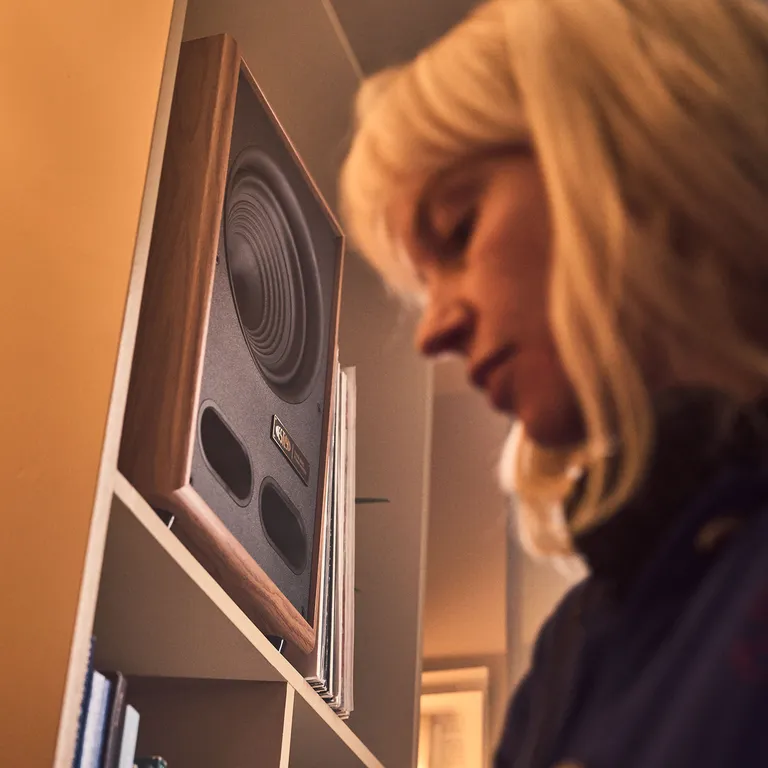
A simplified system, but not a cable-free one
All electronics reside in the main speaker, which can be assigned as either the left or right channel. That choice should make placement easier when source equipment or a wall outlet favors one side of the room. The two speakers must still be joined by the supplied five-meter speaker cable, and the system includes a three-meter power cable. It is therefore a reduced-component arrangement rather than a fully wireless stereo pair.
Automatic power operation is supported for compatible use cases, but it does not activate from Bluetooth or the turntable input. Owners relying mainly on either of those sources will need to account for manual operation. Volume is controlled remotely or through supported source devices; there is no front-mounted volume button.
The supplied remote includes the EQ selections and handles day-to-day control, while the package also contains AAA batteries, the inter-speaker cable, USB-C cable and a start guide. Multiple finishes are listed, including an oak version. Together with the broad baffle, exposed coaxial driver and monitor proportions, the finish options reinforce the intended blend of vintage styling and contemporary electronics.
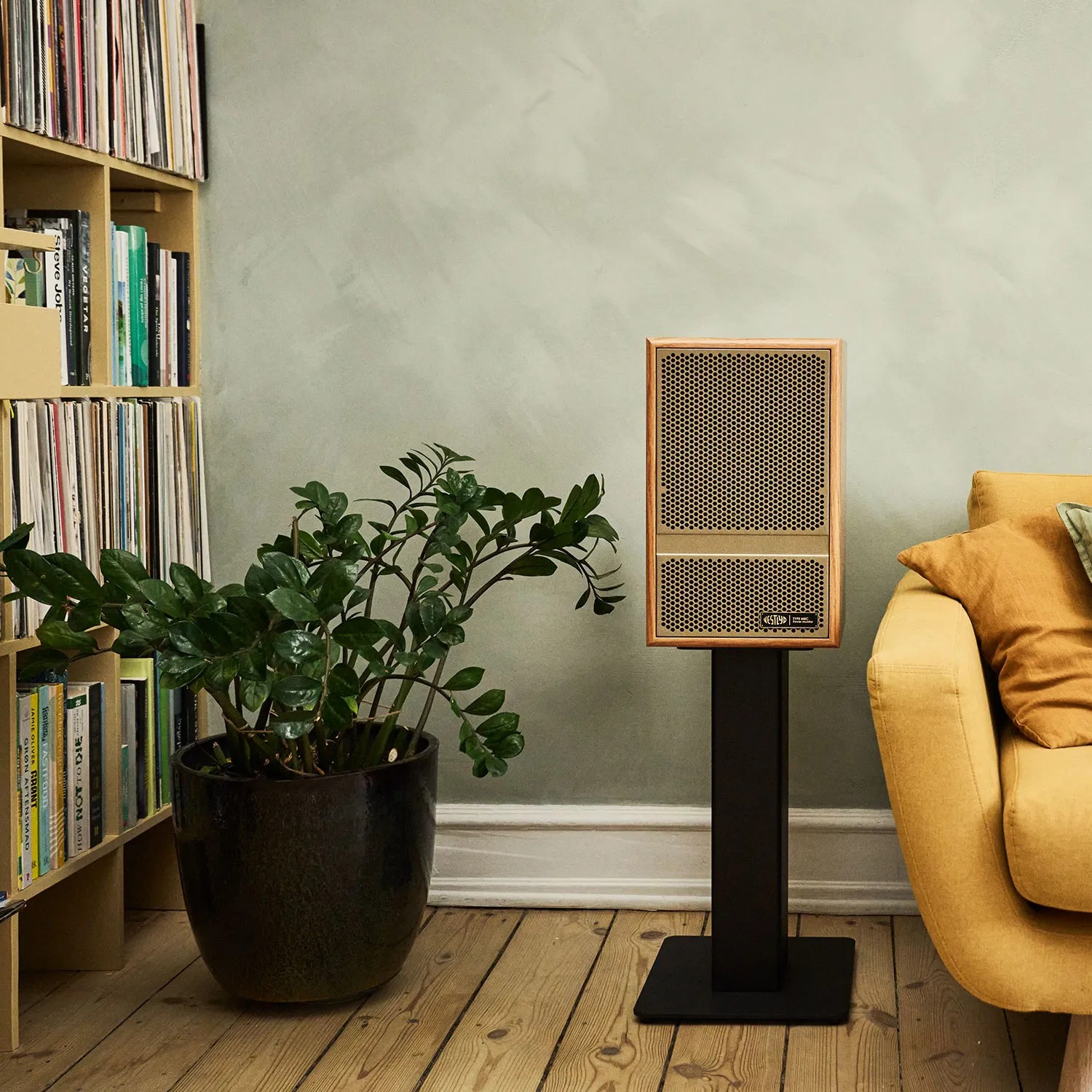
The M8C Active appears aimed at buyers who want one stereo pair to move between several roles rather than optimize the room around a single source. HDMI eARC and the MM phono stage make particular sense in a shared living space, while USB-C, balanced connectivity, selectable channel assignment and stand-mounting options extend its usefulness to a desk or project studio. The main considerations are equally clear: the cabinets are substantial, the pair requires a physical interconnect, and Bluetooth or phono playback will not trigger automatic power-on. What remains unknown from the available information is how broadly the M8C Active will be distributed and when additional markets may receive it. Prospective owners should also check turntable cartridge compatibility, available placement space and whether the supplied five-meter linking cable suits the intended layout.


Sound Off
0Join the discussion if you have something to add.