
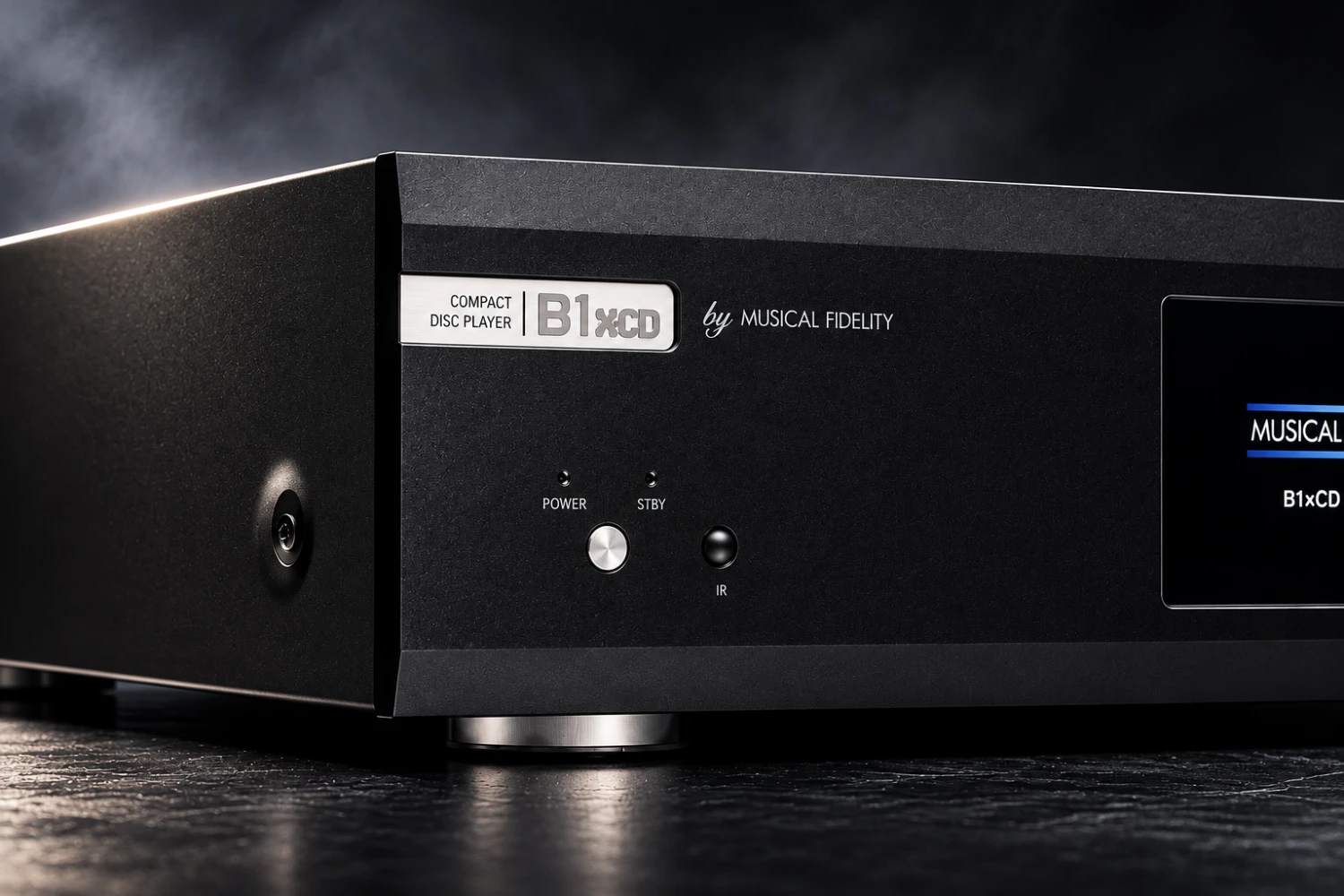
The Musical Fidelity B1xcd is designed for listeners who still regard compact disc as a primary music format. Rather than turning the player into a digital hub, Musical Fidelity has concentrated on Red Book playback, sturdy construction and the flexibility to use either its internal ESS DAC or an external converter.
Design and Build Quality
The B1xcd follows the conventional full-width hi-fi format, measuring 430 x 90 x 298mm and weighing 5.8kg. Its substantial mass is supported by an all-metal chassis, an extruded aluminum front panel and machined aluminum controls. Those materials give the design a suitably purposeful specification for a dedicated component, even though no internal construction details are provided.
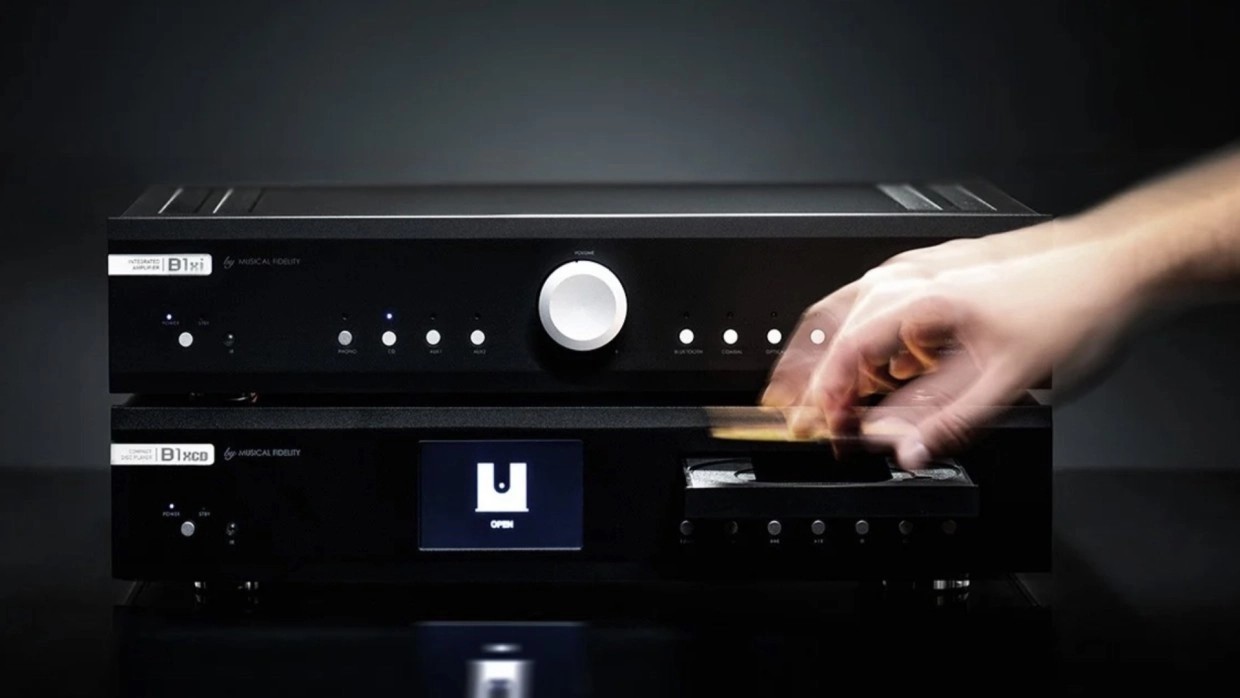
A centrally positioned LCD supplies playback information and can show artist and track details when a disc includes CD-Text. The visual presentation is intended to complement Musical Fidelity’s B1xi integrated amplifier, making the two components a natural pairing for anyone building a coordinated B-Line system. The traditional proportions should also allow the player to sit comfortably alongside standard-width amplifiers and other separates.
Dedicated Red Book Transport
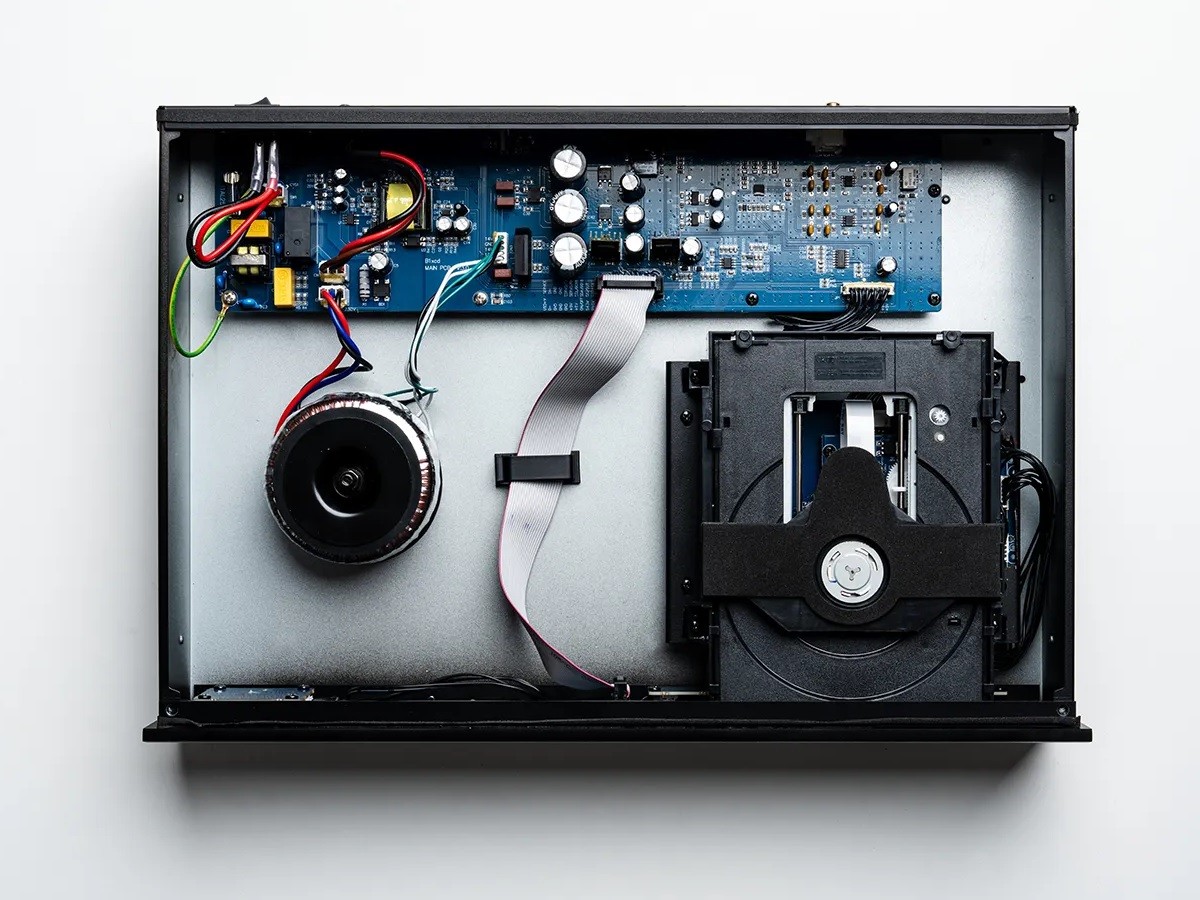
At the center of the B1xcd is a tray-loading mechanism developed specifically for Red Book CD-DA playback. That means its remit is the original compact disc standard of 16-bit/44.1kHz audio rather than high-resolution discs, network services or broad file-format support.
The transport is partnered with a SUOS-developed BlueTiger CD-88 servo system. Musical Fidelity states that this arrangement is intended to improve disc-reading accuracy while reducing the effects of vibration and read errors. These engineering priorities are relevant for a conventional CD player because stable data retrieval and transport control establish the conditions under which the downstream digital and analog stages operate.
Its specialization is both an attraction and a limitation. Owners with established CD collections may appreciate a machine that is designed around one task, but anyone seeking an all-purpose digital source will need additional equipment.
ESS Digital-to-Analog Conversion
Digital-to-analog conversion is handled by an ESS ES9018Q2M DAC. The inclusion of an onboard converter allows the B1xcd to connect directly to an amplifier through its stereo RCA analog outputs, avoiding the need for a separate DAC in a straightforward system.
The available information does not detail the analog output-stage topology, power-supply arrangement or user-selectable digital filters. Consequently, the ESS chip should be viewed as one element of the overall design rather than a guarantee of a particular sonic character. DAC implementation, clocking, power integrity and analog circuitry all contribute to the final result.
Musical Fidelity specifies a signal-to-noise ratio greater than 112dB A-weighted, channel separation greater than 96dB and total harmonic distortion below 0.003% across the stated 20Hz to 20kHz frequency range. These are credible figures for the intended application, although specifications alone cannot establish subjective sound quality.
Connectivity and Everyday Use
Connectivity reflects the B1xcd’s focused purpose. Stereo RCA outputs provide the analog connection, while coaxial and optical digital outputs allow the player to operate solely as a CD transport with an external DAC. That gives owners a practical upgrade path and makes the machine adaptable to amplifiers that already contain preferred conversion hardware.
A supplied remote control covers the customary playback functions, while front-panel controls preserve direct operation at the component. CD-Text support is a useful convenience when compatible metadata is present on the disc.
The deliberately narrow feature set means there is no stated provision for streaming, USB playback or digital inputs. The B1xcd is therefore not intended to replace a network streamer or function as a system-wide DAC. Its appeal depends on whether that simplicity feels refreshingly direct or unnecessarily restrictive.
Performance Potential
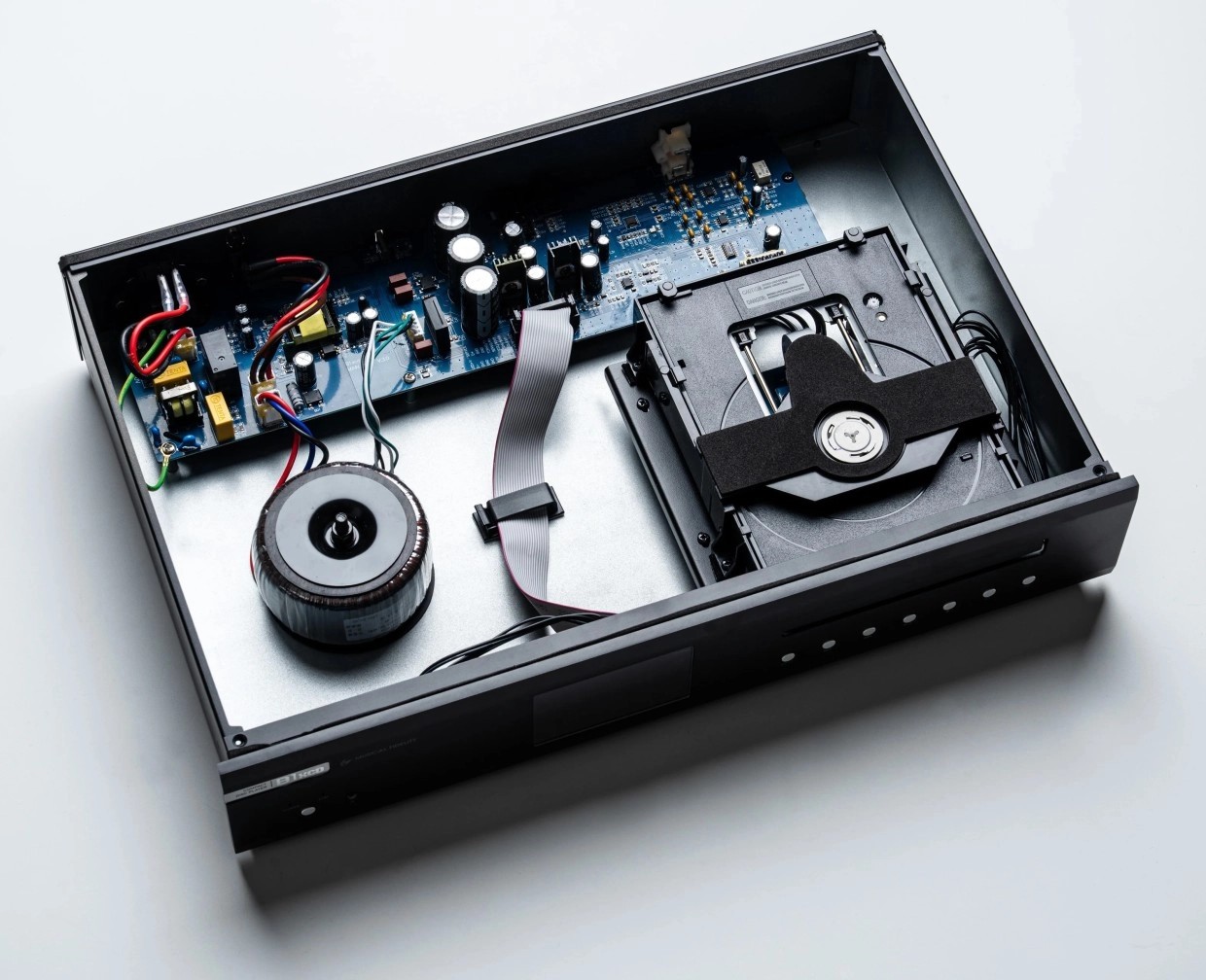
On an engineering basis, the B1xcd presents a coherent route from disc to analog output. The dedicated Red Book mechanism and BlueTiger servo address data retrieval, while the ES9018Q2M handles conversion. Users who prefer another DAC can bypass the internal conversion stage through either digital output.
The quoted distortion, noise and channel-separation figures suggest that the player is designed to keep unwanted artifacts at low levels within the audible frequency range. Its substantial metal construction may also provide a mechanically stable platform for the transport, although no vibration measurements are supplied.
Nothing in these specifications supports a definitive claim about tonal balance, spatial presentation or musical character. The most defensible assessment is that the architecture is sensible for reliable CD replay and offers enough output flexibility to suit both simple and externally converted systems.
Pros
- Dedicated Red Book CD-DA transport
- ESS ES9018Q2M DAC with stereo RCA output
- Coaxial and optical outputs enable transport-only use
- All-metal chassis with aluminum front panel and controls
- LCD supports CD-Text information when available
Cons
- No stated streaming, USB playback or digital inputs
- Limited to conventional Red Book CD playback
- Value remains uncertain without confirmed USD pricing
Verdict
The Musical Fidelity B1xcd is a deliberately specialized CD player with credible engineering, robust construction and flexible analog or digital output options. It makes the strongest case for listeners who want focused Red Book playback rather than an all-purpose digital source.
The Musical Fidelity B1xcd is an intentionally conventional component in a market increasingly dominated by multifunction digital sources. Its strengths are clearly defined: a dedicated tray-loading Red Book transport, the SUOS BlueTiger CD-88 servo system, an ESS ES9018Q2M DAC and a solid metal enclosure. Stereo RCA outputs make it ready for direct connection to an amplifier, while coaxial and optical outputs allow it to serve as a transport for an external DAC. CD-Text support and an included remote add practical convenience without changing the player’s focused identity.
That specialization also establishes its limitations. The supplied information identifies no streaming, USB playback or digital inputs, and the machine is centered on standard 16-bit/44.1kHz compact discs. It is not designed to become the digital control center of a modern system. A final value judgment must also wait because no confirmed USD price is available.
The ideal buyer is a listener with a meaningful CD collection who prefers a straightforward full-width component and wants the option to choose between internal and external conversion. Provided its eventual pricing is competitive, the B1xcd appears to be a sensible and well-specified choice for a disc-first hi-fi system, but buyers seeking broad digital versatility should look elsewhere.



Sound Off
0Join the discussion if you have something to add.