

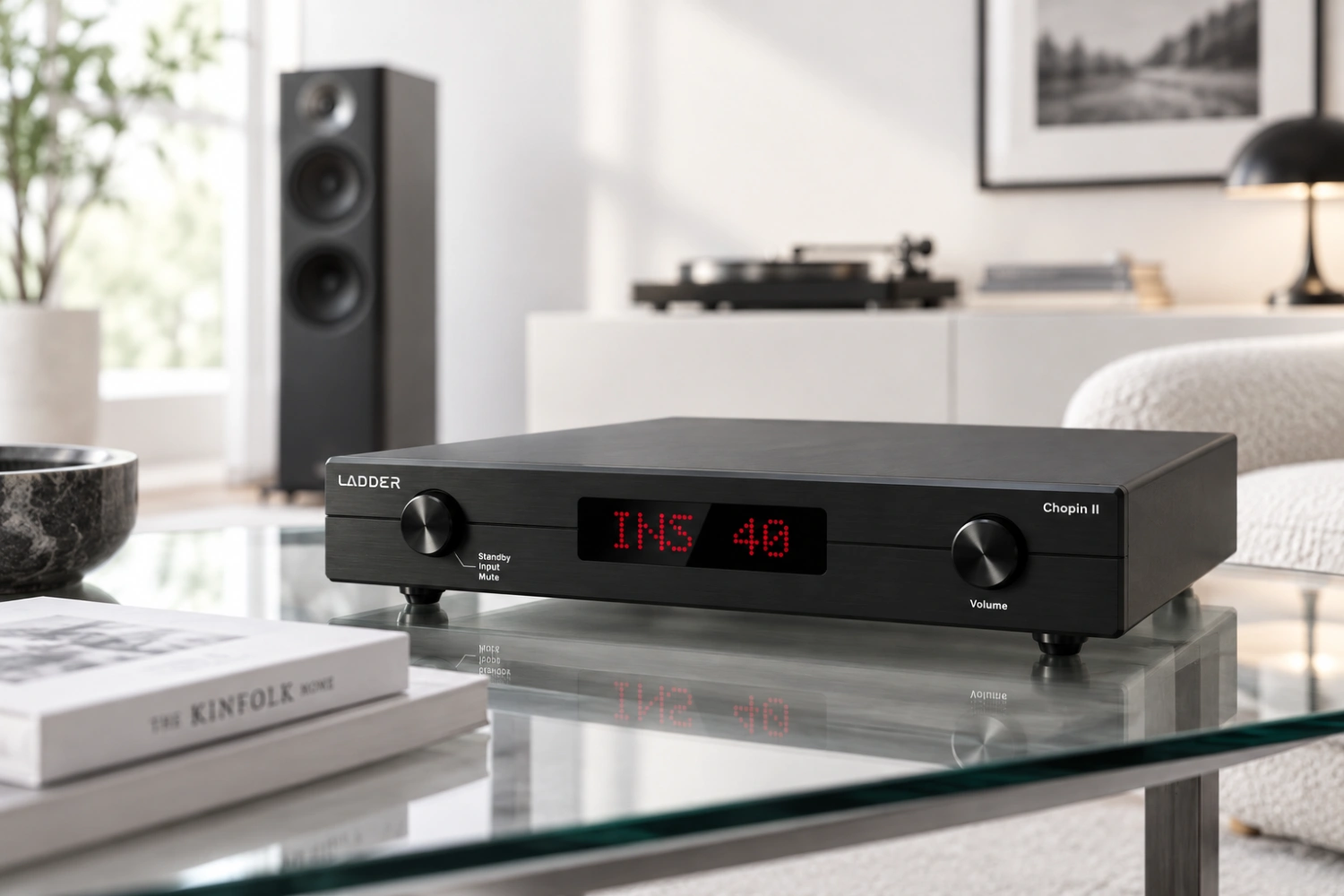
Ladder has introduced the Chopin II, a compact analog preamplifier built around a fully balanced, fully discrete Class-A line stage. Priced at $1,545, it combines relay-based volume adjustment, balanced and single-ended connections, remote operation and a linear power supply within an aluminum-alloy enclosure.
Fully balanced discrete Class-A architecture
At the center of the Chopin II is a differential amplification circuit using discrete field-effect transistors for output amplification. The preamplifier operates at unity gain, or 0 dB, positioning it as an analog control stage rather than a source of additional system gain.
Published specifications include a frequency response of 10 Hz to 80 kHz at -0.3 dB, a signal-to-noise ratio of 120 dB and dynamic range greater than 121 dB. Stereo crosstalk is rated at -110 dB, while the manufacturer lists THD+N as 0.00%.

Output levels differ according to connection type: the RCA output is rated at 2.0 Vrms, while the balanced XLR output provides 4.0 Vrms. Output impedance is specified as 200 ohms through RCA and 400 ohms through XLR. The corresponding input impedances are 12.2 kilohms for single-ended sources and 60 kilohms for balanced equipment.
A 60-step relay attenuator handles volume
Rather than relying on a conventional potentiometer, the Chopin II uses a microprocessor-controlled 60-step relay attenuator. Precision-matched resistors and components are employed to support consistent level changes and channel tracking throughout the adjustment range.
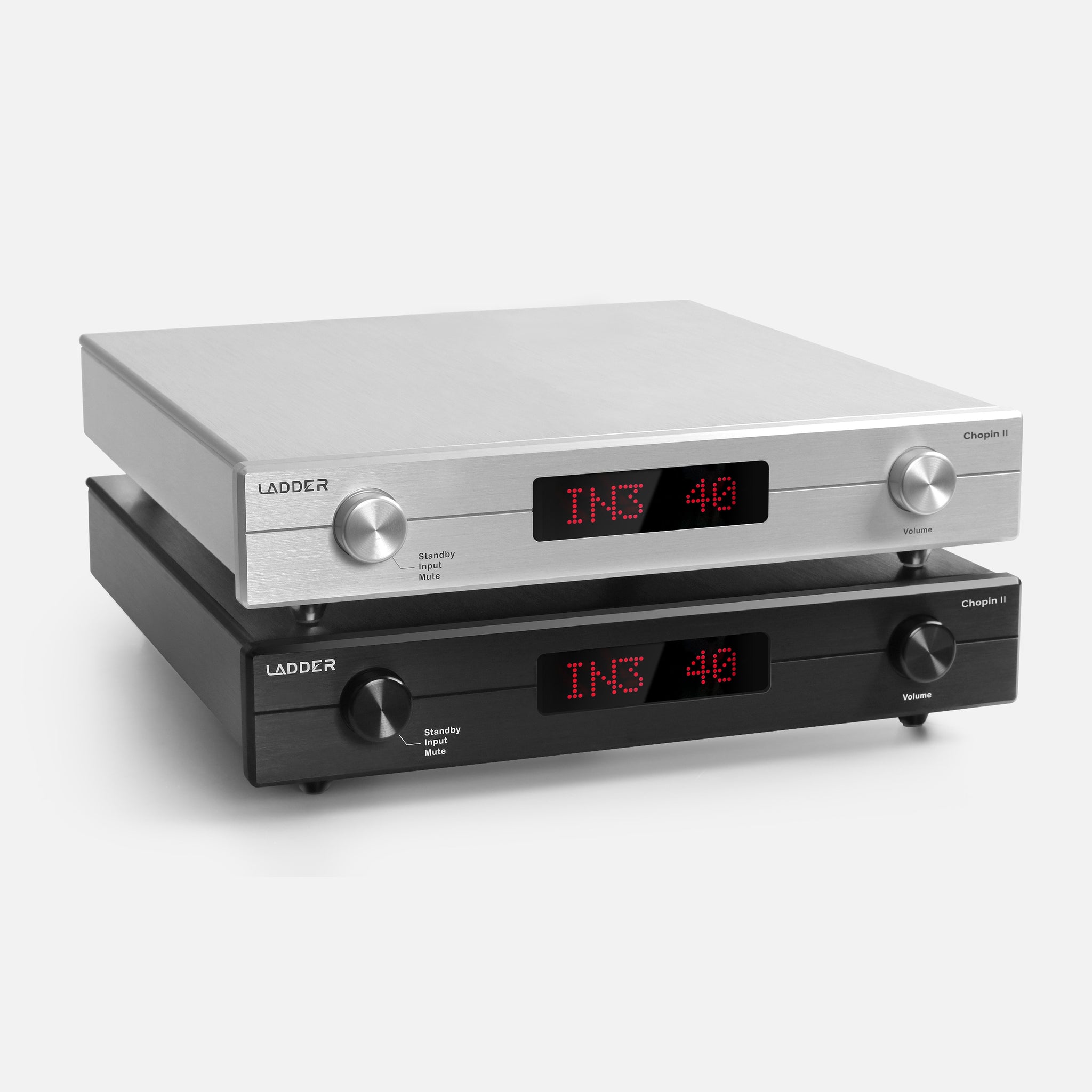
Two controls sit on either side of the central front-panel display. The left control manages power, source selection, standby and mute functions, while the right control adjusts listening level. The display identifies the active input and selected volume setting. An included remote control provides access to operating adjustments from the listening position.

Linear power supply with independent regulation
Power comes from a 65W pure-copper toroidal transformer supported by a bank of ERSE capacitors. Eight independently regulated power supplies distribute power across the internal circuitry, reflecting the Chopin II’s focus on separating and stabilizing the electrical supply for its analog stages.
The unit accepts 100–240 VAC at 50 or 60 Hz. Power consumption is specified at 20W during operation and 1W at idle. Its aluminum-alloy chassis measures 12.6 inches wide, 13.0 inches deep and 2.4 inches high, with a net weight of 14.3 pounds. Those dimensions allow the preamplifier to accommodate its transformer and discrete circuitry while retaining a relatively low-profile form.
Balanced and single-ended system integration
The rear panel provides two stereo XLR inputs and one stereo RCA input, allowing three analog source components to remain connected. Output is available simultaneously by connection type through stereo XLR and stereo RCA sockets, making the preamplifier compatible with balanced power amplifiers, conventional single-ended models and active speaker systems with suitable analog inputs.
Ladder uses gold-plated single-crystal copper terminals for the RCA connections. The combination of XLR and RCA connectivity also means users can mix balanced and single-ended components without limiting the Chopin II to one interface standard.

Price, finishes and included accessories
The Ladder Chopin II is offered in black or silver, with both finishes listed at $1,545. The package includes the preamplifier and its remote control, and the stated warranty period is 12 months.
With unity-gain operation and no digital input stage specified, the Chopin II is positioned as a dedicated analog line-level controller. Its feature set centers on signal routing, precise volume adjustment and connection flexibility rather than source conversion or integrated power amplification.
The Chopin II packages Ladder’s balanced Class-A topology, 60-step relay attenuator and substantial linear power supply into a compact line-stage preamplifier. Its mix of XLR and RCA connections should make it straightforward to place between multiple analog sources and a wide range of downstream amplification.



Sound Off
0Join the discussion if you have something to add.