
The best AV receiver is not simply the model with the largest channel count.
Amplifier channels, processing capacity, subwoofer control, HDMI support, room correction, streaming and expansion options all determine whether a component suits a particular home-cinema system.
Power figures also require context because ratings measured with two channels driven cannot be compared directly with figures obtained under different conditions. This source set contains five conventional multichannel receivers, followed by an AV processor, a stereo integrated amplifier and three source or compact-system alternatives. Those latter products are not substitutes for a surround receiver, so they rank below the true AV models and are included only for their relevant niches. The Marantz requires external power amplifiers, the Lyngdorf is for two-channel systems, the TEAC is a turntable, and the Yamaha and Pioneer products are self-contained music systems. The ranking therefore prioritizes category fit first, followed by channel flexibility, video connectivity, system expansion and supported audio features. Denon's AVC-X3900H is the strongest all-round recommendation, while the JBL Synthesis SDR-40 is the more specialized proposition for a large dedicated cinema room.
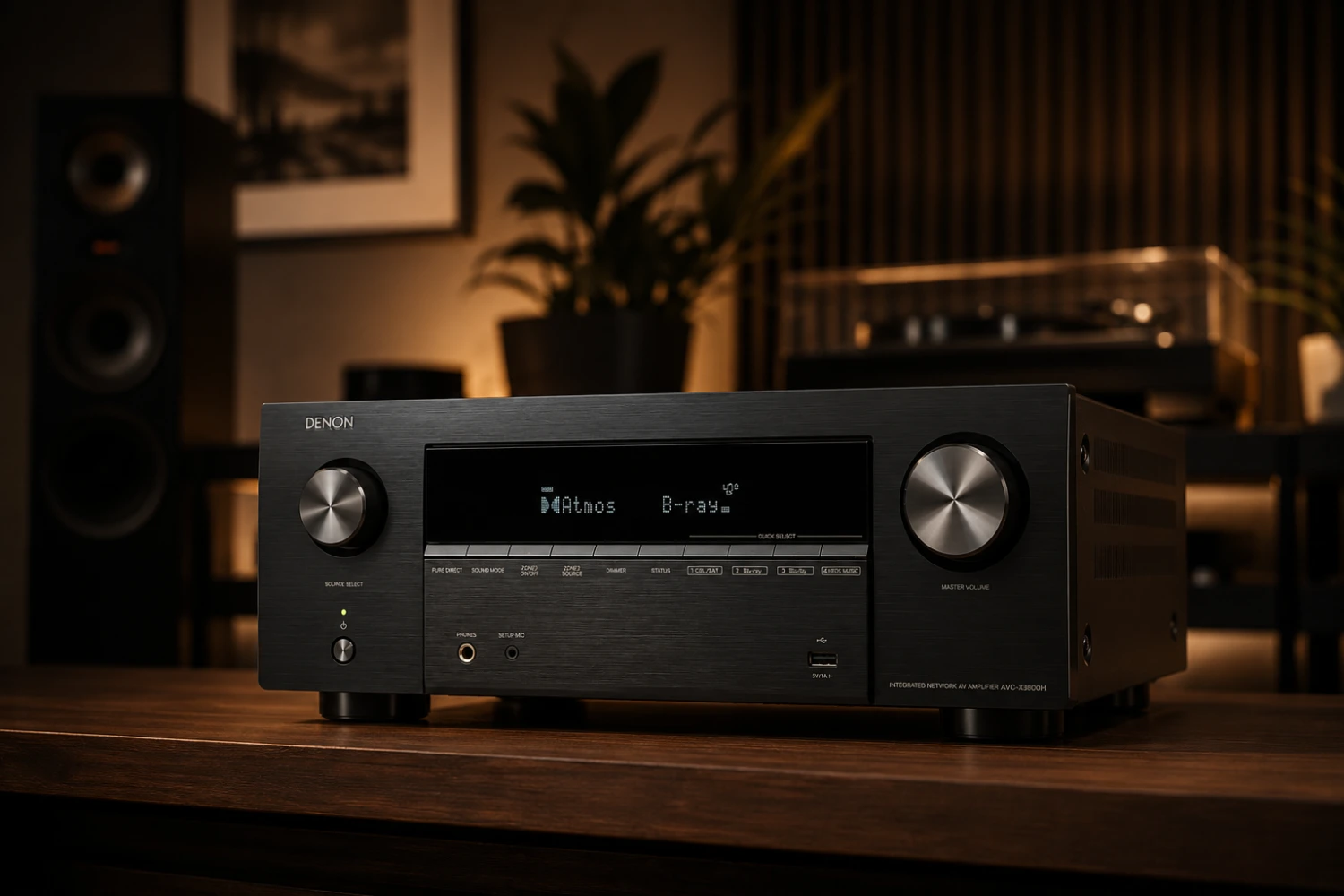
1. Denon AVC-X3900H
Denon AVC-X3900H, a nine-channel home-cinema receiver with 11.4-channel pre-outs.
The Denon AVC-X3900H offers the most convincing balance of built-in amplification and future expansion among the conventional receivers in this list.
Its nine amplifier channels can support arrangements such as 5.4.4 or 7.4.2 without additional power amplifiers, while 11.4-channel pre-outs permit larger layouts when external amplification is added.
Four subwoofer outputs make it particularly relevant to rooms using multiple low-frequency sources. Denon specifies 105 watts into 8 ohms across 20 Hz to 20 kHz with two channels driven, a properly stated condition that should not be treated as simultaneous nine-channel output. HDMI 2.1 video handling, 8K capability and HEOS multiroom streaming complete a notably adaptable package.
Best for: Expandable immersive home-cinema systems
- Nine built-in amplifier channels with 11.4-channel pre-out expansion
- Supports up to four subwoofer outputs
- 8K-capable HDMI 2.1 connectivity
- Integrated HEOS multiroom streaming
Verdict: The AVC-X3900H is the strongest overall choice for buyers who want substantial onboard amplification without closing off a later move to a larger system.

2. JBL Synthesis SDR-40
JBL Synthesis SDR-40, a 16-channel processor with nine integrated Class-G amplifier stages.
The JBL Synthesis SDR-40 is the most ambitious cinema component in the ranking, but it is aimed at a more specialized installation than the Denon.
It combines 16-channel processing with nine built-in Class-G amplifier stages, allowing it to power a substantial initial system while retaining pre-out expansion for a larger configuration.
Format support includes Dolby Atmos, DTS:X Pro, IMAX Enhanced and AURO-3D. Flexible channel assignment and advanced room correction reinforce its dedicated-theater focus. It sits behind the Denon only because its scale and installation-led design are less universally applicable, not because it lacks home-cinema reach.
Best for: Large dedicated cinema rooms
- Processes as many as 16 channels
- Nine built-in Class-G amplifier stages
- Supports Dolby Atmos, DTS:X Pro, IMAX Enhanced and AURO-3D
- Pre-outs, flexible channel assignment and advanced room correction
Verdict: The SDR-40 is the standout specialist for ambitious theaters that need extensive processing and a path beyond its nine internal amplifiers.
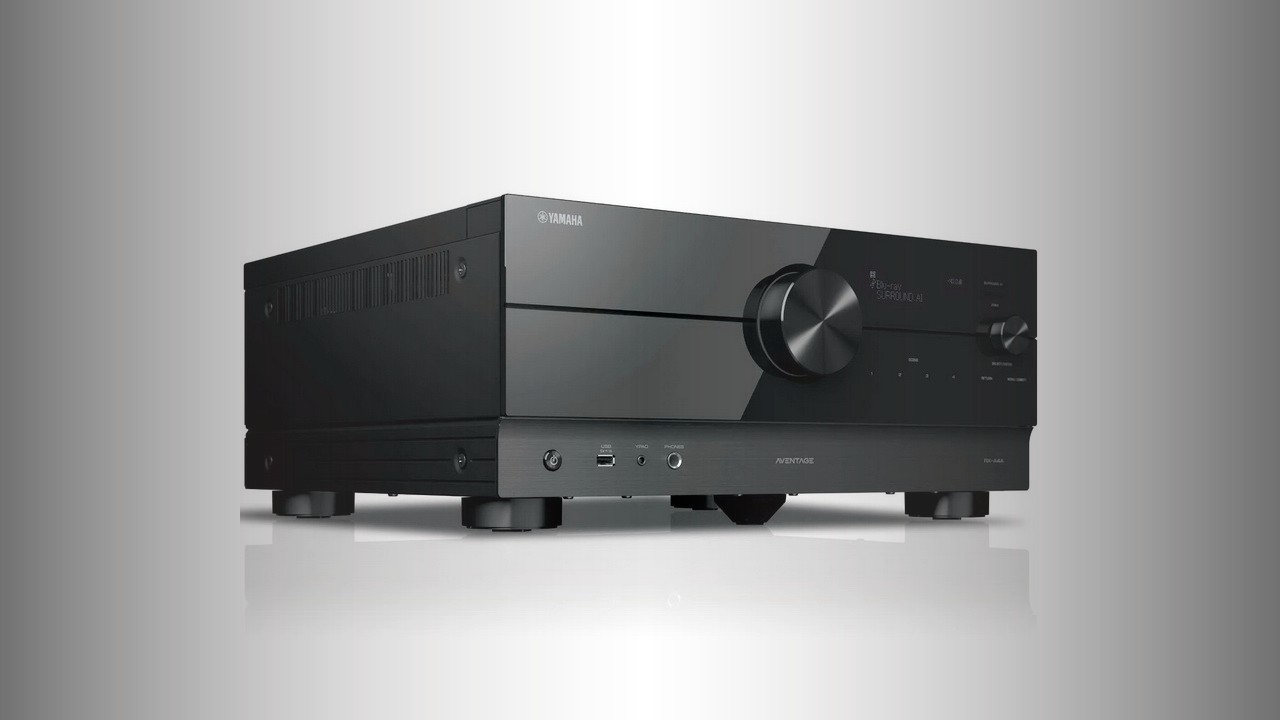
3. Yamaha RX-A4A
Yamaha RX-A4A, a 7.2-channel receiver with Cinema DSP HD3 processing.
The Yamaha RX-A4A is a focused 7.2-channel receiver for buyers who value Yamaha's proprietary cinema processing alongside the core immersive formats.
It supports Dolby Atmos and DTS:X, while Cinema DSP HD3 applies Yamaha's sound-field processing to film and other multichannel material.
The receiver uses a Qualcomm QCS407 chipset and an ESS Sabre ES9007S DAC. Wi-Fi and Bluetooth cover connected playback, while Yamaha's Anti Resonance Technology adds a fifth chassis foot intended to reduce vibration from internal components. It cannot match the channel expansion of the two higher-ranked models, but it is a coherent option for a conventional seven-channel theater.
Best for: Seven-channel systems favoring Yamaha cinema processing
- 7.2-channel architecture with Dolby Atmos and DTS:X
- Yamaha Cinema DSP HD3 sound-field processing
- ESS Sabre ES9007S digital-to-analog converter
- Wi-Fi, Bluetooth and an anti-resonance chassis design
Verdict: The RX-A4A is a well-defined 7.2-channel choice with distinctive Yamaha processing, although it offers less expansion than the leaders.
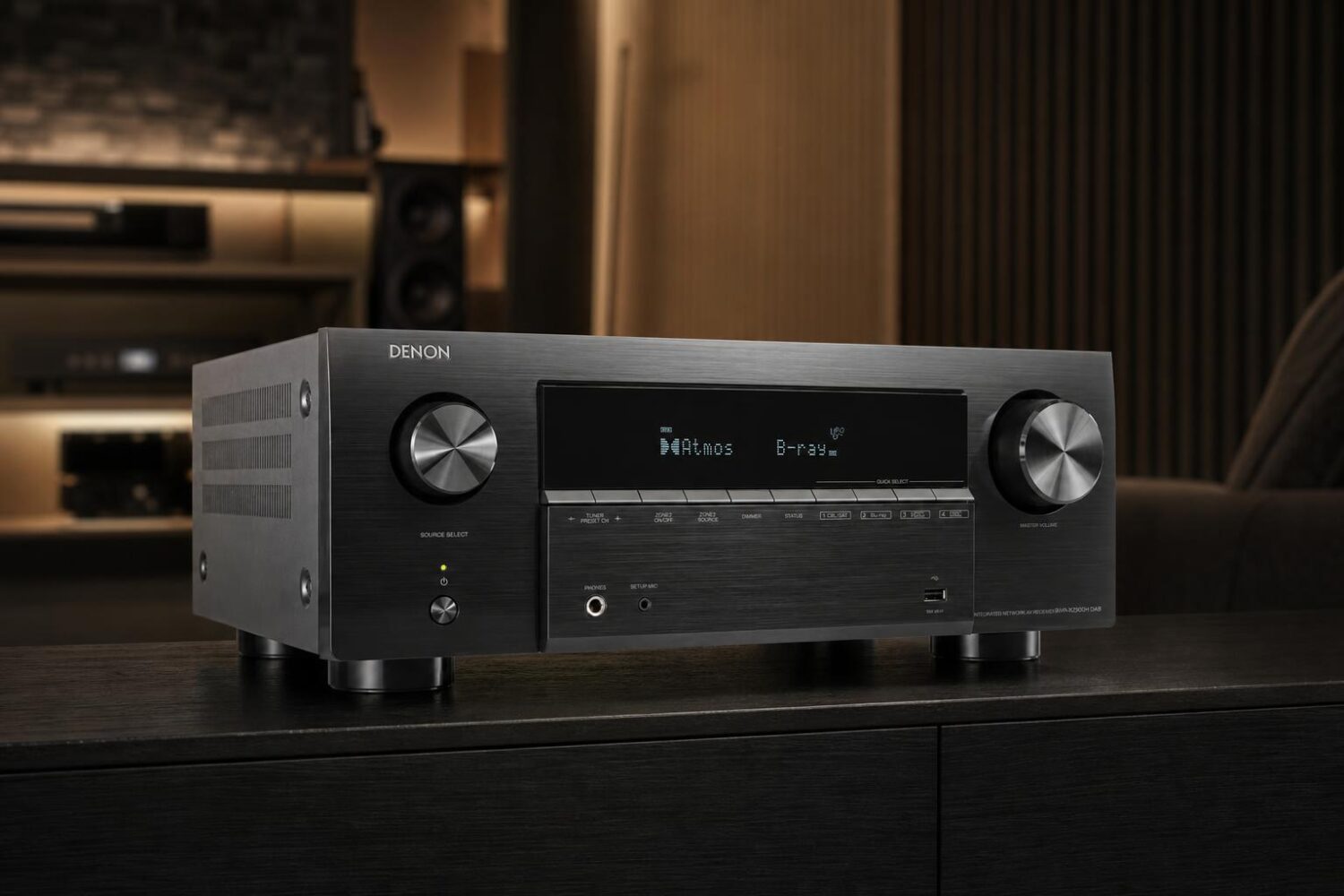
4. Denon AVR-X2900H DAB
Denon AVR-X2900H DAB, a seven-channel receiver with HEOS and digital radio.
The Denon AVR-X2900H DAB combines a manageable seven-channel platform with unusually broad source support.
Its seven matching amplifier blocks support a 7.1-channel system, with two subwoofer connections available.
Denon rates output at 95 watts into 8 ohms with two channels driven across the stated audio band. Dolby Atmos and DTS:X are supported, while Dolby Atmos Height Virtualization and DTS Virtual:X provide alternatives when physical height speakers are impractical. Six HDMI inputs, HDMI 2.1 video handling, 8K capability, HEOS and DAB+/FM reception make this a particularly versatile hub for cinema, streaming and broadcast radio.
Best for: Compact surround systems needing radio and streaming
- Seven-channel amplification with connections for two subwoofers
- Six HDMI inputs with HDMI 2.1 and 8K handling
- Dolby Atmos, DTS:X and virtualized-height options
- HEOS streaming plus DAB+ and FM radio
Verdict: The AVR-X2900H DAB is a versatile seven-channel receiver for households that want modern video handling, HEOS and terrestrial radio in one component.
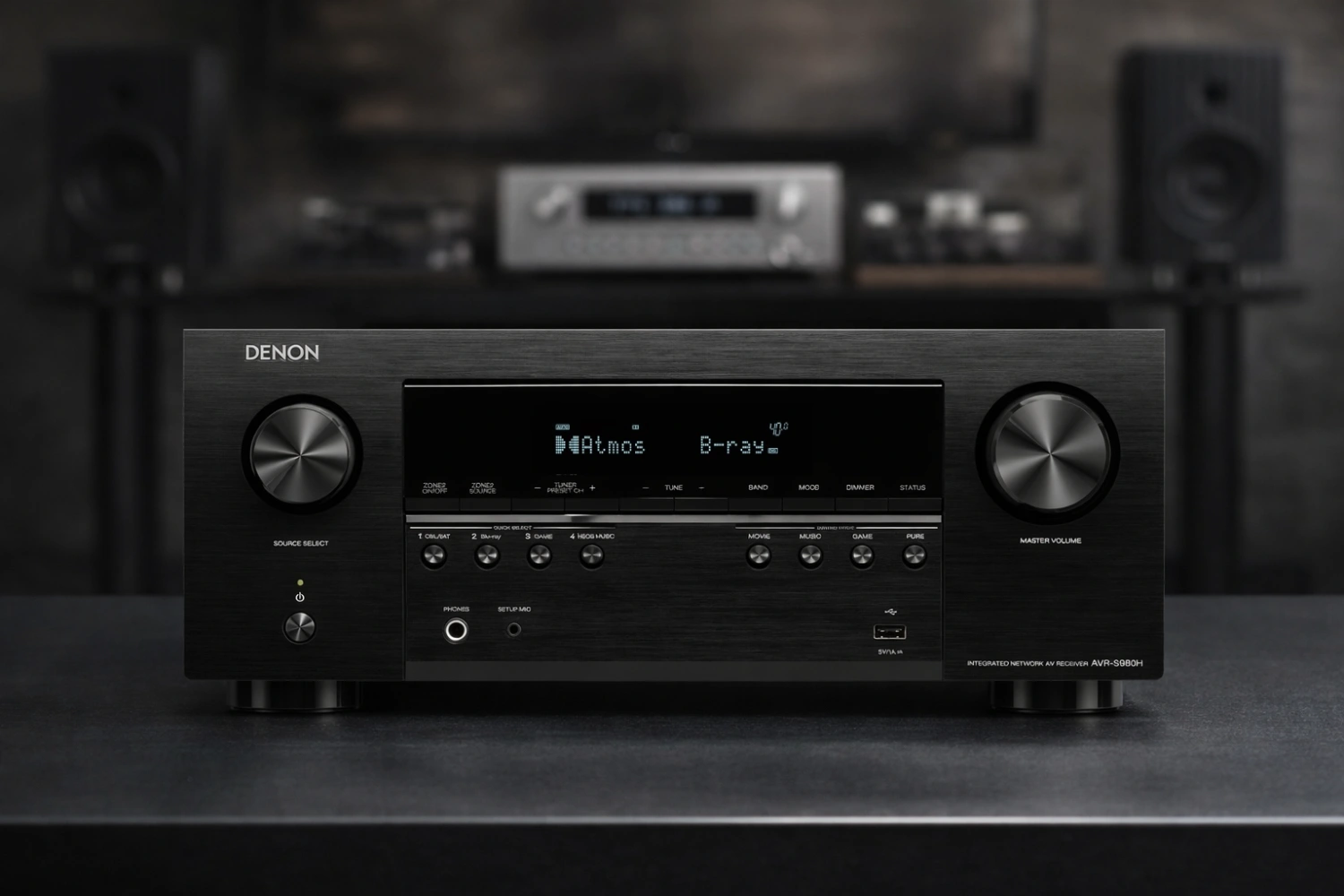
5. Denon AVR-S980H
Denon AVR-S980H, a 7.2-channel receiver designed as an accessible home-cinema upgrade.
The Denon AVR-S980H is presented as an accessible step beyond a soundbar or basic home-audio arrangement.
It provides a 7.2-channel foundation and a quoted 90 watts per channel, giving it the core architecture required for a conventional multichannel speaker system.
HEOS multiroom support and the stated wireless-surround upgrade path broaden its role in a connected household. It ranks below the AVR-X2900H DAB because the supplied material establishes fewer detailed distinctions around HDMI, processing and system expansion, but its straightforward positioning may be an advantage for buyers who do not need a more elaborate installation.
Best for: First full-size surround systems
- 7.2-channel configuration
- Quoted 90-watt-per-channel amplifier platform
- HEOS multiroom integration
- Designed as an approachable upgrade from simpler audio systems
Verdict: The AVR-S980H is the most approachable conventional receiver here, with seven-channel flexibility and HEOS for buyers moving beyond a soundbar.

6. Marantz AV7706
Marantz AV7706, an AV processor designed for use with separate power amplifiers.
The Marantz AV7706 is an AV processor rather than a receiver because it contains no power amplifiers.
Every speaker channel therefore requires suitable external amplification.
That distinction places it below the five integrated receivers, but it also makes the AV7706 relevant to enthusiasts building a separates-based theater. Its line outputs include balanced connections and are controlled by a dedicated HDAM circuit. The processor also provides AKM AK4458 conversion for each channel, supports high-resolution playback including DSD through USB and a local network, and handles HDMI 2.1 features including 8K at 60 Hz, 4K at 120 Hz, eARC, VRR, ALLM, QMS and QFT. It is the appropriate niche choice when amplifier selection is intended to remain independent from surround processing.
Best for: Separates-based home theaters
- Balanced and unbalanced outputs for external amplification
- Dedicated HDAM output-stage circuitry
- HDMI 2.1 support including 8K at 60 Hz and 4K at 120 Hz
- Network and USB playback with DSD support
Verdict: The AV7706 offers receiver-like processing and video connectivity, but it is suitable only when external power amplifiers are part of the plan.

7. Lyngdorf TDAI-2170
Lyngdorf TDAI-2170, a stereo integrated amplifier featuring RoomPerfect correction.
The Lyngdorf TDAI-2170 is a stereo integrated amplifier, not a multichannel AV receiver.
Its relevance lies in systems where music reproduction and room correction matter more than surround decoding or extensive speaker layouts.
The supplied material specifies output of 2 x 170 watts into 4 ohms at 0.07 percent distortion. Lyngdorf's digital signal path converts incoming PCM into the pulse-width-modulated signal used by the output stage. RoomPerfect correction is the more distinctive practical feature, with Focus modes intended to optimize the presentation for specific listening positions. This is a two-channel alternative for a music-centered room rather than a direct competitor to the receivers above it.
Best for: Room-corrected two-channel systems
- Specified at 2 x 170 watts into 4 ohms
- RoomPerfect room-correction system
- Direct digital signal-path concept
- Eight-kilogram chassis despite the stated output
Verdict: The TDAI-2170 is a compelling stereo specialist with RoomPerfect, but it does not replace a receiver in a multichannel theater.

8. Pioneer P2-K
Pioneer P2-K, a compact stereo package with network playback and matching speakers.
The Pioneer P2-K is a compact music system rather than an AV receiver.
It packages two two-way speakers with separate source and stereo-receiver units, making it a self-contained alternative for listeners who want network playback without assembling a component system.
Its network player supports high-resolution files, including DSD, and the front panel carries a 3.5-inch color display for track information, artwork and folder browsing. The display shows only four lines at once, which may make large libraries slower to navigate. Its stereo focus and supplied speakers distinguish it clearly from a surround receiver.
Best for: Compact network-based stereo listening
- Complete system with two-way speakers and separate electronics
- Network playback with high-resolution and DSD support
- Color display presents artwork and playback information
- Compact alternative to a full component system
Verdict: The P2-K is a convenient high-resolution music package, but it is not designed to anchor a surround-sound theater.

9. Yamaha TSX-N237D
Yamaha TSX-N237D, a compact MusicCast desktop system with CD and digital radio.
The Yamaha TSX-N237D is a desktop audio system built around convenience rather than home-cinema expansion.
Wi-Fi, MusicCast, AirPlay, Bluetooth, USB, CD and digital radio provide a broad range of ways to access music in a compact format.
MusicCast allows it to participate in a compatible Yamaha multiroom network, including networks containing Yamaha receivers, soundbars and wireless speakers. A wireless smartphone charger adds another desktop-oriented convenience. This makes the TSX-N237D relevant as a secondary-room companion, not as the control center for a multichannel speaker system.
Best for: Desktop or secondary-room audio
- Wi-Fi, AirPlay, Bluetooth and USB connectivity
- MusicCast multiroom compatibility
- Integrated CD playback and digital radio
- Built-in wireless smartphone charging
Verdict: The TSX-N237D is a flexible MusicCast desktop system, but its role is complementary to an AV receiver rather than equivalent to one.

10. TEAC TN-3B
TEAC TN-3B, a belt-drive turntable with an integrated phono stage.
The TEAC TN-3B is a belt-drive turntable and the least direct match for an AV receiver ranking.
It can nevertheless serve as an analog source for a receiver because its built-in phono stage permits connection to an ordinary line-level input, avoiding the need for a receiver with a dedicated phono input.
The TN-3B supports electronically selected 33 and 45 rpm speeds and uses an aluminum platter, a decoupled motor and an S-shaped tonearm developed with SAEC. A Sumiko Oyster moving-magnet cartridge is supplied on a standard removable headshell, leaving scope for a later cartridge change. It belongs here only as a vinyl source component, not as an amplifier, processor or system controller.
Best for: Adding vinyl to a receiver without a phono input
- Built-in phono stage works with a standard line input
- S-shaped tonearm developed with SAEC
- Pre-installed Sumiko Oyster moving-magnet cartridge
- Electronic selection between 33 and 45 rpm
Verdict: The TN-3B is a practical receiver-friendly turntable, but it performs none of the amplification, switching or surround-processing duties of an AV receiver.
Quick comparison
The first five products are complete multichannel receivers with onboard amplification.
The JBL offers the greatest stated processing scale, while the Denon AVC-X3900H provides the strongest all-round combination of internal channels, subwoofer support and expansion.
The remaining products should be compared by role rather than rank alone: the Marantz is an unamplified AV processor, the Lyngdorf is a stereo amplifier, the Pioneer and Yamaha are compact music systems, and the TEAC is a vinyl source.
| Product | Best for | Verdict |
|---|---|---|
| Denon AVC-X3900H | Expandable immersive home-cinema systems | Best overall balance of nine-channel amplification, 11.4-channel expansion, four subwoofer outputs and connected features. |
| JBL Synthesis SDR-40 | Large dedicated cinema rooms | The most ambitious theater specialist, with 16-channel processing and nine Class-G amplifier stages. |
| Yamaha RX-A4A | Seven-channel systems favoring Yamaha cinema processing | A focused 7.2-channel receiver distinguished by Cinema DSP HD3 and Yamaha's anti-resonance construction. |
| Denon AVR-X2900H DAB | Compact surround systems needing radio and streaming | A versatile seven-channel hub combining 8K-capable HDMI, HEOS and DAB+/FM reception. |
| Denon AVR-S980H | First full-size surround systems | An accessible 7.2-channel entry point for households moving beyond a soundbar. |
| Marantz AV7706 | Separates-based home theaters | A capable AV processor with modern HDMI handling, but no built-in power amplification. |
| Lyngdorf TDAI-2170 | Room-corrected two-channel systems | A powerful stereo integrated amplifier with RoomPerfect rather than a surround receiver. |
| Pioneer P2-K | Compact network-based stereo listening | A complete speaker and electronics package centered on high-resolution network playback. |
| Yamaha TSX-N237D | Desktop or secondary-room audio | A compact MusicCast system with numerous music sources but no multichannel receiver role. |
| TEAC TN-3B | Adding vinyl to a receiver without a phono input | A turntable with its own phono stage, intended to feed a receiver rather than replace one. |
Frequently asked questions
How many amplifier channels does an AV receiver need?
Match the onboard amplifier count to the intended speaker layout.
A conventional seven-channel model can serve common 5.1.2 or 7.1 arrangements, while nine channels allow layouts such as 5.4.4 or 7.4.2 on the Denon AVC-X3900H.
Processing and pre-out counts may exceed the number of internal amplifiers, so larger systems can still require external power amplifiers.
Is an AV processor the same as an AV receiver?
No.
A receiver combines source switching, surround processing and power amplification.
A processor such as the Marantz AV7706 performs switching and processing but requires external amplification for every speaker. The JBL SDR-40 is different again because it combines extensive processing with nine built-in amplifier stages.
When is 8K-capable HDMI useful?
It matters when compatible displays, game systems or video sources are part of the system, and it can provide additional headroom for future source changes.
Buyers should still check the exact input count and supported signal features they need; audio channel capacity and speaker expansion can be more important than headline video resolution.
Can a turntable connect to an AV receiver without a phono input?
Yes, if the turntable has a built-in phono stage.
The TEAC TN-3B can connect to a normal line-level input for this reason.
A turntable without an internal phono stage would require either a receiver with a compatible phono input or a separate phono preamplifier.
How to choose among these AV receivers and system alternatives
Start with the intended speaker layout.
For the broadest combination of onboard amplification and practical expansion, the Denon AVC-X3900H is the most balanced choice.
A much larger dedicated theater points toward the JBL Synthesis SDR-40, whose 16-channel processing and nine internal Class-G stages provide a stronger installation platform. The Yamaha RX-A4A, Denon AVR-X2900H DAB and Denon AVR-S980H are more conventional seven-channel choices, differentiated by Yamaha processing, Denon's radio and HDMI feature set, or the S980H's accessible positioning. The Marantz AV7706 should be considered only if separate power amplifiers are desirable and budgeted for. The Lyngdorf TDAI-2170 belongs in a music-first two-channel room where RoomPerfect is more valuable than surround capability. The Pioneer P2-K and Yamaha TSX-N237D are self-contained stereo solutions for compact spaces, while the TEAC TN-3B is solely a source for adding vinyl to another system. Channel numbers and quoted power figures should not be judged in isolation. Confirm the number of internal amplifier channels, the maximum processed channels, pre-out availability, subwoofer connections and the HDMI requirements of every source and display. That system-level match is more useful than choosing the model with the longest feature list.



Sound Off
0Join the discussion if you have something to add.