
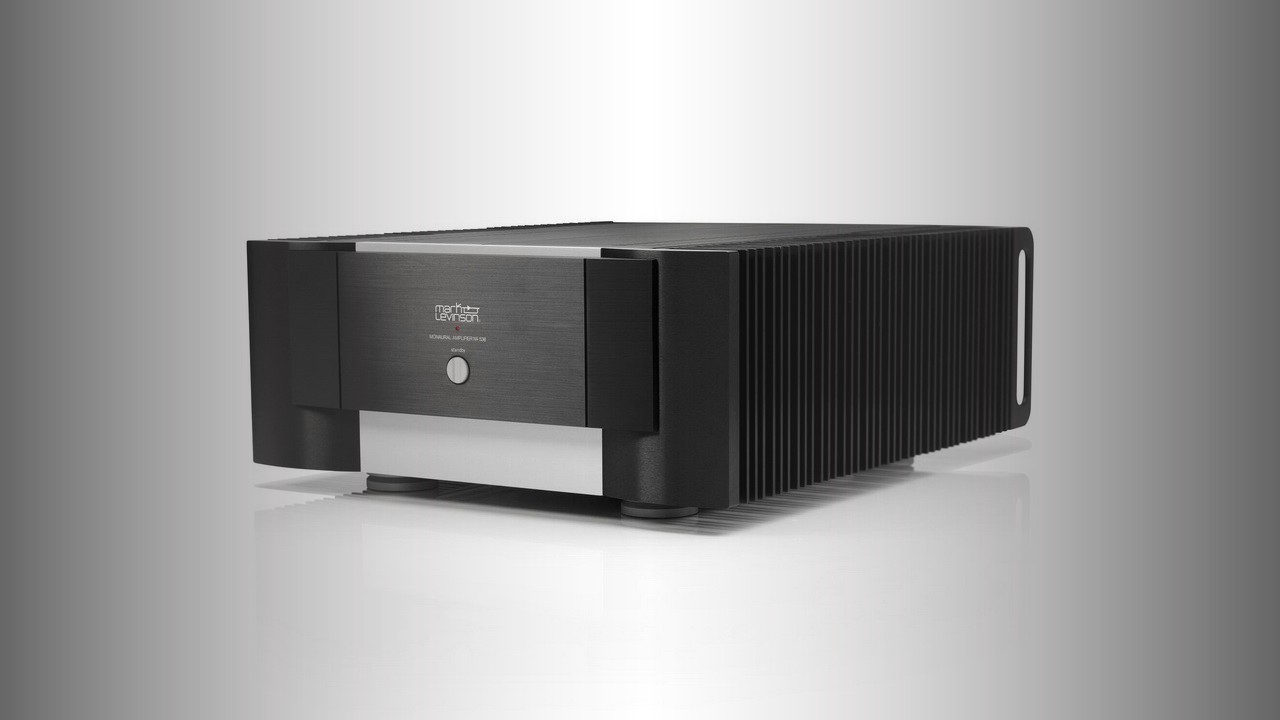
The Mark Levinson № 536 is a power amplifier built around a clear premise: assign one substantial chassis, power supply, and audio circuit to each loudspeaker channel. Rated at 400W into 8 ohms and 800W into 4 ohms, it is intended for systems that require considerable output capability and support for loudspeakers with demanding electrical characteristics. Its minimum specified load impedance is 2 ohms.
Power is only part of the design. The № 536 uses Mark Levinson’s fully differential, fully discrete Pure Path architecture, with direct-coupled circuitry, Class A voltage-gain and main-gain stages, and a deliberately low level of negative feedback. Around that audio platform, the company has added balanced and unbalanced inputs, two pairs of locking speaker terminals, network-based monitoring, configuration access, serial control, and 12V triggers. The result is a traditional high-power monoblock conceived for contemporary, potentially automated hi-fi installations.
A monoblock architecture with substantial output capability
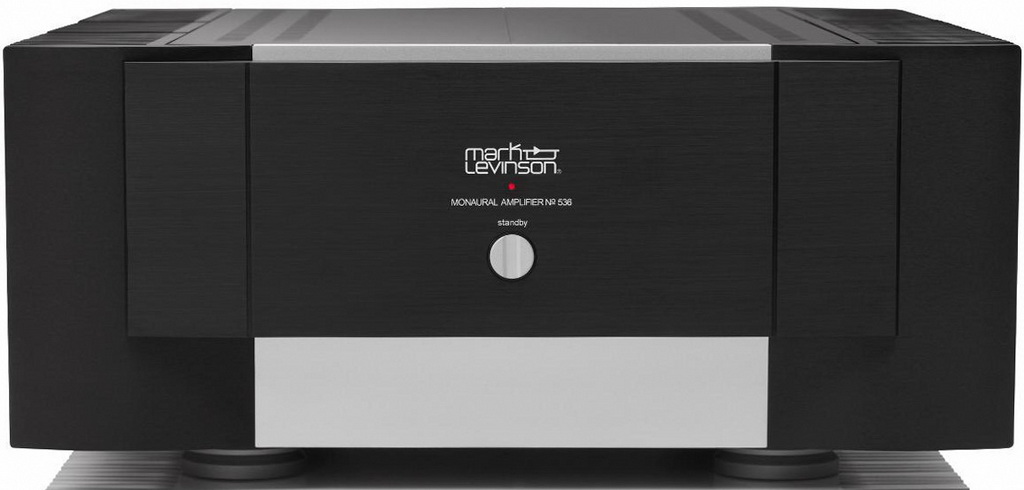
As a mono amplifier, each № 536 handles one audio channel. A stereo installation therefore requires two amplifiers, but the format gives every channel its own chassis, transformer, rectification, filter bank, and output stage. This arrangement will appeal to system builders who prefer physically independent left- and right-channel amplification rather than housing both channels in a shared enclosure.
The amplifier is specified to produce 400W into 8 ohms from 20Hz to 20kHz at less than 0.3% total harmonic distortion, rising to 800W into 4 ohms. The doubling of the stated output as impedance halves is an important indication of the amplifier’s intended role with more demanding speakers. A 2-ohm minimum load specification further broadens the range of loudspeakers with which it can be considered, although speaker impedance behavior and installation conditions should always be evaluated as part of the complete system.
Additional specifications include a 100V/μs slew rate, 26dB voltage gain, harmonic distortion below 0.02% at 1kHz, and a signal-to-noise ratio above 85dB referenced to 2.83V. Its quoted frequency response is 10Hz to 20kHz at +0/–0.2dB. These figures define an amplifier designed for wide bandwidth, high output, and operation into relatively low impedances without requiring unusual gain arrangements upstream.
Pure Path circuitry and the folded-cascode gain stage
The № 536’s Pure Path circuit is fully differential and constructed from discrete devices. Rather than relying on integrated amplifier modules, Mark Levinson uses individual semiconductor components selected and arranged for specific roles within the circuit. The signal path is also direct coupled, reflecting the company’s effort to keep the route through the amplifier straightforward.
A central element of Pure Path is the cascode. In general terms, a cascode combines two transistors so that they function as a composite device, retaining useful characteristics from each while reducing less desirable behavior. For the № 536’s gain stage, Mark Levinson starts with junction field-effect transistors, or JFETs, selected for low noise and high gain. Their size can also introduce gain nonlinearity, so bipolar junction transistors are incorporated to improve bandwidth and linearity.
The output of this JFET-and-BJT cascode is connected to a complementary transistor through what is known as a folded cascode. Current through that complementary device runs in the opposite direction, effectively reversing the direction of signal current. This arrangement is a defining part of the Pure Path architecture and was chosen to provide high gain, low noise, broad dynamic range, and linear operation.
The voltage-gain and main-gain stages operate in Class A. That description should not be confused with claiming that the entire 400W output stage is a pure Class A design; it applies specifically to the documented gain stages. It is nevertheless a meaningful design choice because these stages establish and amplify the low-level signal before the output section supplies the current required by the loudspeaker.
Low-feedback design begins with open-loop behavior
Rather than using a large amount of negative feedback to correct the circuit after the fact, Mark Levinson optimized the № 536 for strong open-loop performance. Open-loop gain and bandwidth were tuned with precision resistors and compensation capacitors, after which additional precision resistors were used to establish the feedback network.
The resulting amplifier uses relatively little negative feedback. Importantly, the documentation describes feedback adjustment as part of circuit development and tuning; it is not presented as an owner-operated control. For a prospective owner, the relevant point is that the amplifier’s linearity is intended to originate substantially from its underlying circuit topology, component selection, and operating conditions.
This approach also explains why the cascode architecture matters beyond being a technical curiosity. By improving gain, bandwidth, and linearity within the gain stage itself, it supports the broader goal of reducing reliance on corrective feedback while still meeting the amplifier’s specified performance targets.
A power supply built on considerable reserves
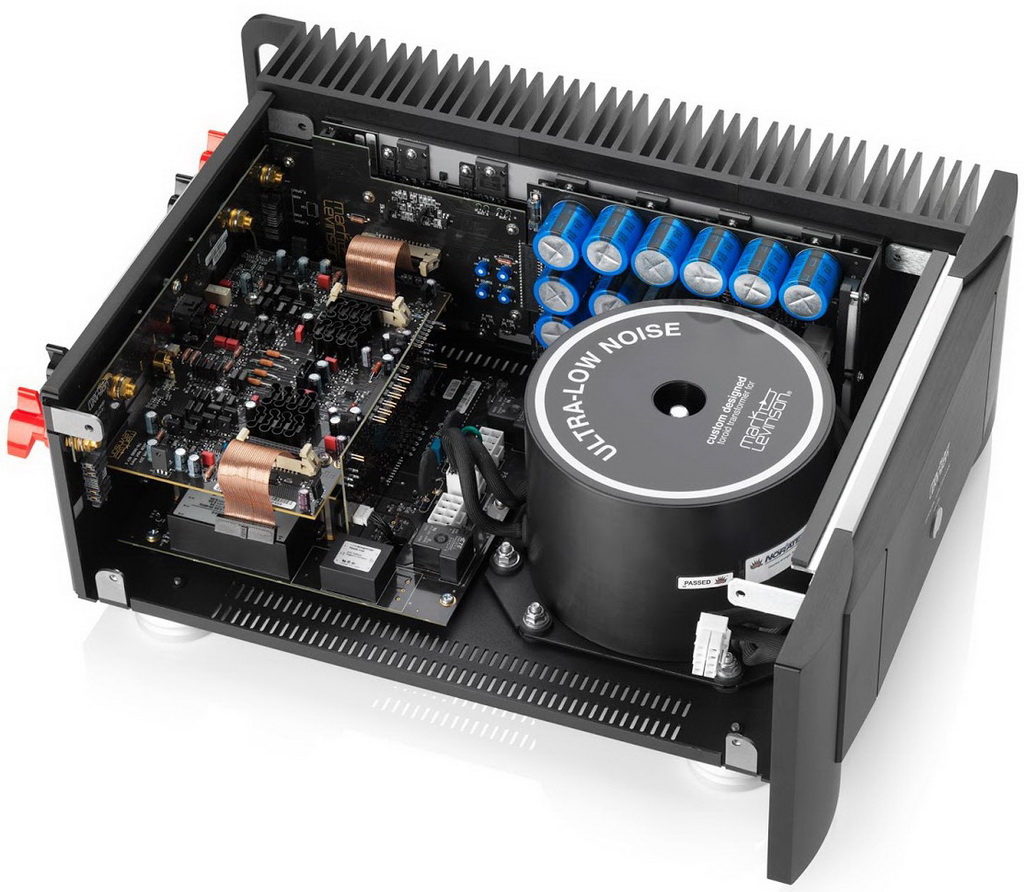
The power supply is centered on a shielded 1800VA toroidal transformer. Rectification is handled by 16 discrete TO-220 high-speed Schottky diodes, each specified at 40A and 250V. The filtering section uses 36 electrolytic capacitors with a combined stated capacity of 169,200μF.
The output section is similarly extensive. It contains 24 discrete TO-264 bipolar output transistors, specified individually at 15A, 260V, and 200W. Another 24 TO-220 bipolar transistors are used, one for each output transistor. This component count helps explain both the amplifier’s power rating and its physical scale.
The № 536 measures 438mm wide, 197mm high, and 533mm deep, with a weight of 45.4kg. Those figures make placement an important part of system planning. Suitable support, sufficient physical space, access to the rear connections, and the practicalities of installing two units for stereo should all be considered before purchase.
Straightforward audio connections and bi-wire support
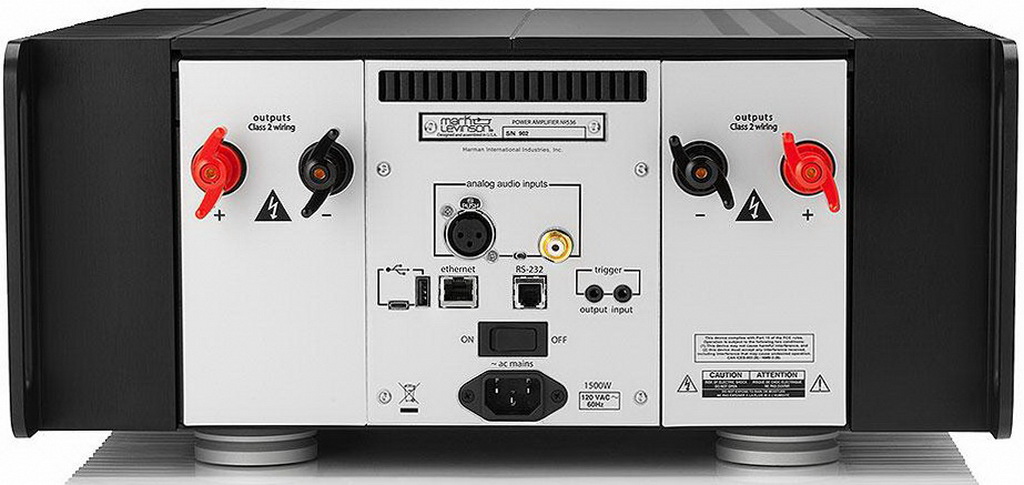
Both balanced XLR and unbalanced RCA inputs are provided, so the № 536 can work with a wide range of preamplifiers or source components equipped with adjustable output. Input impedance is specified at 60k ohms through XLR and 30k ohms through RCA. The higher balanced-input impedance and the availability of both connection standards make integration less restrictive, particularly in systems where the preamplifier and power amplifiers are separated by longer cable runs.
Speaker connection is through two pairs of gold-plated binding posts fitted with Mark Levinson Hurricane locking screws. These provide secure, tool-free cable attachment and allow either conventional single-wire connection or bi-wiring from one amplifier. Banana-plug compatibility is available in the United States and other markets outside Europe.
Providing two terminal pairs is useful for loudspeakers with independently accessible high- and low-frequency inputs. It should not be confused with bi-amping, however: the № 536 remains a single-channel amplifier, and both terminal pairs are fed by that same channel.
Control and monitoring for integrated systems
Although the № 536 follows a conventional analog power-amplifier concept, its control facilities are suited to modern installations. Ethernet/IP networking, RS-232, USB-related configuration access, and 12V trigger input and output are all provided.
The Ethernet connection supports network monitoring and control, while the RS-232 interface allows integration with compatible control systems. A standard USB port can be used with a USB drive for software updates or importing configurations. A separate MicroUSB connection allows a computer to access the amplifier’s internal web page for monitoring and setup. Trigger connections enable coordinated power operation with a preamplifier or other system component.
These facilities are especially relevant when the amplifiers are installed away from the listening position, placed in equipment furniture, or incorporated into a professionally controlled system. They extend usability without turning the № 536 into a network audio device: music still enters through its analog XLR or RCA input, while the digital connections are dedicated to management, updates, and control.
Who the Mark Levinson № 536 is most suitable for
The № 536 is primarily suited to owners building a high-output separates system around a dedicated preamplifier or a source component with variable analog output. Its 400W rating, 4-ohm output specification, and stated 2-ohm minimum load make it particularly relevant when the chosen loudspeakers present substantial power or current demands.
It also makes sense for installations that benefit from remote monitoring, trigger operation, Ethernet control, or RS-232 integration. The choice of XLR and RCA inputs accommodates both balanced and single-ended systems, while the dual binding-post pairs are convenient for owners using bi-wire speaker cables.
There are practical considerations. Stereo requires two 45.4kg chassis, and each amplifier consumes a specified 350W while powered on with no signal. Standby consumption is listed at 65W, with low-power standby reducing that to 5W and eco standby to less than 0.5W. Buyers who prioritize compact dimensions, low idle consumption, or a single-box amplifier may therefore find another format more appropriate. For those prepared to accommodate its size and dedicated-channel architecture, the № 536 offers a carefully defined combination of power, circuit sophistication, connection flexibility, and control-system compatibility.
Conclusion
The Mark Levinson № 536 is distinguished by more than its 400W output rating. Its fully discrete, fully differential Pure Path circuitry, folded-cascode gain stage, low-feedback design, substantial 1800VA power supply, and support for loads down to 2 ohms establish it as a purpose-built monoblock for ambitious separates systems. Balanced and unbalanced inputs keep preamplifier matching flexible, while locking dual speaker terminals, Ethernet monitoring, RS-232, USB configuration, and 12V triggers address both conventional listening rooms and integrated installations. It is best suited to owners with demanding loudspeakers, sufficient space for two large chassis, and an interest in combining traditional analog amplification with practical modern system control.



Sound Off
0Join the discussion if you have something to add.