
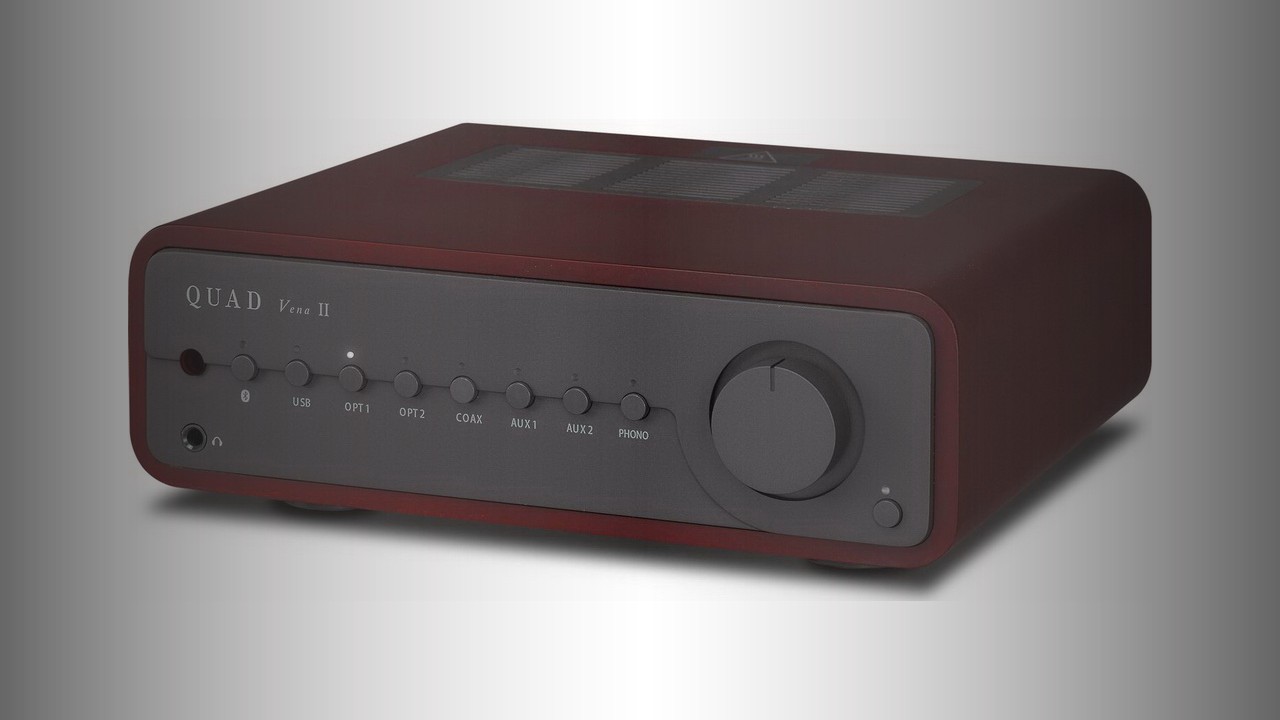
The Quad Vena II is designed for listeners who want a compact stereo amplifier without limiting themselves to a single format or source. Its 45-watt-per-channel output into 8 ohms is joined by an MM phono stage, line-level analog inputs, multiple digital connections, high-resolution USB support, Bluetooth aptX, and a dedicated headphone amplifier. That combination allows the Vena II to sit at the center of a varied system containing a turntable, computer, television, disc transport, smartphone, and conventional loudspeakers. Quad also separates the power supplies for its digital and analog circuitry, an engineering choice intended to reduce interaction between the amplifier’s different sections. With a choice of an all-metal enclosure or additional wooden side panels, it also presents its broad functionality in a relatively understated form.
A practical foundation for a compact stereo system
At 94 x 313 x 302 mm, the Vena II is substantially narrower than a conventional full-width hi-fi component. Its 7.5 kg weight, however, indicates that this is not simply a lightweight desktop accessory. The format makes it suitable for spaces where a traditional equipment rack would be inconvenient, while retaining the connections expected from a serious integrated amplifier.
The power amplifier is rated at 2 x 45 watts into 8 ohms and 2 x 65 watts into 4 ohms. The increase into the lower impedance is useful when considering real-world loudspeakers, whose electrical demands rarely remain constant across the frequency range. Quad positions the amplifier for use with quality bookshelf speakers and in medium-sized rooms, although prospective owners should still consider speaker sensitivity, impedance behavior, room size, and desired playback level when matching a system.
A pair of secure screw terminals provides the speaker connection. This straightforward arrangement suits a conventional two-channel installation rather than a multi-zone or multi-speaker setup, keeping the Vena II focused on its primary role as the center of a compact stereo system.
Digital connectivity beyond a basic integrated amplifier
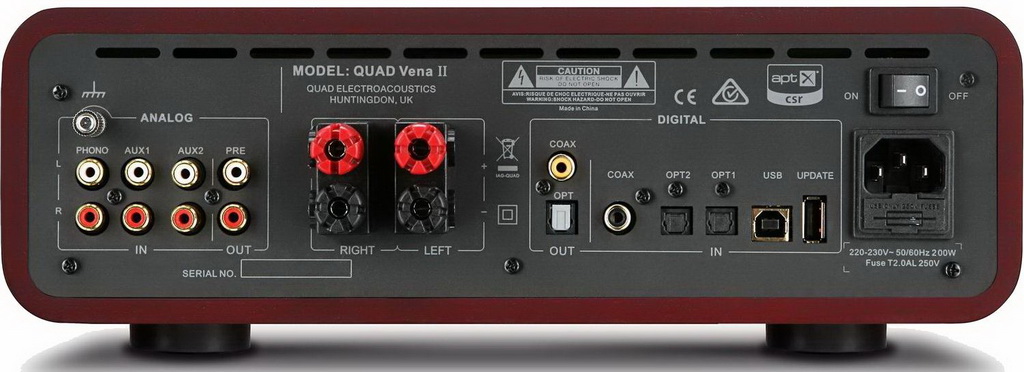
The Vena II accommodates several common digital-source types. Two optical inputs and one coaxial input can be used with televisions, CD transports, media players, and other components equipped with S/PDIF outputs. These inputs support PCM signals at up to 24-bit/96 kHz, which is sufficient for many music libraries and the output formats commonly available from televisions and conventional digital transports.
USB Type-B is provided for a direct computer connection. Through USB, the amplifier supports PCM at sampling rates up to 384 kHz as well as DSD256. This gives owners a route for playing high-resolution files without adding a separate USB digital-to-analog converter between the computer and amplifier. The exact bit-depth description in the published specifications varies, but the documented maximum sampling rate is 384 kHz, alongside DSD256 support.
A rear USB Type-A port serves a different purpose: it can charge compatible Apple devices and play music from them. Keeping the two USB roles separate makes the layout easier to understand. Type-B is the computer-audio interface, while Type-A addresses compatible portable devices rather than acting as a duplicate computer input.
Bluetooth for convenient everyday listening
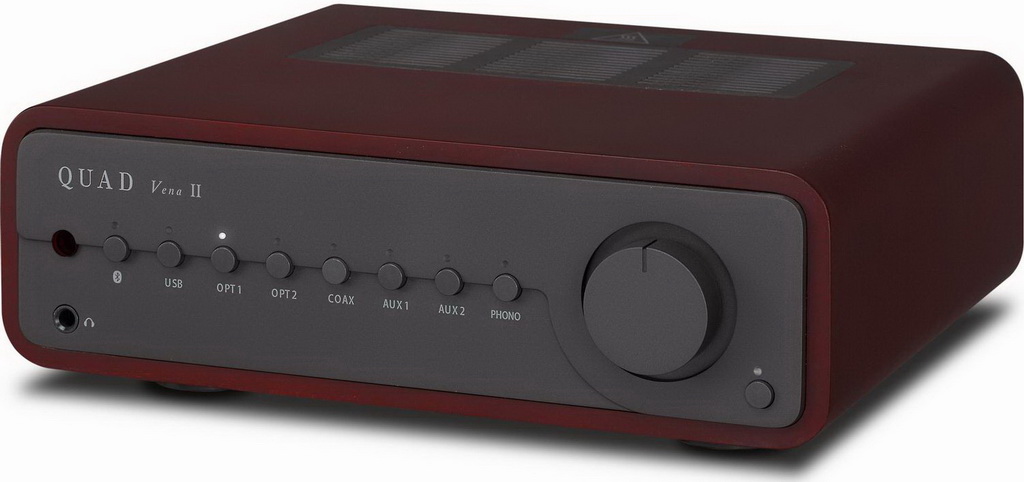
Bluetooth adds a quick, cable-free source option for smartphones and tablets. The Vena II supports the A2DP profile along with aptX and SBC codecs. When paired with an aptX-compatible source, it can use aptX rather than relying exclusively on the standard SBC codec.
This functionality is valuable in a shared household or any system used for both focused and casual listening. A visitor or family member can connect a portable device without accessing the primary computer or physically changing cables. Bluetooth also gives streaming services a simple path into the stereo system, provided they are running on the connected phone or tablet.
The Vena II should not, however, be mistaken for a complete network streamer. The documented connectivity does not include built-in Wi-Fi, Ethernet, or named integrated streaming platforms. Owners who want app-controlled network playback, multiroom integration, or direct access to online services would need an external streamer, which could be connected through one of the amplifier’s digital or analog inputs.
Analog sources and an integrated MM phono stage
Quad has not treated analog connectivity as secondary. Two pairs of line-level RCA inputs allow conventional sources such as a tuner, external streamer, disc player, tape component, or separate DAC to be connected. This preserves room for system expansion even when the amplifier’s own digital inputs are already in use.
The dedicated moving-magnet phono input is particularly useful for listeners building a compact vinyl system. A compatible MM cartridge can be connected without requiring an external phono preamplifier, reducing the number of boxes, power supplies, and interconnects around the turntable. The listed phono input impedance is 47 kOhms, while the line-level RCA input impedance is specified at 10 kOhms.
The inclusion of phono, line-level, USB, S/PDIF, and Bluetooth inputs makes the Vena II relevant to collections that span several generations of playback technology. It can support vinyl and locally stored computer files while also accepting audio from contemporary portable devices. That breadth is one of its most practical attributes.
Headphones, preamplifier output, and digital expansion
A 3.5 mm headphone socket is placed on the front panel, where it can be reached without moving the amplifier. More importantly, the headphone output is supported by a separate amplifier module rather than being presented merely as an incidental convenience. That makes private listening part of the Vena II’s intended use, although owners of headphones requiring unusual power levels should still check compatibility before purchase.
An analog RCA pre-output provides another avenue for expansion. It can be used to pass a variable line-level signal to suitable external equipment, potentially including a separate power amplifier or an active subwoofer with the appropriate input and controls. This gives the Vena II more flexibility than an integrated amplifier restricted to speaker terminals and fixed source inputs.
Optical and coaxial digital outputs are also included. These connections can pass a digital source onward to compatible external equipment, allowing the amplifier to participate in a system that includes a separate digital recorder or converter. Their presence is useful for owners who expect their systems to change over time and do not want every upgrade to require replacing the central amplifier.
Circuit separation and long-term usability
Inside the Vena II, the digital and analog circuits are powered by separate stabilized supplies. The purpose of this arrangement is to reduce crosstalk and limit unwanted interaction between sections handling different types of signal. It is a considered design choice in a product where digital conversion, wireless reception, low-level phono signals, preamplification, and speaker amplification all occupy the same enclosure.
The published specifications include a signal-to-noise ratio above 108 dB, distortion below 0.0005 percent at 30 watts into 8 ohms, and a frequency response of 20 Hz to 20 kHz within plus or minus 0.5 dB. These figures define the manufacturer’s stated engineering targets; they should not be read as listening impressions or independent measurements.
Usability also benefits from a relatively direct control layout and the front-mounted headphone connection. The metal enclosure can be specified on its own or complemented by wooden side panels, allowing the amplifier to suit either a more technical-looking installation or a room where warmer materials are preferred. Both treatments retain the same compact underlying design.

Who the Quad Vena II is most suitable for
The Vena II is best suited to someone assembling a space-conscious two-channel system around passive speakers and several different source types. It is especially relevant for listeners who alternate between a computer, turntable, television or digital transport, Bluetooth device, and headphones. Its built-in conversion and phono facilities can eliminate the need for several separate components.
It also makes sense for owners who value future flexibility. The line inputs can accept external source components, the pre-output leaves room for amplification or subwoofer expansion, and the digital outputs support integration with other compatible hardware. The choice of metal or wood-trimmed styling broadens its suitability for both desktop-adjacent and living-room systems.
It will be less appropriate for users who require integrated Wi-Fi streaming, Ethernet, multiroom software, balanced analog connections, or multiple pairs of speaker outputs. Likewise, very insensitive speakers, unusually difficult loads, or large rooms may call for more amplifier power. Its documented 45 watts per channel into 8 ohms should therefore be matched thoughtfully rather than judged by wattage alone.
Conclusion
The Quad Vena II’s principal strength is the way it combines a conventional integrated amplifier with the connections required by a mixed-format modern system. Its 45-watt-per-channel output, MM phono input, two analog line inputs, optical and coaxial connectivity, high-resolution computer USB interface, Bluetooth aptX, dedicated headphone module, pre-output, and digital outputs cover an unusually broad range of everyday source requirements within a compact chassis. Separate stabilized supplies for the analog and digital circuitry further show that its many functions were considered as parts of one integrated design. It is most compelling for listeners seeking a tidy stereo hub for passive bookshelf speakers, vinyl, computer audio, portable-device streaming, television sound, and headphones, provided they do not require built-in network-streaming services or substantially higher output power.


Sound Off
0Join the discussion if you have something to add.