
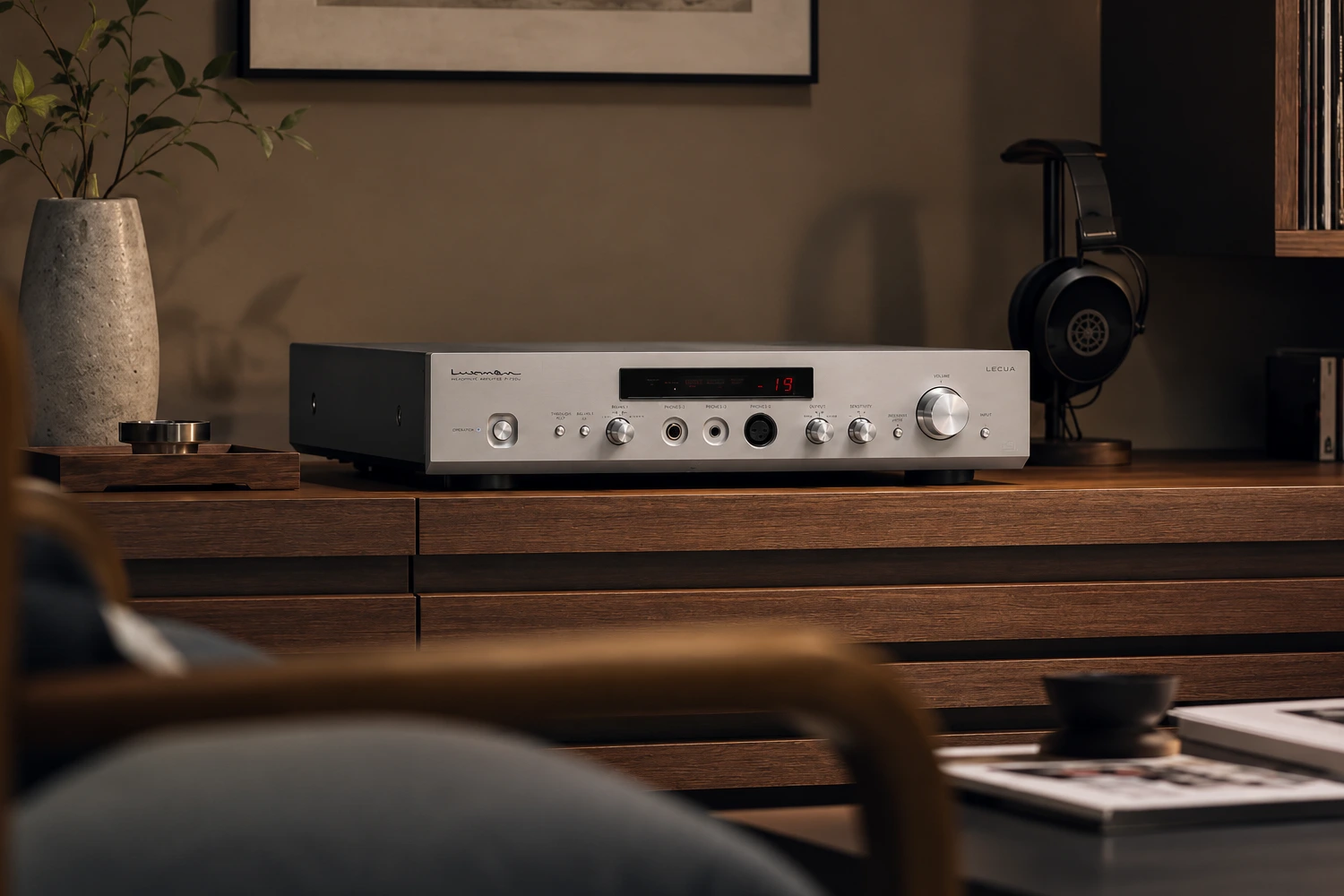
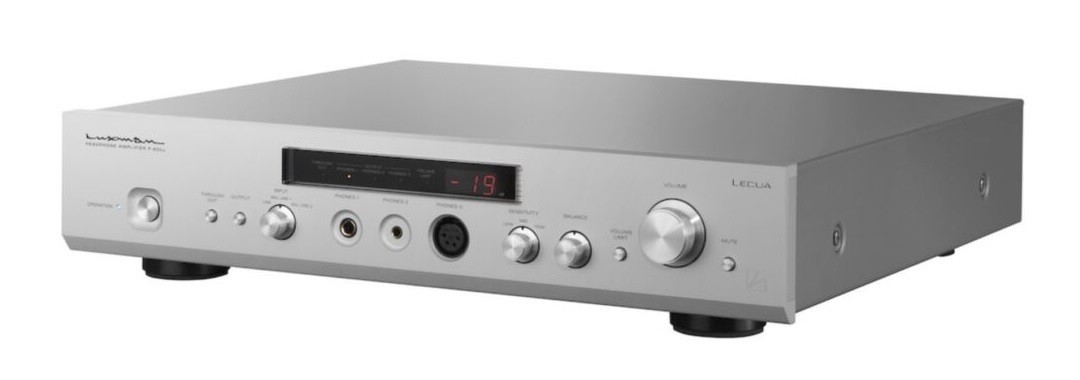
Rather than treating headphone listening as an accessory to a conventional hi-fi system, Luxman has built the P-800u as a dedicated, full-width analog component. Shown publicly at the Tokyo International Audio Show, it draws on technology and expertise developed for the P-100 Centennial while occupying its own place in the company’s headphone-amplifier range. Its defining idea is a four-channel amplification architecture used differently according to the selected headphone connection: bridged balanced operation for the 4.4 mm and four-pin XLR sockets, or parallel unbalanced drive through the 6.35 mm output. There is no onboard digital conversion or streaming layer.
A P-100 Centennial connection without the digital extras
The relationship to the P-100 Centennial establishes the P-800u’s engineering context. Luxman says technology and expertise created for that model have informed the newer amplifier, but the P-800u is presented as an exclusively analog design. Its job is therefore narrowly defined: accept a line-level analog source, control volume and drive a wide range of wired headphones through balanced or conventional connections.
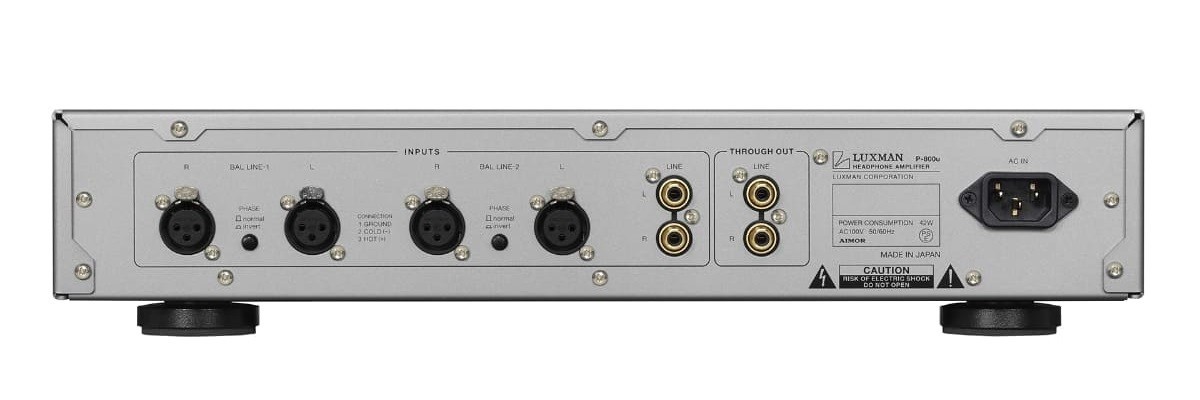
That focus will make the most sense in systems where digital conversion is already handled elsewhere. A standalone DAC, disc player with analog outputs, phono stage routed through a preamplifier, or another line-level component can feed the P-800u without duplicating digital functions inside the headphone amplifier. The rear pass-through output also allows the signal to continue to a preamplifier or integrated amplifier, reducing the need to disconnect a source when moving between headphones and loudspeakers.
Physically, this is closer to a traditional hi-fi component than a compact desktop accessory. The chassis measures 440 x 402 x 93 mm and weighs 15.7 kg. Luxman has finished it in the company’s familiar Blaster White color. Those dimensions and the substantial weight imply a permanent place on a rack or large desk rather than a system intended to be moved frequently.
Four amplifier channels, used in two different ways
At the center of the P-800u is version 1.1 of Luxman’s proprietary LIFES feedback circuit. All four channels use the same circuit size and configuration, an arrangement intended to preserve consistency across the amplifier’s balanced architecture. LIFES is Luxman’s current feedback technology, and its deployment across every channel is one of the clearest links between the P-800u’s positioning and its internal design.
Connecting headphones through either the 4.4 mm socket or the four-pin XLR output places the amplifier in bridged, or BTL, balanced mode. Here, the four amplification channels provide separate drive for the left and right sides. Luxman attributes improved channel separation, more precise localization, lower intermodulation distortion and tighter supply-voltage regulation to this configuration. Those are manufacturer-stated benefits rather than independent performance findings, but they explain why both common balanced headphone formats are provided on the front panel.
The 6.35 mm output makes different use of the same hardware. In unbalanced mode, two amplification circuits are combined in parallel for each side, doubling the available output-current capacity. Instead of leaving half of the four-channel architecture unused when conventional headphones are connected, the P-800u redirects it toward parallel drive. That distinction is important: balanced and unbalanced users receive different circuit configurations, not merely different socket types attached to an identical output stage.
Output figures cover low- and high-impedance loads
Luxman specifies continuous unbalanced output at 4W + 4W into 8 ohms, 2W + 2W into 16 ohms and 1W + 1W into 32 ohms. At the other end of the impedance range, the rating is 53mW + 53mW into 600 ohms. The published signal-to-noise ratio for unbalanced operation is 116 dB.
Balanced output is rated at 8W + 8W into 16 ohms and 4W + 4W into 32 ohms, with 213mW + 213mW available into 600 ohms. Luxman quotes a 119 dB signal-to-noise ratio in this mode. The figures are not directly interchangeable across every load because the company lists different impedance points for the two operating configurations, but they show that the amplifier is specified for both relatively low-impedance and 600-ohm headphones.
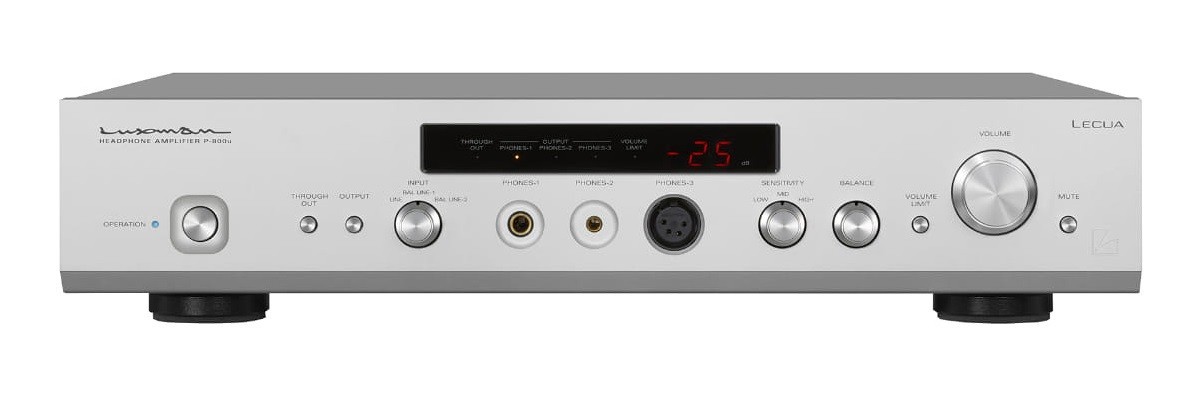
A three-position sensitivity control adds another layer of adjustment. Rather than relying on the volume knob alone for headphones with widely differing requirements, users can select an appropriate sensitivity range first. A left-right balance control is also included, with Luxman stating that it operates without degrading sound quality. Together, these controls broaden the setup options without moving the P-800u away from its analog remit.
LECUA volume control and built-in level protection
Volume is managed by Luxman’s electronically controlled LECUA attenuator. The design is intended to minimize discrepancies between the left and right channels at low settings while avoiding changes in quality as the level is adjusted. Low-volume channel tracking is particularly relevant to a powerful headphone amplifier, where sensitive headphones may place normal listening near the bottom of a conventional potentiometer’s range.
A volume display makes the selected setting visible, while a six-step volume-limiting function can restrict the amplifier’s maximum level. That feature is designed to protect both hearing and connected headphones, and it is especially relevant when equipment is shared or when users regularly alternate between models with very different sensitivities. The limiter, gain selection and balance adjustment give the P-800u more operational control than a minimalist input-and-volume design.
Source connectivity consists of one pair of unbalanced RCA inputs and two sets of balanced XLR inputs. On the output side, the front panel carries the balanced 4.4 mm and four-pin XLR sockets alongside the unbalanced 6.35 mm connection. The rear pass-through completes the system-oriented layout, allowing the amplifier to sit between an analog source and another amplification component. Power consumption is listed as 42W, falling to 27W when no music is playing.
The P-800u appears aimed at headphone systems that already have their source and conversion arrangements settled, and whose owners want balanced and conventional headphones served by purpose-specific implementations of the same four-channel platform. Its full-size chassis, multiple analog inputs and rear pass-through also make it easier to view as part of a wider component system rather than an isolated desktop amplifier. The main unanswered questions concern market timing and cost: regional pricing and delivery information have not yet been announced. When those details emerge, they will clarify how Luxman intends to position the P-800u alongside the P-100 Centennial and within the broader market for reference-oriented analog headphone amplifiers. Until then, the significant point is its tightly defined role—an analog-only hub built to use all four amplifier channels regardless of which headphone output is selected.


Sound Off
0Join the discussion if you have something to add.