
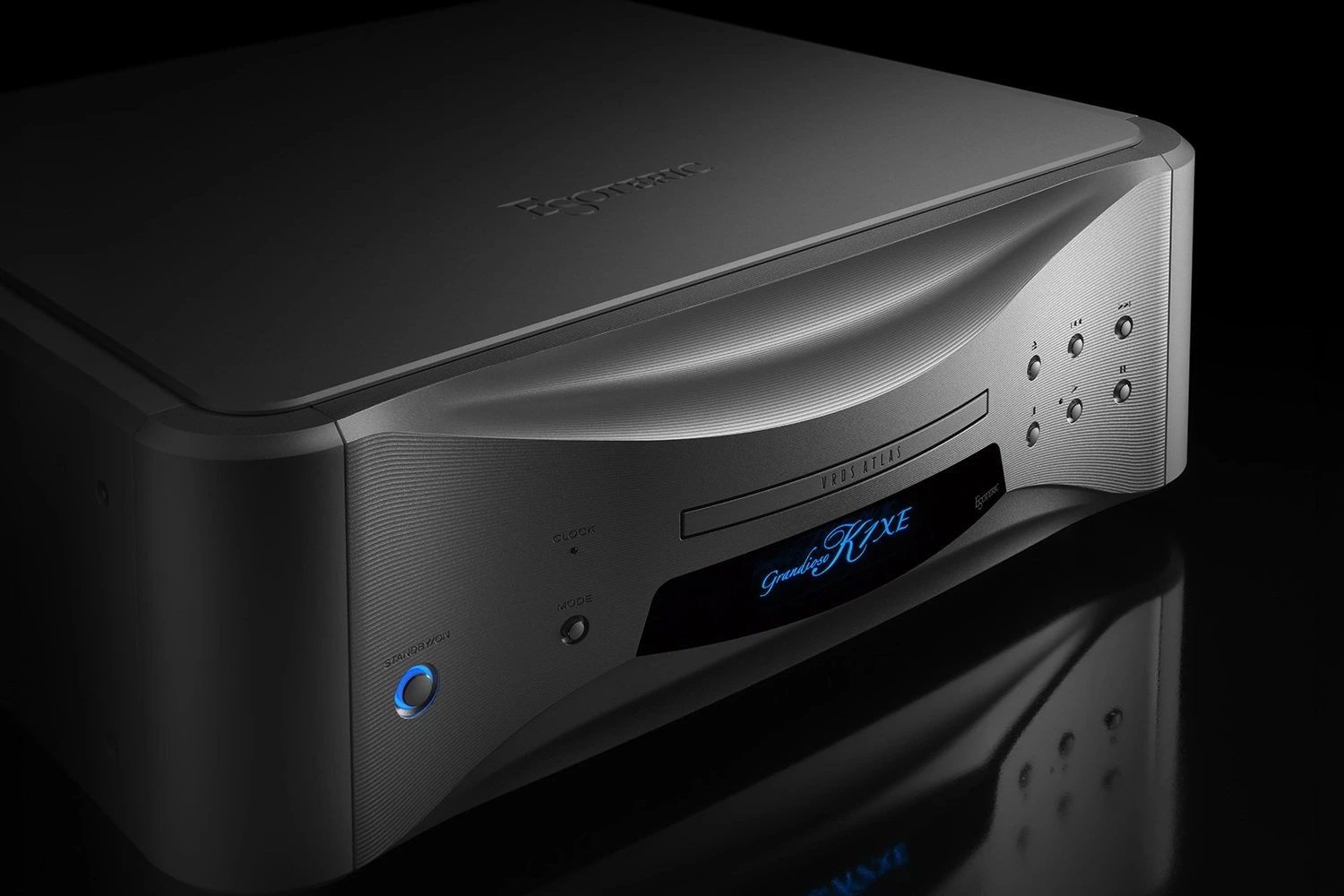
Esoteric’s latest Grandioso source is built around three priorities: physical control of optical discs, proprietary digital conversion and room for the system to expand beyond a single chassis. The Grandioso K1XE combines the company’s substantial VRDS-ATLAS SACD transport with its second-generation Master Sound Discrete DAC, while digital inputs allow it to serve sources beyond its disc mechanism. Owners can also add an external 10 MHz master clock and the matching PS1XE power supply. At 34.3 kilograms, this is nominally an integrated player, but its construction and upgrade architecture place it closer to a modular flagship digital system.
VRDS-ATLAS makes the disc mechanism the physical center
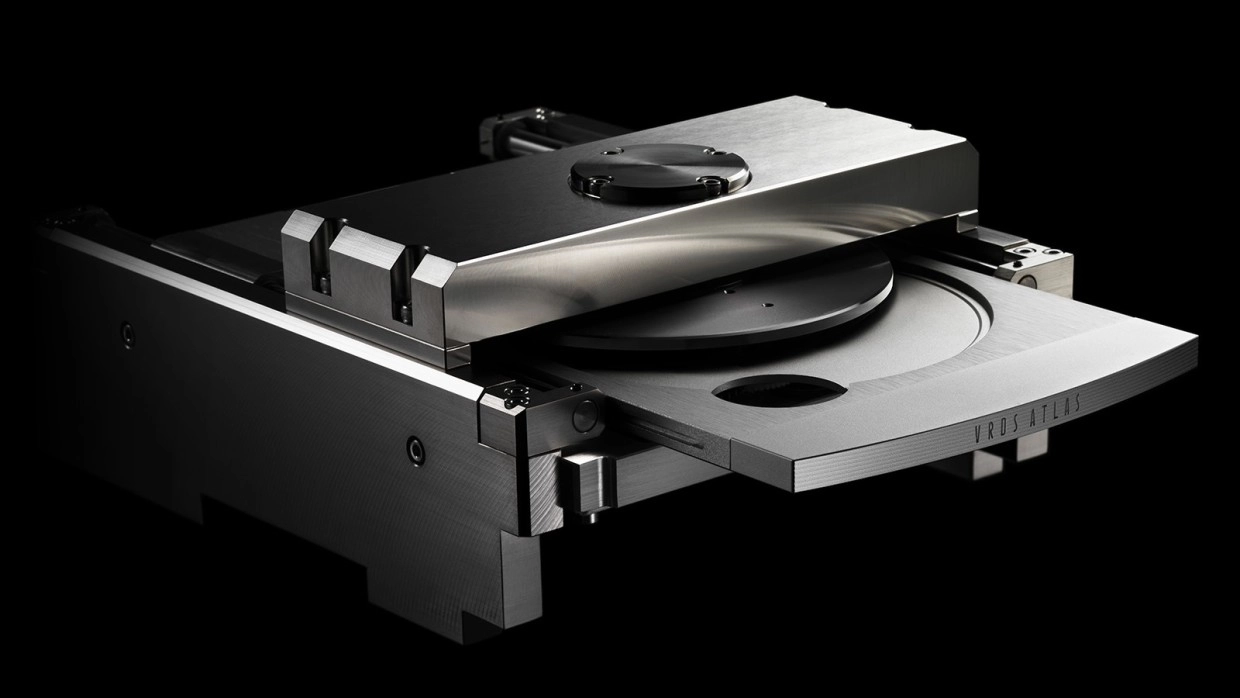
The defining hardware element is Esoteric’s VRDS-ATLAS transport, a mechanism designed for CD and SACD playback. Its clamping system holds the disc against a turntable of matching diameter. That arrangement is intended to control vibration and correct disc warping, giving the optical pickup a more stable surface from which to read data.
Esoteric’s figures underline how much of the K1XE’s engineering is concentrated on this task. The mechanism weighs 6.6 kilograms by itself and 13.5 kilograms when its base is included. Structural parts use SS400 steel, while the turntable is made from duralumin. A low-center-of-gravity layout further indicates that mechanical stability was treated as a system-level requirement rather than left to the transport assembly alone.
That approach carries a clear trade-off. This is not a compact disc player designed to disappear onto a narrow shelf. The K1XE measures 445 x 162 x 447 millimeters and weighs 34.3 kilograms, so installation requires furniture able to accommodate both its depth and mass. The scale is consequential, however: it reflects a source component in which disc handling, chassis behavior and internal isolation are central parts of the design brief.
The G2 converter replaces an off-the-shelf DAC path
Disc control is only one half of the K1XE’s hierarchy. Once the data has been recovered—or received through a digital input—it is passed to the second-generation Master Sound Discrete DAC. Esoteric first introduced this converter concept in 2019, and the G2 revision continues to avoid a conventional integrated DAC chipset.
Conversion instead uses an FPGA-based multilevel delta-sigma architecture with proprietary 64-bit, 512Fs modulation. Separate processing algorithms are provided for PCM and DSD. On the analog side, the design incorporates industrial MELF resistors and Esoteric IDM-01 amplifier modules. Revisions for this generation include an updated resistor network and greater separation between the FPGA and analog power lines.
Four high-current buffer circuits are assigned to each channel. According to Esoteric, the revised architecture is intended to improve noise behavior, image definition and drive capability. Those intended effects remain manufacturer claims rather than independent listening findings, but the underlying layout shows where the G2 design differs from a DAC assembled around a single commercial conversion chip.
The converter operates in a fully dual-mono configuration, keeping the left and right channels in independent sections. Published specifications give a frequency range of 5 Hz to 30 kHz at minus 3 dB, a signal-to-noise ratio of 113 dB and distortion of 0.001 percent at 1 kHz. These figures provide context, although the more distinctive aspect is the combination of channel separation, custom digital processing and discrete analog circuitry.
One chassis, but not a closed digital system
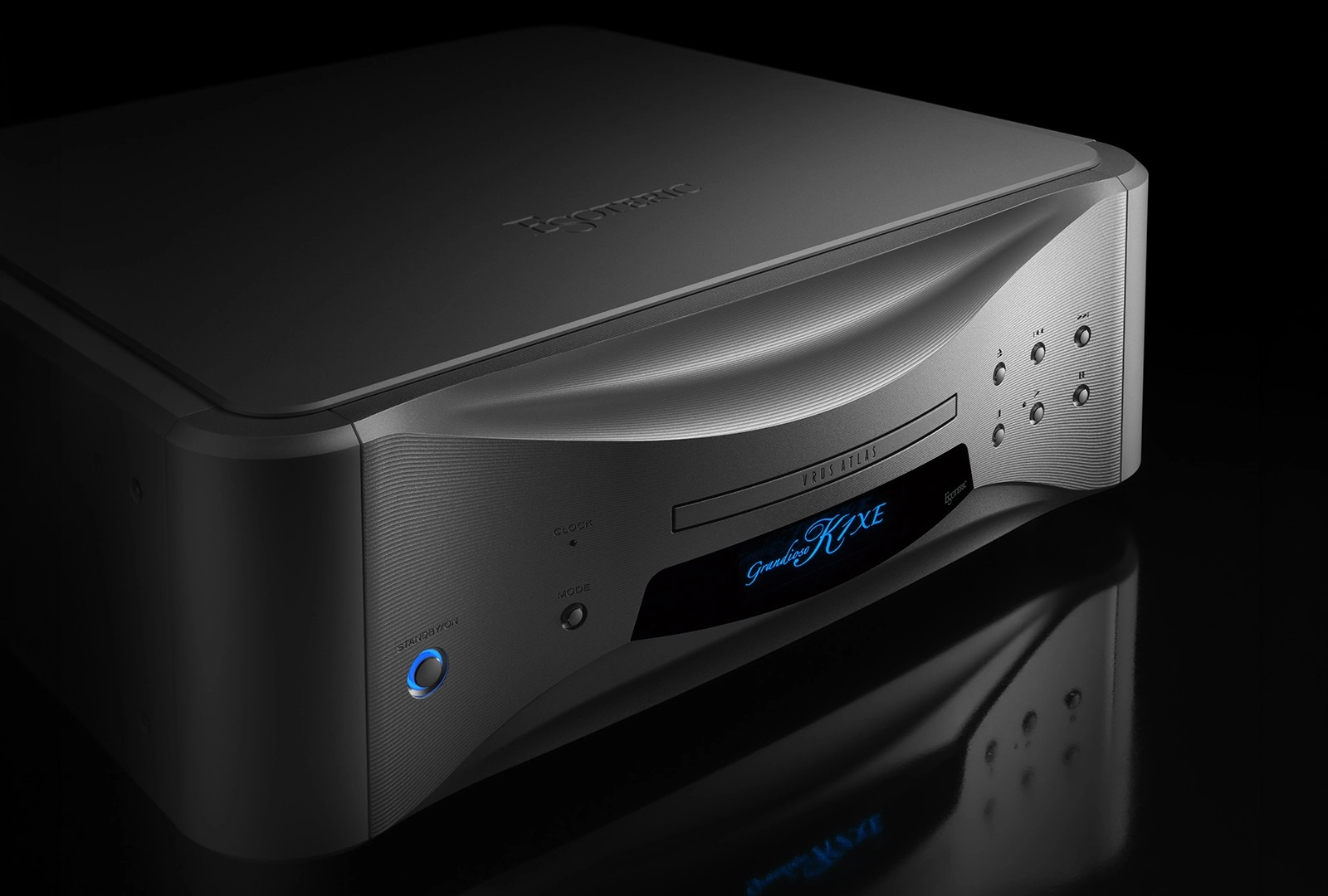
Although optical playback receives the heaviest mechanical investment, the K1XE is also intended to operate as a DAC for external sources. Its new ES-Link 5 digital input supports connection to the Grandioso N1T streaming transport. That makes the internal G2 converter available to both physical media and network playback without requiring a separate DAC chassis.
This relationship changes the role of the product. A conventional integrated SACD player can become peripheral in a system that increasingly relies on streaming. Here, Esoteric has made the transport and converter independently useful: the disc mechanism addresses existing CD and SACD libraries, while the digital-input provision extends the life of the analog output stage and conversion platform.
Five linear power supplies divide duties among the two DAC channels, disc mechanism, digital circuitry and control system. Separate supplies do not make the K1XE physically modular, but they follow the same isolation logic seen elsewhere in the design. Mechanical operation, data processing and analog conversion are housed together while being given dedicated power domains.
Clock and PS1XE options create a staged upgrade route
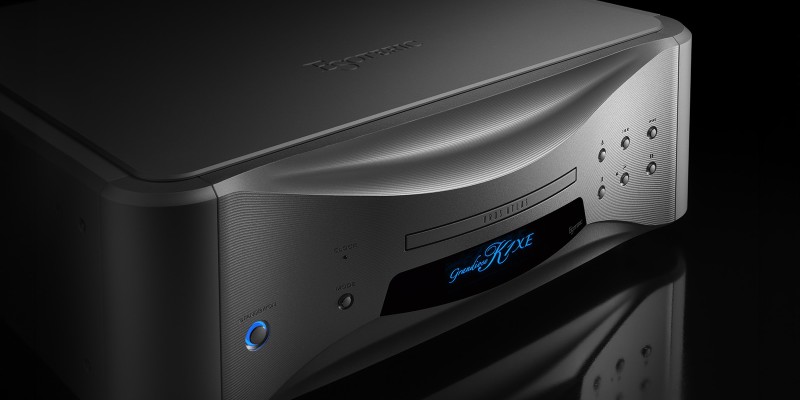
A 10 MHz BNC clock input allows the K1XE to work with the Grandioso G1X master clock generator. The internal clock remains part of the player, so the external generator is an option rather than a prerequisite. Its presence gives owners of larger Grandioso systems a way to integrate timing across compatible components without making the base player dependent on another box.
Power can be externalized through the matching Grandioso PS1XE. The supply uses four transformers to feed the left and right conversion stages and their output buffers independently. When connected, the corresponding transformers inside the supported source component are switched off. Esoteric’s stated aim is to reduce vibration and magnetic interference while increasing the degree of separation between digital and analog power delivery.
The PS1XE also includes filtering intended specifically for products fitted with the G2 converter. Its construction uses a multilayer chassis, semi-floating top panel and isolation feet. Compatibility extends beyond the K1XE to the Grandioso N1, K1X SE and K1X, making the supply an upgrade component that can remain relevant across several supported Grandioso sources.
This arrangement preserves the usefulness of the K1XE as a self-contained player while reserving the most elaborate power architecture for buyers who want a multichassis installation. It also avoids forcing every owner to accommodate the external supply from the outset. The implication is a deliberately staged ownership model: begin with the integrated source, then add clocking, external power or a matching streaming transport according to the wider system.
Esoteric expects the Grandioso K1XE and PS1XE to become available worldwide from November 2026, with regional details likely to determine the exact rollout. No USD pricing has been specified. The product appears directed at listeners who still treat CD and SACD as primary formats but do not want their flagship source restricted to discs. Its ES-Link 5 input, external clock connection and optional supply provide several routes into a broader Grandioso installation, while the internal transport, DAC and five linear supplies preserve single-chassis operation. The key question for prospective owners will be how much of that expansion path they intend to use. Further documentation should clarify the complete digital-input support and regional ordering arrangements, both of which will matter when positioning the K1XE as either a standalone player or the center of a larger digital front end.


Sound Off
0Join the discussion if you have something to add.