
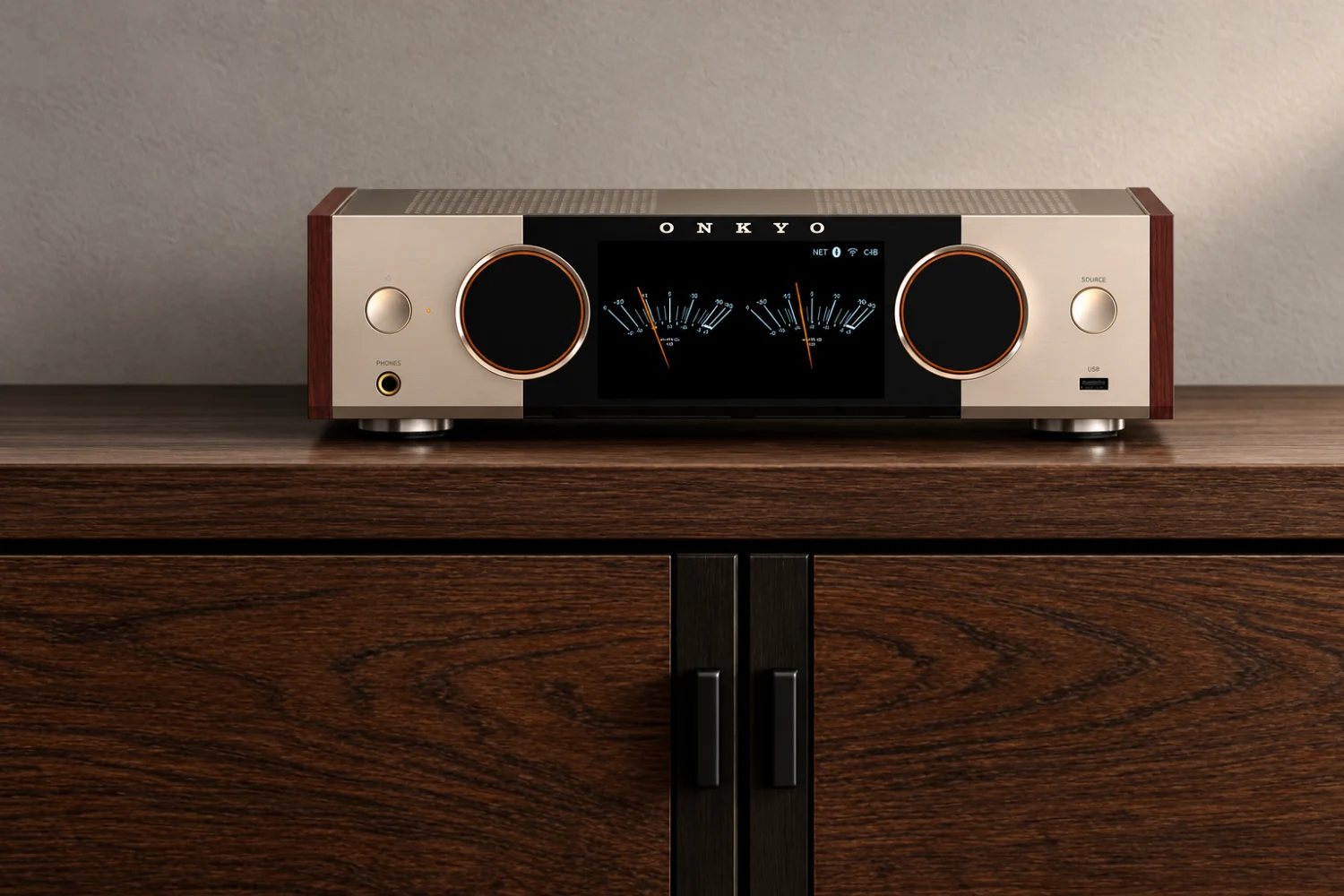
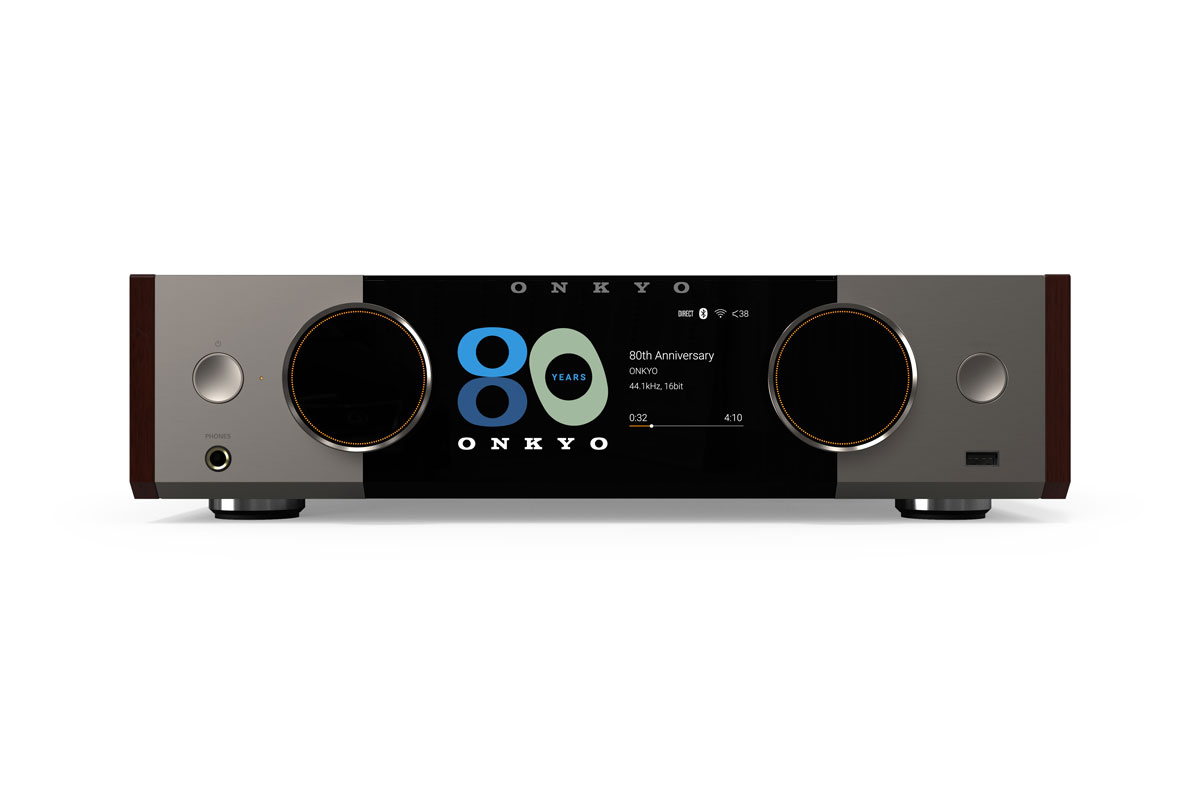
Rather than marking its 80th anniversary with a purely commemorative component, Onkyo has used the occasion to define a modern centerpiece for the Muse Series. The Muse Y-50G 80th Anniversary Edition is a network integrated amplifier that connects the company’s history to the requirements of a current stereo system: substantial Class-D output, built-in streaming, MM and MC phono support, television integration and room correction. Its Bordeaux walnut side panels, Champagne Gold aluminum faceplate and virtual VU meters refer directly to earlier Onkyo Integra electronics, but the underlying proposition is contemporary—one relatively compact component designed to manage sources, amplification and system setup.
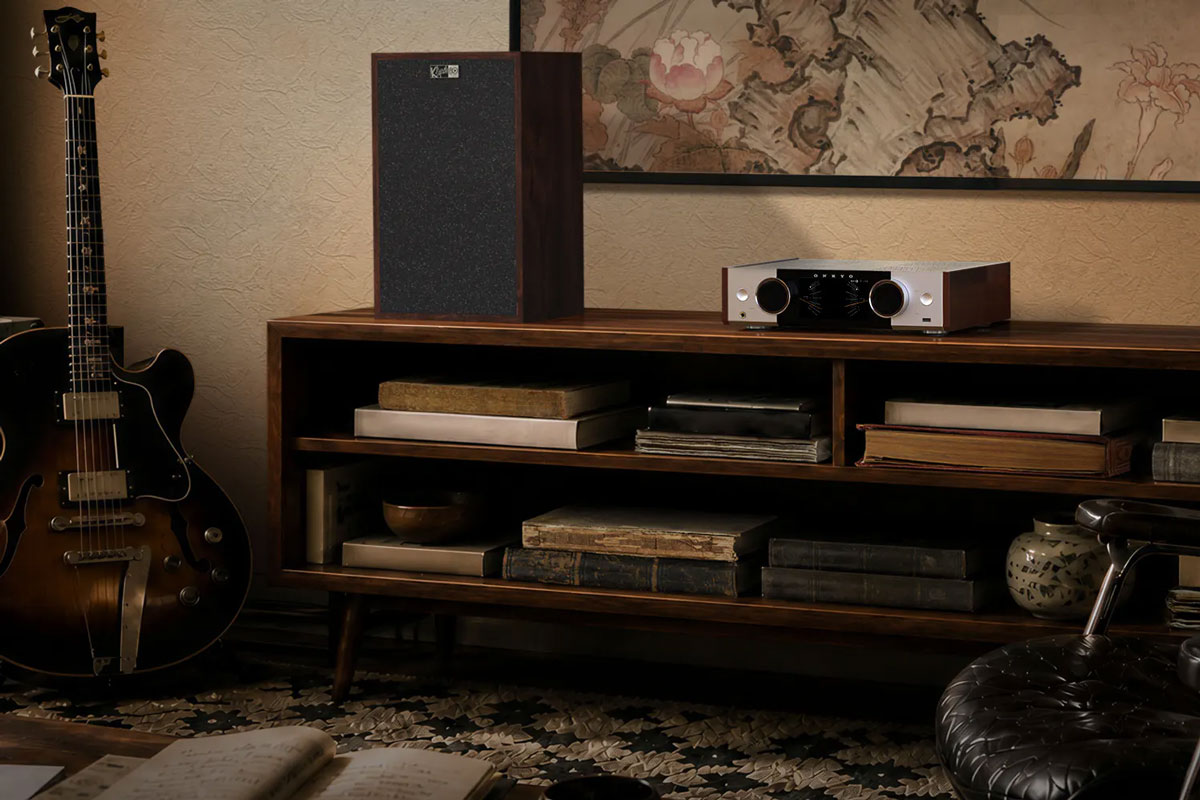
An Integra reference point, not a retro replica
Founded in 1946, Onkyo is using the Y-50G to acknowledge eight decades of audio production while giving the amplifier a defined role within its present-day range. The visual reference is the company’s Integra equipment from the 1990s, particularly the M-588 power amplifier. That model’s substantial appearance, illuminated meters and real-wood details inform the anniversary edition without dictating an exact reproduction.
The distinction matters because the Y-50G is not limited to being a display piece for established Onkyo enthusiasts. Its architecture brings together functions that would once have required several separate components. Streaming, source selection, phono amplification, room equalization and speaker power all sit within a chassis measuring 350mm wide, making the unit easier to accommodate than conventional full-width hi-fi hardware.
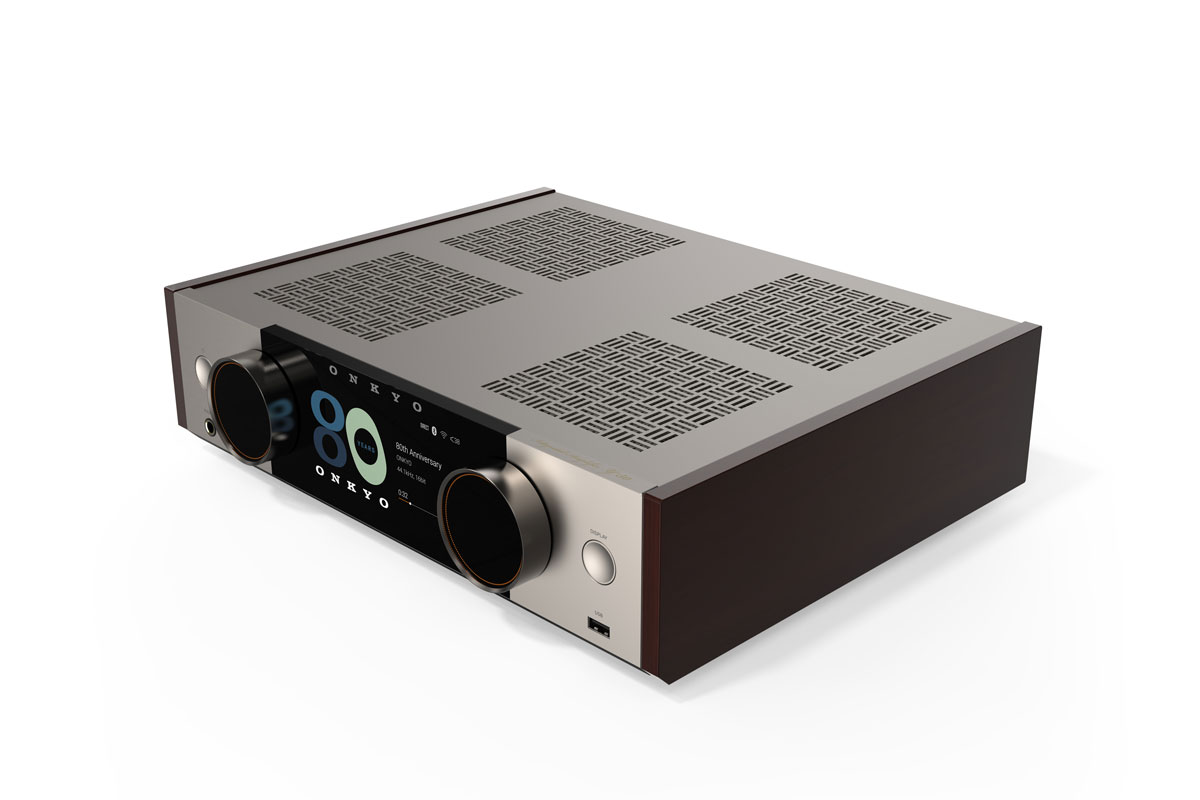
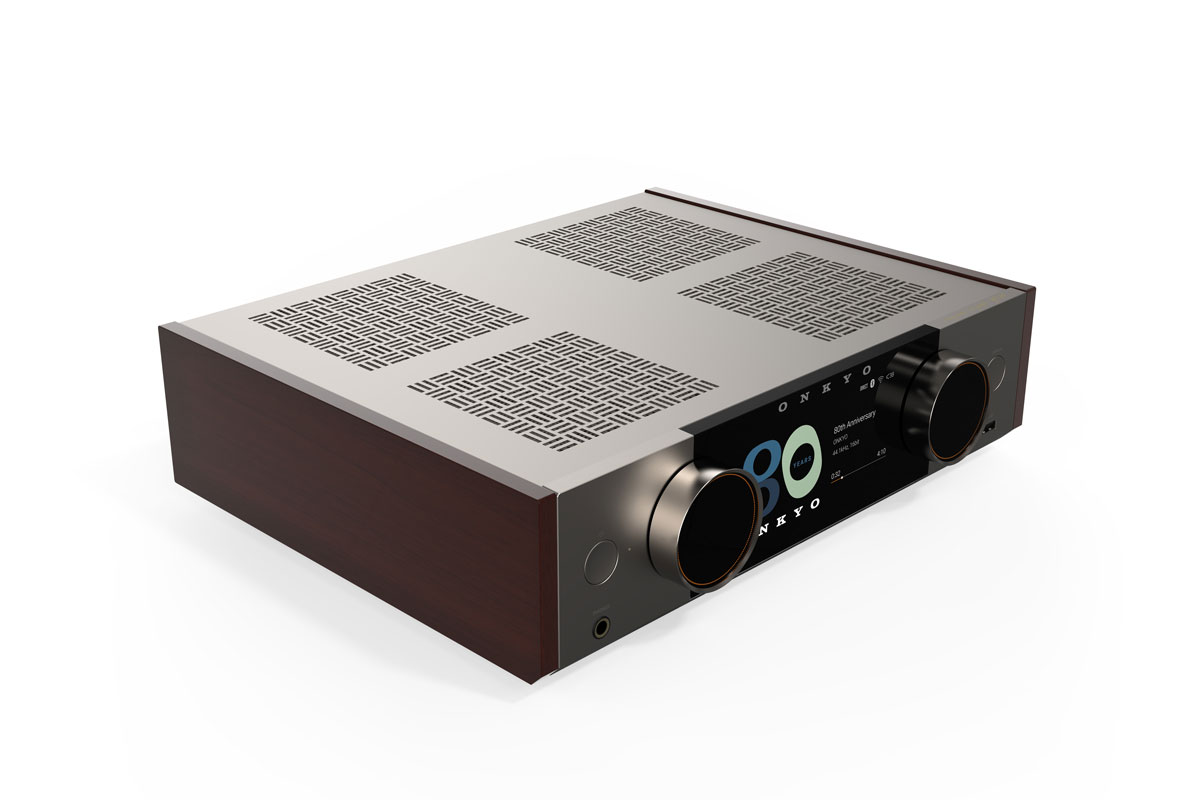
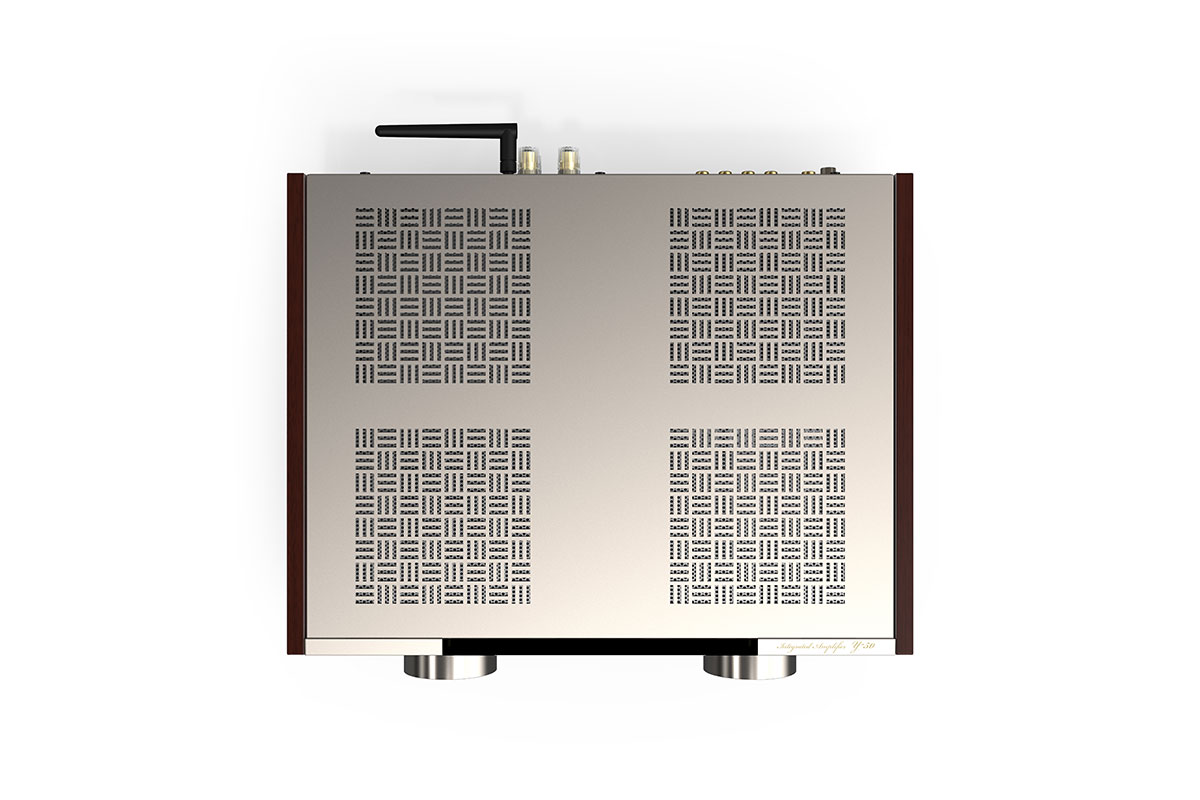
Real walnut side cheeks finished in Bordeaux provide the strongest historical cue, contrasting with the Champagne Gold aluminum front panel. On top, a large ventilation area uses a traditional Japanese San-Kuzushi pattern. The pattern supplies a cultural and decorative detail, but it also has a functional role in releasing heat from the internal electronics. Onkyo has designed the thermal management to work without active fan cooling, avoiding an additional mechanical noise source in the listening room.
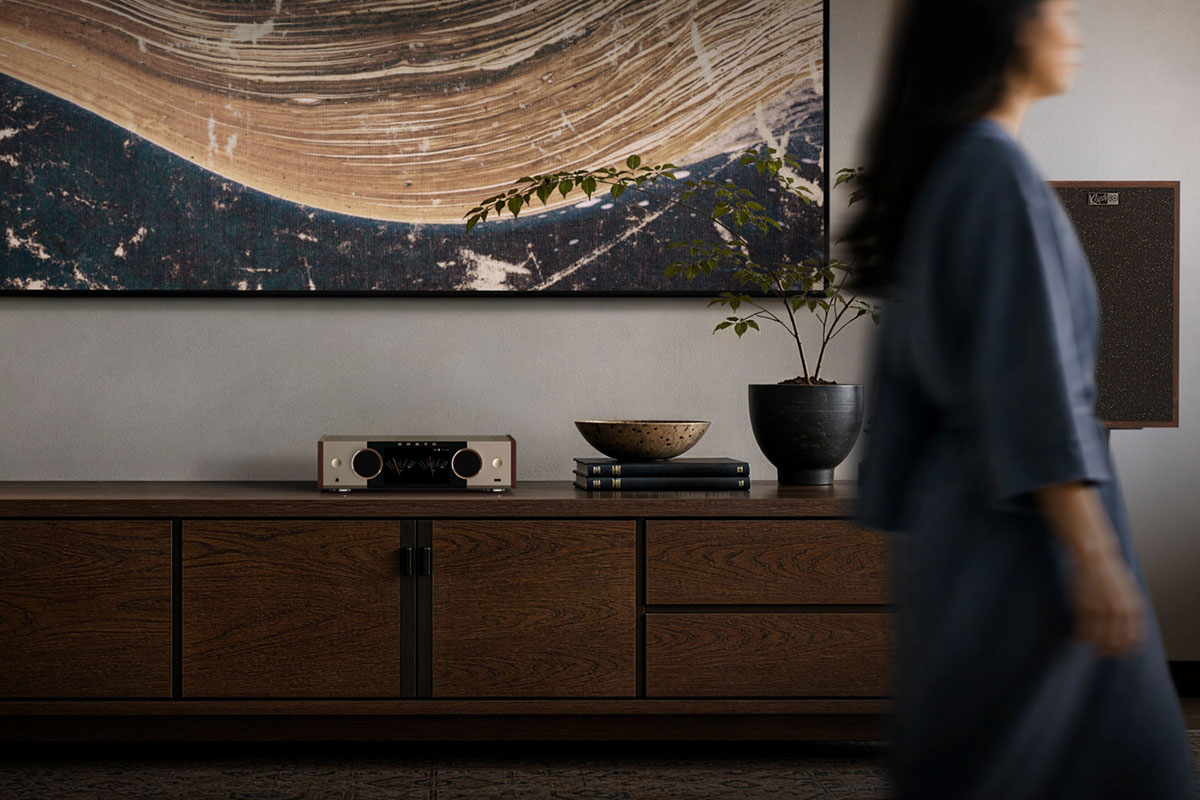
Digital meters give the front panel its focal point
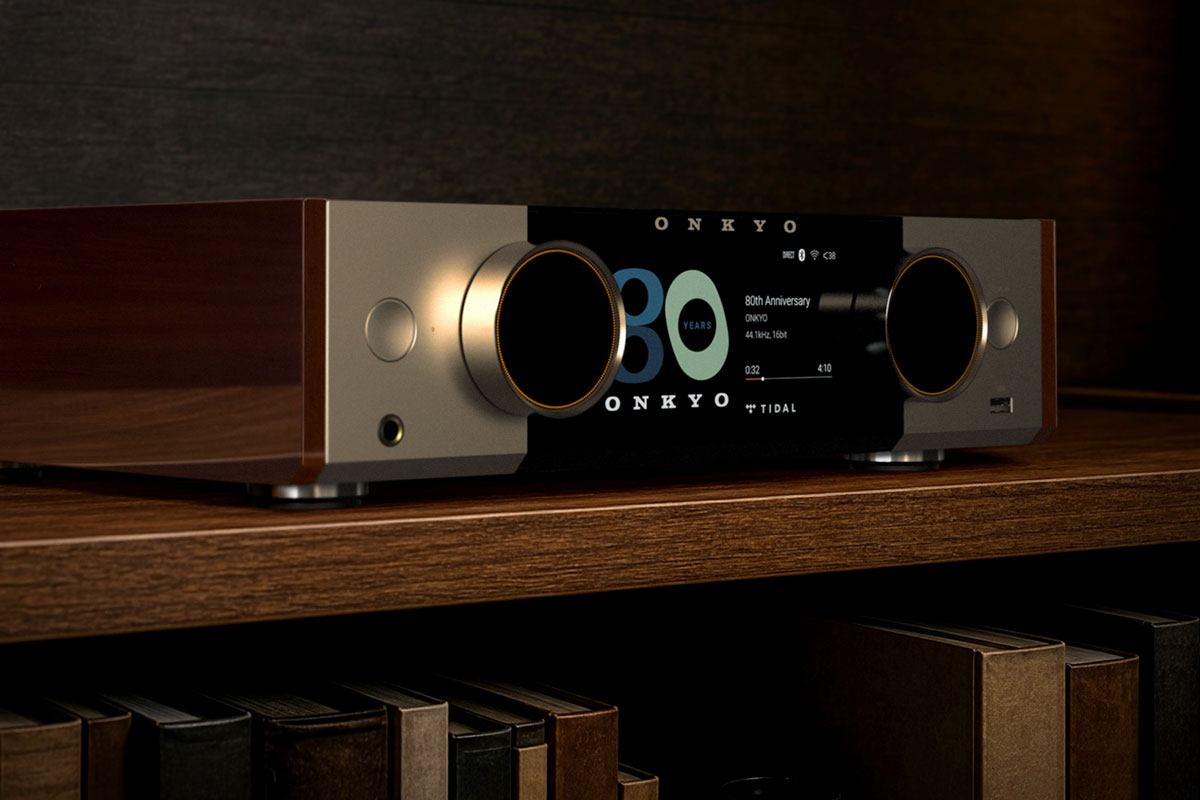
A centrally mounted 5.46-inch color LCD bridges the amplifier’s old and new identities. It can show playback information and system settings, while its analog-style virtual VU meters recall the illuminated displays associated with earlier Japanese audio components. Because the meters are rendered digitally, they form part of a broader interface rather than serving as the unit’s only visual feedback.
Two large rotary controls preserve direct access to core operations and prevent the anniversary design from depending entirely on a touchscreen or phone. Broader control and configuration are available through the Onkyo Controller app. That combination should suit systems in which the amplifier remains physically accessible while still allowing everyday source selection and adjustment from a listening position.
Axign Class-D power supports the compact format
Behind the traditional front panel is a fully digital signal-processing architecture feeding an Axign Class-D amplifier with a MOSFET output stage. Onkyo specifies 250W per channel into 4 ohms, measured at 1kHz with 0.7% total harmonic distortion. Into 8 ohms, the rating is 125W per channel across 20Hz to 20kHz at 0.08% distortion. Both figures apply with the two channels operating, although their different test conditions should be considered when comparing them.
The amplifier is specified for speakers with impedances from 4 to 16 ohms, and Onkyo identifies both stand-mount and floorstanding designs as potential partners. The output ratings give the Y-50G a broader system brief than its 350mm case width might initially suggest, although final suitability will still depend on the speaker and room involved.
A stated frequency response of 20Hz to 30kHz accompanies conventional bass and treble controls, each offering a ±10dB adjustment range. Those controls provide straightforward tonal tailoring, while the more consequential acoustic intervention comes from the separate room-correction system.
Room EQ makes the all-in-one concept more complete
Onkyo Room EQ is integrated to adapt playback to the room’s acoustic conditions. The announcement does not detail its filter resolution or setup procedure, so its precise scope remains to be established. Even so, its inclusion is significant to the Y-50G’s positioning: this is intended to be more than an amplifier with a network module attached, extending its control to the interaction among speakers, placement and room.
That approach is particularly relevant to a compact system hub, which may be installed in living spaces where loudspeaker and seating locations are shaped by furniture rather than dedicated-room conventions. Room correction cannot remove every placement compromise, but the documented presence of Onkyo Room EQ gives owners an additional setup tool beyond the traditional bass and treble controls.
Streaming, vinyl and television share one system
Network playback covers Spotify Connect, TIDAL Connect and Qobuz Connect, alongside Apple AirPlay 2 and Google Cast. The mix of service-specific connections and platform-level casting allows music to be initiated from several familiar applications rather than forcing every session through a single proprietary interface. Bluetooth is also included with SBC and AAC codec support for direct wireless playback.
Analog sources have not been sidelined by that network focus. The built-in phono stage accepts both moving-magnet and moving-coil cartridges, broadening the range of turntables that can be connected without an external phono preamplifier. That is a particularly coherent feature for an anniversary component whose appearance refers to an earlier era of Onkyo hardware while its source handling addresses current listening habits.
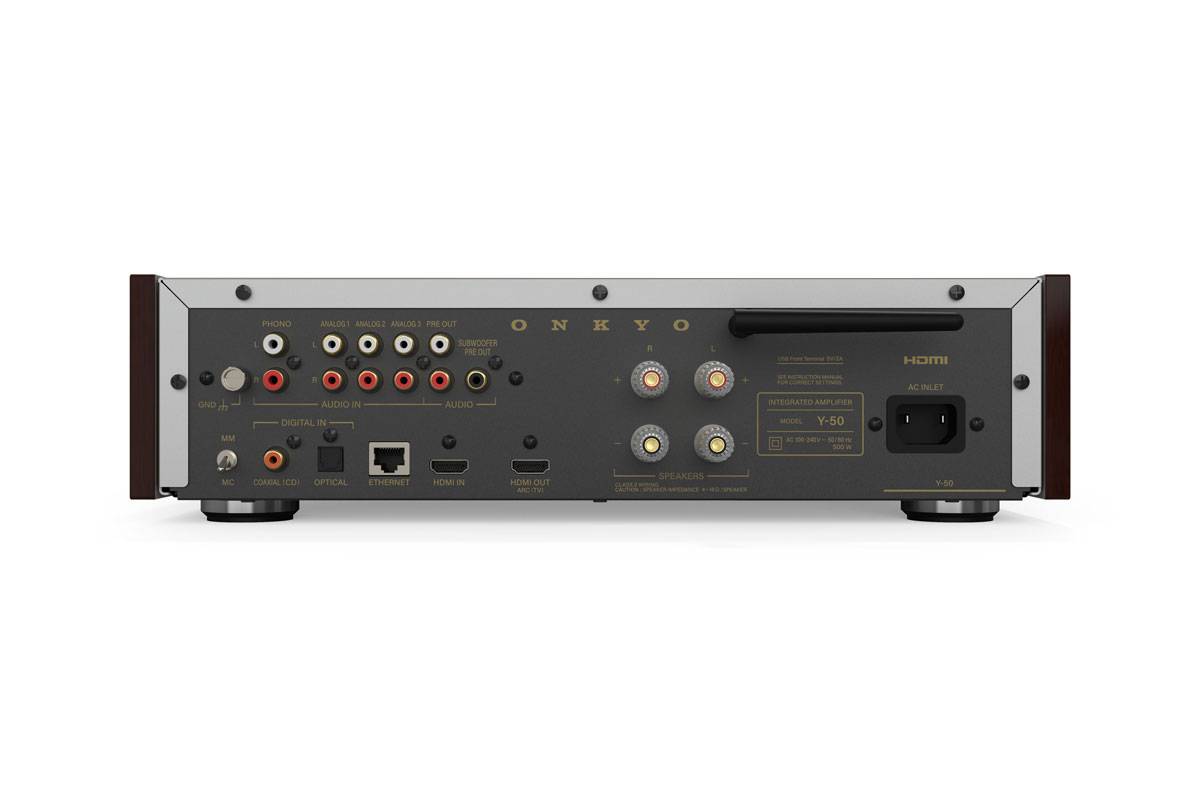
HDMI with ARC gives the amplifier a route into a television-based system, allowing stereo speakers to handle TV sound without requiring an AV receiver. A stereo preamplifier output leaves room for external amplification, while a dedicated subwoofer output supports systems that need additional low-frequency capacity. A headphone connection completes the documented output options.
Taken together, these connections position the Y-50G between a traditional integrated amplifier and a modern all-in-one hub. It can anchor a focused two-channel setup built around streaming and vinyl, but HDMI ARC and the subwoofer output also make sense for a shared music-and-television room. The pre-out means the control and source sections need not become redundant if an owner later changes the power-amplification arrangement.
The Muse Y-50G 80th Anniversary Edition appears aimed at listeners who want Onkyo’s historical design language without assembling a period-style stack of separate components. Its strongest idea is the contrast between the Integra-inspired exterior and a consolidated system architecture built around network playback, room correction and high-output Class-D amplification. Several details still need clarification, including market availability, final pricing and the exact operation of Onkyo Room EQ. Those omissions will matter when the amplifier can be assessed against other ways of building a compact stereo hub. For now, the Y-50G establishes a clear anniversary role: not simply a visual tribute, but an attempt to carry recognizable Onkyo cues into a system that can accommodate streaming services, records, headphones, a television and an optional subwoofer from one chassis.


Sound Off
0Join the discussion if you have something to add.