
Choosing a DAC begins with deciding what role it needs to perform.
A fixed hi-fi system may benefit from balanced outputs, several digital inputs or direct connection to a power amplifier, while a desktop setup might place greater value on headphone drive and a compact enclosure.
Portable listeners have a different priority again: a simple USB connection and suitable headphone outputs. These editor picks cover dedicated converters, DAC and headphone-amplifier combinations, a TV-friendly model, portable USB devices and a networked preamplifier. The distinctions are often more important than headline format support. HDMI ARC, BluOS, I2S, Bluetooth, room correction and power-amplifier control each suit a particular system rather than every buyer. The supplied source material does not provide consistent comparative listening evidence, so these recommendations are based on documented architecture, connectivity, format compatibility and intended use. The result is a guide to suitability rather than an unsupported sound-quality ranking.

1. SMSL DO100 PRO: Perfectly balanced DAC with Bluetooth 5.1
The SMSL DO100 PRO combines dual ES9039Q2M conversion with HDMI ARC, Bluetooth and balanced XLR connectivity.
The SMSL DO100 PRO is a flexible choice for systems that need to accommodate more than conventional hi-fi sources.
HDMI ARC allows it to receive television audio, while its USB-C connection is listed as compatible with the PS4, PS5 and Nintendo Switch.
Bluetooth reception covers SBC, AAC, aptX, aptX HD and LDAC. Conversion is handled by two ES9039Q2M chips, with an XMOS XU316 USB interface supporting PCM up to 32-bit/768 kHz and DSD512. RCA and balanced XLR outputs make it suitable for powered speakers or a separate amplifier, giving the DO100 PRO an unusually broad range of possible system roles.
Best for: TV, gaming and hi-fi systems sharing one DAC
- HDMI ARC for television audio
- RCA and balanced XLR outputs
- LDAC and aptX HD Bluetooth support
- USB-C compatibility with listed consoles
Verdict: The DO100 PRO is the most adaptable option here for readers who want television, console, wireless and conventional digital audio handled by one compact component.

2. Leema Constellation Libra: Fully balanced flagship DAC
The Leema Constellation Libra is a full-size dual-mono DAC with a replaceable conversion module and specialist I2S connectivity.
The full-size Leema Constellation Libra is aimed at advanced component systems, particularly those already built around Leema's Constellation range and LIPS control platform.
Its proprietary Quattro Infinity DAC section uses a fully balanced dual-mono design and is constructed as a replaceable module.
Connectivity includes asynchronous USB and two non-standard I2S interfaces on RJ45 connectors, one of which is configurable. The cited format support extends to 24-bit/384 kHz PCM, DXD, DSD64 and DSD128. Its specialized I2S implementation makes careful source matching important, but it also gives experienced system builders more integration scope than a basic USB DAC.
Best for: Advanced Leema and specialist digital systems
- Fully balanced dual-mono architecture
- Replaceable Quattro Infinity DAC module
- Two I2S interfaces
- LIPS system integration
Verdict: The Libra suits readers building a full-size, highly integrated system and prepared to make use of its LIPS and configurable I2S facilities.
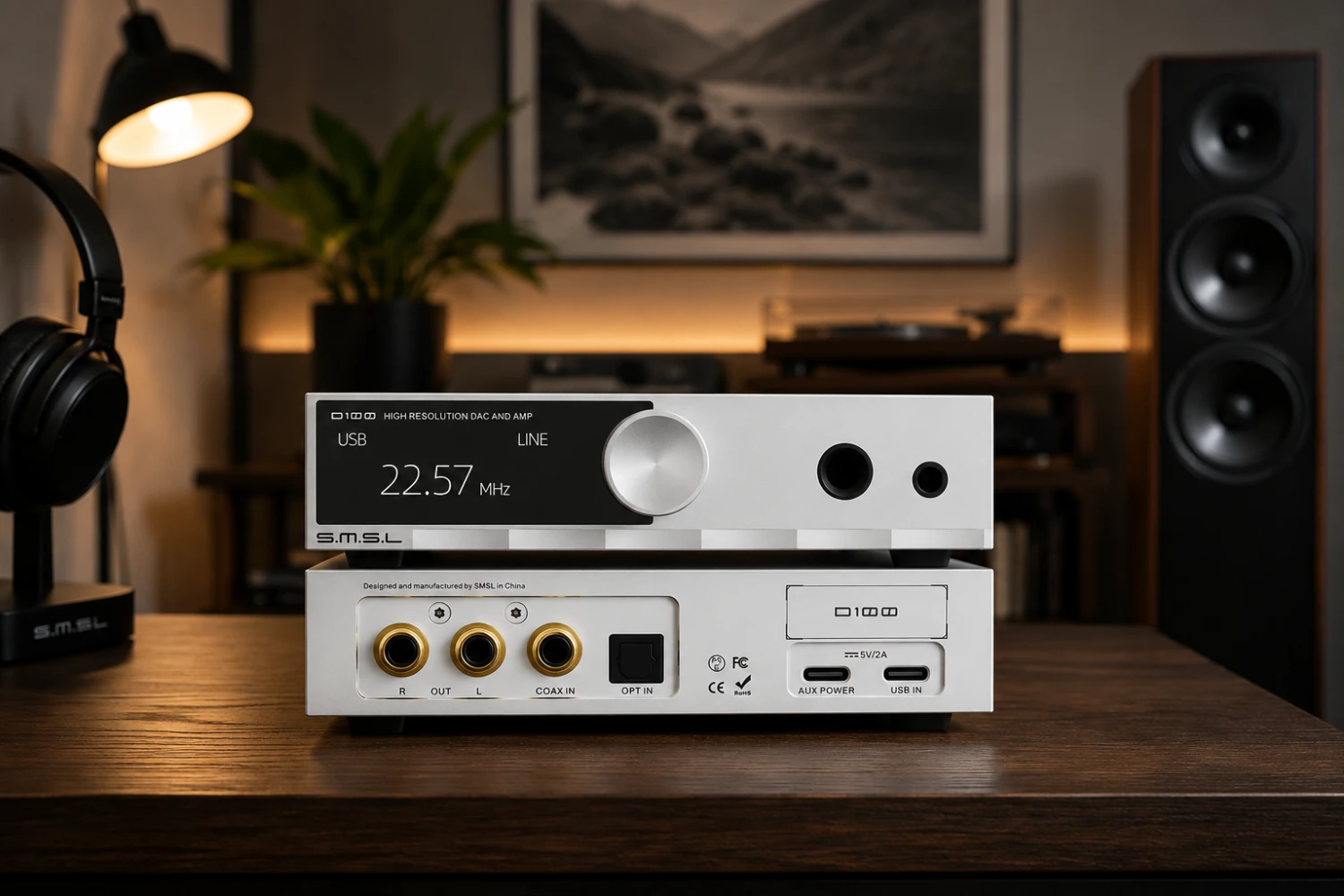
3. SMSL D100 Desktop DAC Adds Balanced Headphone Drive in a Compact Chassis
The compact SMSL D100 provides multiple digital inputs, an RCA line output and front-panel headphone connections.
SMSL's D100 combines a fixed desktop DAC with a headphone amplifier in a small aluminum chassis.
Its ESS ES9081 converter uses eight-channel parallel summing, while the XMOS XU316 USB interface supports PCM up to 32-bit/768 kHz, DSD512 and MQA according to the published specifications.
USB, optical and coaxial inputs allow it to work with computers, streamers and digital transports. An RCA line output and two front-panel headphone connections give it a useful dual role: it can serve a conventional audio system while remaining convenient for private desktop listening.
Best for: Compact desktop systems with headphones and speakers
- Compact DAC and headphone-amplifier design
- USB, optical and coaxial inputs
- RCA line output
- Two front-panel headphone connections
Verdict: The D100 is a practical fit when a small desktop component must handle both headphone listening and line-level output to a separate system.

4. Shanling EH3: A highly versatile device
The Shanling EH3 combines an ES9039SPRO DAC with Wi-Fi, Bluetooth and an I2S link intended for the matching ET3 transport.
The Shanling EH3 stands out for network and wireless playback rather than acting solely as a wired converter.
It supports Bluetooth 5.0 with LDAC, AAC and SBC, connects to 2.4 GHz or 5 GHz Wi-Fi networks, and can operate as an AirPlay 1 or DLNA endpoint.
Shanling also designed the EH3 as a partner for its ET3 CD transport through an I2S connection. Internally, it uses an ESS ES9039SPRO eight-channel DAC and a fully balanced amplifier built around OPA1612 devices. That combination of network access, Bluetooth and dedicated transport integration makes it relevant to several different listening arrangements.
Best for: Network playback and Shanling ET3 systems
- Bluetooth and dual-band Wi-Fi
- AirPlay 1 and DLNA endpoint support
- I2S connection for the Shanling ET3
- Fully balanced amplifier architecture
Verdict: The EH3 is best suited to readers who want Wi-Fi and Bluetooth reception alongside a dedicated DAC and headphone-amplifier platform.

5. Tanchjim Luna: DAC/Headphone amp boasting 2 CS43198 chips from Cirrus Logic
The aluminum Tanchjim Luna offers dual CS43198 conversion with separate 3.5 mm and balanced 4.4 mm headphone outputs.
The Tanchjim Luna is a USB DAC and headphone amplifier built around two Cirrus Logic CS43198 chips, with individual amplification for each channel.
Both 3.5 mm single-ended and 4.4 mm balanced headphone outputs are provided, avoiding the need to choose one connection standard at purchase.
Its published decoding limits are 32-bit/768 kHz PCM and DSD256. Tanchjim also separates the device's volume setting from the output signal level to provide smoother adjustment, while the supplied USB 2.0 cable uses separate shielding for its digital and power lines. Standard and graphically decorated Asano versions are available.
Best for: Headphone users needing both single-ended and balanced outputs
- Dual CS43198 DAC chips
- 3.5 mm and 4.4 mm headphone outputs
- PCM up to 32-bit/768 kHz
- Shielded USB 2.0 cable included
Verdict: The Luna is a focused option for wired headphone listening, particularly when access to both 3.5 mm and 4.4 mm connections matters.

6. TEAC UD-301-X: Dual-Mono USB DAC with Burr-Brown Chip and Headphone Amp
The TEAC UD-301-X uses dual Burr-Brown PCM1795 converters and provides USB, optical and coaxial digital connectivity.
The TEAC UD-301-X follows a traditional component-DAC approach, using one Burr-Brown PCM1795 converter and one Muses operational amplifier per channel in a dual-mono circuit.
A toroidal transformer supplies power, and the unit also incorporates a headphone amplifier.
USB accepts PCM up to 24-bit/192 kHz and DSD at 2.8 or 5.6 MHz, while optical and coaxial inputs support PCM up to 24-bit/192 kHz. Analog output is available through RCA and XLR connections. Optional conversion of incoming signals to 192 kHz can be engaged or disabled according to the user's preference.
Best for: Traditional component systems needing a headphone output
- Dual-mono conversion and analog stages
- Toroidal transformer power supply
- RCA and XLR analog outputs
- Switchable upsampling to 192 kHz
Verdict: The UD-301-X suits a conventional hi-fi installation where dual-mono construction, several wired inputs and both RCA and XLR outputs take priority over networking.

7. Exposure DAC: High-Resolution British DAC with 99-Step Volume Control and Power Amp Output
The Exposure DAC pairs seven S/PDIF inputs with volume-controlled RCA and XLR outputs for digital-only systems.
The Exposure DAC is deliberately focused on digital conversion, omitting streaming functions and analog inputs.
Its 99-step digital volume control and high output level allow it to connect directly to a power amplifier through RCA or XLR, potentially removing the need for a separate preamplifier in an all-digital system.
Seven S/PDIF inputs accept PCM from 44.1 kHz to 192 kHz. USB extends compatibility to 32-bit/768 kHz PCM and DSD256. This extensive wired input provision makes the Exposure particularly relevant when several digital transports or source components need to share one converter.
Best for: Digital-only systems feeding a power amplifier
- 99-step digital volume control
- Direct connection to a power amplifier
- Seven S/PDIF inputs
- RCA and XLR outputs
Verdict: The Exposure DAC is the clearest fit for readers who want extensive wired digital connectivity and volume-controlled output without paying for streaming or analog inputs.

8. The Hidizs SD2 is a compact DAC and headphone amplifier
The 34.5 mm-long Hidizs SD2 combines a USB Type-C input, ES9270 DAC and conventional 3.5 mm headphone output.
Measuring 34.5 by 20 by 10 mm, the Hidizs SD2 is the smallest and simplest option in this selection.
Its USB Type-C interface connects to smartphones, computers, tablets and game consoles, while a 3.5 mm output can feed wired headphones or powered speakers.
The ES9270 chip combines conversion with a built-in SABRE headphone amplifier. Published support reaches 32-bit/384 kHz PCM and native DSD128, with output specified at 70 mW per channel into 32 ohms. There is no balanced output, making this a straightforward choice for conventional 3.5 mm headphones.
Best for: Simple USB-C listening with 3.5 mm headphones
- Very compact enclosure
- USB Type-C connectivity
- PCM up to 32-bit/384 kHz
- 70 mW per channel into 32 ohms
Verdict: The SD2 is the uncomplicated choice for adding a compact wired headphone output to a phone, tablet, computer or compatible game console.

9. Shanling UA7: Tiny Tube DAC with ESS Power and 577mW Output
The compact Shanling UA7 protects its dual JAN6418 tubes within a shock-absorbing aluminum housing.
The Shanling UA7 distinguishes itself from typical compact USB DACs by incorporating two JAN6418 tubes in its output stage.
A redesigned aluminum housing includes a shock-absorbing structure intended to protect the tubes during mobile use, while an OLED display and multifunction control provide access to filters and gain settings.
Its ESS ES9069 converter supports PCM up to 32-bit/768 kHz and DSD512. The amplifier is specified to deliver up to 577 mW into 32 ohms from the balanced 4.4 mm output and 195 mW into 32 ohms from the 3.5 mm output. This combination makes the UA7 a more specialized portable proposition than a basic dongle DAC.
Best for: Portable listeners interested in a tube output stage
- Dual JAN6418 tube output stage
- 3.5 mm and balanced 4.4 mm outputs
- OLED display with direct controls
- Up to 577 mW into 32 ohms from 4.4 mm
Verdict: The UA7 suits headphone users who specifically want tube-based output circuitry and substantial published balanced power in a compact format.

10. NAD C658: Modular BluOS Streamer, DAC & Preamp with Dirac Live Room Correction and MQA Support
The NAD C 658 combines BluOS streaming, digital conversion, preamplifier control and Dirac Live room correction.
The NAD C 658 goes well beyond standalone conversion by combining a DAC, preamplifier and BluOS network streamer.
BluOS provides access to numerous music and internet-radio services, indexes local and online libraries, and supports files up to 32-bit/192 kHz as well as MQA.
AirPlay 2 adds streaming from Apple devices and another route into multi-room playback, while the associated BluOS app is available across mobile and desktop platforms. Dirac Live room correction further separates the C 658 from simpler DACs. It is the appropriate choice when source management, streaming, preamplifier control and room correction need to be consolidated in one component.
Best for: Consolidated streaming, preamplifier and room-correction systems
- DAC, preamplifier and BluOS streamer
- Dirac Live room correction
- AirPlay 2 and BluOS multi-room playback
- Local and online library support
Verdict: The C 658 is the broadest system hub in this guide, making sense for readers who need BluOS streaming, preamplifier functions and room correction rather than a DAC alone.


Sound Off
0Join the discussion if you have something to add.