
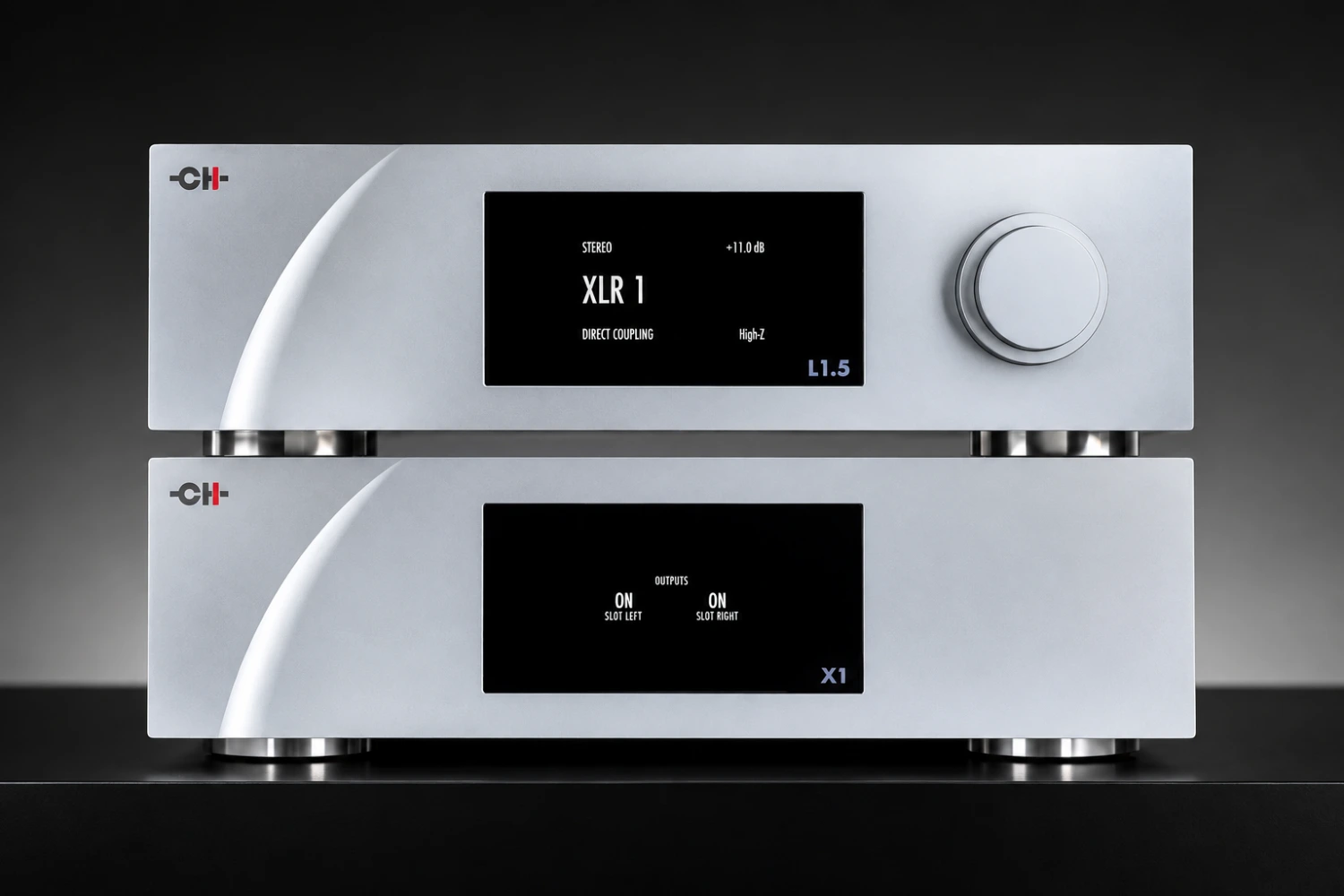
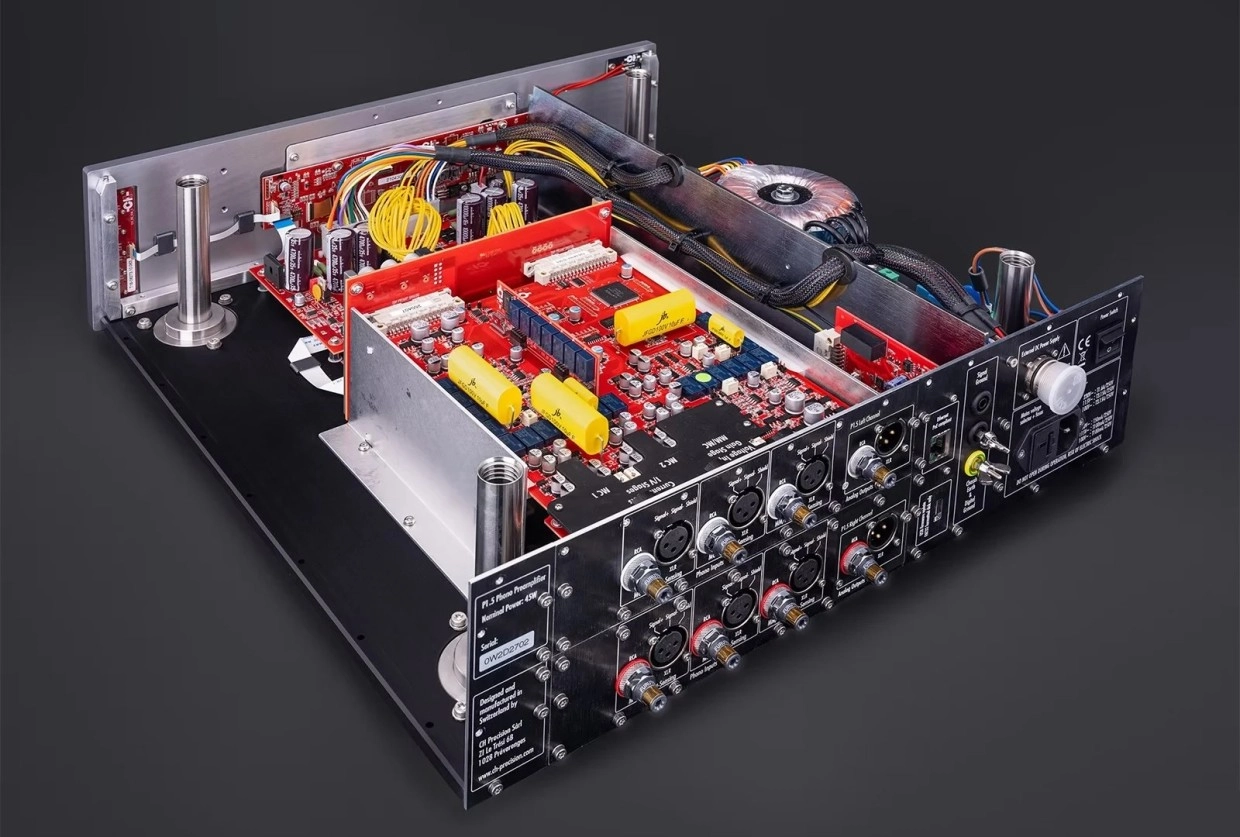
Rather than replace two established preamplifiers with unrelated designs, CH Precision has reworked their underlying signal architectures. The resulting P1.5 phono stage and L1.5 line preamplifier draw on circuitry developed for the Swiss manufacturer’s reference P10 and L10, respectively. Noise reduction is the central objective, but the revisions also address gain flexibility, cartridge matching, electrical stability and control-system isolation. Just as importantly for existing owners, CH Precision is retaining its modular philosophy by offering an upgrade route for the earlier P1 and L1. The announcement therefore concerns more than two new model numbers: it shows how the company intends to move reference-series engineering through the rest of its preamplifier range.
P10 thinking reshapes the P1.5 signal path
The defining change inside the P1.5 is a redesigned three-stage gain architecture derived from the P10 phono preamplifier. Passive equalization is positioned between the gain stages, an arrangement intended to improve equalization accuracy while lowering the circuit’s noise floor. That combination is especially relevant in a phono stage, where the input signal can be extremely small and must be amplified substantially before reaching a line-level preamplifier.
CH Precision specifies a 6 dB reduction in equivalent input noise for the current-sensing moving-coil inputs and a 4 dB reduction for the voltage-sensing input compared with the P1. Available gain margin has also increased by 6 dB and 5 dB, respectively. Those are related changes rather than isolated headline figures: lower input noise helps preserve a cleaner operating foundation, while additional gain margin expands the range of cartridge outputs the phono stage can accommodate.
The architecture does not force every cartridge into the same interface. Two current-sensing inputs are provided for low-impedance moving-coil cartridges, while a third, voltage-sensing input supports both moving-magnet and moving-coil designs. Current-mode operation is therefore available where cartridge characteristics make it appropriate, without removing the conventional voltage-input route needed for broader compatibility.
Cartridge setup extends beyond a loading switch
On the voltage-sensing input, users can choose from more than 400 resistance values spanning 20 ohms to 70 kilohms. Such fine adjustment is intended to make cartridge loading a controlled setup parameter rather than a choice between a small number of preset values. The practical benefit will depend on the cartridge and system, but the range gives installers and owners considerable scope to follow manufacturer guidance or investigate how a particular cartridge behaves under different loads.
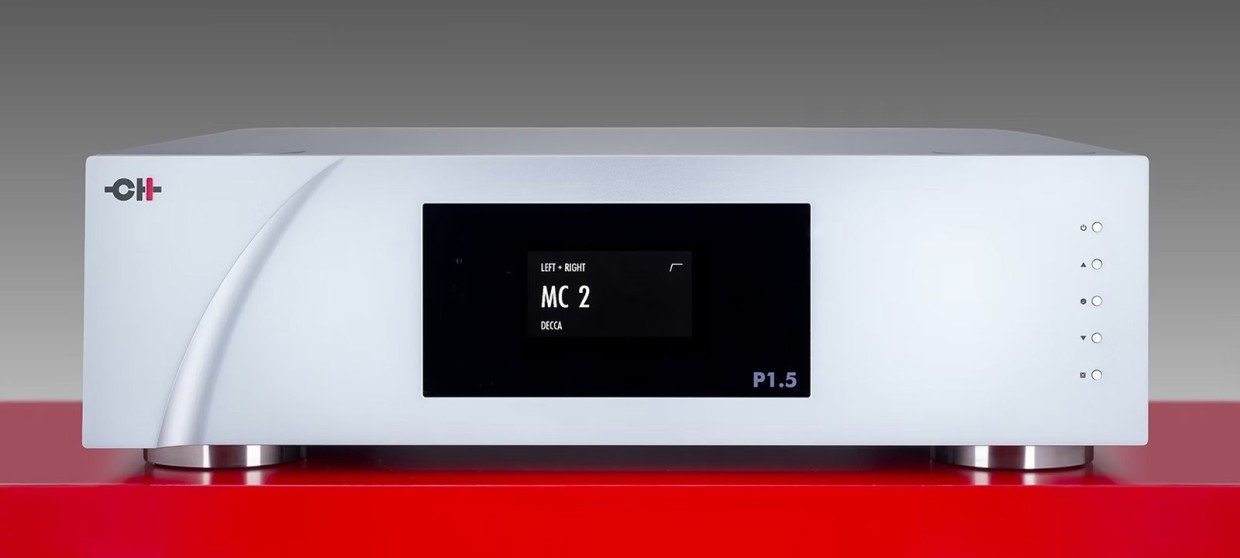
The returning software-based Gain Wizard and Loading Wizard are important because the P1.5’s extensive adjustment would otherwise risk becoming cumbersome. These tools help identify suitable settings for an individual cartridge. The Loading Wizard can also display measured changes in frequency response at different loading values, giving the user information on which to base a selection rather than requiring settings to be chosen by specification alone.
That approach places measurement and configuration alongside the analog circuit design. It also clarifies the P1.5’s intended role: this is not simply a fixed phono input for one turntable, but a configurable component for systems in which cartridges may change and setup is treated as part of the playback chain. No listening result can be inferred from the controls themselves, but their breadth should reduce the likelihood that cartridge compatibility is limited by coarse loading or gain options.
Older records receive dedicated equalization options
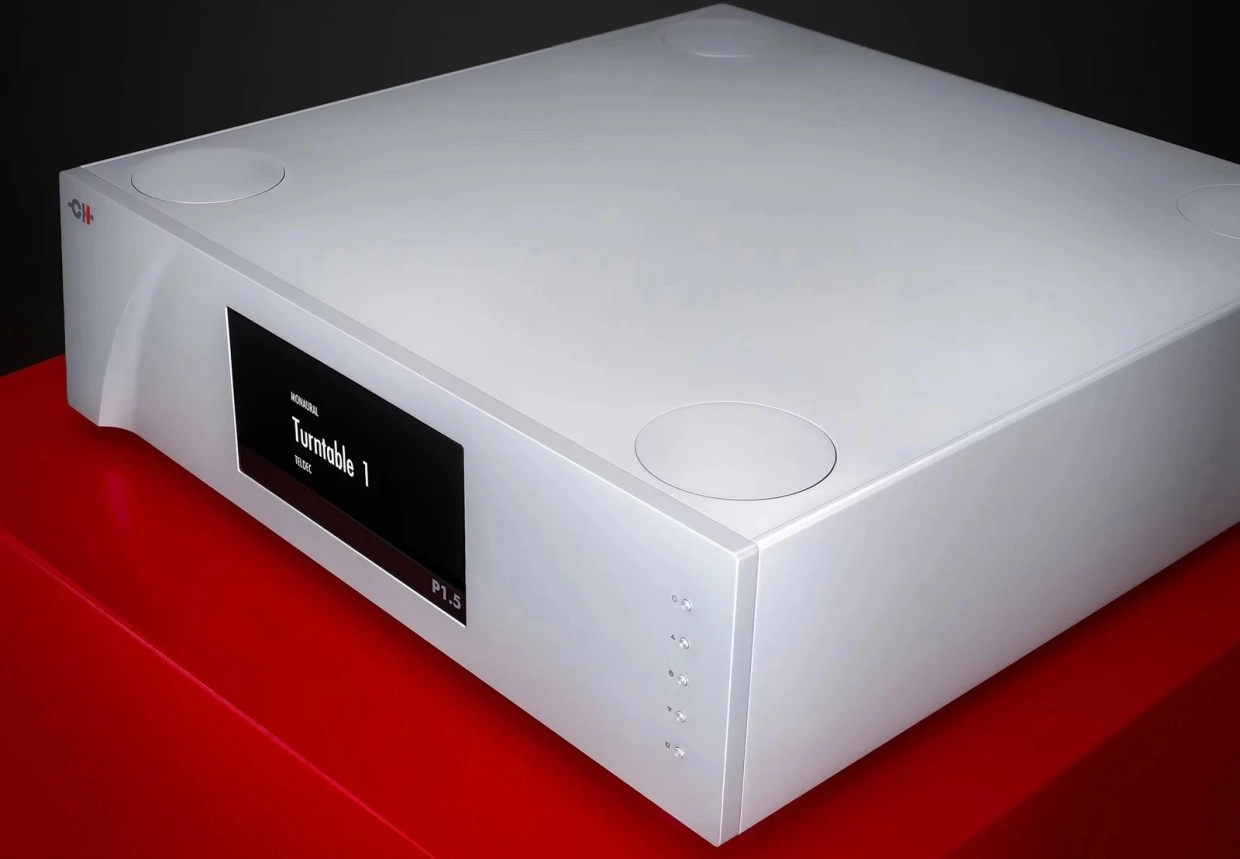
Standard RIAA equalization remains part of the P1.5, but CH Precision is also offering an optional module with playback curves for older recordings issued by labels including Columbia, Decca, EMI, Philips and Capitol. Records made before equalization practices became standardized can require different replay curves, so the module addresses an archival and specialist use case rather than adding another adjustment for contemporary pressings.
Dedicated mono playback configurations further extend that focus. These are intended for collectors using vintage mono records and specialist cartridges, where channel treatment and playback configuration may differ from a normal stereo setup. Together with the multiple cartridge inputs, the optional curves allow one phono component to serve a collection spanning different eras and formats. The module remains optional, which avoids making those specialist facilities mandatory for users whose libraries are predominantly RIAA-standard stereo releases.
L1.5 combines discrete buffers with analog attenuation
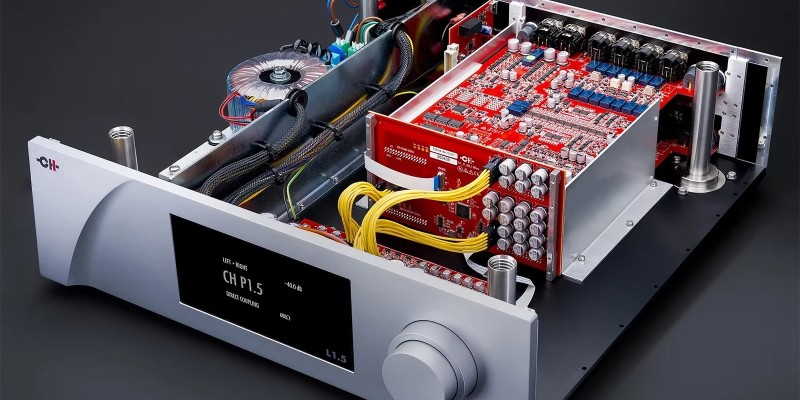
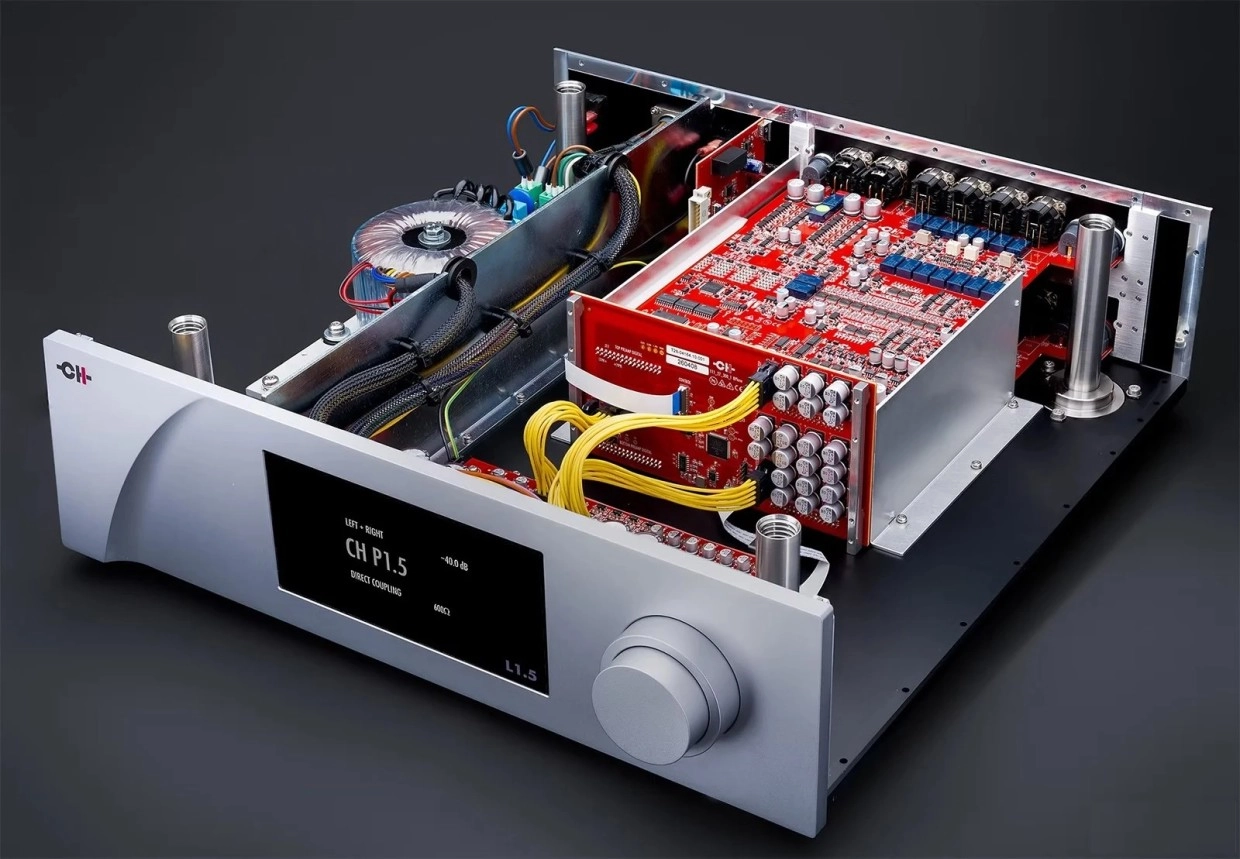
For the L1.5, CH Precision has transferred elements of the L10 line preamplifier’s engineering into a revised input and gain structure. New discrete diamond input buffers are designed to improve electrical and thermal stability. They work with updated Class A gain stages, improved DC compensation and a more advanced power-regulation system, with the collective aim of maintaining signal integrity while minimizing unwanted noise and distortion.
Volume is controlled by a fully differential 20-bit R2R resistor network operating entirely in the analog domain. Its attenuation range runs from -99.5 dB to 0 dB in 0.5 dB increments. Selectable active-gain settings of 0 dB, +6 dB, +12 dB and +18 dB allow the preamplifier’s overall gain structure to be adapted to different source levels, power amplifiers and system sensitivities.
Separating attenuation from selectable active gain gives the installer more control over how the available volume range is used. A high-gain system does not necessarily require the same preamplifier setting as one built around lower-output sources or less-sensitive amplification. CH Precision has not supplied system-specific recommendations here, but the four gain choices provide a documented means of tailoring that relationship.
Isolation, input capacity and external power
Each L1.5 channel provides four balanced XLR inputs and two unbalanced RCA inputs. That allocation favors systems built primarily around balanced source components while retaining connections for conventional unbalanced equipment. Control is available through the front panel, the supplied remote handset or CH Precision’s control software, allowing the unit to be operated either as a traditional hardware preamplifier or as part of a software-managed installation.
The digital control circuits are galvanically isolated from the analog signal path. This does not remove digital control from the product; instead, it electrically separates the supporting control domain from the circuitry carrying the audio signal. The design is consistent with the broader emphasis on managing noise and interference rather than sacrificing operational flexibility to obtain a purely manual interface.
Both the P1.5 and L1.5 remain compatible with CH Precision’s optional X1 external power supply. The X1 moves critical power-supply circuitry into a separate enclosure to reduce electrical interference within the audio components. It also preserves a staged system path: an owner can use either preamplifier in its standard form and add the external supply later, rather than being required to adopt a multi-chassis arrangement from the outset.
An upgrade path protects the modular premise
Existing P1 and L1 owners are not being left with immediately obsolete hardware. CH Precision plans to offer an upgrade option for both predecessors, avoiding the need to purchase a complete replacement component to obtain the revisions. The precise scope and logistics of those upgrades have not been detailed in the supplied announcement, so owners will need to consult an authorized dealer about eligibility and implementation.
The P1.5 and L1.5 are available through authorized CH Precision dealers, alongside the optional X1 supply and the P1.5’s specialist equalization module. Their clearest audience is the owner assembling a configurable analog front end: the phono stage addresses multiple cartridge types and historical replay standards, while the line preamplifier offers fine analog attenuation, adjustable active gain and a strong bias toward balanced sources. What remains to be established outside the announcement is how much the revised circuitry changes measured performance beyond the specified noise and gain improvements, and how the upgrade process compares with purchasing the current versions. Those details will determine how existing owners, in particular, assess the move from the original P1 and L1.
CH Precision’s revisions are most notable for preserving continuity while changing key circuitry. The P1.5 gains a P10-derived three-stage architecture, lower specified input noise and wider gain latitude without abandoning detailed cartridge setup. The L1.5 applies L10-influenced buffering, regulation and DC control around an analog R2R volume system that can be adjusted to suit different system gain requirements. Compatibility with the X1 external supply and the promised upgrade route reinforce the same modular strategy. Prospective buyers should watch for further information on the optional legacy-equalization module and the practical process for updating earlier units. For current P1 and L1 owners, those upgrade details may matter as much as the specifications of the factory-built P1.5 and L1.5 themselves.


Sound Off
0Join the discussion if you have something to add.