
A complete home cinema depends on several distinct product types, and this ranking reflects that reality.
The ten supplied products include projectors, AV processors, integrated receivers and disc players.
They are therefore ranked as home cinema recommendations rather than as direct substitutes performing the same job. Priority goes to current video and audio format support, system-building flexibility, installation practicality and the significance of each component within a cinema setup. The projectors lead through their combination of 4K presentation, laser light sources and placement options, while the processors stand out for multichannel control and room correction. Integrated receivers offer greater convenience, and the disc players serve more specialized physical-media roles. Several products are particularly appealing to collectors of Blu-ray, SACD and other legacy formats, but upscaling to 4K is not the same as playing Ultra HD Blu-ray discs. The ranking makes that distinction explicit and also treats manufacturer specifications and launch claims cautiously where the supplied source does not include independent measurements or comparative testing.

1. Optoma UHZ68LV
Optoma UHZ68LV dual-laser 4K UHD home cinema projector.
The Optoma UHZ68LV takes first place because it combines the most comprehensive modern projection specification in the supplied material.
This dual-laser 4K UHD projector is specified at 5,000 lumens and carries a stated 90% DCI-P3 figure.
Its support for both Dolby Vision and HDR10+ is especially relevant to a home cinema built around contemporary high-dynamic-range material. Installation flexibility strengthens the recommendation. A 1.6x zoom, lens shift and support for 360-degree projection provide options for front, rear or ceiling placement, while Optoma's PureEngine Ultra processing is intended to address motion, detail and color. The source presents specifications rather than independent test results, so contrast, noise and real-room color performance remain unverified.
Best for: A modern, high-output dedicated home cinema projector
- Dual-laser 4K UHD projection
- Dolby Vision and HDR10+ support
- Specified 5,000-lumen output
- 1.6x zoom, lens shift and flexible projection orientation
Verdict: The strongest overall choice for viewers seeking a feature-rich 4K laser projector with broad HDR support and adaptable installation.

2. Marantz AV8805
Marantz AV8805 high-channel-count home theater processor.
The Marantz AV8805 is the most expansive surround processor in this selection.
Its 15.2-channel RCA and balanced XLR outputs provide substantial system flexibility, including the option of balanced connections where long cable runs make interference a concern.
Dolby Atmos, DTS:X and Auro-3D support make it suitable for elaborate immersive-audio layouts. Marantz also equips every channel with 24-bit/192 kHz conversion and uses its proprietary HDAM modules. The copper-clad chassis and extensive physical connectivity reinforce its high-end positioning. As an AV processor rather than an integrated receiver, however, the AV8805 requires separate power amplification and is consequently best suited to a more complex component system.
Best for: Large immersive-audio systems using separate power amplifiers
- 15.2-channel RCA and balanced XLR outputs
- Dolby Atmos, DTS:X and Auro-3D support
- 24-bit/192 kHz digital-to-analog conversion across all channels
- Flexible foundation for a separate-power-amplifier system
Verdict: A highly flexible high-end processor for serious multichannel installations, provided the system budget and space accommodate external amplification.
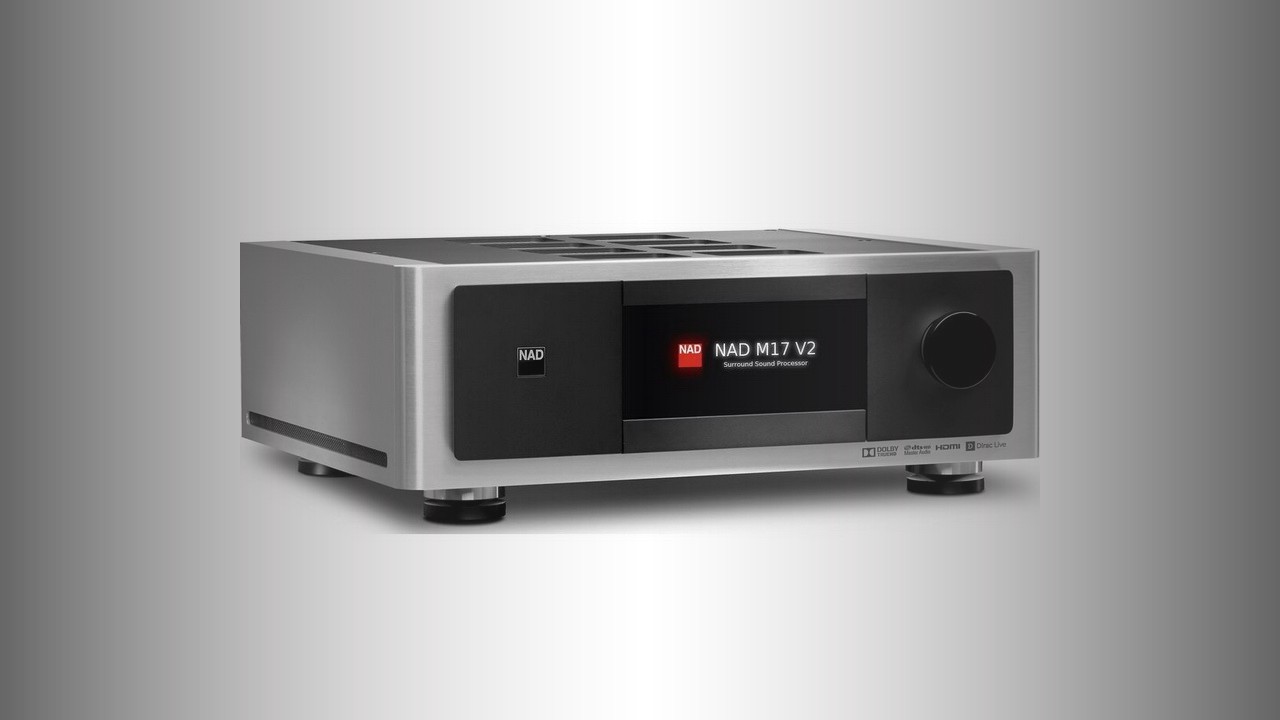
3. NAD M17 V2
NAD M17 V2 AV processor-preamplifier with Dirac Live and BluOS.
NAD's M17 V2 combines premium AV processing with two meaningful differentiators: Dirac Live room correction and the company's Modular Design Construction architecture.
Dirac Live addresses the interaction between the speakers and listening room, while replaceable internal modules offer an upgrade route if NAD releases compatible hardware for newer technologies.
The processor handles 4K, HDR and 4:4:4 video signals over HDCP 2.2-equipped HDMI connections. It also provides balanced XLR preamplifier outputs, coaxial and optical digital connections, LAN and control-system interfaces including RS-232, infrared and triggers. BluOS adds high-resolution network playback and access to supported streaming services. Like the Marantz, this is a processor-preamplifier and therefore needs external power amplifiers.
Best for: A premium cinema and music system requiring room correction and modularity
- Dirac Live room correction
- Modular internal architecture
- 4K, HDR and 4:4:4 video compatibility
- BluOS playback plus balanced XLR outputs
Verdict: A sophisticated processor whose Dirac correction, BluOS integration and modular design create a compelling balance of cinema and music functionality.

4. ViewSonic V57-4K
ViewSonic V57-4K RGB laser projector for cinema and gaming.
The ViewSonic V57-4K is a high-output alternative to the Optoma, built around an RGB laser light source and 4K UHD imaging.
ViewSonic specifies 5,200 lumens, HDR and HLG support, and full BT. color-gamut coverage.
Those are ambitious manufacturer claims, although the supplied announcement does not include measurements that independently confirm brightness, gamut or contrast performance. Its optical and digital setup tools include 1.6x zoom, vertical lens shift, side projection, horizontal and vertical keystone correction, and four-corner adjustment. Gaming is another clear focus: the Created for Xbox designation accompanies support for 1440p signals at 120 Hz. A stated 30,000-hour lamp-free light-source life further distinguishes it from conventional lamp projectors, but the source does not list Dolby Vision or HDR10+ support.
Best for: Bright, multipurpose cinema rooms that also host console gaming
- 4K UHD RGB laser projection
- Specified 5,200-lumen brightness
- Stated full BT. color-gamut coverage
- 1440p at 120 Hz gaming support
Verdict: A versatile, gaming-friendly laser projector with striking claimed color and brightness specifications, though the supplied source offers no independent performance verification.

5. Pioneer VSX-934
Pioneer VSX-934 network-equipped AV receiver.
The Pioneer VSX-934 is the highest-ranked integrated AV receiver because it combines cinema switching and amplification with a notably broad range of network-audio options.
Its six HDMI inputs provide room for multiple sources, while support for Tidal, Spotify, Deezer, UPnP/DLNA, Bluetooth and AirPlay covers several common approaches to music playback.
AirPlay 2, Sonos ecosystem support, DTS Play-Fi and Pioneer's FlareConnect platform expand its multiroom potential. The source also makes clear that built-in Chromecast was removed, although an external device can occupy an HDMI input. More detailed amplification, speaker-layout and video-format information is not supplied, preventing the VSX-934 from ranking above the more comprehensively documented processors and projectors.
Best for: A network-focused home cinema built around one integrated receiver
- Six HDMI inputs
- AirPlay 2, Bluetooth and UPnP/DLNA connectivity
- Support for Sonos, DTS Play-Fi and FlareConnect ecosystems
- Access to several named music-streaming services
Verdict: A practical hub for viewers who value extensive streaming and multiroom connectivity alongside conventional AV source switching.

6. Sony UBP-X700/K
Sony UBP-X700/K Ultra HD Blu-ray player with dual HDMI outputs.
The Sony UBP-X700/K is the most relevant disc player here for current movie collections because it plays Ultra HD Blu-ray as well as standard Blu-ray and DVD.
HDR10 and Dolby Vision support provide compatibility with two important HDR formats, while Dolby Atmos and DTS:X support addresses contemporary immersive soundtracks when the player is connected to suitable downstream equipment.
Two HDMI outputs allow audio to be routed separately from video, which can be useful when combining a modern display with older audio hardware. This simplified version removes the original model's Netflix, YouTube, Spotify Connect, screen-mirroring and app-related functions. An Ethernet port remains, but the source does not establish it as a route to restored streaming services, so the UBP-X700/K should be considered a focused physical-media player rather than an all-purpose streaming box.
Best for: Physical-media viewers who want UHD Blu-ray and do not need integrated streaming apps
- Native Ultra HD Blu-ray playback
- HDR10 and Dolby Vision support
- Dolby Atmos and DTS:X compatibility
- Separate HDMI outputs for video and audio
Verdict: A focused and well-specified UHD disc player whose reduced network features matter little in a system with a separate streamer.

7. Pioneer VSX-S520
Pioneer VSX-S520 slimline AV receiver.
At only 70 mm high and 4 kg, the Pioneer VSX-S520 addresses installations where a full-height AV receiver would be impractical.
It provides five amplified channels rated in the source at 80 watts per channel into 4 ohms or 55 watts into 8 ohms, while a sixth channel can be configured to drive a passive subwoofer.
Wi-Fi, Bluetooth and 4K support add useful modern functionality to the slim chassis. Compactness involves clear compromises. The receiver lacks preamplifier outputs, uses spring-clip speaker connections rather than binding posts, has a single subwoofer output and omits the predecessor's rear USB port. Those limitations make it less adaptable than the VSX-934, but its unusually low-profile form remains valuable for smaller rooms and discreet furniture installations.
Best for: Small rooms and cabinets that cannot accommodate a conventional receiver
- Slim 70 mm-high chassis
- Five integrated amplification channels
- Wi-Fi and Bluetooth connectivity
- 4K video support
Verdict: A useful space-saving receiver with genuine cinema functionality, balanced by basic speaker terminals and limited expansion options.

8. McIntosh MVP901
McIntosh MVP901 universal Blu-ray, SACD and audio player.
The McIntosh MVP901 is a specialist universal player for collections spanning Blu-ray, DVD, CD and SACD.
It also handles data discs containing MP3, WMA, AAC, FLAC, ALAC, AIFF, LPCM and DSD files, with the supplied source specifying high-resolution audio up to 24-bit/192 kHz and DSD128.
Balanced XLR and unbalanced RCA stereo outputs make it particularly relevant to systems in which two-channel music quality is a major consideration. Its home cinema limitation is decisive: the MVP901 does not play Ultra HD Blu-ray discs. It can upscale compatible video to 4K, but upscaling cannot recover the native resolution or HDR information of an actual UHD disc. Multichannel audio also requires a connected AV processor through HDMI, optical or coaxial output. The player is therefore better understood as a premium universal legacy-disc source than as the default choice for a new UHD cinema.
Best for: Audiophile disc collections combining Blu-ray, SACD, CD and high-resolution files
- Blu-ray, DVD, CD and SACD playback
- Extensive high-resolution file support up to 24-bit/192 kHz and DSD128
- Balanced XLR and unbalanced RCA stereo outputs
- 4K upscaling for compatible non-UHD sources
Verdict: An unusually versatile premium disc source for music and legacy video, but the absence of native UHD Blu-ray playback limits its modern cinema appeal.

9. Denon DBT-3313UD
Denon DBT-3313UD universal Blu-ray and network-media player.
The Denon DBT-3313UD combines Blu-ray, DVD, DVD-Audio, SACD and CD playback with network-media access from a computer or network-attached storage device.
Supported network material includes FLAC files up to 24-bit/192 kHz, while a front USB input accommodates portable storage.
Blu-ray Profile 2.0 and 3D video support reflect its focus on the pre-UHD Blu-ray ecosystem. Two HDMI outputs can separate picture and sound or feed two display devices. Denon Link HD is intended to reduce digital jitter when the player is paired with compatible Denon receivers, and a 10-bit video processor handles image processing. The source does not establish Ultra HD Blu-ray or modern HDR compatibility, while named online video services should not be treated as guaranteed current features. It remains most useful for mixed music-and-movie disc libraries.
Best for: Mixed legacy disc libraries and matching Denon AV systems
- Blu-ray, DVD-Audio, SACD, DVD and CD compatibility
- Network playback including FLAC up to 24-bit/192 kHz
- Dual HDMI outputs
- Denon Link HD compatibility with selected Denon receivers
Verdict: A flexible universal player with strong disc and network-file coverage, but its lack of documented UHD and HDR support places it behind current-format alternatives.

10. Yamaha BD-A1060
Yamaha BD-A1060 universal Blu-ray player with balanced stereo outputs.
The Yamaha BD-A1060 emphasizes universal playback and two-channel audio integration.
It plays Blu-ray, 3D Blu-ray, DVD and SACD, while professional-style balanced XLR outputs make it easier to connect directly to suitable stereo equipment.
An aluminum front panel, steel side plates and construction intended to reduce vibration support its premium positioning. Built-in Wi-Fi and Wi-Fi Direct provide routes for network and mobile-device connectivity, and the player can upscale 1080p video for a 4K display. The essential caveat is that the supplied source establishes 4K upscaling, not native Ultra HD Blu-ray playback. That distinction makes the BD-A1060 a niche choice for SACD, Blu-ray and stereo-oriented systems rather than a primary recommendation for contemporary UHD movie collections.
Best for: Music-oriented systems combining SACD, Blu-ray and balanced stereo connections
- Blu-ray, 3D Blu-ray, DVD and SACD playback
- Balanced XLR stereo outputs
- Built-in Wi-Fi and Wi-Fi Direct
- 4K upscaling for lower-resolution video
Verdict: A thoughtfully constructed universal player for legacy discs and stereo playback, but 4K upscaling cannot substitute for native UHD Blu-ray support.


Sound Off
0Join the discussion if you have something to add.