
Home cinema performance depends on an entire system rather than one interchangeable class of product.
These ten choices span surround processors, AV receivers, a projector, a 5.1 speaker package, an optical-disc player and a stereo receiver.
The ranking therefore reflects each product’s usefulness within a theater, the substance of its documented features and how confidently it can be recommended from the supplied source. The strongest entries combine clearly defined capabilities with meaningful system-level advantages. Room correction, channel capacity, video support, installation flexibility and compatibility all matter, but their importance changes with the intended system. A processor suited to a professionally installed theater is not automatically the right choice for someone assembling an affordable 5.1 setup. Several caveats are essential. Surround processors require separate power amplification, the projector addresses the picture rather than the sound system, and the disc player is a source component. The Onkyo is an early flagship preview with incomplete specifications, while the Yamaha R-N600A is a two-channel receiver rather than a surround product. Those distinctions explain their positions and prevent the ranking from implying direct equivalence.

1. Lyngdorf MP-40 2.1
Lyngdorf MP-40 2.1 surround processor for a premium multichannel theater.
The Lyngdorf MP-40 2.1 takes first place because it offers the most convincing balance of advanced surround processing, modern video connectivity and room-aware system control.
It is a fully digital 12-channel processor with HDMI 2.1, 8K support and Lyngdorf’s RoomPerfect calibration technology.
The documented connection complement includes three HDMI inputs and two HDMI outputs. RoomPerfect is the defining advantage for a serious theater installed in a real domestic space, where placement constraints and room acoustics can undermine otherwise capable equipment. The MP-40 2.1 still requires external power amplifiers, and its 12-channel architecture cannot match the AudioControl’s 16-channel scale, but its coherent and clearly specified feature set makes it the strongest overall control center in this group.
Best for: Room-aware premium theaters
- 12-channel surround processing
- RoomPerfect room-correction technology
- HDMI 2.1 and 8K video support
- Three HDMI inputs and two HDMI outputs
Verdict: A focused 12-channel processor whose digital architecture, current HDMI support and RoomPerfect integration form the most balanced overall package here.

2. AudioControl Hyperion APR-16
AudioControl Hyperion APR-16 immersive sound processor for custom home cinemas.
The AudioControl Hyperion APR-16 is the most ambitious processor in the ranking.
Designed for professional AV integrators and reference-grade installations, it supports as many as 16 channels of decoding and upmixing.
AudioControl also says it meets or exceeds all 21 performance criteria in the CEDIA and CTA RP22 immersive-audio design practice and carries HAA certification. Its principal differentiator is the integration of Dirac Live Room Correction, Dirac Live Bass Control and Dirac Active Room Treatment. Those tools are intended to address room modes, coordinate multiple subwoofers and improve spatial coherence, although the modules can be licensed selectively rather than necessarily being included in every installation. The APR-16 ranks just behind the Lyngdorf because it is a newly introduced, integrator-focused flagship rather than the more broadly approachable recommendation.
Best for: Large professionally calibrated theaters
- Up to 16 channels of decoding and upmixing
- Support for Dirac Live Room Correction, Bass Control and Active Room Treatment
- Designed for professionally installed reference theaters
- Claimed compliance with all 21 CEDIA and CTA RP22 performance criteria
Verdict: A formidable 16-channel processor for custom installations, especially when its extensive Dirac options can be configured by an experienced integrator.

3. Optoma UHZ58LV
Optoma UHZ58LV dual-laser 4K projector displaying a large home cinema image.
The Optoma UHZ58LV is the highest-ranked video component because its supplied specifications directly address the priorities of projection-based cinema.
The dual-laser 4K projector is rated at 3,000 lumens, covers a claimed 95 percent of the DCI-P3 color space and has a stated light-source life of up to 30,000 hours.
HDR10+ support adds dynamic high-dynamic-range processing for compatible material. Optoma’s PureEngine Ultra processing adjusts contrast, sharpness and motion, while Filmmaker Mode is intended to preserve the source frame rate, aspect ratio and color settings. ISF Day and Night modes provide separate foundations for professional calibration under different room-lighting conditions. It cannot solve the audio side of a theater, but it is the most complete display proposition among the ten sources.
Best for: Projection-based movie rooms
- Dual-laser 4K projection rated at 3,000 lumens
- Claimed 95 percent DCI-P3 color coverage
- HDR10+ and Filmmaker Mode support
- ISF Day and Night calibration modes
Verdict: A well-specified 4K laser projector that combines useful brightness, wide claimed color coverage and serious calibration provisions.

4. Arcam AV40
Arcam AV40 surround processor with its central front-panel display.
The Arcam AV40 is a dedicated surround processor rather than an AV receiver, so it must be partnered with external amplification.
Its appeal lies in combining multichannel system control with an emphasis on high-quality digital conversion and music-source flexibility.
The design uses an ESS Technologies digital-to-analog converter and follows Arcam’s restrained HDA-series styling. An unusually practical strength is the front-panel configuration interface. The display changes when setup mode is selected, allowing adjustments without always relying on a television or projector screen. The supplied source does not provide the same detailed account of channel capacity, HDMI support or calibration features available for the higher-ranked processors, but it establishes the AV40 as a flexible and user-friendly foundation for a separates-based theater.
Best for: Flexible separates-based systems
- Dedicated surround-sound processing
- ESS Technologies digital-to-analog converter
- Usable front-panel configuration interface
- Designed to handle both cinema and music sources
Verdict: A capable surround processor distinguished by its approachable setup interface and emphasis on high-quality source handling.

5. Denon AVR-S270BT
Denon AVR-S270BT entry-level 5.1-channel AV receiver.
The Denon AVR-S270BT is the most clearly documented entry point into conventional surround sound in this ranking.
It provides five amplified channels for a 5.1 speaker system and supports Dolby Digital, Dolby TrueHD and DTS-HD Master Audio.
Stereo sources can also be expanded to surround through Dolby Pro Logic II or DTS Neo:6. Connectivity includes five HDMI inputs, although only three accept 4K UHD signals and the remaining two are limited to 1080p. HDR and HLG video are supported. The decisive limitation is the absence of Dolby Atmos and sufficient amplification for height channels, but that restriction is reasonable for listeners who want a straightforward 5.1 system rather than a larger immersive installation.
Best for: Affordable conventional 5.1 systems
- Integrated amplification for a 5.1 system
- Dolby TrueHD and DTS-HD Master Audio decoding
- Five HDMI inputs, including three with 4K UHD compatibility
- HDR and HLG video support
Verdict: A practical first AV receiver for buyers who value accessible 5.1 surround more than height channels or extensive system expansion.

6. Yamaha NS-P41
Yamaha NS-P41 compact 5.1 speaker package with active subwoofer.
The Yamaha NS-P41 covers the loudspeaker side of a starter home theater with a traditional 5.1-channel package.
Its compact satellite and center speakers are complemented by an active subwoofer using Yamaha’s Advanced YST II technology.
The stated system frequency response extends from 30 Hz to 25 kHz, while the non-subwoofer speakers have a nominal impedance of 6 ohms. Rear mounting holes allow the speakers to be installed on walls, and the glossy black finish is intended to complement modern televisions. Yamaha’s Linear Port design is used to reduce unwanted port noise and promote smoother bass response. An AV receiver is still required, but the NS-P41 provides a coordinated alternative to selecting six separate speakers.
Best for: Compact first-time speaker systems
- Complete 5.1 speaker and subwoofer package
- Advanced YST II subwoofer technology
- Linear Port design intended to reduce port noise
- Rear mounting holes for wall installation
Verdict: A convenient coordinated 5.1 package for smaller rooms and buyers who want discrete surround speakers without assembling a set individually.

7. Pioneer VSX-534
Pioneer VSX-534 five-channel AV receiver in its black compact chassis.
The Pioneer VSX-534 is a compact, entry-level five-channel AV receiver with a traditional control layout.
Its 14.8-centimeter chassis is relatively short for the category, which can help where equipment-rack clearance is restricted.
The front panel includes prominent input and volume controls, along with an indicator for 4K signal handling. Its five-channel architecture is appropriate for a basic surround installation but inherently limits expansion compared with the processors placed higher in the ranking. The supplied source does not establish the receiver’s full codec selection, HDMI complement or room-correction provisions, making its value proposition less fully defined than the Denon’s. It remains a relevant option when compact dimensions and familiar operation take priority.
Best for: Space-conscious entry-level setups
- Five-channel AV receiver architecture
- Support for 4K signal handling
- Relatively short 14.8-centimeter chassis
- Simple traditional front-panel controls
Verdict: A compact and conventional five-channel receiver, but one whose supplied documentation leaves important system capabilities less clearly defined.
8. Magnetar UDP900MkII
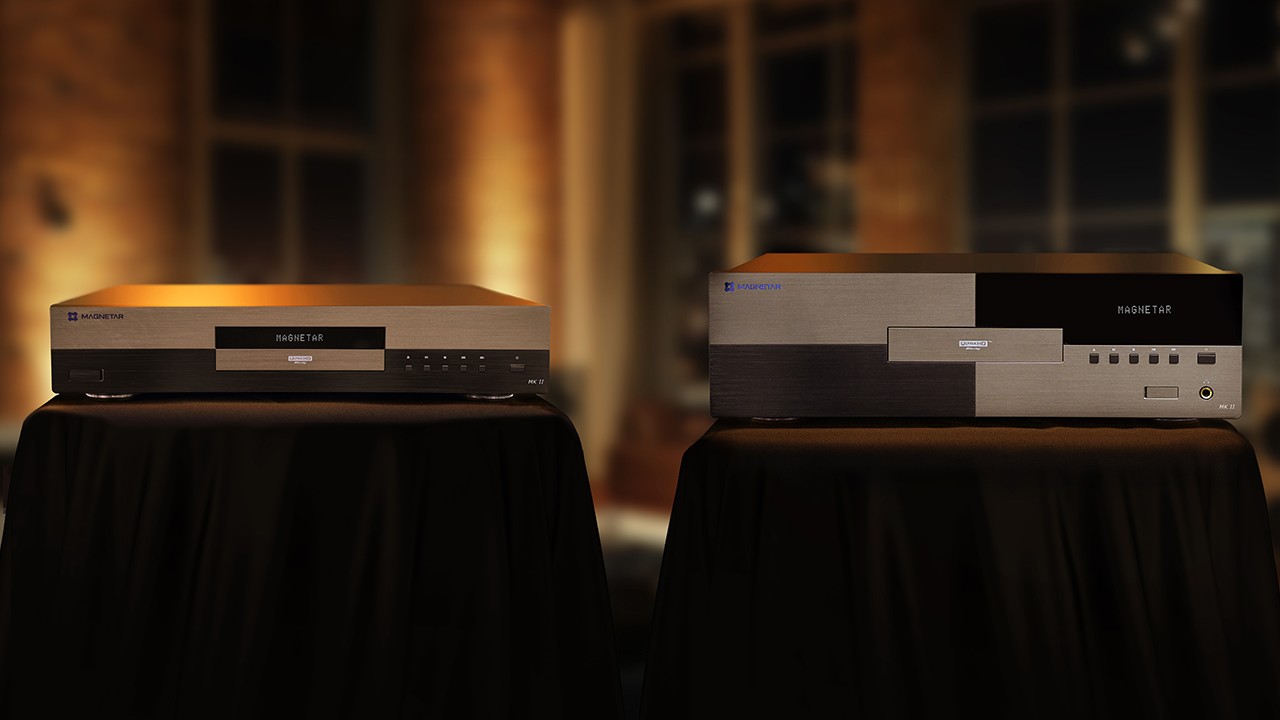
Magnetar UDP900MkII 4K UHD Blu-ray player for a physical-media theater.
The Magnetar UDP900MkII is a specialist source component for viewers who maintain physical movie libraries.
It is presented as a 4K UHD Blu-ray player capable of handling earlier optical-disc formats, giving one component responsibility for both current UHD releases and legacy media.
Its role is narrower than that of a processor, receiver, display or speaker package, but disc playback remains relevant in theaters built around physical media. The supplied article announces the UDP900MkII alongside the separate UDP800MkII and provides family-level information rather than a detailed model-by-model specification comparison. This ranking therefore treats the UDP900MkII alone as the product entry without assuming differences that the source does not document. That limited model-specific evidence keeps it below the more comprehensively described components.
Best for: Dedicated physical-media collections
- 4K UHD Blu-ray playback
- Compatibility with previous optical-disc formats
- Purpose-built support for physical movie collections
Verdict: A niche but relevant theater source for disc enthusiasts, constrained in this ranking by the source’s lack of UDP900MkII-specific technical detail.

9. Onkyo PR-RZ91
Onkyo PR-RZ91 flagship AV preamplifier preview in the brand’s latest design language.
The Onkyo PR-RZ91 is an early look at a next-generation flagship AV preamplifier, not a finished receiver specification that can be assessed in full.
Onkyo presents it as a clean break from its previous high-end platform, with an industrial design intended to establish a new direction for the brand’s theater electronics.
As a preamplifier, it will require separate power amplification. The roadmap is ambitious: Onkyo has discussed Dirac Live, planned Dirac Active Room Treatment and expected THX Certified Dominus support for the wider platform. However, the official PR-RZ91 specifications remain under wraps, and the source does not confirm its channel count, connections or final feature implementation. It consequently ranks as a promising preview rather than a recommendation equal to the documented products above it.
Best for: Future flagship separates systems
- Purpose-built flagship AV preamplifier concept
- Dirac Live identified as the planned room-correction platform
- Dirac Active Room Treatment and THX Dominus included in Onkyo’s stated ambitions
Verdict: An intriguing high-end preamplifier preview whose incomplete specifications prevent a firm assessment of its eventual performance and value.

10. Yamaha R-N600A
Yamaha R-N600A stereo receiver with traditional front-panel controls.
The Yamaha R-N600A is the least directly comparable product because it is a two-channel receiver rather than a surround-sound component.
Its engineering is nevertheless relevant to a music-first entertainment room: Yamaha separates the power supplies for the analog and digital sections, uses its ToP-ART circuit concept and mounts the design on an ART Base chassis intended to limit the effects of vibration and resonance.
Digital conversion is handled by an ESS Sabre ES9010K2M DAC, while Pure Direct bypasses the tone, balance and buffer-amplifier stages. A continuously adjustable loudness control is also provided. These are meaningful stereo features, but the lack of multichannel processing means the R-N600A cannot perform the central role expected of a home cinema receiver, placing it last despite its stronger two-channel credentials.
Best for: Music-first two-channel rooms
- Separate power supplies for digital and analog sections
- ESS Sabre ES9010K2M digital-to-analog converter
- Pure Direct signal path
- ART Base chassis designed to address vibration and resonance
Verdict: A thoughtfully engineered stereo receiver, but an outlier for home cinema because it does not provide the multichannel foundation of the other audio-system choices.

Sound Off
0Join the discussion if you have something to add.