Pioneer VSX-934: Next-Gen AV Receiver with Advanced Network Features and Virtual Height Sound
We are now presented with the successor to the Pioneer VSX-933 receiver, which received the EISA award for 2018-19. The European jury recognized it for its outstanding price-to-quality ratio, likely influenced by its comprehensive network capabilities. These include connectivity to popular streaming services such as Tidal, Spotify, and Deezer, support for UPnP/DLNA, Bluetooth/AirPlay, a proprietary […]

We are now presented with the successor to the Pioneer VSX-933 receiver, which received the EISA award for 2018-19. The European jury recognized it for its outstanding price-to-quality ratio, likely influenced by its comprehensive network capabilities. These include connectivity to popular streaming services such as Tidal, Spotify, and Deezer, support for UPnP/DLNA, Bluetooth/AirPlay, a proprietary FlareConnect multi-room system for integrating wireless speakers using dual-band Wi-Fi, a built-in Chromecast media receiver, and an advanced DTS Play-Fi audio protocol.
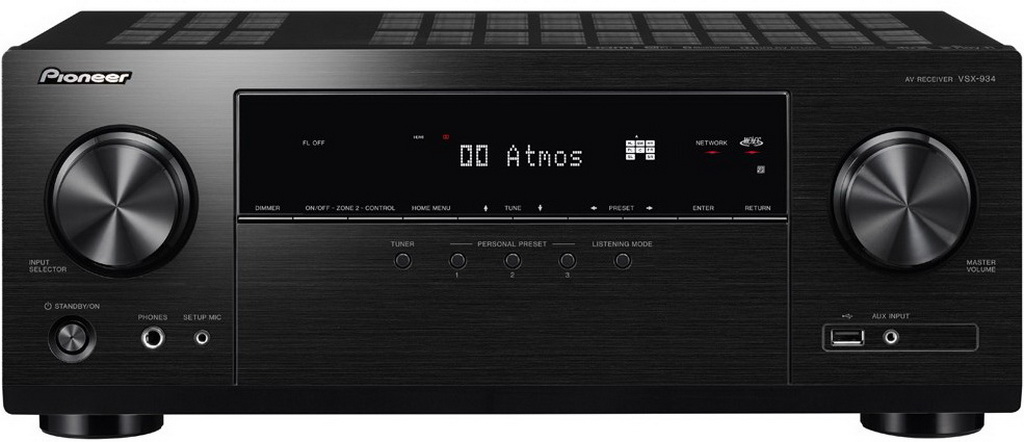
The Pioneer VSX-934 receiver supports both the Sonos and AirPlay 2 ecosystems, among other features. While Chromecast is no longer included in the feature list, I don’t believe this is a significant loss. You can still connect a compatible external module to one of the six HDMI inputs if needed.
Many may wonder why they should explore network standards and protocols if they have no intention of using them for music listening, Bluetooth, or multiroom setups. However, it’s important to recognize that these technologies will likely become standard, whether you embrace them or not. In the past, consumers were similarly confused by mobile phones equipped with high-speed internet, cameras, and flashlights. Now, consider how you would feel about a smartphone lacking these features. Those who have experienced new music listening methods are unlikely to revert to older practices; many network systems are surprisingly user-friendly and some even offer studio-quality audio transmission.
There is no reason to fear the multitude of protocols; this situation is both evident and temporary. Since all technologies are built on the same foundational standards, it is inevitable that network technologies will converge towards a common standard—only the most compatible, effective, and user-friendly options will prevail. This should be a concern for those advocating for specific technologies. Our task is to select a device that currently supports the widest range of standards and can incorporate additional features through software updates in the future. The Pioneer VSX-934 excels in meeting these requirements compared to other models in its category. The only notable protocol it lacks is the licensed Roon, which is tailored for audiophiles. Additionally, the device can easily integrate with various proprietary protocols (such as HEOS, MusicCast, BluOS, SoundLink, etc.) with minimal effort from programmers, provided that the companies behind these brands reach an agreement. As previously mentioned, this collaboration has already been established with Sonos.
One notable advantage for users is the inclusion of three system presets. By pressing one of the dedicated buttons on the front panel for a few seconds, the device saves the chosen configuration of sources, modes, and other settings. Users can easily revert to this configuration at any time using either the remote control or the Pioneer Remote App.
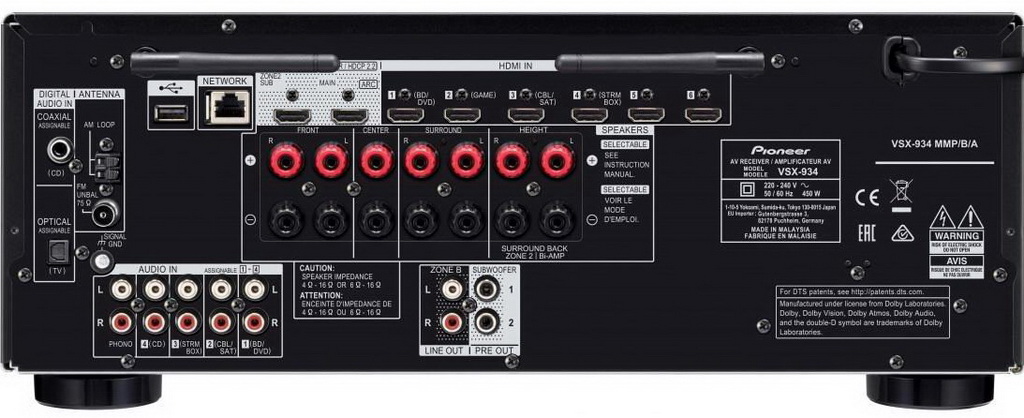
Significant changes have been made to the switching capabilities. The Pioneer VSX-934 features seven pairs of output terminals, requiring you to prioritize your needs—whether that be power output for additional speakers in a second zone, connecting height channels, or bi-amping the front speakers. In contrast, the American version retains nine terminals for the same seven amplification channels, offering enhanced functionality, though it still has limitations. While the second zone can remain operational, activating it may result in some speakers in the main zone being disabled. If you seek comprehensive options, consider the more advanced nine-channel VSX-LX304. This model is built on the same foundation as the VSX-934 and shares its external design, but it includes hardware support for Roon and IMAX.
What stands out here is the addition of a second HDMI output on the Pioneer VSX-934, which is a significant enhancement. Furthermore, a dedicated DAC has been integrated into the audio path for the second zone, allowing it to operate independently from the digital sources selected in the Main zone. This model also offers expanded options for users seeking 3D sound without the need for ceiling speakers or extensive wiring. It introduces virtual height channels through the new Dolby Atmos Height Virtualization and DTS Virtual:X modes, marking a world-first implementation based on this device.
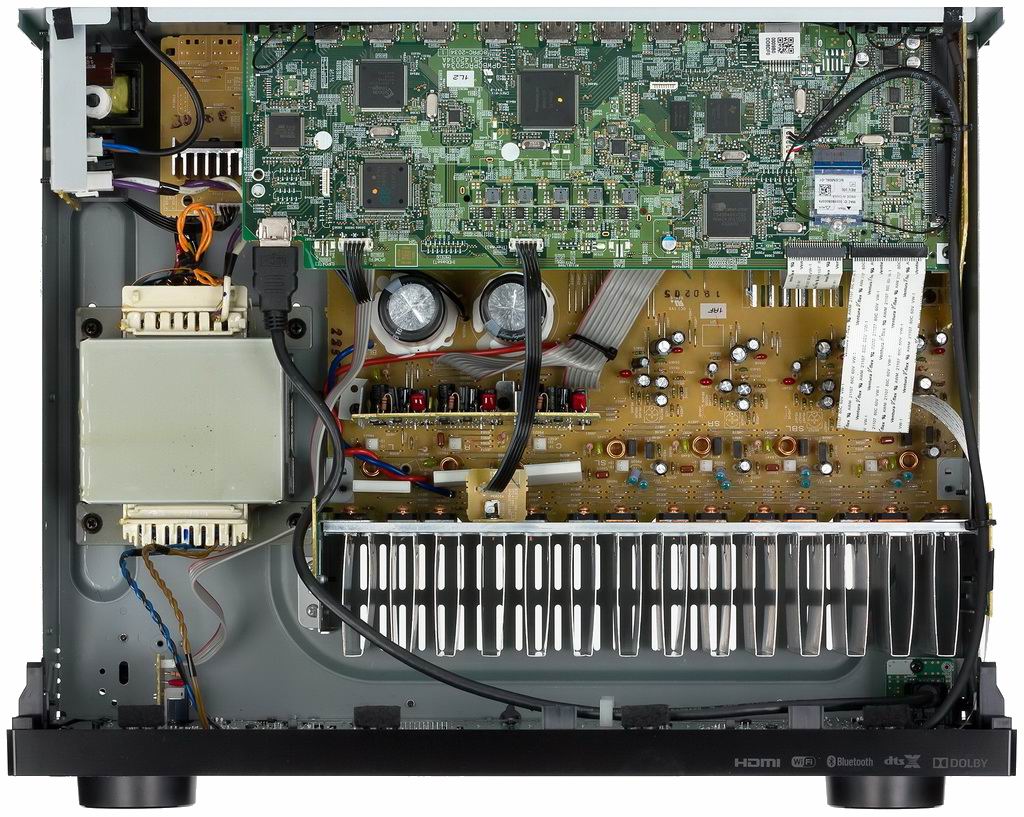
On the hardware side, the components are quite familiar. Audio processing is handled by a quad-core 32-bit DSP, the CS49844A, while analog conversion is managed by 32-bit DACs, including the eight-channel AK4458VN and the two-channel Burr-Brown PCM5101A. Input signal processing is conducted by a pair of Burr-Brown PCM9211, which feature built-in 24-bit/96 kHz ADCs. Traditional power amplifiers utilizing complementary pairs of Toshiba 2SA1941/2SC5198 are responsible for amplification, delivering a reliable 80 W per channel at 8 Ohms with a distortion rate not exceeding 0.08%. The power supply is supported by a robust transformer suitable for a seven-channel setup, although the capacitive buffer contains two relatively modest 6800 μF 63V capacitors, specifically from Nichicon. The proprietary MCACC system facilitates room correction, adjusting both frequency response and phase while ensuring linearity in the subwoofer channel. Additionally, the auto-calibration process, conducted with an external microphone and utilizing cyclic noise fragments at high volumes, accurately measures distances to within millimeters, demonstrating the measuring system’s impressive time resolution.
Pioneer VSX-934 Specifications
-
Number of Channels: 7.2
-
Output Power: 135 W per channel (6 Ohms, 1 kHz, 1 channel driven, IEC)
-
Input Sensitivity/Impedance:
-
Line Input: 200 mV / 47 kOhms
-
Phono: 3.5 mV / 47 kOhms
-
Tuner
-
FM Tuner Range: 87.5 MHz – 108 MHz
-
AM Tuner Range:
-
522 kHz – 1611 kHz
-
530 kHz – 1710 kHz
-
-
Number of Memory Presets: 40
Audio Decoding & Processing
-
Built-in Decoders:
-
Dolby Atmos
-
DTS:X
-
Dolby Pro Logic IIz
-
Dolby Digital Plus
-
DTS-HD High Resolution Audio
-
DTS-HD Express
-
Dolby TrueHD
-
DTS-HD Master Audio
-
Dolby Height Virtualizer
-
DTS Virtual:X
-
-
Processors:
-
Dolby Surround
-
DTS Neural:X
-
-
Calibration System: MCACC auto-calibration system
-
DSP Processor: 32-bit
-
Enhancer for Compressed Music Files: Yes
Multiroom & Zones
-
Number of Additional Zones: 1
-
Second Zone Output: Linear (including post-DAC), acoustic
-
Wireless Multiroom Support:
-
DTS Play-Fi
-
Flare Connect
-
Streaming & Connectivity
-
Supported Streaming Audio Formats (Local Network):
-
MP3
-
WMA / WMA Lossless
-
FLAC
-
WAV (24-bit / 192 kHz)
-
Ogg Vorbis
-
AAC
-
Apple Lossless
-
DSD (5.6 MHz)
-
LPCM
-
-
DLNA: v1.5
-
Wi-Fi: Dual-band (5 / 2.4 GHz)
-
AirPlay 2 Support: Yes
-
Bluetooth: Version 4.1
-
Pioneer App Support: iPhone & Android
-
Direct Mode: Yes
Internet Services Supported
-
TuneIn Radio
-
Tidal
-
Spotify
-
AUPEO!
-
Deezer
Audio Configuration
-
Independent Crossover Frequency Adjustment per Channel:
40 / 50 / 60 / 70 / 80 / 90 / 100 / 120 / 150 / 200 Hz
Inputs
-
6 HDMI 2.0 (4K/60 Hz, HDCP 2.2, HDR10, Dolby Vision)
-
Phono
-
4 x RCA (linear)
-
1 x Coaxial
-
1 x Optical
-
USB Port
-
Ethernet
Outputs
-
2 x HDMI 2.0 (4K/60 Hz, HDCP 2.2, HDR10)
-
Line Output (Zone 2)
-
2 x Subwoofer Outputs
-
6.3 mm Headphone Jack
Other Connections
-
Mini-jack for Calibration Microphone
-
AM and FM Antenna Jacks
-
Ground Terminal
Speaker Terminals
-
7 Pairs of Screw Terminals
Power
-
Power Supply: High-current transformer
-
Power Consumption: 460 W
-
Standby Power Consumption: 0.15 W
Physical Specs
-
Dimensions (W x H x D): 435 x 173 x 370 mm
-
Weight: 9.6 kg