
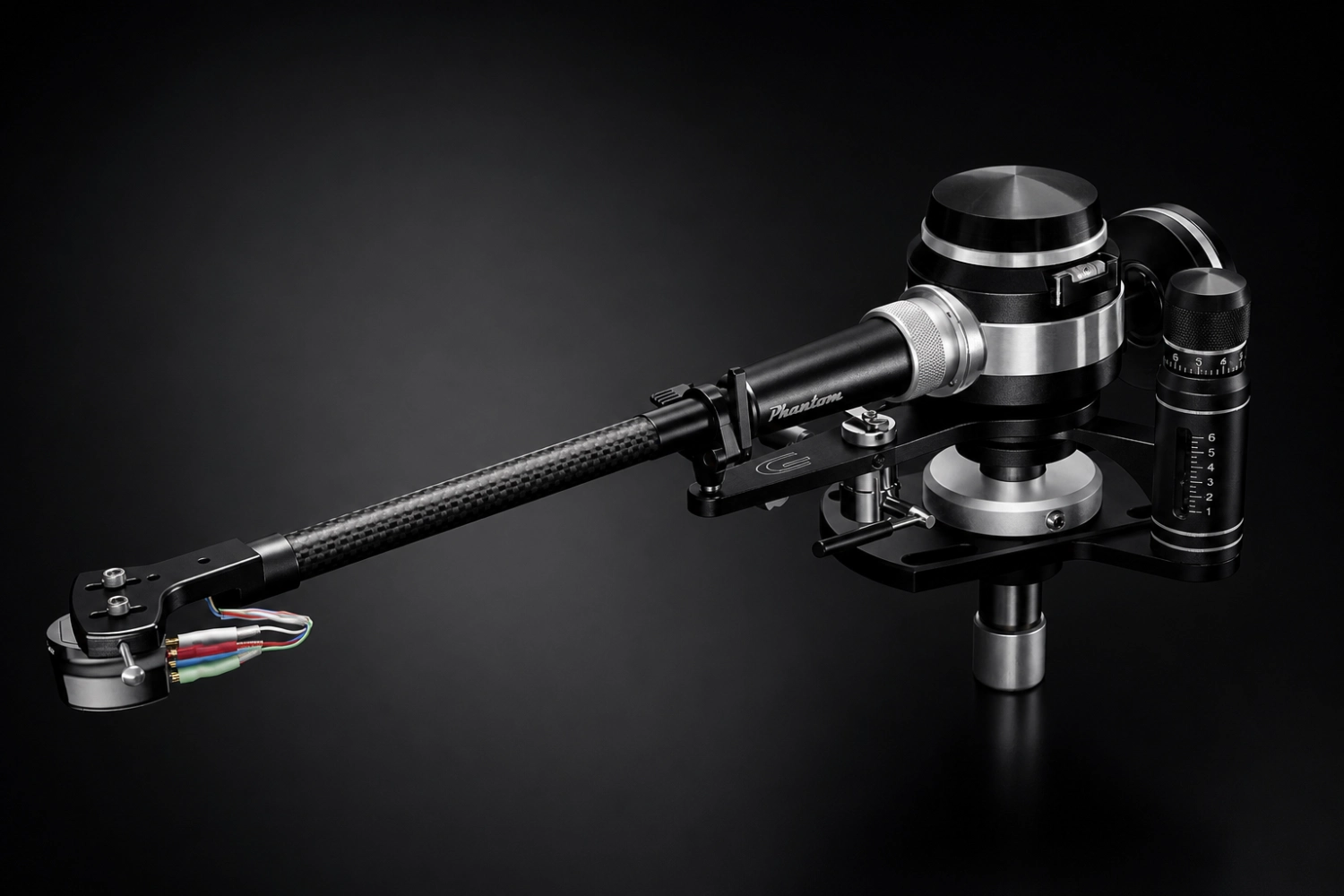
The Phantom Platinum tonearm from Graham Engineering Inc. represents a focused mechanical refinement of the long-established Phantom platform. Rather than introducing a new concept, this design concentrates on optimizing every critical interface that affects cartridge behavior, tracking stability, and energy control. The result is a tonearm engineered as a true micromechanical system, where friction, resonance, and geometry are treated as interdependent variables rather than isolated features.
Bearing architecture and friction management
At the core of the Phantom Platinum is a high-precision unipivot bearing executed in tungsten carbide. The bearing system relies on a carefully matched interface between a finely radiused pivot tip and a precision-machined bearing cup. This geometry is not a simple point contact, but a controlled contact surface designed to minimize friction while maintaining consistent positional stability under dynamic load.
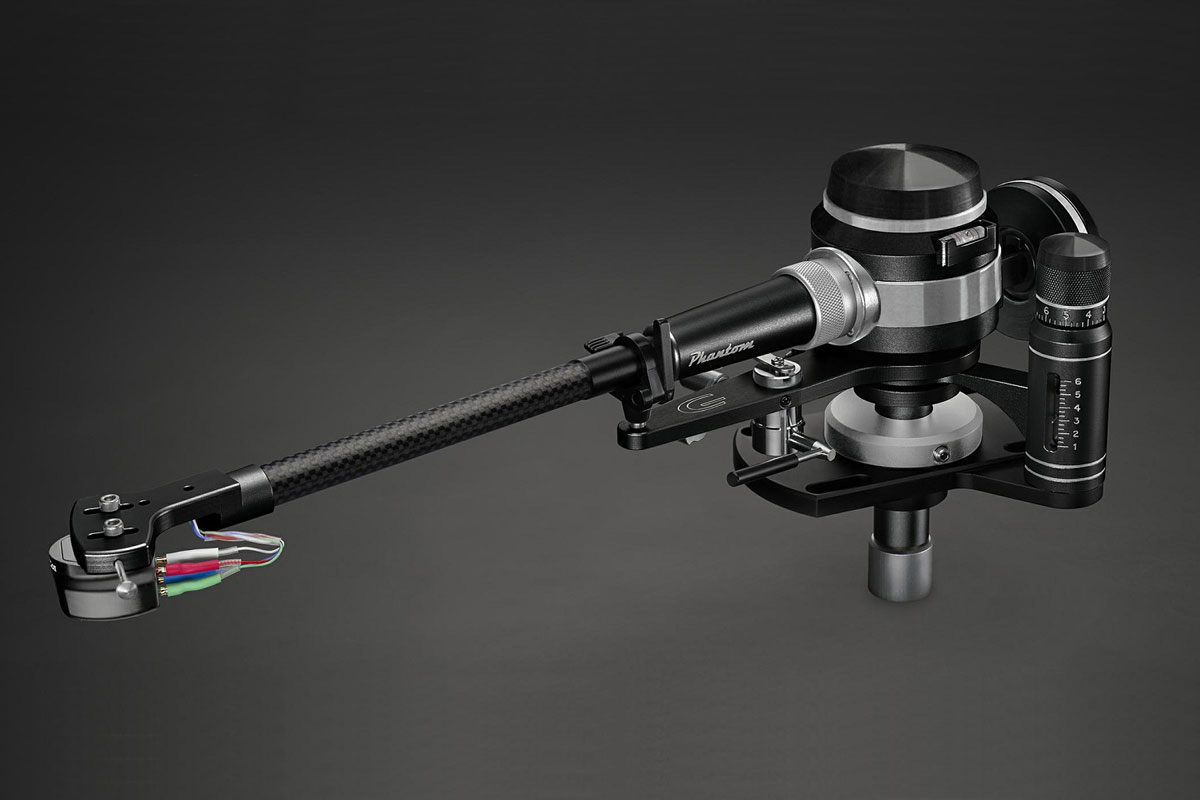
Manufacturing is outsourced to a Swiss micromechanical specialist, reflecting the tolerances required for this level of performance. The objective is to reduce parasitic resistance in both vertical and horizontal movement, allowing the cartridge to respond to groove modulation without mechanical lag or stored energy.
Silicone damping is integrated directly into the bearing environment. This serves a dual purpose, acting as a controlled viscous medium to stabilize motion while simultaneously attenuating micro-vibrations. In practice, this reduces susceptibility to external disturbances and limits high-frequency mechanical noise that can translate into perceived grain or instability in playback.
Magneglide stabilization system
One of the defining elements of the Phantom design is the patented Magneglide system. This approach addresses the inherent lateral instability of unipivot tonearms without introducing additional mechanical contact points.
The system uses two precisely aligned magnets positioned relative to the pivot axis. One is fixed within the tonearm structure, while the second is mounted on an adjustable, mechanically isolated support. The magnetic field provides lateral centering force, effectively stabilizing the tonearm without increasing friction.
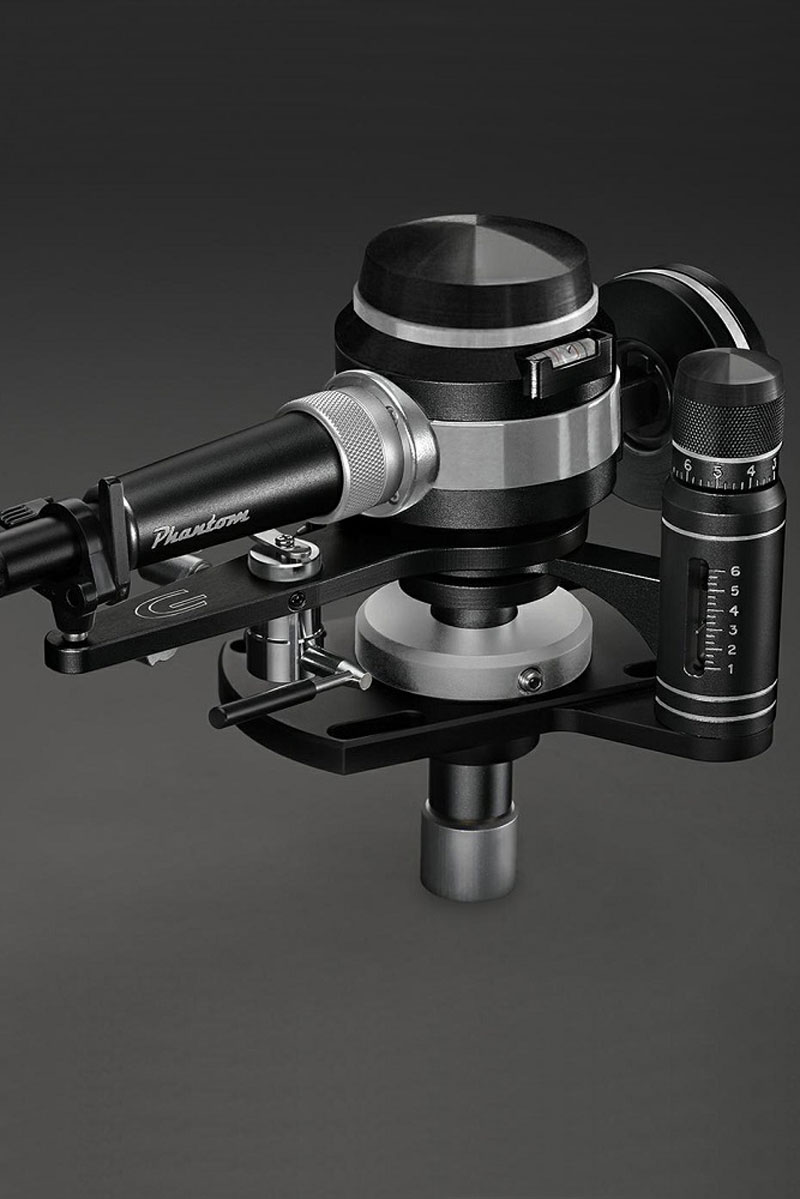
This configuration offers several technical advantages. Lateral movement is controlled without the need for secondary bearings, preserving the low-friction characteristics of the unipivot architecture. At the same time, the adjustable magnet assembly enables precise azimuth calibration. This is critical for maintaining channel balance and minimizing crosstalk, particularly with advanced stylus profiles where alignment tolerances are extremely tight.
The system also improves tracking behavior on warped records by maintaining consistent stylus orientation under changing vertical forces.
Structural design, arm tube and headshell
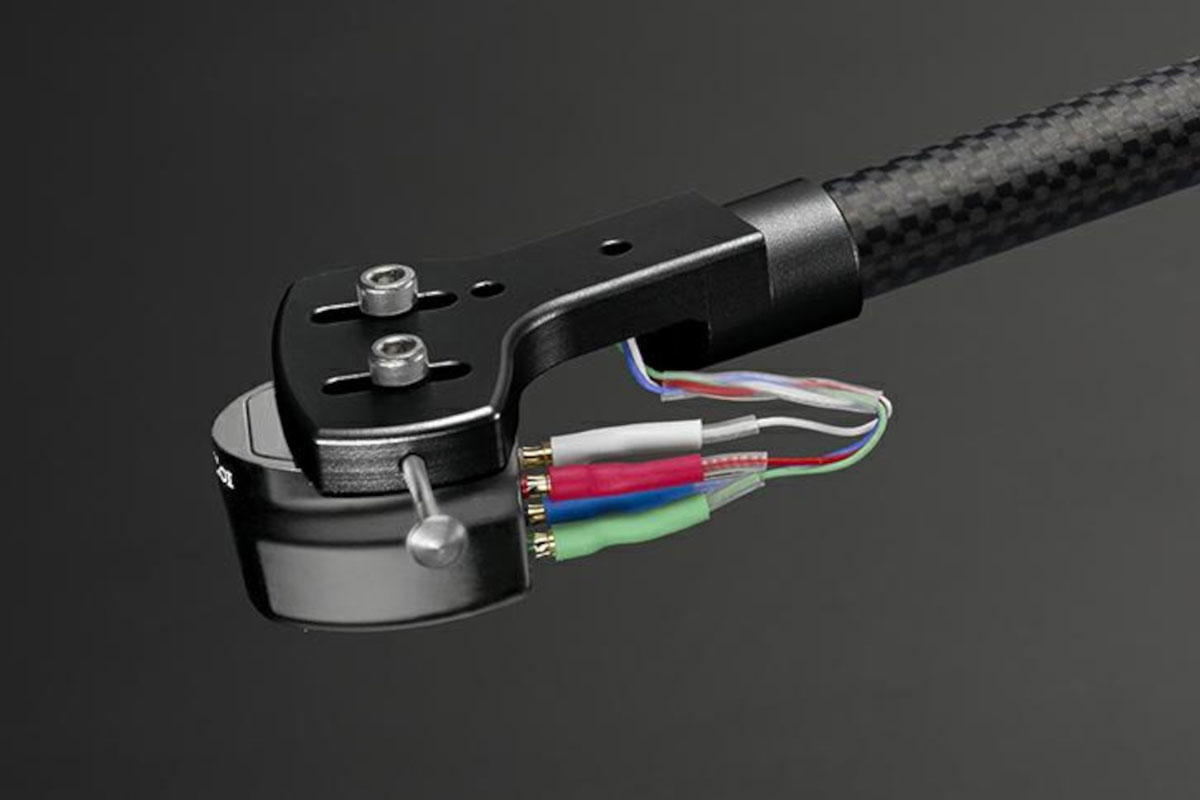
The Phantom Platinum introduces a newly developed arm tube constructed from carbon fiber, paired with a magnesium headshell. This material combination is chosen to optimize stiffness-to-mass ratio while controlling resonance behavior across a broad frequency range.
Carbon fiber provides high rigidity with relatively low mass, reducing flex under dynamic conditions. Its internal damping characteristics help prevent the accumulation and delayed release of vibrational energy, which can otherwise smear transient response.
The magnesium headshell complements this behavior. Magnesium is both lightweight and inherently well damped, minimizing localized resonance at the cartridge interface. This is particularly important because energy generated at the stylus must be dissipated efficiently rather than reflected back into the cartridge system.
Together, the arm tube and headshell form a mechanically coherent structure designed to maintain geometric stability while controlling energy flow.
Detachable arm system and setup precision
A distinctive feature of the Phantom platform is the removable armwand assembly. This allows cartridge installation and alignment to be performed off the turntable, significantly improving setup accuracy and reducing the risk of damage during handling.
From a technical standpoint, this approach increases repeatability. Precise alignment parameters such as overhang, offset angle, and azimuth can be adjusted in a controlled environment. For users working with multiple cartridges, it also enables rapid interchangeability without reconfiguring the entire system.
Internal wiring and signal integrity
Signal transmission within the tonearm is handled by ultra-flexible, silver-plated 4N copper conductors. The wiring is designed to impose minimal mechanical resistance on tonearm movement, an often overlooked factor in tonearm design.
Additional shielding and a spiral grounding structure are implemented to reduce electromagnetic interference and maintain signal integrity. Given the extremely low output levels of moving coil cartridges, even minor electrical or mechanical disturbances in the signal path can have audible consequences.
The routing and flexibility of the internal wiring ensure that the tonearm’s mechanical performance is not compromised by cable-induced forces.
Geometry and configuration options
The Phantom Platinum is available in both 10-inch and 12-inch configurations. The 10-inch version offers an effective length of 246.8 mm with an effective mass of approximately 10 grams, while the 12-inch version extends to 308.8 mm with a mass of around 12 grams.
Longer tonearms reduce tracking angle error across the record surface, improving geometric accuracy at the cost of increased space requirements and system complexity. The 10-inch version represents a balance between performance and integration flexibility, while the 12-inch version targets large-format turntables and systems optimized for minimal tracking distortion.
Both versions utilize a standard SME mounting interface and a 5-pin DIN output, ensuring compatibility with a wide range of high-end turntables and external cabling solutions.
Manufacturing and design approach
The Phantom Platinum reflects a design philosophy rooted in precision engineering rather than visual emphasis. Surface finishes, tolerances, and component interfaces are executed with a level of detail comparable to fine mechanical instrumentation.
The design avoids unnecessary complexity, focusing instead on optimizing the essential parameters that influence playback accuracy, bearing behavior, structural integrity, and vibrational control.
Pricing and positioning
The Phantom Platinum is positioned firmly in the reference category of tonearm design. The 10-inch version is priced at approximately €33,000, while the 12-inch version is available at around €34,000.
At this level, the tonearm is not considered in isolation but as part of a complete analog system. Its performance potential is dependent on equally capable components, including the turntable, cartridge, phono stage, and system setup.
The Graham Phantom Platinum is a highly resolved execution of the unipivot tonearm concept, combining extremely low friction with controlled stabilization through magnetic guidance. Its design focuses on maintaining cartridge freedom of movement while eliminating the instability and resonance issues typically associated with unipivot systems.
Through its bearing architecture, Magneglide stabilization, advanced materials, and attention to signal integrity, the Phantom Platinum functions as a precision interface between the record groove and the playback system. In high-resolution analog setups, where mechanical accuracy directly influences sonic outcome, this level of engineering is not incremental, it is fundamental.


Sound Off
0Join the discussion if you have something to add.