
Choosing better speakers starts with choosing the right type.
This selection ranges from passive standmount and floorstanding models to modular satellites, wireless stereo speakers, a soundbar and a dedicated subwoofer guide.
They are not direct competitors, but each represents a distinct route to improving a music or television system. Begin with the intended use. Passive speakers require suitable amplification, while the Yamaha wireless system places greater emphasis on integration and streaming. Compact satellites suit flexible installations, floorstanders target larger rooms, and a soundbar offers a more focused answer for television and film. Buyers seeking deeper bass can also add a subwoofer rather than replace their main speakers. The source material includes announcements, technical overviews and product recommendations rather than a consistent set of comparative listening tests. Manufacturer specifications and performance claims are therefore identified as such. Where pricing, dimensions, connectivity or amplifier requirements are not supplied, those details should be confirmed before treating any model as a final choice.

1. Jamo launches Studio 7: A new series of budget speakers
The Jamo Studio 7 family includes standmount, floorstanding and center-channel speakers with rounded, backward-sloping MDF cabinets.
Studio 7 is a complete passive-speaker family rather than a single model.
It includes two floorstanders, two standmount speakers and two center channels, making it relevant to both stereo buyers and those assembling a consistent multichannel system.
Listed prices run from €300 for the S7-25C center speaker to €950 for the S7-27F floorstander. Every model uses a 25 mm soft-dome tweeter with a small waveguide, while the midrange and bass drivers employ Jamo’s reinforced Thor’s Hammer paper-cone profile. The rounded MDF cabinets lean slightly backward, an arrangement intended to orient the acoustic axes toward the listener and improve low-frequency interaction with the room. The source outlines a thoughtfully coordinated range, although it does not provide listening results or amplifier-matching guidance.
Best for: Affordable matched passive-speaker systems
- Six models covering stereo and multichannel roles
- Backward-sloping MDF cabinets
- Shared 25 mm soft-dome tweeter design
- Standmount, floorstanding and center-channel options
Verdict: Studio 7 offers a practical route to a visually and technically consistent stereo or home-cinema system, with enough model choice to suit several room sizes.
2. Cambridge Audio MSX: Compact BMR Speakers with Wide Soundstage & Modular Hi-Fi Power
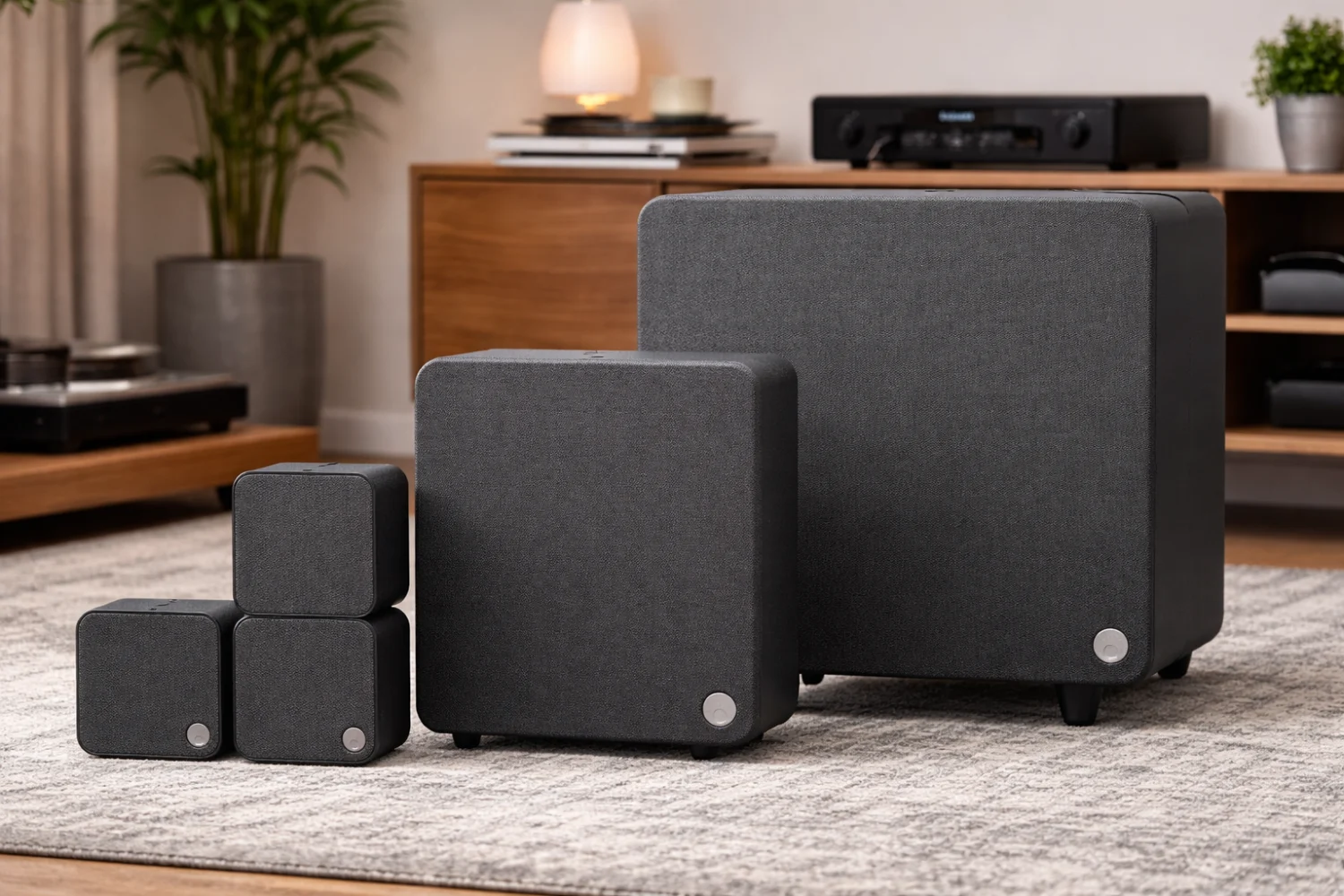
Cambridge Audio’s MSX family combines compact BMR satellite speakers with a choice of matching subwoofers.
Cambridge Audio’s MSX range is built around compact, modular speakers that can be used in stereo or multichannel systems.
The MSX10 and MSX20 satellites can be stacked, while the MSX Sub 200 and Sub 300 provide dedicated low-frequency options.
Matte-black and matte-white finishes support discreet placement in small rooms or around a television. The satellites use the fourth generation of Cambridge Audio’s Balanced Mode Radiator technology. According to the designers, combining the driver with a waveguide produces broad dispersion and a wide listening area; the larger MSX20 supplements that driver with a woofer/midrange unit. The modular concept is the main practical advantage, allowing a small installation to be expanded rather than replaced, though the supplied source does not include prices or complete system specifications.
Best for: Small rooms and expandable installations
- Compact and stackable modular design
- Suitable for stereo and multichannel use
- Two matching subwoofer options
- BMR design intended to provide wide dispersion
Verdict: The MSX range is a flexible choice for listeners who value compact placement and the option to build a larger system in stages.
3. Sonus Faber Concertino G4 represents the latest evolution of the iconic monitor speakers
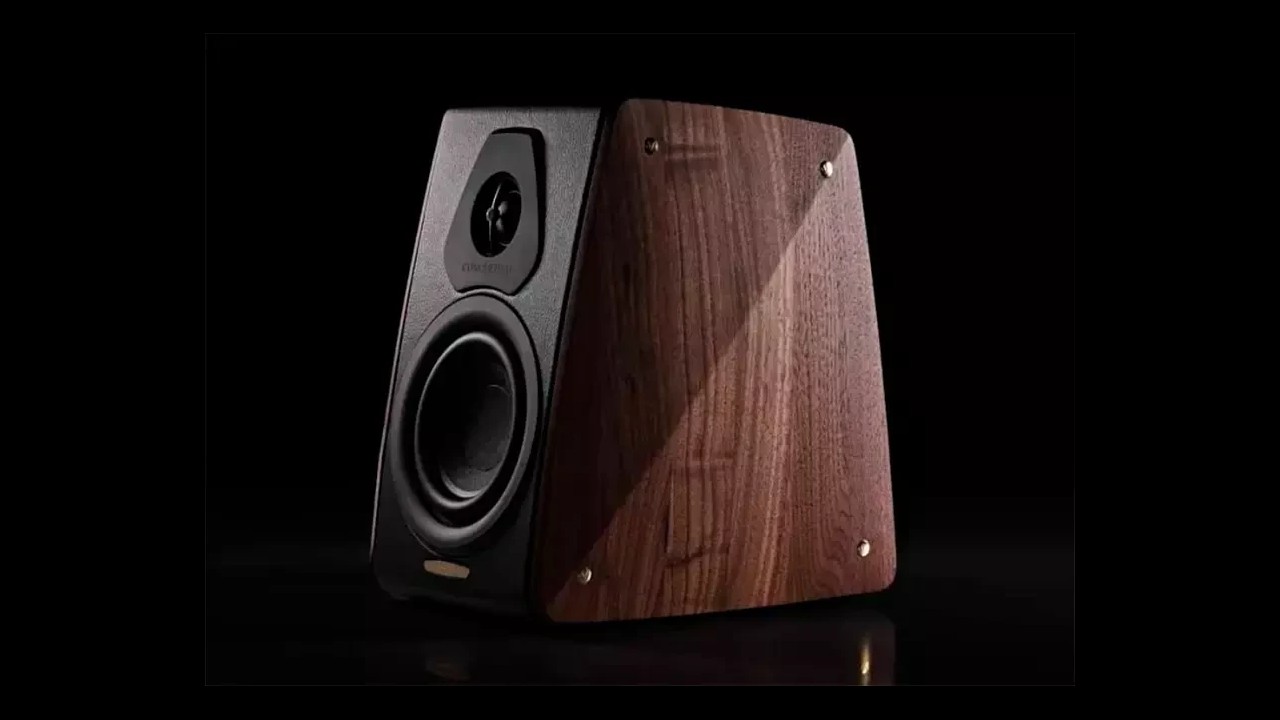
The Sonus faber Concertino G4 pairs a trapezoidal cork-based enclosure with ribbed solid-walnut side panels and alternative leather coverings.
The Concertino G4 is a bookshelf monitor distinguished as much by its cabinet engineering and materials as by conventional driver technology.
Cork is used in the cabinet and around the midwoofer, while the retained trapezoidal form is intended to limit internal resonances and reduce the need for additional damping.
Ribbed solid-walnut side panels add rigidity without internal bracing. Sonus faber also uses recycled leather and a plant-derived alternative developed by Italian startup Ohoskin from orange and cactus by-products. That combination gives the Concertino G4 a clear appeal for buyers who place craftsmanship and material choices alongside acoustic design. The excerpt does not supply sensitivity, impedance, dimensions, price or recommended amplification, so system compatibility and overall value cannot be judged from the available information alone.
Best for: Design-conscious standmount-speaker systems
- Cork-based cabinet construction
- Rigid ribbed solid-walnut side panels
- Trapezoidal enclosure designed to reduce resonances
- Plant-derived and recycled covering materials
Verdict: Concertino G4 combines distinctive Italian cabinet work with resonance-control measures, but its practical system requirements need further investigation.

4. HECO BellaDonna: New two-way bookshelf speakers
The two-way HECO BellaDonna uses a 30 mm silk-compound tweeter, a kraft-paper-cone woofer and an adjustable treble output.
HECO’s BellaDonna is a two-way passive bookshelf speaker with several provisions for system tuning.
Its 30 mm silk-compound tweeter sits in a substantial aluminum front plate with Fluktus geometry, while the woofer uses HECO’s kraft-paper cone, a Phase Optimization Cap and a cast-aluminum basket.
The phase-optimized crossover is described as using tightly specified components, including custom film capacitors in the signal path. Manufacturer figures include 91 dB sensitivity, 150 W rated power and a 28 Hz lower limit. The quoted tweeter range extends to 52 kHz, with the crossover limiting its lower operating point to 2.6 kHz. A two-position control provides linear or +2 dB treble output, and separate band connections are available. These are substantial on-paper capabilities, although the source provides no price, dimensions or independent listening assessment.
Best for: Adjustable two-way passive systems
- Two-position treble-level adjustment
- Claimed 91 dB sensitivity
- Phase-optimized crossover
- Separate connections for the frequency bands
Verdict: BellaDonna stands out for its treble adjustment, substantial driver construction and ambitious manufacturer specifications, subject to confirming price and room fit.
5. Yamaha NX-70A: Wireless Hi-Fi Speakers with MusicCast Streaming
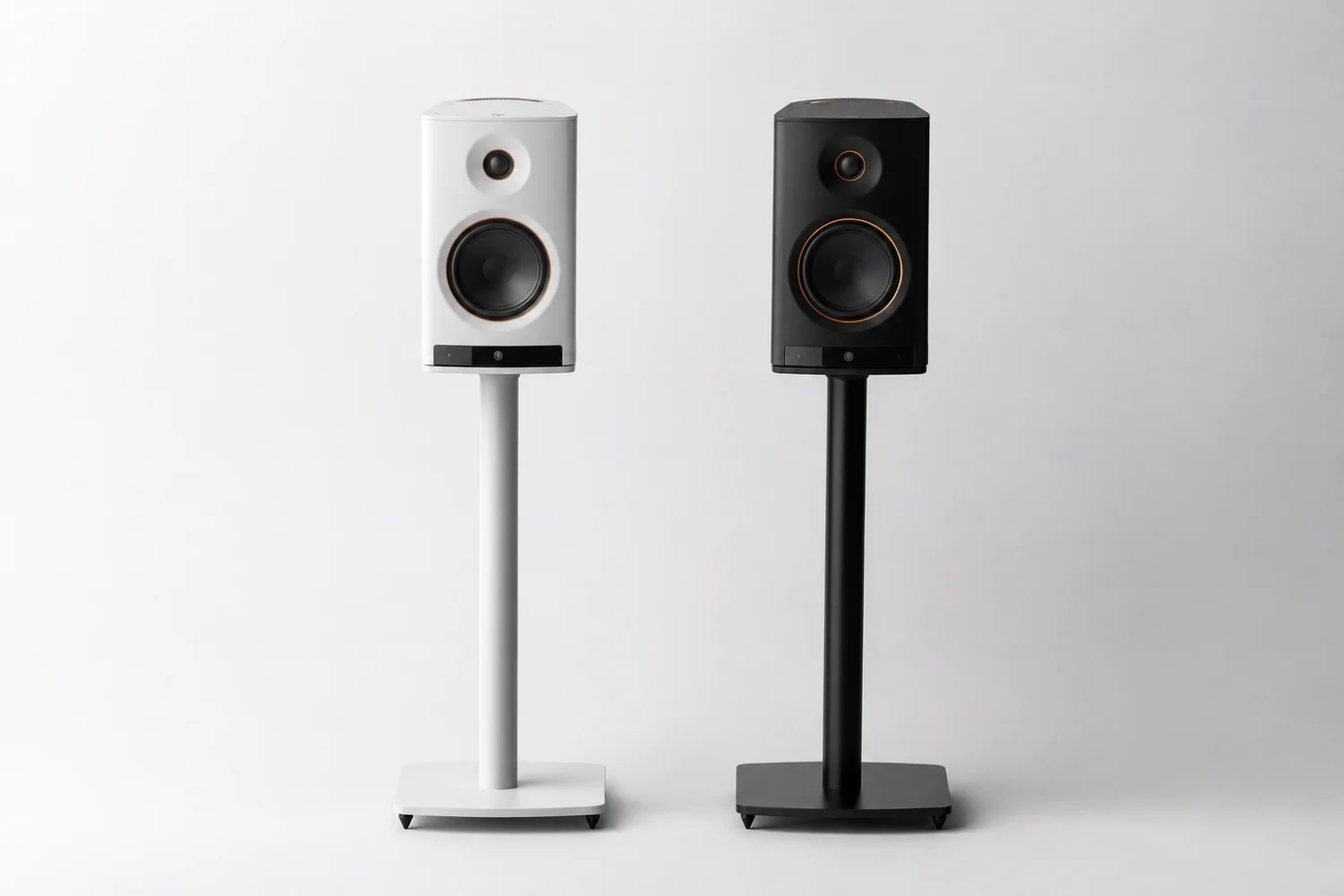
Yamaha’s NX-70A wireless stereo speakers are offered in black or white with matching SPS-70A stands available separately.
The NX-70A is Yamaha’s wireless stereo answer for listeners who want music streaming and television sound within one system.
MusicCast support connects it to Yamaha’s broader network-audio ecosystem, and the source specifically positions the speakers for conventional stereo listening as well as use beside a television.
They can also be paired with the MusicCast VINYL 500 for a network-connected vinyl setup. Black and white finishes are offered, with matching SPS-70A stands sold separately. The cited recommended price is just under €3,000 per pair, while the stands are listed at just under €600 per pair, placing this firmly above entry-level wireless alternatives. The available excerpt does not specify inputs, driver configuration or supported streaming formats beyond MusicCast, so buyers should verify that it accommodates every intended source.
Best for: MusicCast users seeking a streamlined stereo system
- Integrated Yamaha MusicCast support
- Designed for stereo and television use
- Compatible with the wider MusicCast ecosystem
- Available with matching optional stands
Verdict: The NX-70A is a convenient premium option for combining network audio, stereo listening and television sound without assembling a conventional passive system.

6. Looking to buy a new subwoofer? Here are the top 8 subwoofers right now
The subwoofer guide includes compact 8-inch models such as the Magnat Alpha RS 8 and Acoustic Energy AE108-2.
This entry is a subwoofer buying guide rather than a recommendation for one speaker.
Its stated aim is to cover models suitable for music systems, home cinema and different budgets.
The supplied excerpt gives useful detail on two compact 8-inch designs while acknowledging their respective compromises. The Magnat Alpha RS 8 combines an 80 W Class D amplifier, a 200 mm long-throw driver and two Airflex ports in a fiberboard enclosure. The article praises its value, build and powerful bass but notes limited finesse. Acoustic Energy’s AE108-2 is another compact 8-inch design, this time with 150 W of built-in amplification; it is credited with resolution and musicality, although its stated 38 Hz lower limit is less extended. The remaining six ranked models are not described in the source excerpt, preventing a complete comparison here.
Best for: Readers shortlisting a dedicated subwoofer
- Covers music and home-cinema applications
- Includes options aimed at different budgets
- States size, weight and bass-extension figures
- Identifies sonic compromises as well as strengths
Verdict: The guide provides a useful starting framework for subwoofer shopping, but the supplied material supports detailed conclusions for only two of its eight selections.

7. Franco Serbli Lignea: Speakers carved from a single piece of wood
The Franco Serblin Lignea integrates a four-liter wooden enclosure and stand into one slender, seamless structure.
The Franco Serblin Lignea occupies an unusual position between a bookshelf speaker and a floorstander.
Its stand is integrated into the design, eliminating the need to select a separate support, while the acoustic enclosure has a volume of only four liters.
Each seamless cabinet is carved from one piece of wood and contains a 110 mm mid/bass driver and a 27 mm tweeter. The specified operating range is 58 Hz to 36 kHz, with 8-ohm impedance, 83 dB sensitivity and a stated minimum power requirement of 20 W. Each speaker weighs 8 kg and measures 500 by 295 by 1,000 mm, including its tall integrated structure. The relatively low sensitivity makes amplifier compatibility worth checking, while the 58 Hz lower limit suggests that listeners seeking deeper bass may need to consider system context carefully.
Best for: Design-led systems with limited floor space
- Integrated stands require no separate supports
- Seamless cabinet carved from one piece of wood
- Compact four-liter enclosure volume
- Specified 8-ohm impedance
Verdict: Lignea offers rare cabinet construction and an exceptionally slender integrated form, although its sensitivity and bass specification deserve careful system matching.

8. Børresen M6: Official World Premiere at Pacific Audio Fest
The flagship Børresen M6 combines six 4.5-inch M-series drivers with a proprietary sealed-chamber ribbon tweeter.
The M6 is presented as a flagship Børresen loudspeaker built around six proprietary 4.5-inch M-series drivers.
Two cover the midrange and mid-bass, while four are assigned to low frequencies.
A proprietary ribbon tweeter operates from 2.5 kHz in a sealed chamber; the source gives its sensitivity as 94 dB and its diaphragm mass as 0.01 grams. Internal wiring uses Ansuz Gold Signature speaker cable, reinforcing the M6’s place in an uncompromising showcase system. The article focuses on its public demonstration with Aavik electronics rather than supplying a complete buying assessment. There is no price, cabinet size, overall sensitivity, impedance or minimum amplification requirement in the excerpt, making it impossible to evaluate value, placement demands or broader compatibility from this material alone.
Best for: Flagship-system research
- Six proprietary 4.5-inch M-series drivers
- Dedicated ribbon tweeter in a sealed chamber
- Four drivers assigned to low frequencies
- Ansuz Gold Signature internal wiring
Verdict: The M6 has an elaborate driver layout and premium internal construction, but the source is better suited to technical discovery than a practical value judgment.
9. Davis Acoustics Courbet No. 7: Floorstanders with high dynamic characteristics
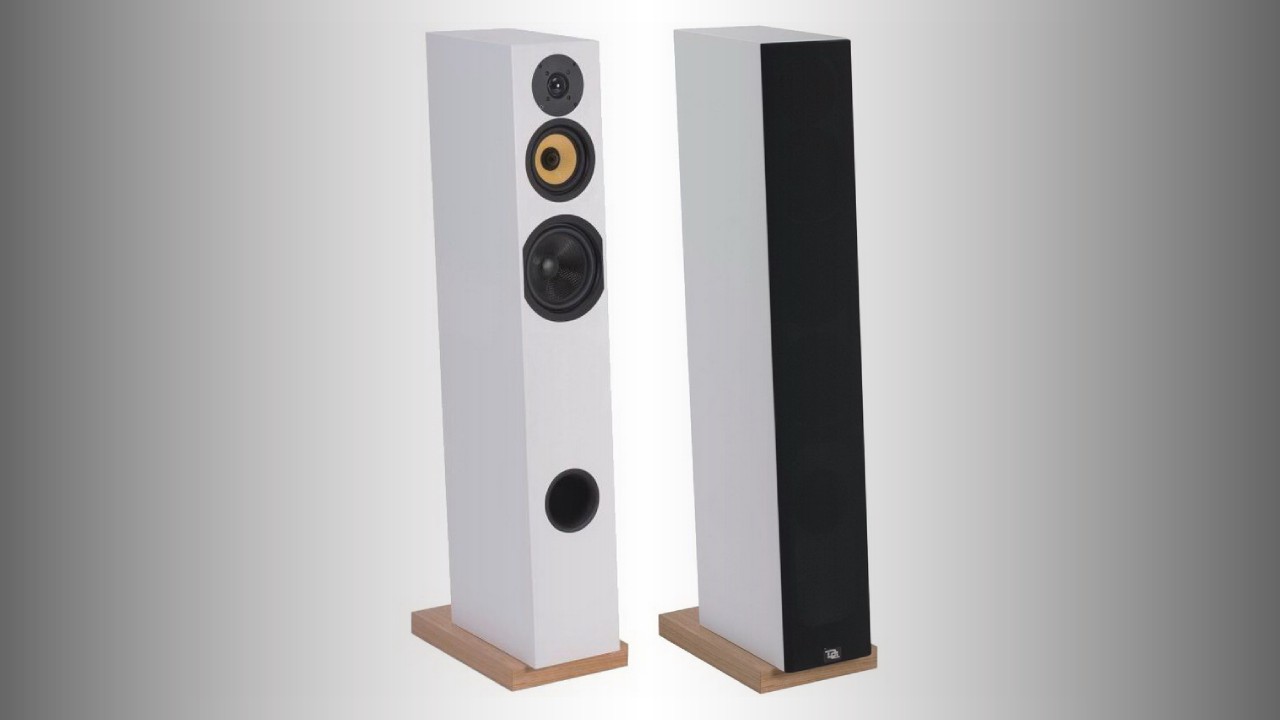
The Davis Acoustics Courbet No. 7 uses a reinforced, slightly tilted floorstanding cabinet designed for large-room performance.
The Courbet No.
7 is the largest model in its series and was designed specifically for larger rooms and high dynamic capability.
Davis Acoustics develops and manufactures its own drivers in France rather than selecting standard commercial units, an approach the source argues provides tighter control over design, production and component costs. Its rigid enclosure uses thick MDF panels and internal ties, with a substantial base fitted with threaded inserts for spikes. The cabinet also leans slightly backward. According to the source, this reduces the likelihood of standing waves and improves time alignment across the three-way design by positioning the bass driver closer to the listener and the lighter tweeter farther away. No price, sensitivity or amplifier recommendation is included in the excerpt, so its value and partnering requirements remain open questions.
Best for: Large-room passive stereo systems
- Designed for use in large rooms
- In-house driver development and production
- Thick MDF cabinet with internal reinforcement
- Tilted enclosure intended to improve time alignment
Verdict: The Courbet No. 7 is a purpose-built large-room floorstander with controlled in-house production and considered cabinet geometry, but amplifier and budget suitability require more information.
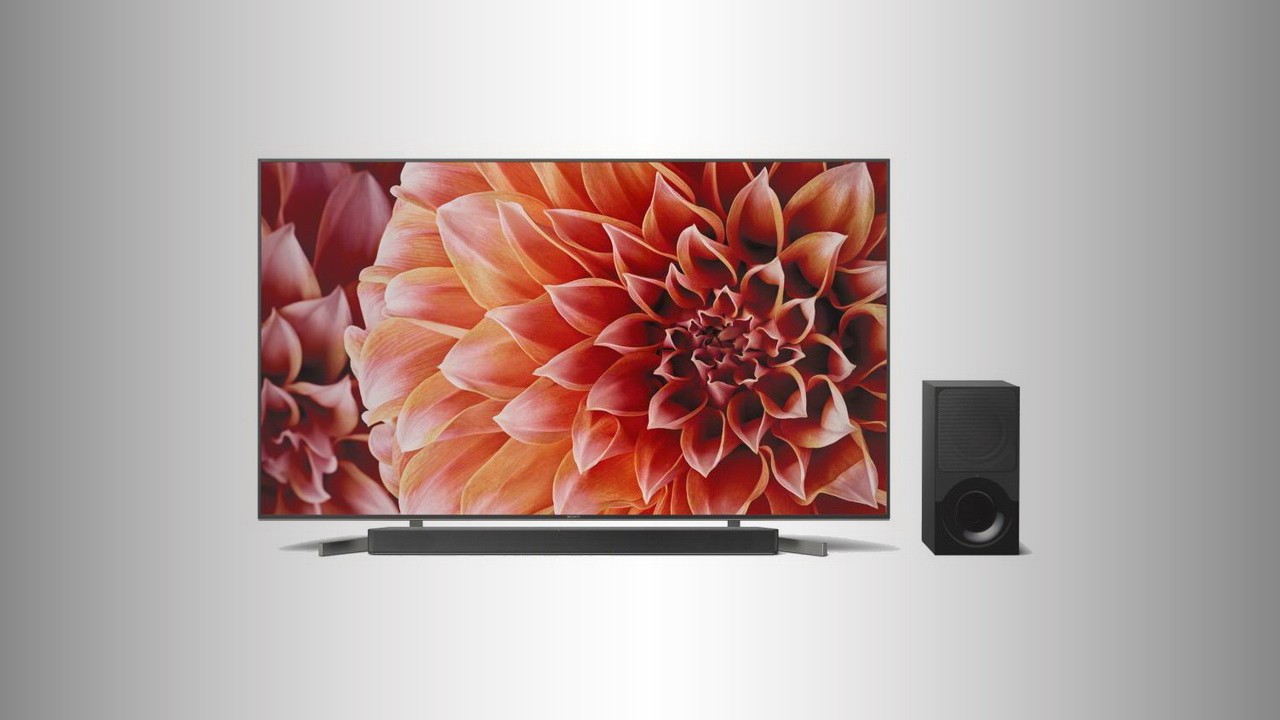
10. Sony HT-XF9000: Immersive 2.1-channel soundbar with Dolby Atmos
The slim Sony HT-XF9000 is a 2.1-channel soundbar with virtual surround processing and 4K HDR passthrough.
The HT-XF9000 is a television-focused alternative to a conventional pair of speakers.
This 2.1-channel soundbar supports Dolby Atmos and DTS:X, using Sony’s Vertical Surround Engine and digital signal processing to create a virtual surround presentation from a compact front-facing system.
Its styling was developed to complement Sony BRAVIA televisions. Practical connections include HDMI ARC, 4K HDR passthrough at a stated 18 Gbps and HDCP 2.2 support. The source also identifies a wireless connection option intended to reduce visible cabling, although it does not specify the connection standard in the supplied excerpt. This is the most film-oriented selection in the guide and prioritizes simple television integration over the placement flexibility and channel separation of traditional stereo speakers.
Best for: Film-focused BRAVIA television systems
- Dolby Atmos and DTS:X support
- Sony Vertical Surround Engine processing
- 4K HDR 18 Gbps passthrough
- HDMI ARC connectivity
Verdict: The HT-XF9000 is the practical choice here for viewers who prioritize compact placement, current cinema formats and straightforward television integration.


Sound Off
0Join the discussion if you have something to add.