
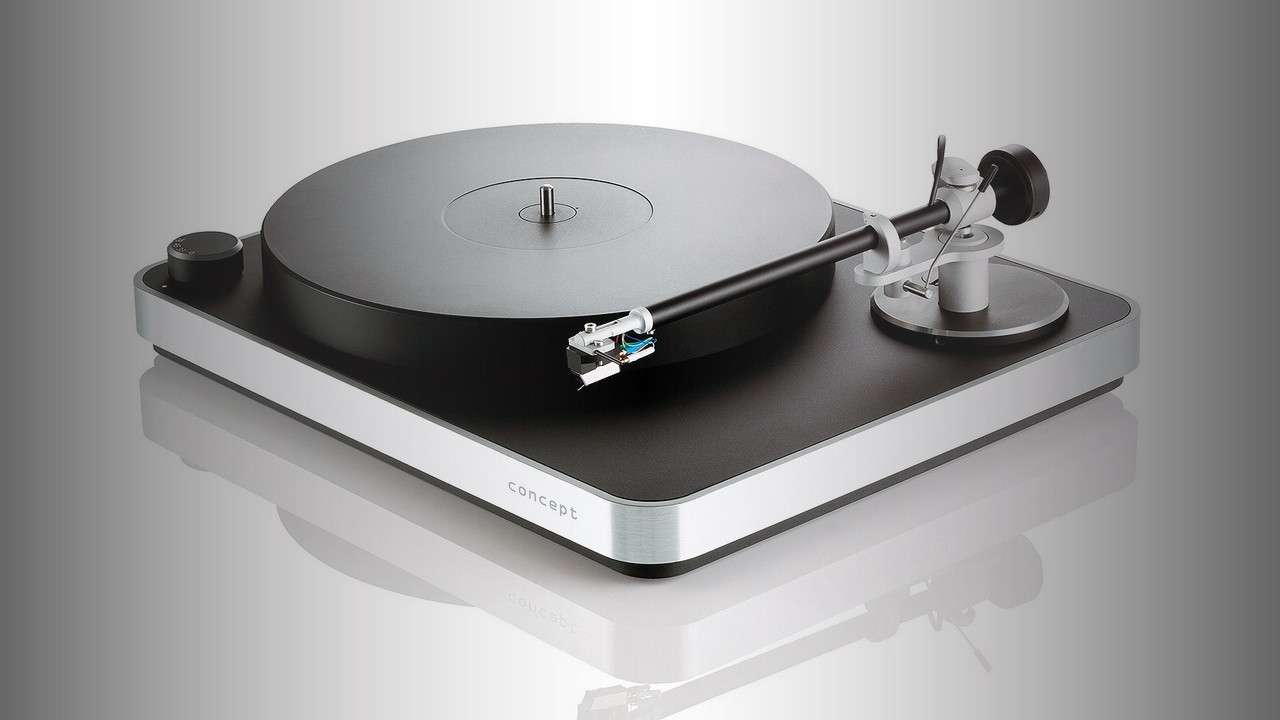
The Clearaudio Concept MM addresses a familiar tension in turntable design: the mechanical precision that makes vinyl playback rewarding can also make installation intimidating. Rather than requiring an owner to assemble and align every component from scratch, the Concept MM arrives with its tonearm tracking force, cartridge alignment, and anti-skating set at the factory. That approach gives the turntable a clear identity. It is a serious, manually operated belt-drive design intended for listeners who value careful engineering but would prefer not to begin ownership with a lengthy calibration session. Its appeal extends beyond convenience, however. A resonance-controlled chassis, substantial POM platter, isolated DC motor, magnetic-bearing tonearm, and supplied Concept MM cartridge form a deliberately integrated record-playing system.
Factory setup is central to the design
The Concept MM’s most immediately useful quality is that its principal adjustments are completed before delivery. Cartridge alignment, tracking force, and anti-skating are factory set, allowing the turntable to be put into service with considerably less preparation than a component assembled from separately selected parts. Clearaudio also supplies a level so that the adjustable feet can be used to establish a properly horizontal playing surface.
This matters because turntable performance depends on mechanical relationships that are easy to disturb. Cartridge position, stylus pressure, anti-skating, and deck leveling all affect how the pickup follows a record groove. By treating the tonearm and cartridge as parts of a preconfigured package, the Concept MM reduces the risk of a basic installation error while retaining the adjustability expected of a specialist turntable.
The design is not permanently locked to its original configuration. The cartridge and tonearm can be replaced, but doing so means repeating the relevant setup procedures. That makes the supplied arrangement especially attractive for owners who want a coherent system from the outset, while preserving an upgrade path for those prepared to perform more advanced calibration later.

A compact chassis built around resonance control
The turntable measures 420 by 140 by 350 mm and weighs 7.5 kg with its motor, tonearm, and cartridge. Its visual design is restrained, with rounded edges and a silver-colored perimeter detail. More importantly, the chassis is specifically constructed to minimize unwanted resonance and vibration rather than relying on imposing dimensions or excessive mass.
Its relatively compact proportions should make it easier to accommodate on dedicated audio furniture than some larger turntable designs. Placement still deserves attention: the supplied level and height-adjustable feet help establish the correct orientation, but the Concept MM remains a precision mechanical source and therefore benefits from a stable supporting surface.
Clearaudio uses a separate external power adapter rather than placing the complete power supply within the plinth. This separates a potential source of electrical interference from the cartridge and its low-level signal. A grounding lead and a fixed phono cable are provided for connection to an amplifier or external phono stage.

Belt drive with a 30 mm POM platter
A low-noise DC motor drives the subplatter through a wide, flat belt. The motor is damped within the chassis, while the belt provides mechanical separation between the motor and the record-supporting assembly. This is a conventional drive principle executed with materials chosen to control vibration at each stage.
The main platter is 30 mm thick and made from polyoxymethylene, usually abbreviated to POM. It is a tough engineering polymer used here for its resistance to resonant behavior. The platter sits over a steel pulley and subplatter assembly, while the main bearing combines a hardened, polished steel spindle with a specially treated sintered-bronze sleeve. A Teflon-coated thrust-bearing segment supports the assembly, and a spiral groove assists lubricant circulation within the bearing.
Three rotational speeds are selected from a control positioned at the lower-left corner of the plinth: 33.3, 45, and 78 rpm. The first two cover conventional LPs and singles, while 78 rpm adds flexibility for owners of compatible records. Playing shellac discs appropriately may require a different cartridge or stylus arrangement, so the presence of the speed alone does not make the factory MM configuration universal for every 78 rpm record.

The Verify tonearm takes an unusual approach
The straight Verify tonearm is one of the Concept MM’s most distinctive technical elements. Its rotating assembly uses magnetic suspension and string centering rather than a conventional bearing arrangement. The upper magnet maintains suspension and tension, while the lower string locates the arm tube. The objective is to minimize friction at the pivot and mechanically decouple the arm’s moving structure.
The tonearm has an effective length of 239.3 mm and a pivot-to-stylus distance of 222 mm. It can balance cartridges weighing from 2.5 to 17 grams, providing scope for future cartridge changes. The installed Concept MM cartridge falls comfortably within that range at 8.4 grams.
Although the factory setup makes the unconventional arm straightforward to use initially, later adjustment is less casual. The anti-skating control is underneath the tonearm mounting area and has no marked scale, while the counterweight also lacks a calibrated tracking-force scale. Owners altering the original configuration will therefore need suitable setup tools, including an accurate stylus-force gauge, and should expect a more methodical process than the initial installation requires.

A complete moving-magnet starting point
The supplied Concept MM moving-magnet cartridge uses an oxygen-free-copper coil and an aluminum-magnesium body with a ceramic layer. Its Micro Line stylus profile is specified for a recommended tracking force of 2 grams, with a tolerance of plus or minus 0.2 gram. Output is quoted at 3.3 mV at 5 cm/s, and the stated frequency range is 20 Hz to 20 kHz.
Including a mounted and aligned cartridge is significant because it removes the compatibility questions that accompany a bare turntable. The arm and pickup arrive as a known combination, and the moving-magnet output makes the Concept MM suitable for connection to an appropriate MM phono input or separate MM phono preamplifier. The turntable itself is passive and does not include an onboard phono stage.
The fixed output cable simplifies the signal path and means another cable is not required for initial installation. The trade-off is reduced flexibility for owners who prefer to select or replace phono cables without modifying the turntable. That design decision is consistent with the Concept MM’s emphasis on an integrated, ready-configured package rather than continual component substitution.

Accessories are deliberately minimal
The platter is intended to support records without a supplied mat, and no record clamp is included. This keeps the standard mechanical interface simple and avoids making an accessory part of the required operating routine. Owners can still explore compatible mats or clamps if desired, but these should be treated as optional system changes rather than omissions that must be corrected immediately.
The practical accessories are focused instead on installation and connection: the leveling tool, adjustable feet, grounding lead, captive phono cable, and external power adapter. Together with the preadjusted arm and cartridge, they reinforce the turntable’s emphasis on getting the fundamentals established with relatively little assembly.

Who the Concept MM is best suited to
The Concept MM is most suitable for a listener who wants the construction and adjustability of a specialist manual turntable without having to select, mount, and align a cartridge on day one. Its restrained dimensions also suit systems where a large or visually dominant deck would be difficult to accommodate. Support for three speeds gives it broader record-format flexibility than a two-speed design, provided the pickup is appropriate for the records being played.
It is less naturally suited to someone seeking automation, an integrated phono stage, or quick, tool-free experimentation with cartridges and cables. Changing the factory configuration is possible, but the unmarked tracking-force and anti-skating arrangements make accurate setup equipment and patience important. The permanently attached phono lead may also be a limitation for systems built around cable interchangeability.
For its intended owner, however, those compromises are coherent. The Concept MM prioritizes a carefully assembled starting point, mechanical isolation, and straightforward everyday speed selection over automation or modular connectivity.
Conclusion
The Clearaudio Concept MM’s strongest documented qualities are its integrated factory setup, resonance-conscious chassis, 30 mm POM platter, isolated belt-drive motor, three-speed operation, and unusual magnetic-bearing Verify tonearm. The preinstalled moving-magnet cartridge and supplied setup accessories further reduce the work required to establish a correctly configured vinyl source. Its manual operation, passive output, fixed phono cable, and more involved adjustment procedure should be considered before purchase, particularly by frequent cartridge experimenters. For listeners who want a compact specialist turntable that arrives as a coordinated arm-and-cartridge system, the Concept MM offers a thoughtful balance of convenience, precision engineering, and future adjustability.


Sound Off
0Join the discussion if you have something to add.