
These ten receivers cover a unusually wide range of systems, from conventional seven-channel living-room setups to ambitious theaters requiring 13 amplified channels or 16-channel processing.
The principal differences are amplification scale, supported speaker layouts, room-correction options, video connectivity, streaming integration, and the amount of external hardware needed for expansion.
The ranking prioritizes documented home-cinema capability, configuration flexibility, calibration, and overall completeness. Power figures are not treated as directly comparable because the supplied sources cite different impedances and do not consistently state how many channels were driven during measurement. Pricing is also excluded because the sources do not provide a reliable common basis for value comparisons. Two entries require special context. The Onkyo HT-S3705 is a home-cinema system whose source concentrates on the associated TX-SR333 receiver, while the Yamaha R-N1000A is a two-channel network receiver rather than a conventional multichannel AV receiver. Both remain useful in their intended niches, but they rank below products designed explicitly for immersive surround sound.

1. Denon AVC-A10H
Denon AVC-A10H 13-channel AV receiver.
The AVC-A10H takes first place by combining 13 channels of amplification with connections for as many as four active subwoofers.
The source cites 150 watts per channel into 8 ohms, although it does not provide an all-channels-driven measurement, so the ranking rests primarily on the receiver's exceptional channel scale and system flexibility rather than a simplified power comparison.
Audyssey MultEQ XT32 is included for automatic calibration, while Dirac Live Room Correction and Bass Control are supported through separately purchased licenses. ESS digital-to-analog conversion, an oxygen-free-copper-wound transformer, monolithic amplifier construction, and production at Denon's Shirakawa facility reinforce its position as the most comprehensively specified integrated receiver in this group.
Best for: Large, ambitious theaters requiring extensive amplification and bass integration
- Thirteen amplified channels for large immersive speaker layouts
- Four independent subwoofer outputs
- Audyssey MultEQ XT32 room calibration
- Optional Dirac Live Room Correction and Bass Control
Verdict: The Denon AVC-A10H is the strongest overall choice for readers who want near-separates system scale in a single receiver.

2. JBL Synthesis SDR-40
JBL Synthesis SDR-40 immersive AV receiver.
The JBL Synthesis SDR-40 is aimed at dedicated cinema rooms rather than ordinary living-room installations.
It can process 16 channels and incorporates nine Class-G amplifier stages, allowing it to power a substantial system directly while providing pre-outs for configurations that require additional external amplification.
Format support includes Dolby Atmos, DTS:X Pro, IMAX Enhanced, and AURO-3D. Flexible matrix channel assignment and advanced room correction add installation versatility. It ranks just behind the Denon because only nine of its 16 processed channels are internally amplified, but it is arguably the more natural foundation for a customized system that will mix internal and external power amplifiers.
Best for: Dedicated cinema rooms using a mixture of internal and external amplification
- Sixteen-channel audio processing
- Nine integrated Class-G amplifier channels
- Dolby Atmos, DTS:X Pro, IMAX Enhanced, and AURO-3D support
- Pre-outs and flexible channel assignment for system expansion
Verdict: The SDR-40 is a highly expandable receiver for serious installations, especially when 16-channel processing matters more than having every channel internally powered.

3. Onkyo TX-NR7100 B M2
Onkyo TX-NR7100 B M2 nine-channel AV receiver.
The Onkyo TX-NR7100 B M2 offers a particularly balanced combination of channel capacity, calibration, video support, and network features.
Its nine-channel architecture can support 7.1.2 or 5.1.4 immersive layouts, while Dolby Atmos, DTS:X, Dirac Live, THX certification, and IMAX Enhanced address both system setup and cinematic format compatibility.
Seven HDMI inputs and two outputs support 8K video, HDCP 2.3, Dolby Vision, HDR10+, and eARC according to the source. Ethernet, dual-band Wi-Fi, DTS Play-Fi, AirPlay 2, and Chromecast broaden its role as a music source. Although a maximum output figure of 220 watts is cited, the source does not specify sufficiently comparable test conditions, so that number is not a factor in its placement.
Best for: Feature-rich 5.1.4 or 7.1.2 home theaters
- Nine channels for 7.1.2 or 5.1.4 speaker systems
- Dirac Live room correction
- Seven HDMI inputs with 8K, Dolby Vision, HDR10+, and eARC support
- Extensive wired and wireless streaming options
Verdict: The TX-NR7100 B M2 is the most rounded mid-list recommendation for buyers seeking nine-channel immersion, Dirac Live, and broad connectivity in one component.

4. Pioneer SC-LX704
Pioneer SC-LX704 nine-channel AV receiver.
The Pioneer SC-LX704 combines nine-channel amplification with processing intended to place and move effects precisely around an immersive sound field.
Its sixth-generation Direct Energy HD amplifier section is rated by the source at 9 x 135 watts into 8-ohm speakers, and the receiver can accommodate a system incorporating four ceiling channels.
Dolby Atmos, DTS:X, and IMAX Enhanced cover the principal formats identified in the source. Google Cast support adds network convenience, while revised power coils and capacitors are intended to reduce noise. It remains a formidable option, but the supplied material documents less about room-correction flexibility than it does for the three receivers ranked above it.
Best for: High-impact nine-channel theaters built around multiple height speakers
- Nine Direct Energy HD amplifier channels
- Support for systems with four ceiling channels
- Dolby Atmos, DTS:X, and IMAX Enhanced compatibility
- Google Cast support
Verdict: The SC-LX704 is a powerful immersive receiver whose nine-channel amplification and four-height-speaker capability remain its clearest strengths.

5. JBL MA7100HP
JBL MA7100HP 7.2-channel AV receiver.
The JBL MA7100HP is a more approachable seven-channel alternative to the large theater receivers above it.
Its 7.2-channel architecture can power a conventional surround system or a 5.2.2 Dolby Atmos and DTS:X layout, while all-digital amplification is intended to combine useful output with energy efficiency.
The source cites 125 watts of output but does not provide measurement conditions that would permit a fair comparison with the other receivers. More important is its choice of setup tools: the MA7100HP is ready for Dirac Live through a separately purchased license, while JBL's free EZ Set EQ application provides a simpler calibration route. That flexibility makes it especially suitable for users who want to choose between guided setup and more advanced tuning.
Best for: Modern 5.2.2 systems needing a choice of simple or advanced room tuning
- 7.2-channel design supporting 5.2.2 immersive audio
- Dolby Atmos and DTS:X compatibility
- Optional Dirac Live room correction
- Free EZ Set EQ application for simpler calibration
Verdict: The MA7100HP is a well-focused seven-channel receiver with unusually flexible calibration options, provided buyers account for the separate Dirac Live license.

6. Denon AVR-X1700H
Denon AVR-X1700H seven-channel AV receiver.
The AVR-X1700H is a seven-channel receiver with the essential architecture for a contemporary apartment or living-room cinema.
Its 7.2 configuration can be arranged as a 5.2.2 system, and native Dolby Atmos and DTS:X decoding is supplemented by Dolby Atmos Height Virtualization when physical height speakers are not practical.
The supplied source places unusual emphasis on internal engineering. It describes specially developed output transistors, reduced output impedance across the conversion and amplification stages, custom 10,000-microfarad smoothing capacitors, redesigned power-supply stabilizers, and shielding for the pulse power supply. Those details give it a stronger technical foundation in the available material than many basic seven-channel models, even though the source provides less information about its video and network platform.
Best for: Compact 5.2.2 theaters where documented audio engineering is a priority
- Seven-channel amplification with dual-subwoofer support
- Supports a 5.2.2 Dolby Atmos or DTS:X system
- Dolby Atmos Height Virtualization
- Reworked power-supply, output-stage, and capacitor design
Verdict: The AVR-X1700H is a thoughtfully engineered seven-channel foundation for a practical immersive home theater.

7. Marantz NR1711
Marantz NR1711 low-profile AV receiver.
The Marantz NR1711 distinguishes itself with a low-profile enclosure approximately half the height of a conventional full-size receiver.
Despite that compact format, it contains seven discrete amplifier channels and supports 5.1.2 Dolby Atmos or DTS:X playback, along with DTS Virtual:X and Dolby Atmos Height Virtualization for systems without physical height speakers.
Its video platform supports 8K at 60 Hz and 4K at 120 Hz, while Audyssey MultEQ, Dynamic EQ, and Dynamic Volume provide speaker calibration and listening-level optimization. The quoted 90-watt rating is specified into 6 ohms, so it should not be compared directly with ratings given at 8 ohms. Its slim construction is the main reason to choose it over the neighboring Denon models.
Best for: Space-conscious installations that still require genuine 5.1.2 surround sound
- Low-profile chassis for space-constrained installations
- Seven discrete amplifier channels with 5.1.2 support
- 8K at 60 Hz and 4K at 120 Hz video compatibility
- Audyssey MultEQ calibration with Dynamic EQ and Dynamic Volume
Verdict: The NR1711 packs meaningful immersive-audio and high-bandwidth video support into one of the most installation-friendly chassis in the ranking.
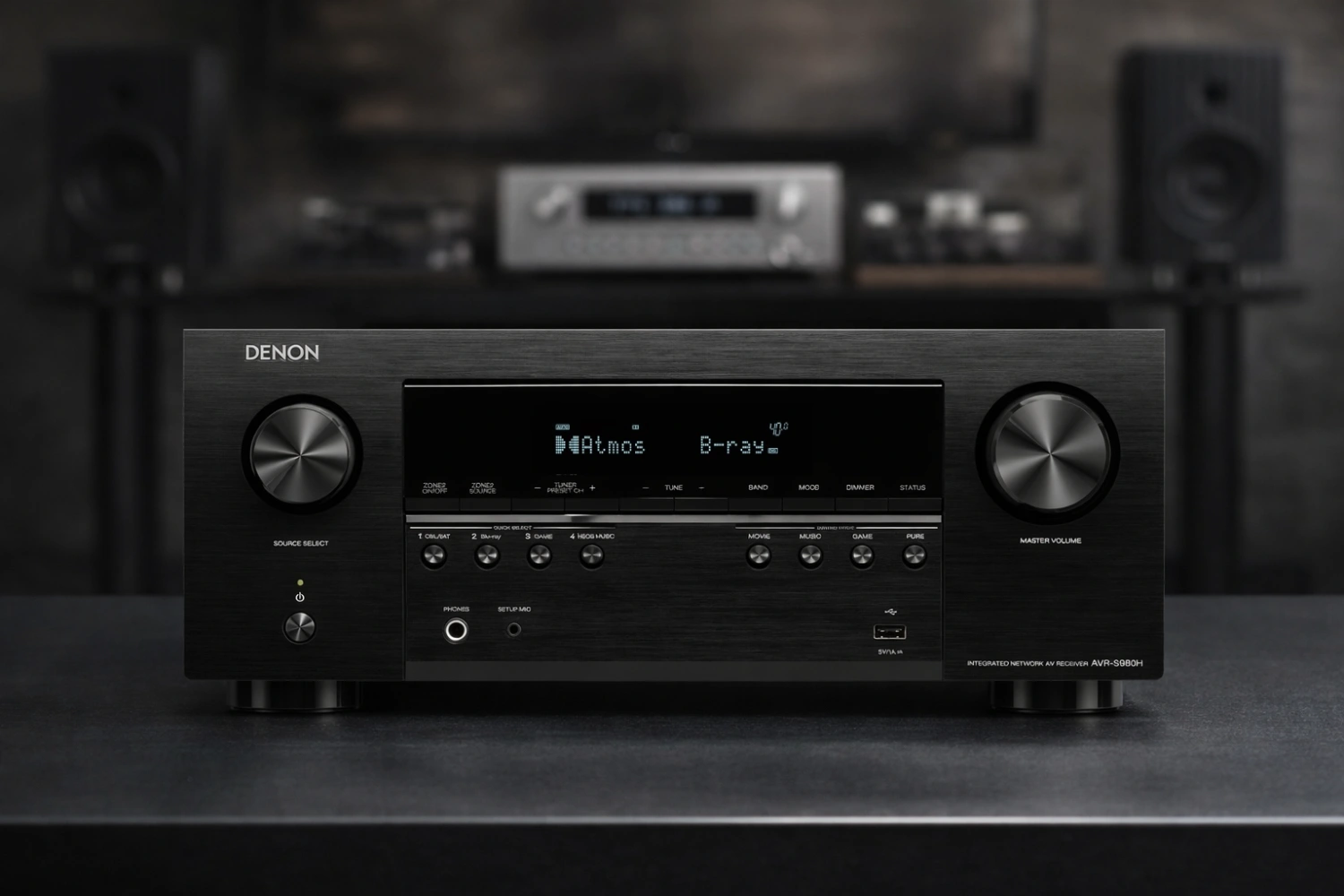
8. Denon AVR-S980H
Denon AVR-S980H 7.2-channel AV receiver.
The AVR-S980H is positioned as an accessible step beyond a soundbar or basic audio system.
It offers 7.2-channel amplification rated at 90 watts per channel in the source and is intended to work for both two-channel music and multichannel home entertainment without imposing unnecessary setup complexity.
HEOS multiroom integration and the identified wireless-surround upgrade path are its main differentiators within the Denon group. It ranks below the AVR-X1700H and Marantz NR1711 because the supplied material documents fewer specifics about immersive formats, room correction, and video connectivity, not because it lacks everyday appeal.
Best for: Households moving from a soundbar to a flexible multichannel system
- 7.2-channel amplification
- HEOS multiroom integration
- Designed for both stereo and multichannel use
- Emphasis on accessible setup and operation
Verdict: The AVR-S980H is a sensible, user-oriented 7.2-channel hub, although the supplied source offers less technical detail than it does for the higher-ranked receivers.

9. Onkyo HT-S3705
Onkyo HT-S3705 home-cinema system built around the TX-SR333 receiver.
The HT-S3705 is not presented as a directly comparable standalone receiver: it is identified as a home-cinema system, while the source's technical discussion concentrates on the TX-SR333 receiver.
That receiver uses five discrete WRAT amplifier channels, making this a conventional five-channel option rather than an immersive Dolby Atmos system.
The documented features include six HDMI inputs, Ultra HD video handling at up to 60 Hz, Bluetooth, HDMI pass-through, and high-resolution audio playback through USB. This is useful basic functionality, but the package-versus-receiver naming mismatch and five-channel limit make the HT-S3705 a more specialized recommendation than the dedicated AV receivers above it.
Best for: Entry-level buyers specifically considering a complete five-channel home-cinema system
- Five discrete WRAT amplifier channels
- Six HDMI inputs with Ultra HD video handling up to 60 Hz
- Built-in Bluetooth
- High-resolution audio playback through USB
Verdict: The HT-S3705 provides a practical route into five-channel cinema, but it is less expandable and less directly comparable than the standalone immersive receivers ranked above it.

10. Yamaha R-N1000A
Yamaha R-N1000A network stereo receiver with HDMI ARC.
The Yamaha R-N1000A is the category boundary case because it is a two-channel network stereo receiver, not a multichannel AV receiver.
It combines a discrete integrated amplifier, FM tuner, network player, and MusicCast multiroom support, while an HDMI input with ARC allows it to reproduce sound from a connected television.
Its double chassis, symmetrical amplifier boards, discrete components, ToP-ART construction, custom transformer, and selected filter capacitors show a clear music-first design philosophy. It can anchor a sophisticated stereo system that also handles TV audio, but the supplied source provides no multichannel amplification or immersive-surround decoding, requiring it to rank last in an AV receiver list.
Best for: Music-first two-channel systems that also need convenient TV audio
- HDMI ARC connection for television sound
- MusicCast network and multiroom integration
- Discrete, symmetrical ToP-ART amplifier construction
- Integrated FM tuner and network player
Verdict: The R-N1000A is an appealing stereo network receiver, but it is not a substitute for a multichannel AV receiver when surround sound is required.

Sound Off
0Join the discussion if you have something to add.