
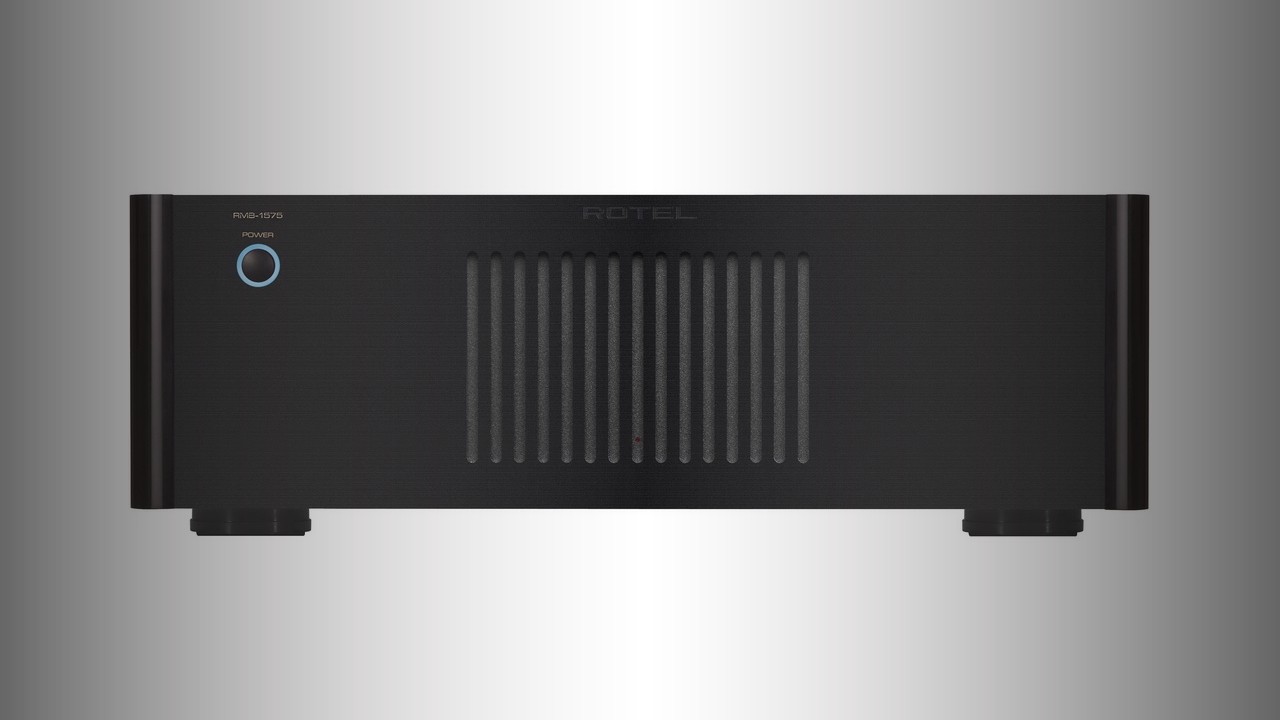
A multichannel power amplifier has a focused but demanding role: it must drive several loudspeakers at once without turning system installation into an exercise in managing heat, electrical consumption and bulky hardware. The Rotel RMB-1575 addresses that brief with five channels of Class D amplification, each rated at 250 watts into 8 ohms with all channels operating simultaneously. Its specification also rises to 500 watts per channel into 4 ohms, making the amplifier relevant to systems using low-sensitivity speakers or models with more challenging impedance characteristics. Just as importantly, Rotel places this output into a relatively straightforward component designed to work with a separate surround processor or preamplifier. RCA inputs, substantial WBT speaker terminals and trigger connections give the RMB-1575 the essentials for integration without adding processing, source selection or other functions that properly belong elsewhere in a separates-based system.
Five Channels With Substantial Rated Output
The defining feature of the RMB-1575 is its combination of channel count and power. It provides five discrete amplifier channels, rated at 250 watts each into 8 ohms from 20 Hz to 20 kHz at 0.03% total harmonic distortion. The specification is stated with all five channels working simultaneously, an important detail for a component intended to reproduce demanding multichannel material rather than supply isolated bursts from a single channel.
Into 4 ohms, the listed output increases to 500 watts per channel over the same 20 Hz to 20 kHz range and at the same stated distortion figure. That capability gives an installer greater freedom when selecting loudspeakers. Large floorstanding designs, low-sensitivity models and speakers whose impedance places heavier demands on an amplifier are the clearest candidates. The specification does not mean every system needs this much output, but it provides useful headroom for larger rooms, higher playback levels and program material with substantial dynamic swings.
The five-channel format is especially logical for a traditional surround layout, where the RMB-1575 can power the front left, center, front right and two surround speakers from one chassis. It can also serve as the main amplification block within a larger theater, leaving height, rear or additional effects channels to another amplifier. Because it contains no surround decoding, volume control or source switching, it is intended to receive line-level signals from an external processor or preamplifier.

Why Class D Matters Here
Delivering high output from five channels can create practical problems involving heat, power consumption and physical size. Rotel uses Class D circuitry to address those concerns. Unlike a conventional Class A/B arrangement with a large mains transformer and extensive output-stage heatsinking, the RMB-1575 employs an efficient switching architecture. Its internal construction is consequently different from that of a traditional high-power multichannel amplifier.
The specified power consumption is 600 watts. That figure is notable in the context of the amplifier's rated multichannel output, and it can simplify installation where electrical demand and heat accumulation need to be considered. Lower output-stage heat also allows the RMB-1575 to operate without cooling fans. Eliminating fans is useful in a listening room or dedicated theater because there is no fan mechanism adding background noise, and there is no need to plan around fan speed changes during demanding passages.
Efficiency does not remove the need for sensible ventilation, but it makes the amplifier easier to accommodate than a similarly ambitious design dependent on very large heatsinks and active cooling. At 432 mm wide, 143 mm high and 406 mm deep, the chassis still requires proper shelf space. Its 11 kg weight is substantial enough to merit secure support, yet it remains manageable for a power amplifier offering five high-output channels.

Purposeful Connectivity and System Control
The rear panel reflects the RMB-1575's dedicated role. Five mono RCA inputs accept signals from a compatible surround processor or multichannel preamplifier. This single-ended connection scheme is uncomplicated and widely supported, although prospective owners should confirm that their chosen controller provides the required RCA preamplifier outputs.
Five pairs of WBT speaker terminals provide the connection points for the loudspeakers. Robust terminals matter on an amplifier of this type because installations may involve thick speaker cable, longer cable runs or large floorstanding speakers. The individual terminal pairs also keep the five channels clearly separated rather than relying on compact multipole connectors.
Trigger input and output connections support remote power control. In an integrated theater, a processor can therefore switch the amplifier on as part of the normal system startup sequence. The trigger output also allows control to be passed to another compatible component. This is a modest feature, but it can make a separates-based installation behave more like a unified system and reduce the need to operate each component manually.

Engineering Details Beyond the Power Rating
Rotel specifies an input sensitivity of 1.5 volts, an input impedance of 8.3 kilohms and a gain of 27.1 dB. These figures are useful when matching the amplifier to a processor or preamplifier, particularly in systems combining more than one power amplifier. Consistent gain and adequate output from the controller help maintain predictable channel calibration across the system.
The published frequency range extends from 10 Hz to 80 kHz at +3 dB, while the signal-to-noise ratio is listed at 109 dB. Harmonic distortion and intermodulation distortion are both specified at 0.03%, and the damping factor is 400. These specifications describe an amplifier engineered for wide bandwidth, low stated distortion and firm electrical control of connected loudspeakers. They should not be treated as listening impressions, but they help explain the design priorities behind the RMB-1575.
Component quality and shielding also receive attention. The densely populated internal circuitry is enclosed by a metal case with a thick aluminum front panel, intended to protect the electronics from external interference. Black and silver finishes allow the chassis to fit visually with different equipment collections. The overall presentation is restrained, which suits a product likely to spend its life in an equipment rack rather than serve as the main user interface.
Who the Rotel RMB-1575 Is Most Suitable For
The RMB-1575 is most relevant to owners building a home theater around a separate surround processor, or to those upgrading from the internal amplification of an AV receiver while retaining a controller with five RCA pre-outs. Its five-channel configuration is particularly neat for conventional surround systems, and its output capability makes the strongest practical case in medium-to-large rooms or installations using relatively demanding loudspeakers.
It may also suit a larger immersive-audio system as a dedicated amplifier for the most power-hungry channels. For example, the front stage and selected surround channels could be assigned to the Rotel while another amplifier handles the remaining speakers. Trigger connectivity makes this type of mixed-amplifier arrangement easier to operate.
Conversely, it is more amplifier than many compact rooms, highly sensitive speaker systems or low-volume installations require. It also does not replace a processor: there is no volume control, decoding, room correction, HDMI connectivity or source selection documented for this model. Owners needing balanced XLR inputs should also look carefully at system compatibility, because the RMB-1575's listed audio inputs are RCA. Its appeal rests on concentrated amplification rather than an extensive feature set.
Conclusion
The Rotel RMB-1575 is a purpose-built answer to the challenge of powering five demanding channels without the heat and bulk commonly associated with high-output multichannel amplification. Its strongest documented qualities are the 250-watt-per-channel rating into 8 ohms with all channels operating, the specified 500 watts per channel into 4 ohms, efficient Class D circuitry and fanless construction. Five RCA inputs, WBT speaker terminals and trigger input and output connections support straightforward integration with a separate processor. For owners of medium-to-large home theaters, especially those using low-sensitivity or more difficult loudspeakers, the RMB-1575 offers a focused combination of output capability, installation practicality and system flexibility.


Sound Off
0Join the discussion if you have something to add.