
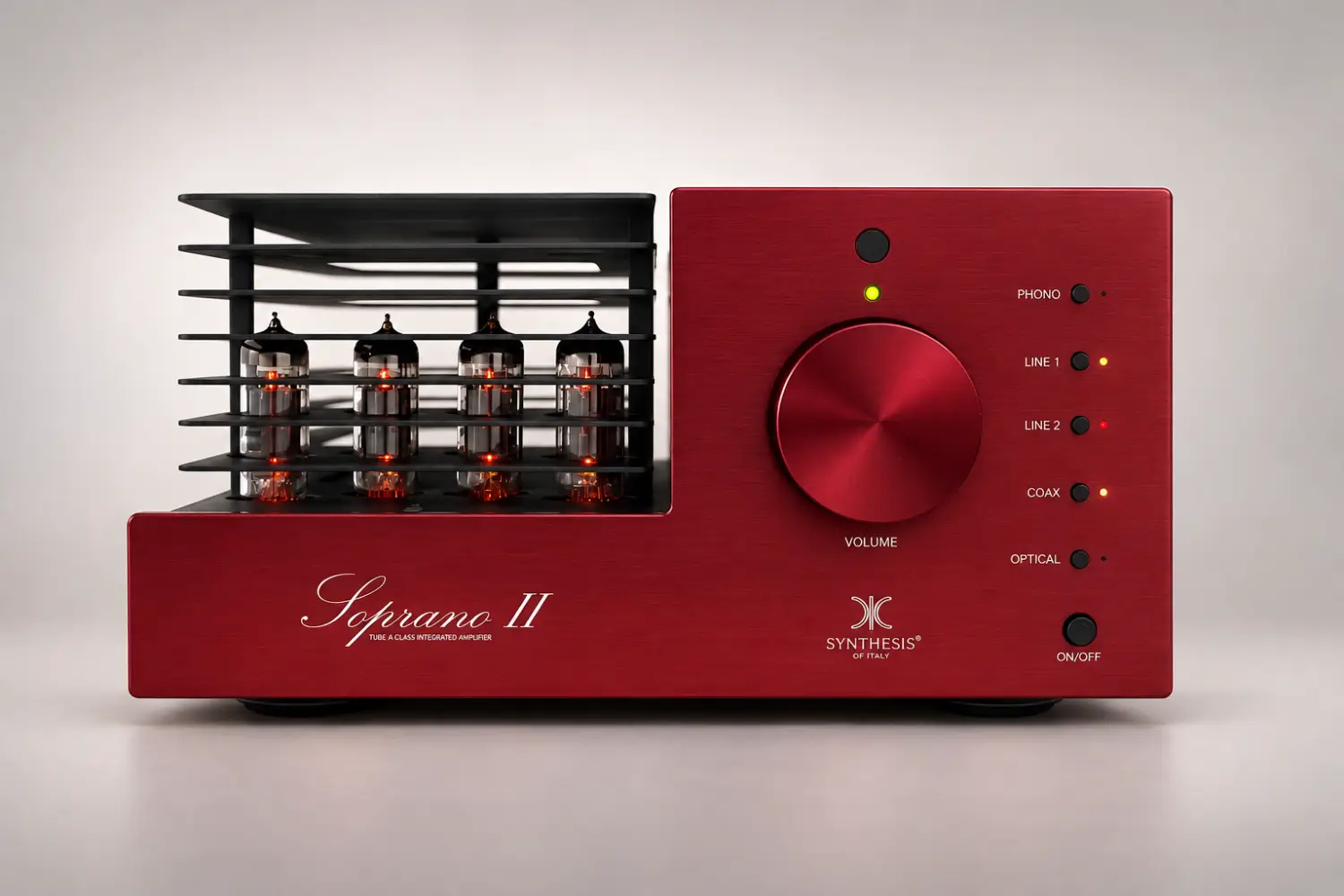
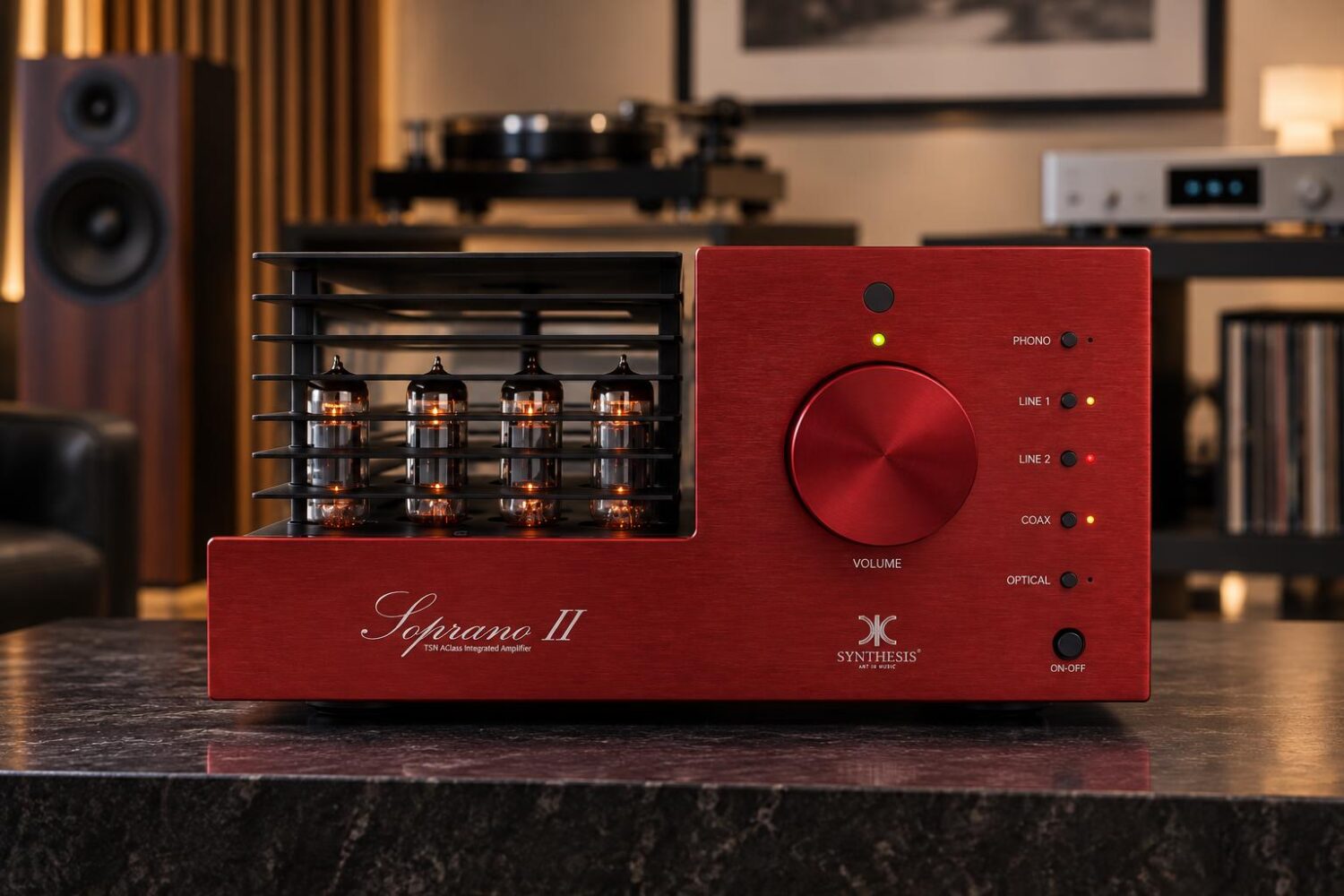
Italian manufacturer Synthesis has announced the Soprano II, an updated integrated tube amplifier designed to accommodate both record players and digital sources. The successor to the Soprano adds a digital-to-analog converter and revises the power supply in response to feedback from owners of the earlier model. Its input selection also changes: USB is gone, while coaxial and optical digital connections join an MM phono input and two analog line inputs. With a rated output of 12 watts into six ohms, the amplifier’s appeal will depend as much on careful speaker matching as on its expanded source options.
A source hub for records and digital components
The Soprano II’s built-in phono stage is intended for moving-magnet cartridges and has a specified input impedance of 47 kilohms. A turntable fitted with a compatible cartridge can therefore be connected without adding a separate phono preamplifier. Owners using another cartridge type should check their requirements: Synthesis specifies an MM input, not support for moving-coil cartridges.
Two analog line inputs provide room for additional sources with line-level outputs. The amplifier also incorporates a 32-bit AKM DAC, accessed through coaxial and optical S/PDIF inputs. Those connections let suitable digital components use the Soprano II’s conversion stage rather than requiring a separate DAC between source and amplifier.
The input arrangement has a consequence for existing Soprano owners considering an upgrade. The earlier model’s USB interface has been removed, so a system that currently relies on a direct USB connection would need a different way to feed the Soprano II. Synthesis has not specified supported digital sample rates in the information available, so owners should check format compatibility before planning a digital connection.
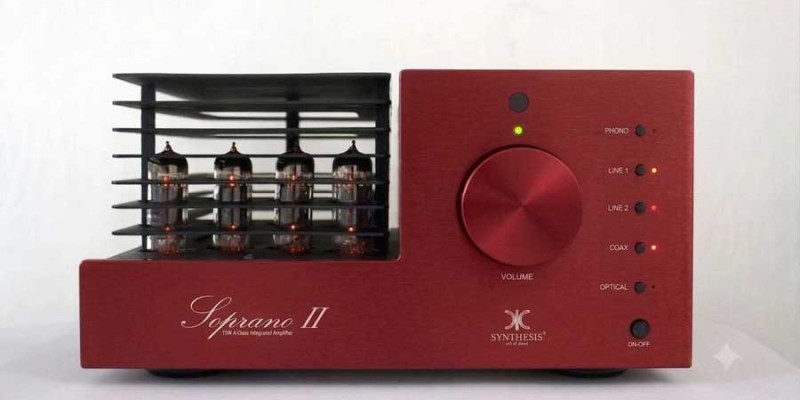
Choosing speakers for a 12-watt tube amplifier
Amplification comes from an ultralinear push-pull output stage operating in Class A, with two EL84/6BQ5 tubes per channel. Synthesis rates output at 12 watts RMS into six ohms. The published frequency response is 20 Hz to 20 kHz, within ±0.5 dB, while total harmonic distortion is specified at 1% at 12 watts and 1 kHz.
That output figure makes speaker selection an important part of the purchase. A prospective owner should consider speaker sensitivity, impedance, room size and desired listening level together rather than treating the wattage figure as a universal indication of suitability. The six-ohm rating describes the stated test load; it does not establish how the amplifier will perform with every speaker.
Synthesis has also fitted more robust speaker terminals that accept banana plugs, spades and thicker bare wire. The range of connections gives owners some flexibility when integrating existing speaker cables, although cable termination and available space around the amplifier will still be worth checking during setup.
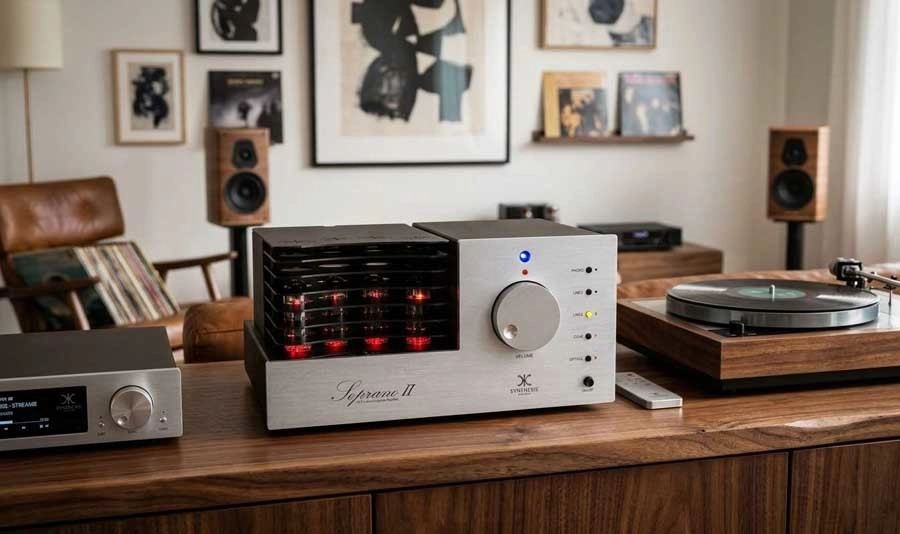
What changed inside the power supply
The Soprano II’s power supply has been revised with voltage regulators specified for high power-supply rejection and low voltage drop, serving the DAC and operational amplifiers. The design also uses electrolytic capacitors with ultra-low equivalent series resistance. These details identify changes to the supply circuitry, but the published information does not establish how much difference they make in audible use.
Synthesis has renewed the EI power transformer and fitted new output transformers using silicon-steel laminations. Together with the addition of the DAC, the revised supply marks the update as more than a change to the input panel. Synthesis links the power-supply and conversion changes to feedback from owners of the original Soprano, without providing a detailed account of individual requests.
For a prospective buyer, the distinction is useful: the second-generation model retains a tube output stage while adding digital conversion within the same amplifier. There is no need to infer a particular sonic character from the component choices, and no comparative listening results have been supplied.
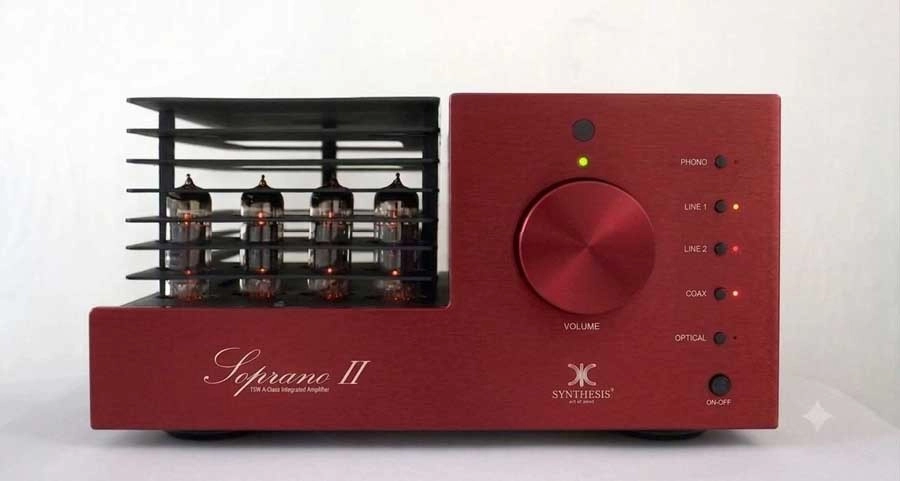
Placement, daily control and expected delivery
The amplifier measures 300 × 265 × 140 mm and weighs eight kilograms. Its specified power consumption is 80 watts. Those figures give owners a starting point for planning shelf space and power use, although the available information does not specify required ventilation clearances.
A supplied remote control handles volume adjustment and source selection. That matters in a system with several connected sources: switching between a turntable, analog component and digital input need not require a trip to the amplifier for those controls.
Synthesis expects the Soprano II to be available from February 2027. Pricing has not been announced, and the available information leaves some practical details open, including supported digital sample rates and regional delivery arrangements.
The Soprano II looks suited to someone building a relatively compact system around several wired sources, particularly a turntable with an MM cartridge and digital equipment offering coaxial or optical output. Its built-in DAC and phono stage reduce the number of separate components needed for those connections, but the absence of USB may complicate a setup that depends on it. Speaker matching is the other key decision: the 12-watt rating calls for a considered assessment of the speakers and listening space rather than an assumption that any pairing will work. Before committing, prospective owners should look for confirmed pricing, digital-format support and local availability, as well as any further guidance on installation and compatible loads.


Sound Off
0Join the discussion if you have something to add.