
These ten DACs span unusually different interpretations of digital conversion.
The field includes discrete R2R ladders, proprietary 1-bit architectures, conventional premium converter chips, DSD-focused processing and tube-equipped output stages.
Some are dedicated digital-to-analog converters, while others add preamplification, headphone amplification, streaming or portable operation. The ranking prioritizes conversion architecture, power-supply and isolation design, system flexibility and the clarity of each product’s intended role. A higher position does not necessarily mean that a model is ideal for every system: the dedicated Topping D900, for example, serves a different buyer from the portable Shanling UA7 or the headphone-focused FiiO K13 R2R. The supplied sources are primarily product and launch reports rather than controlled comparative listening tests. Manufacturer specifications and design claims are therefore treated as such, and the order reflects the strength of the documented engineering proposition rather than unsupported declarations about absolute sound quality.

1. Eversolo DAC-Z10
Eversolo DAC-Z10 with its large information display and selectable VU-meter graphics.
The Eversolo DAC-Z10 presents the most complete overall proposition in this group.
It combines DAC, preamplifier and headphone-amplifier functions with a dual-mono implementation using separate AK4191 and AK4499 conversion components for each channel.
Eversolo’s Fully Isolated Architecture physically separates digital and analog domains, while three toroidal transformers independently supply the two audio channels and system circuitry. Its analog volume control is especially relevant for direct connection to a power amplifier or active speakers. Rather than relying on digital attenuation, the DAC-Z10 uses a dual R2R resistor network intended to preserve resolution and phase alignment as volume changes. That combination of channel separation, power-supply attention and broad system utility earns it first place, although listeners needing only a fixed-output DAC may not require all of its functionality.
Best for: Reference-minded all-in-one systems
- Dual-mono AK4191 and AK4499 conversion architecture
- Three toroidal transformers for channel and system separation
- Dual R2R analog volume-control network
- Integrated preamplifier and headphone amplifier
Verdict: The DAC-Z10 takes the top position by combining an ambitious isolated conversion architecture with unusually comprehensive system-control features.

2. PS Audio PMG Signature 512 DAC
PS Audio PMG Signature 512 DAC, designed as both a converter and a digital system hub.
PS Audio takes a deliberately different route with the PMG Signature 512 DAC.
Its proprietary PureStream DSD512 engine converts every incoming PCM or DSD signal into an 8x DSD stream, after which the SpectraWave 64-Tap Sequencer handles filtering intended to reduce jitter and noise.
The resulting signal passes to a fully balanced, direct-coupled analog output stage with RCA and XLR connections. The inclusion of galvanically isolated inputs, precision analog volume control and a built-in streamer allows the PMG Signature 512 to function as the digital center of a system rather than merely a converter. It ranks just behind the Eversolo because its all-signals-to-DSD philosophy is more prescriptive, but that same singular approach makes it one of the list’s most technically distinctive choices.
Best for: Systems built around DSD-focused conversion
- PureStream engine converts incoming signals to 8x DSD
- Proprietary SpectraWave 64-tap digital processing
- Fully balanced, direct-coupled analog output stage
- Built-in streamer and analog volume control
Verdict: The PMG Signature 512 is a highly focused digital hub for listeners attracted to PS Audio’s proprietary all-to-DSD processing strategy.

3. Topping D900
Topping D900 in its full-width aluminum chassis with side cooling fins.
The Topping D900 is the strongest dedicated-DAC alternative near the top of the ranking.
Instead of using an off-the-shelf ESS or AKM converter, it employs Topping’s discrete Precision Stream Reconstruction Matrix, a proprietary 1-bit architecture that processes all material through a single-bit conversion topology.
This gives the D900 a clear technical identity without adding a headphone amplifier or other functions that could distract from its primary role. Its construction is similarly purposeful. The chassis uses three-millimeter aluminum panels, an eight-millimeter front panel and side-mounted cooling fins, while the supplied remote is milled from aluminum rather than made from finished plastic. The D900 ranks below the two more comprehensively documented system hubs, but it is arguably the most direct choice here for a buyer who wants a full-size, component-style DAC centered on proprietary conversion technology.
Best for: Purist full-size digital front ends
- Proprietary discrete 1-bit PSRM conversion
- Purpose-built standalone DAC format
- Substantial all-aluminum chassis construction
- Milled-aluminum remote control
Verdict: The D900 is a focused flagship DAC whose discrete 1-bit architecture and substantial construction distinguish it from conventional chip-based designs.
4. Gustard R30
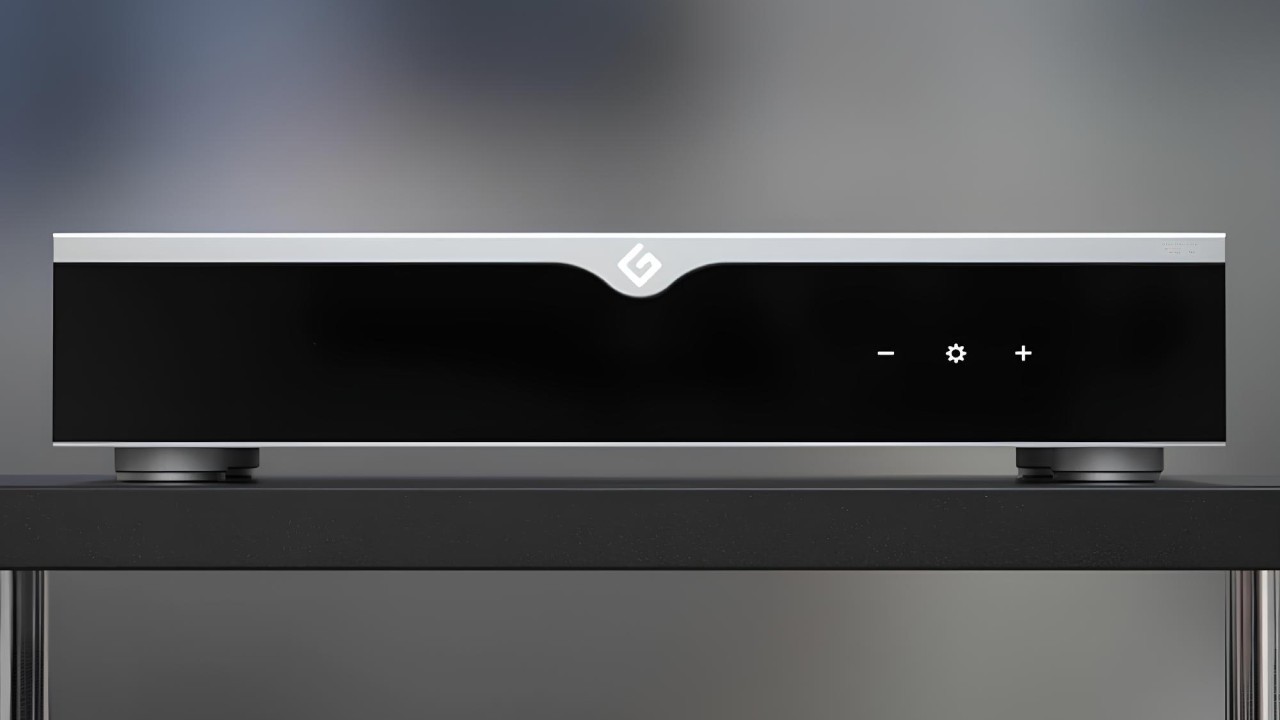
Gustard R30, a full-size DAC with discrete R2R and True 1-Bit conversion paths.
The Gustard R30 accommodates PCM and DSD through two distinctive conversion approaches.
Its discrete R2R network handles digital-to-analog conversion without a conventional delta-sigma DAC chip, while a separate True 1-Bit converter processes DSD at rates up to DSD1024 without first converting it to PCM.
Multi-level upsampling is also included as part of Gustard’s digital-processing system. Timing and power receive substantial attention. The R30 uses an SC-Cut oven-controlled crystal oscillator with a GCLK-02 module, provides an external-clock connection and separates its digital and analog supplies across two toroidal transformers. It narrowly misses the top three because the supplied information offers less comparative performance context, but its combination of R2R and native 1-bit conversion makes it one of the most ambitious specialist DACs in the group.
Best for: PCM and DSD enthusiasts seeking discrete conversion
- Discrete R2R conversion architecture
- Dedicated True 1-Bit processing for DSD up to DSD1024
- SC-Cut OCXO timing system and external-clock support
- Separate toroidal transformers for digital and analog circuits
Verdict: The R30 stands out by pairing a discrete R2R path with dedicated 1-bit DSD conversion and an elaborate clocking system.

5. Topping DX9 Discrete
Topping DX9 Discrete with dual displays and integrated headphone connections.
The Topping DX9 Discrete brings the company’s second-generation 1-bit PSRM conversion architecture to an integrated desktop DAC and headphone amplifier.
Topping specifies a 131 dB signal-to-noise ratio and THD+N below 0.00006 percent for the DAC circuit.
A proprietary six-channel discrete NFCA amplifier is specified to deliver more than seven watts per channel into 32 ohms, giving the unit substantial stated power for full-size headphones. A fully balanced hybrid-relay volume control is intended to maintain channel balance across its adjustment range, and headphone crossfeed is available for listeners who want a more speaker-like presentation. It ranks below the leading standalone converters because its design is optimized just as strongly around headphone use, but it is the most formidable documented DAC and headphone-amplifier combination in the list.
Best for: High-power flagship headphone systems
- Second-generation discrete 1-bit PSRM DAC
- Manufacturer-specified 131 dB signal-to-noise ratio
- More than seven watts per channel into 32 ohms
- Balanced hybrid-relay volume control and crossfeed
Verdict: The DX9 Discrete combines Topping’s proprietary conversion platform with the list’s most powerful documented integrated headphone stage.
6. Unitra DSH-805
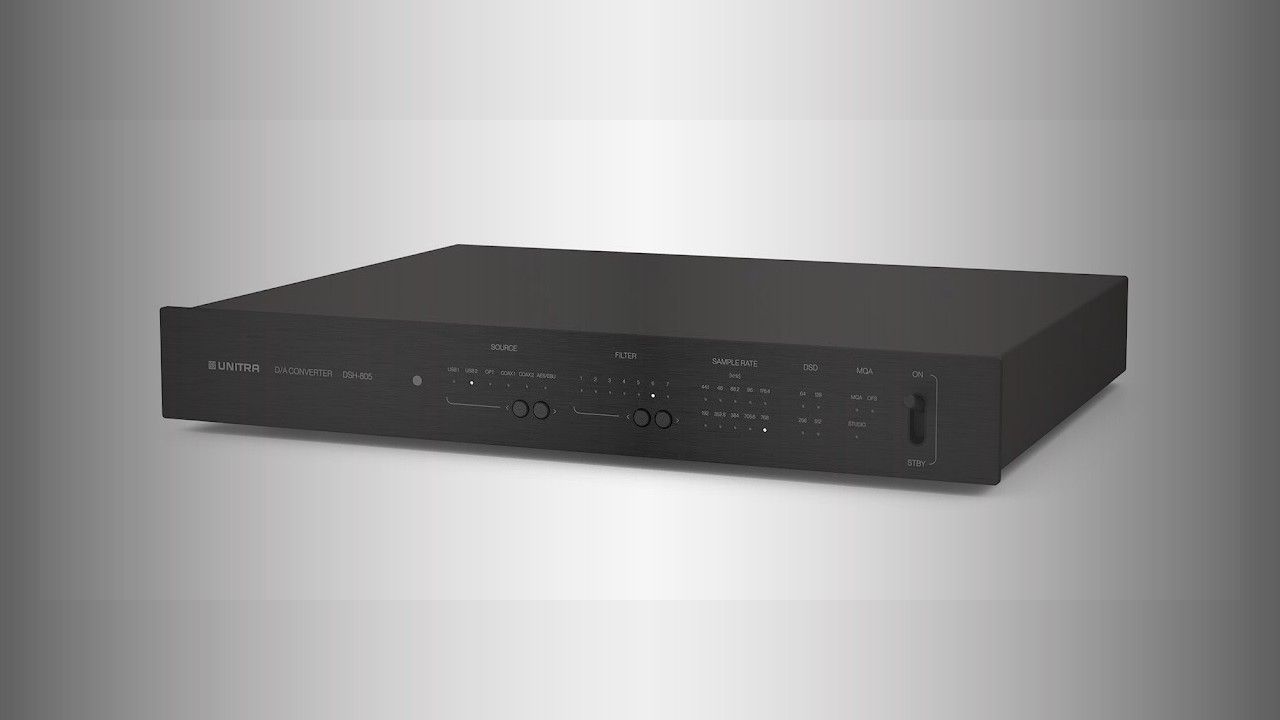
Unitra DSH-805 with a brushed-aluminum front panel designed to complement the brand’s matching amplifier.
The Unitra DSH-805 follows a more conventional chip-based path, but its supporting implementation is carefully developed.
The ESS Sabre ES9039MSPRO is configured with eight internal DAC channels, allocating four per stereo channel.
Its linear power supply uses a transformer designed and manufactured in Poland, EMI filtering, five independently regulated secondary voltages and a dedicated reference-voltage regulator for the conversion stage. Unitra also reports assessing the DAC with the Takt vinyl pressing plant, where digital material is converted to analog for mastering work. Support for DSD512 and MQA broadens format compatibility, while the metal cabinet and brushed-aluminum front panel match Unitra’s WSH-805 integrated amplifier. It lacks the multifunction breadth and more unusual conversion topologies of the higher-ranked models, but it is a serious standalone DAC with a strong emphasis on power integrity and channel allocation.
Best for: Traditional component systems needing a dedicated DAC
- ESS ES9039MSPRO with four DAC channels allocated per stereo channel
- Linear supply with five independently regulated secondary voltages
- Dedicated reference-voltage regulation for the DAC stage
- DSD512 and MQA support
Verdict: The DSH-805 is a thoughtfully powered ESS-based converter for buyers who value disciplined implementation over unconventional topology.

7. FiiO K13 R2R
FiiO K13 R2R desktop DAC and headphone amplifier with front-panel display and balanced connectivity.
The FiiO K13 R2R compresses a substantial feature set into a desktop DAC and headphone amplifier.
Its fully balanced 24-bit R2R converter employs four resistor-array channels, each containing 48 thin-film resistors selected to a stated tolerance of up to 0.1 percent.
Users can choose between non-oversampling and oversampling operation, allowing two different approaches to digital processing without changing hardware. The K13 R2R also includes a ten-band parametric equalizer, LDAC Bluetooth, application and web-based control, and a built-in display. Its balanced headphone output is specified at 2,400 milliwatts per channel into 32 ohms. It sits below the larger high-end components because it targets a more compact desktop role, but its combination of discrete conversion, headphone power and adjustability makes it one of the most versatile recommendations in the ranking.
Best for: Flexible R2R desktop headphone systems
- Fully balanced 24-bit R2R architecture with 192 thin-film resistors
- Selectable NOS and oversampling modes
- Ten-band parametric equalizer and LDAC Bluetooth
- Specified 2,400 mW per channel into 32 ohms
Verdict: The K13 R2R is a feature-rich desktop choice that combines discrete ladder conversion, strong specified headphone output and extensive tuning options.
8. SMSL D200
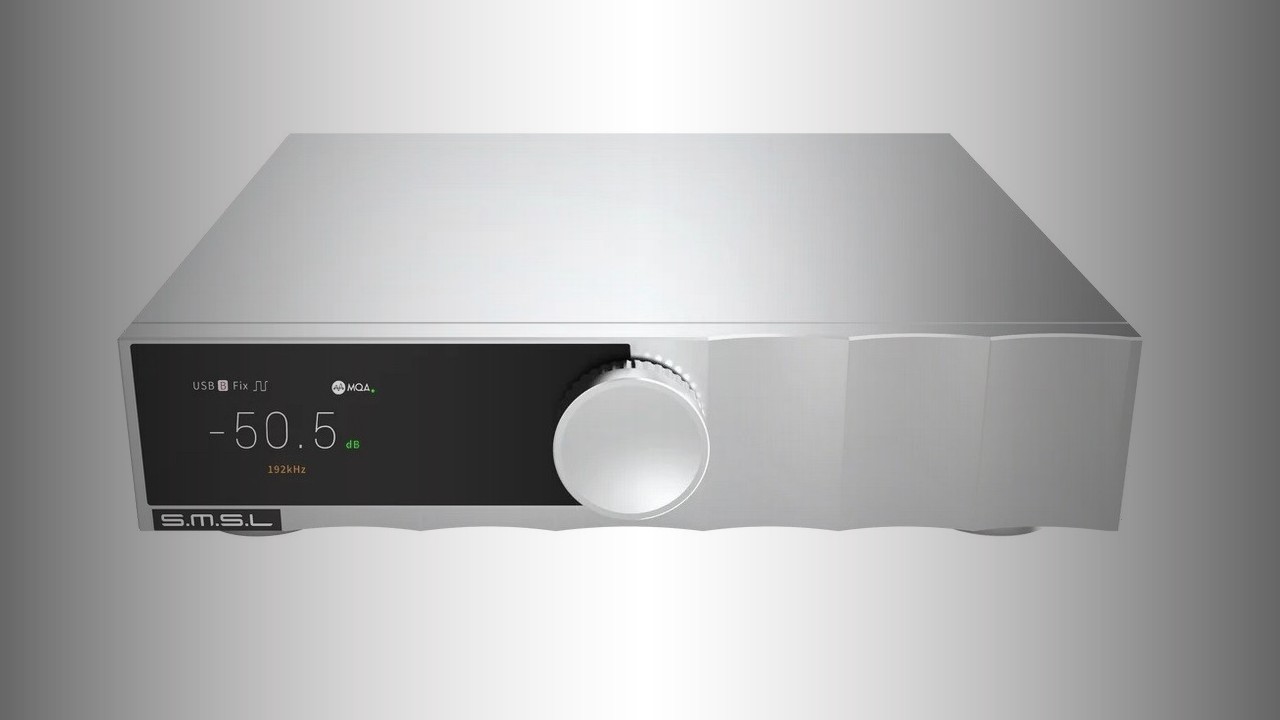
SMSL D200 DAC and preamplifier with a laminated tempered-glass information display.
The SMSL D200 is a desktop DAC and preamplifier built around the ROHM BD34352EKV conversion chip.
SMSL pairs it with its CK-03 jitter-reduction circuit and a balanced preamplifier stage using two NJU72315 volume-control chips.
The supplied figures include distortion of 0.00019 percent and SINAD up to 115.9 dB, presenting a strong on-paper case for a relatively compact component. Connectivity includes USB, optical, coaxial and Bluetooth inputs, with LDAC and aptX HD available for wireless playback. The D200 also supports PCM up to 32-bit/768 kHz, DSD512, MQA and MQA-CD, while a 10 MHz external-clock input serves more specialized installations. It ranks below the K13 because it lacks an integrated headphone stage and the FiiO’s selectable R2R modes, but it is the more natural choice when balanced preamplifier outputs and broad digital connectivity are the priorities.
Best for: Connected desktop systems and active speakers
- ROHM BD34352EKV conversion chip and CK-03 jitter-reduction circuit
- Balanced preamplifier stage with XLR and RCA outputs
- PCM 32-bit/768 kHz and DSD512 support
- LDAC, aptX HD and 10 MHz external-clock compatibility
Verdict: The D200 is a well-equipped DAC and balanced preamplifier with broad format support, wireless playback and specialist clocking provisions.

9. FiiO Warmer R2R
FiiO Warmer R2R with exposed tube ventilation and prominent analog VU meters.
The FiiO Warmer R2R is the most explicitly character-oriented full-size DAC in the ranking.
It combines FiiO’s R2R architecture with four JJ Electronic E88CC tubes and is presented as producing an organic, warm balance rather than pursuing a purely clinical design brief.
Its retro presentation includes large analog VU meters, while a perforated metal cover around the tubes and power supply assists heat dissipation. A 46-watt toroidal transformer anchors the linear power supply, and USB accepts PCM signals up to 32-bit/384 kHz with UAC 1.0 and 2.0 support. Both RCA and XLR outputs are provided for integration with desktop or conventional hi-fi systems. Its lower position reflects its deliberately specialized tube-and-R2R concept and the more limited performance evidence in the supplied source, not a lack of individuality.
Best for: Listeners seeking a tube-based R2R DAC
- R2R conversion combined with four E88CC tubes
- 46-watt toroidal transformer and linear power supply
- RCA and XLR analog outputs
- USB PCM support up to 32-bit/384 kHz
Verdict: The Warmer R2R is a distinctive specialist choice for systems where tube involvement, R2R conversion and retro presentation matter more than maximum format specifications.

10. Shanling UA7
Shanling UA7 portable DAC and headphone amplifier with an OLED display and protected internal tubes.
The Shanling UA7 is a genuine DAC, but its portable format makes it the least directly comparable product in this predominantly full-size field.
It uses an ESS ES9069 converter supporting PCM up to 32-bit/768 kHz and DSD512, then adds two JAN6418 tubes to the output stage.
A shock-absorbing aluminum structure is intended to protect those tubes during mobile use. Its headphone section combines two 1662 operational amplifiers with four BUF634A buffers. Shanling specifies up to 577 milliwatts into 32 ohms from the balanced 4.4 mm output and 195 milliwatts from the 3.5 mm connection, while an OLED screen provides access to filter, gain and input settings. The UA7 ranks last because it cannot serve the same full-size system role as the other products, but it is the clear niche recommendation for portable listeners who specifically want tubes in a compact DAC and headphone amplifier.
Best for: Portable tube DAC and headphone use
- ESS ES9069 DAC with PCM 32-bit/768 kHz and DSD512 support
- Two JAN6418 tubes in a portable design
- Up to 577 mW into 32 ohms from the balanced output
- OLED display with direct filter and gain control
Verdict: The UA7 is the list’s specialist mobile option, combining modern ESS conversion and balanced headphone output with an unusually compact tube stage.


Sound Off
0Join the discussion if you have something to add.