
A home cinema is only as coherent as the components working together.
The center speaker must keep dialogue anchored, the receiver has to accommodate the intended channel layout, and source devices, bass systems and displays all need to suit the room rather than merely add features.
This selection covers those distinct roles. It includes focused components such as the DALI RUBIKORE CINEMA and Cambridge Audio CXUHD, complete or near-complete systems from Onkyo, Harman Kardon and Sony, two capable AV receivers, a portable projector and editorial guides for comparing subwoofers and cinema control centers. These are not interchangeable recommendations. Some favor straightforward installation, while others are intended for expandable systems, specialist separates or portable viewing. The explanations below identify the practical distinction behind each entry without extending beyond the supplied product information.

1. Dali launches Rubikore Cinema center speaker
The DALI RUBIKORE CINEMA combines twin 6.5-inch bass/midrange drivers with a rotatable hybrid tweeter for horizontal or vertical placement.
The DALI RUBIKORE CINEMA is designed primarily for dialogue and film effects, but its flexibility extends beyond the center position.
It can be installed horizontally beneath a screen, used vertically, or deployed across the left, center and right channels alongside other RUBIKORE models.
Two 6.5-inch SMC Clarity Cone bass/midrange drivers are paired with DALI’s hybrid tweeter module, which can be rotated by 90 degrees to preserve the ribbon tweeter’s intended orientation when the cabinet is horizontal.
Best for: Matched, high-quality front-channel speaker systems
- Rotatable hybrid tweeter module
- Two 6.5-inch bass/midrange drivers
- Suitable for left, center or right channels
- Wide horizontal dispersion
Verdict: The RUBIKORE CINEMA stands out as a flexible center speaker that can also support a consistent three-speaker front stage.

2. Harman/Kardon Radiance 2400: Perfect combination of minimalist design and premium materials
Harman Kardon’s Radiance 2400 pairs two tall, narrow speaker arrays with a wireless digital hub and active 10-inch subwoofer.
The Harman Kardon Radiance 2400 takes an integrated approach, combining two exceptionally slim floor-standing speakers with an active subwoofer and a compact digital hub.
Each 1.8-meter speaker is only 5 centimeters wide and 6 centimeters deep, with an array of calibrated 1.25-inch full-range drivers.
Constant Beamwidth technology is designed to distribute sound more consistently around the room, while the hub handles connections to televisions and other AV sources as well as Wi-Fi music streaming.
Best for: Design-conscious rooms with multiple listening positions
- Ultra-slim floor-standing speakers
- Constant Beamwidth sound distribution
- Active 200-watt 10-inch subwoofer
- Compact hub with AV and Wi-Fi connectivity
Verdict: Radiance 2400 offers an unusually discreet route to room-filling sound without relying on conventional speaker cabinets.

3. Onkyo TX-RZ50: AV receiver with cutting-edge features
The Onkyo TX-RZ50 provides built-in amplification for 7.2.2 or 5.2.4 systems and processing for configurations up to 7.2.4.
The Onkyo TX-RZ50 is built for an immersive system that may expand over time.
Its internal amplification supports 5.2.4 or 7.2.2 configurations, while 11-channel processing and 11.2-channel pre-outs permit a 7.2.4 layout when an external two-channel power amplifier is added.
Dolby Atmos, DTS:X and IMAX Enhanced are supported, and Dolby Surround or DTS Neural:X can derive height information from older soundtracks.
Best for: Expandable multichannel and height-speaker installations
- Up to 7.2.2 channels with internal amplification
- 11-channel processing for system expansion
- Dolby Atmos, DTS:X and IMAX Enhanced support
- Height upmixing for older material
Verdict: The TX-RZ50 is a strong control center for listeners who want an immersive layout now and room to add external amplification later.

4. Choosing the perfect sub for your home theater experience
The subwoofer guide compares seven bass modules, including wireless, compact and higher-tier designs for music and home cinema.
This editorial guide approaches subwoofer selection through seven models arranged by ascending price.
Its scope ranges from compact, affordable designs to more ambitious bass modules, with attention paid to practical differences such as wireless placement, low-frequency extension, amplifier power and cabinet damping.
Among the examples are the wirelessly connected Klipsch Flexus Sub 100, the compact Polk Audio Monitor XT10 and the REL HT1205 MK II.
Best for: Comparing subwoofer options by budget and installation needs
- Seven subwoofers across a broad price range
- Clear ascending-price structure
- Coverage of wireless placement options
- Useful driver, amplification and extension details
Verdict: The guide provides a practical starting point for separating subwoofers by price, design and placement flexibility.

5. Marantz Cinema 60: Powerful 7.2-channel AV receiver
The Marantz Cinema 60 combines seven amplified channels with three HDMI inputs supporting 8K at 60 Hz and 4K at 120 Hz.
The Marantz Cinema 60 is a 7.2-channel receiver capable of running a 5.1.2 Dolby Atmos or DTS:X system.
It also provides DTS Virtual:X and Dolby Atmos Height Virtualization for systems without dedicated height speakers.
Three of its six HDMI inputs support 8K at 60 Hz and 4K at 120 Hz, alongside HDR10+, Dynamic HDR, VRR, QMS, ALLM and QFT, making its video section particularly relevant to current television and gaming sources.
Best for: Living-room cinema systems with modern video and gaming sources
- 7.2-channel amplification
- Dolby Atmos and DTS:X in 5.1.2 layouts
- Three 8K-capable HDMI inputs
- VRR, ALLM, QMS and QFT support
Verdict: Cinema 60 balances a manageable 5.1.2 speaker layout with broad HDMI support and object-based surround processing.

6. XGIMI MoGo 4: Portable Full HD Smart Projector with Bluetooth Speaker & Google TV
The portable XGIMI MoGo 4 uses a 360-degree rotating stand and can project Full HD images onto walls or ceilings.
The XGIMI MoGo 4 combines a compact Full HD projector, Bluetooth speaker and Google TV platform in a portable design.
Its integrated battery is rated for 2.5 hours of video or six hours of music, while the 360-degree stand can direct an image onto a wall or ceiling.
Projection specifications include 450 ISO lumens, 1,080p resolution and image sizes from 40 to 200 inches, with built-in Harman Kardon speakers providing 360-degree audio and Dolby Atmos support.
Best for: Portable viewing and flexible room-to-room projection
- Built-in battery for video or music playback
- Full HD projection at 450 ISO lumens
- Rotating stand supports ceiling projection
- Integrated Harman Kardon speaker system
Verdict: The MoGo 4 packages projection, smart playback and speaker functions into a design suited to entertainment beyond a fixed cinema room.

7. Onkyo HT-S7805: Home theater system designed for Dolby Atmos
Onkyo’s HT-S7805 package creates a 5.1.2 layout through upward-firing drivers built into its two front speakers.
The Onkyo HT-S7805 combines a 7.2-channel network AV receiver, five speakers and a powered subwoofer in a complete 5.1.2 package.
Upward-firing full-range drivers are built into the front speakers, reflecting height-channel sound from the ceiling rather than requiring separate overhead speakers.
The receiver supports 4K at 60 Hz with HDCP 2.2 and includes seven HDMI inputs, including one on the front panel.
Best for: A packaged route into Dolby Atmos home cinema
- Complete receiver, speaker and subwoofer package
- Integrated upward-firing Atmos drivers
- 5.1.2-channel configuration
- Seven HDMI inputs with 4K support
Verdict: The HT-S7805 reduces the component-matching required for a 5.1.2 system while retaining a conventional receiver-based architecture.
8. Which AV Receiver or Processor Should You Buy? Five Models Compared
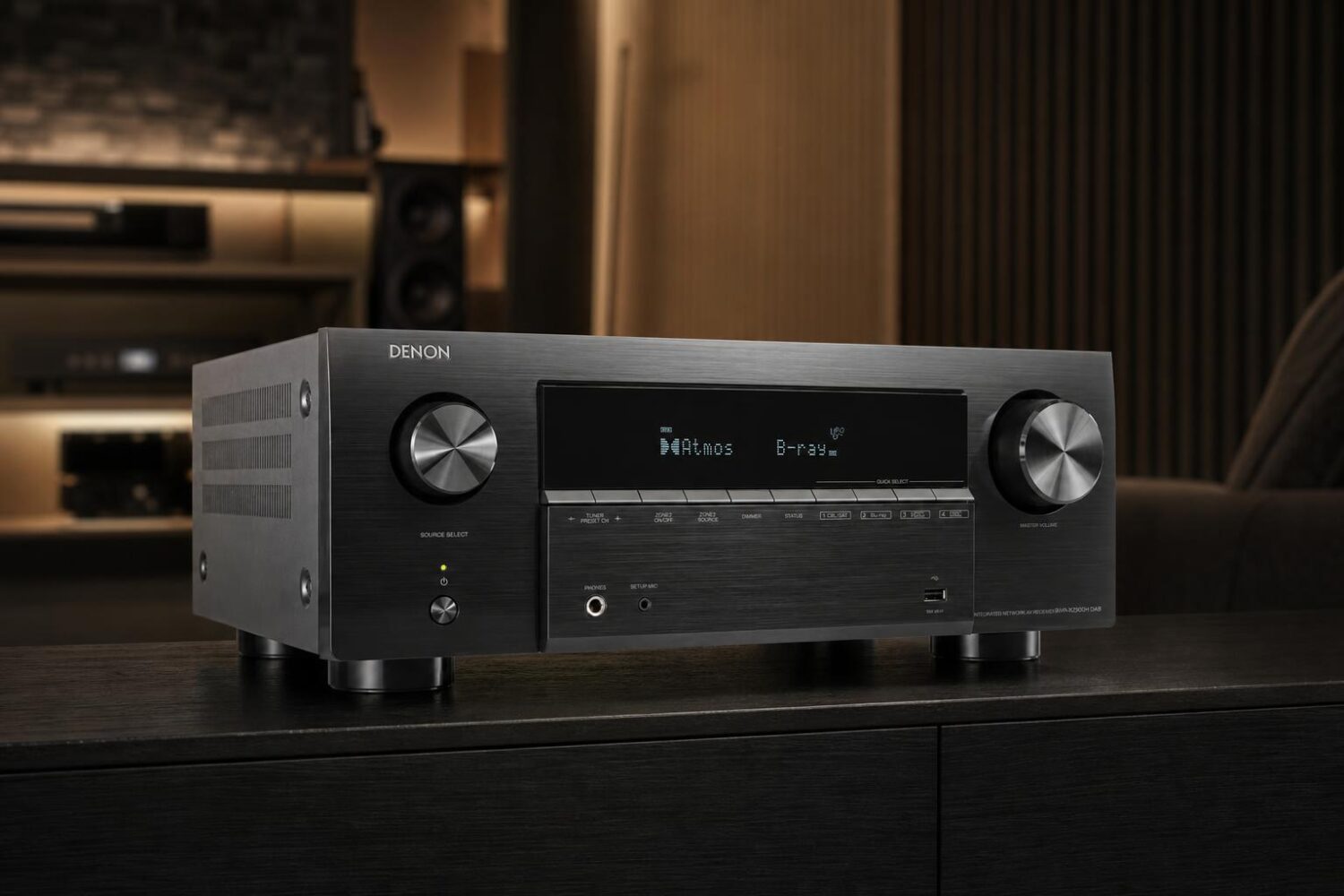
The five-model comparison spans complete AV receivers, an amplified cinema controller and processors designed for separate power amplifiers.
This comparison begins with the essential distinction between receivers that power speakers and processors intended for use with separate amplifiers.
It examines the Arcam AVR11, Sony STR-DN1080, JBL Synthesis SDR-40, McIntosh MX170 and MiniDSP Tide16, differentiating them through amplification, channel count, room correction, HDMI facilities, streaming and balanced connectivity.
The result covers conventional living-room systems, dedicated theaters and specialist separates-based installations without treating every control center as the same kind of product.
Best for: Choosing the architecture of a new home-cinema system
- Clear receiver-versus-processor explanation
- Five distinctly positioned control centers
- Coverage of room correction and HDMI capability
- Options for integrated and separates-based systems
Verdict: The comparison is most useful for determining whether an integrated receiver or a specialist processor better fits the intended speaker system.

9. Cambridge Audio CXUHD: Reference digital player
Cambridge Audio’s CXUHD is a universal disc and network transport designed to pass digital audio and 4K video to external equipment.
The Cambridge Audio CXUHD is a universal digital transport for UHD Blu-ray, Blu-ray, DVD-Audio, SACD and other disc formats, and it can also operate as a network media player.
It supports HDR and Dolby Vision video, UHD upscaling and codecs including HEVC H.265, H.264 and VP9 4K.
There is deliberately no onboard digital-to-analog converter, so audio conversion is left to the connected AV processor, receiver or external DAC.
Best for: Extensive disc libraries and systems with external conversion
- Broad optical-disc compatibility
- UHD, HDR and Dolby Vision support
- Network media playback
- Dedicated transport design without an internal DAC
Verdict: The CXUHD is a focused source component for systems that already have suitable digital-to-analog conversion elsewhere in the signal chain.
10. Sony BRAVIA Theatre Trio Builds a Wider 3.0.2-Channel TV Soundstage
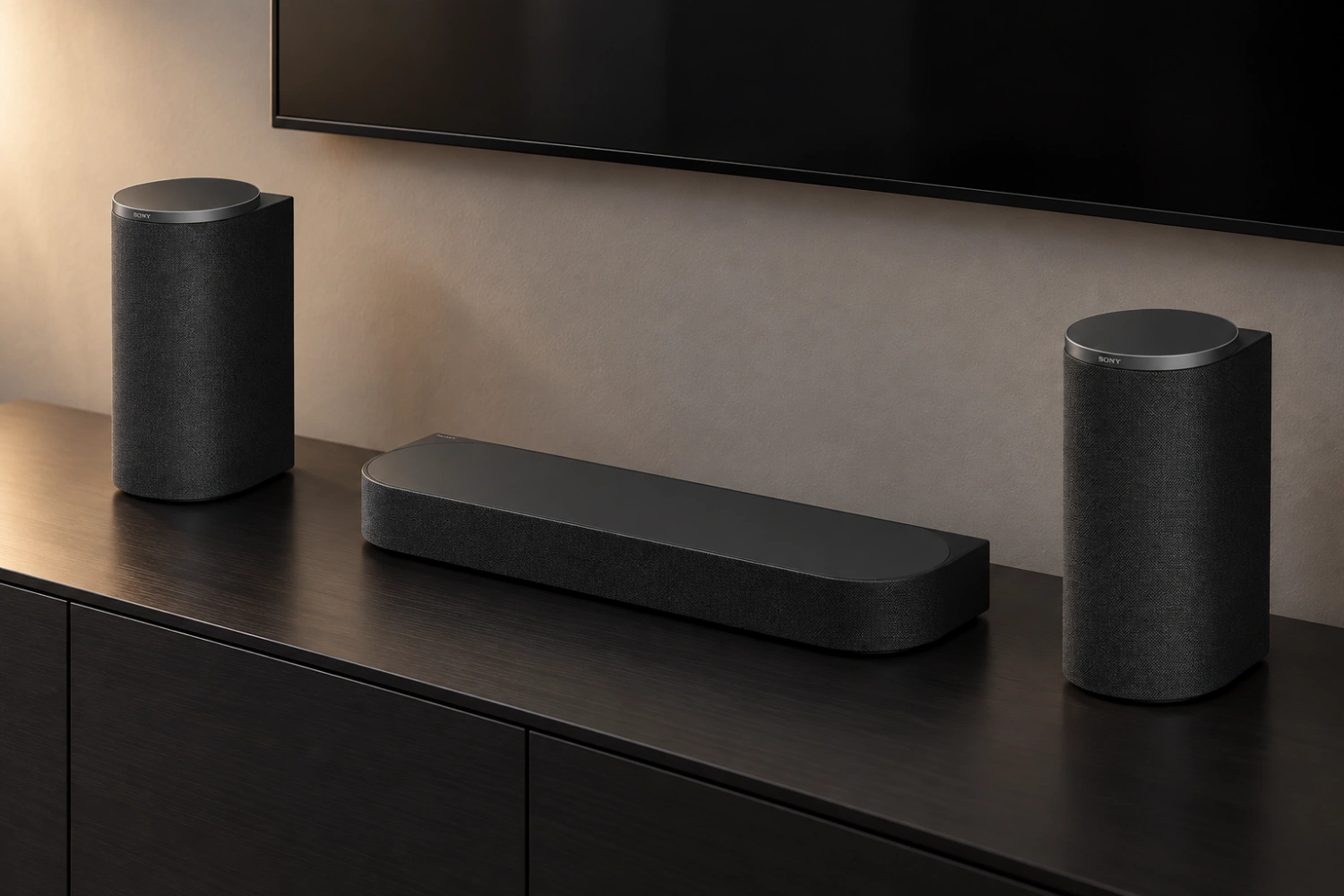
Sony’s BRAVIA Theatre Trio divides nine drivers between a center speaker and two wireless front speakers in a 3.0.2-channel layout.
The Sony BRAVIA Theatre Trio separates its front soundstage across dedicated left, center and right speakers rather than placing every driver inside one soundbar.
Its nine-driver 3.0.2-channel arrangement includes upward-firing speakers, with nine channels of S-Master digital amplification delivering a combined 405 watts.
The center connects to a television through HDMI eARC or ARC, while the left and right speakers communicate wirelessly with the system; Voice and Night modes provide additional control over dialogue and restrained listening levels.
Best for: TV-based cinema without a conventional AV receiver
- Separate left, center and right speakers
- Upward-firing drivers for height information
- 405 watts of combined output
- HDMI eARC or ARC television connection
Verdict: The BRAVIA Theatre Trio offers a useful alternative to a single-enclosure soundbar when front-stage separation and a dedicated dialogue channel are priorities.


Sound Off
0Join the discussion if you have something to add.