
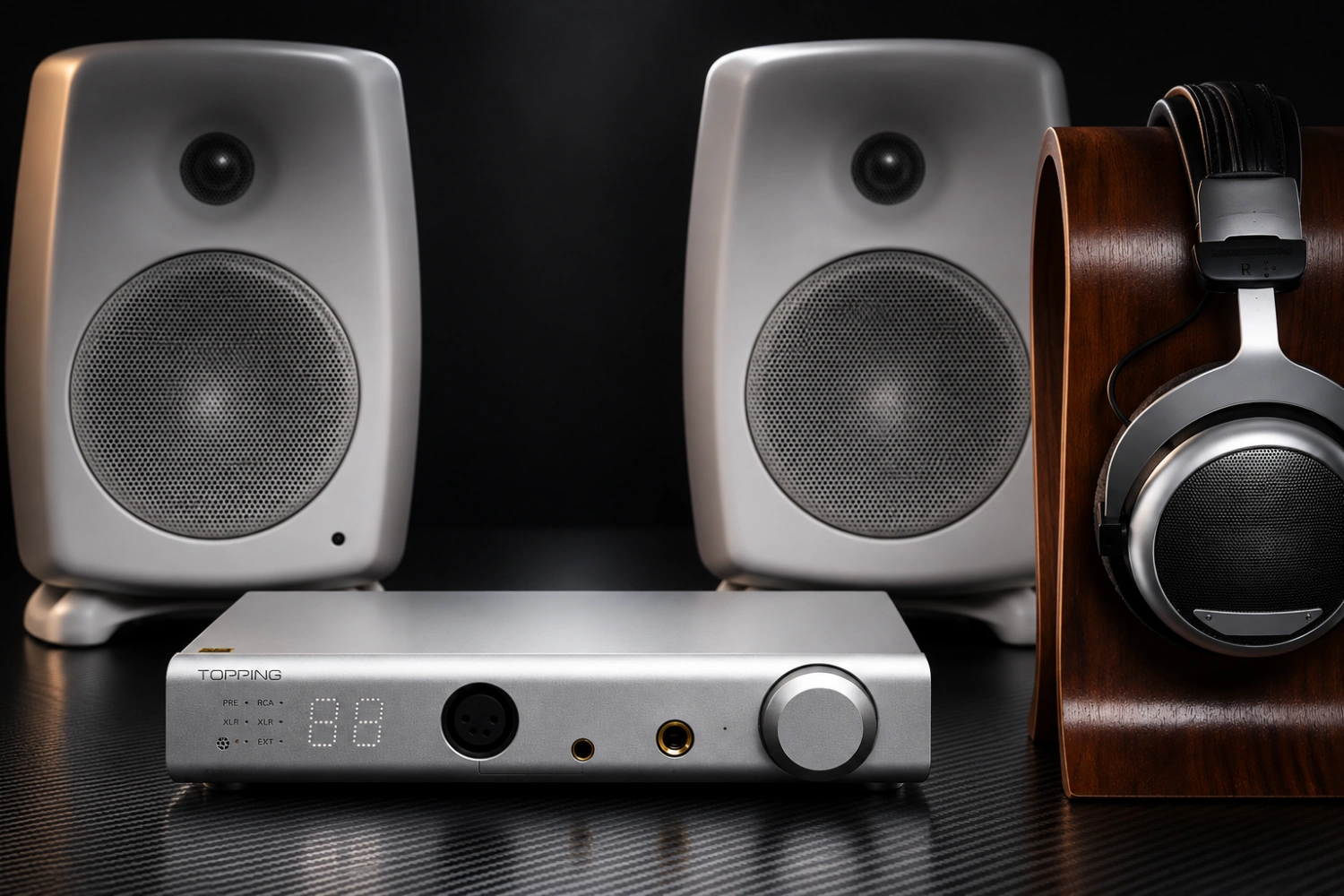
The TOPPING A90 Discrete, commonly shortened to A90D, occupies a useful middle ground between a dedicated headphone amplifier and a compact system controller. Its $599 price buys a fully balanced design built around four discrete NFCA amplifier modules, three front-panel headphone outputs and preamplifier functionality for use with an external power amplifier. That combination gives the A90D a broader role than a single-purpose desktop component. It can accommodate headphones with different connector types and drive requirements, while its remote control, configurable 12V trigger and ground-lift facility address practical concerns that emerge when several components are brought together. For owners who regularly move between headphones and loudspeakers, the ability to retain separate volume settings for different operating modes is another thoughtful detail.
A fully discrete interpretation of NFCA amplification
The defining technical change in the A90D is its use of fully discrete components for the NFCA amplifier stage. Four separate modules are arranged in a fully balanced architecture, with each module containing 39 transistors. TOPPING also uses matched precision devices with the aim of controlling distortion and noise.
The published figures illustrate the intended operating envelope: total harmonic distortion plus noise is specified at less than 0.000055%, dynamic range at 145 dB and maximum output power at 9,800 mW per channel. These are manufacturer specifications rather than listening findings, but they show that the design is intended to combine substantial output capability with low residual noise.
That balance matters because headphone collections are rarely uniform. High-impedance dynamic headphones can demand voltage, planar-magnetic models may place greater emphasis on current delivery, and sensitive in-ear monitors require careful control of noise and volume. The A90D’s high voltage and current capability, low output impedance and two gain settings are intended to let one amplifier cover these differing requirements without forcing the owner into a separate amplifier for every category.

Three outputs reduce connector friction
The front panel provides a four-pin XLR socket, a 4.4 mm balanced connection and a 6.35 mm single-ended output. This is a practical selection for anyone who owns multiple headphones or has adopted balanced cables but still needs support for conventional single-ended models.
Having both major balanced headphone formats is especially useful in mixed desktop and full-size systems. The compact 4.4 mm connector is increasingly common on portable and desktop equipment, while four-pin XLR remains widely used with larger balanced headphone cables. The 6.35 mm output preserves compatibility with long-established home-audio terminations.
TOPPING also supplies a 6.35 mm-to-3.5 mm adapter. Although simple, it means headphones and earphones fitted with the smaller plug can be connected without the owner needing to source an adapter separately. The A90D therefore covers a broad set of cable arrangements directly from its front panel.

Relay-based volume control with useful memory
Instead of relying on a conventional analog potentiometer, the A90D controls volume through an R2R network assembled from relays and resistors. The arrangement is designed to provide accurate level adjustment and preserve channel balance throughout the control range. Consistent left-to-right tracking can be particularly relevant at lower listening levels, where ordinary potentiometers may be more prone to imbalance.
The relay system also supports independent volume memories for the headphone amplifier, preamplifier and combined PRE+HPA modes. When the user returns to one of those modes, the amplifier can restore its last setting. This prevents a loudspeaker-oriented preamp level from automatically becoming the headphone level, or vice versa.
Mode-specific memory is a small but meaningful usability feature in a dual-purpose component. It allows the A90D to behave more like a dedicated controller for each part of the system, even when headphones and a power amplifier share the same central unit. As always, users should still verify the level before playback, particularly when changing headphones or connected equipment.

A headphone amplifier that can control a speaker system
The A90D’s preamplifier function extends its purpose beyond personal listening. Connected to a separate power amplifier, it can provide line-level volume control for either a compact desktop loudspeaker setup or a larger separates-based system. The combined PRE+HPA mode also allows the headphone and preamplifier functions to be incorporated into the same operating arrangement.
A supplied remote control makes this role more practical. Headphone users seated close to a desk may be comfortable using the front panel, but remote operation becomes more valuable when the amplifier is positioned on a rack or used to control loudspeakers from across a room.
This dual-role design can also simplify a system. An owner who already has a suitable source and power amplifier may not need to add a separate line preamplifier solely for volume control. Conversely, someone beginning with headphones can retain the A90D as the control component if powered loudspeakers or a separate power amplifier are added later, provided the connected equipment is compatible.

Trigger control and grounding address real installation needs
A configurable 12V trigger connection helps the A90D coordinate power with other compatible equipment. It can operate as either an active trigger output or a passive trigger input, allowing the amplifier to switch another component or respond to a component elsewhere in the system. This can reduce the number of individual power operations required in a multi-box setup.
TOPPING has also included a GND/LIFT switch to help address ground-loop noise. Under ordinary conditions it remains in the GND position. If interconnected equipment produces audible hum or buzzing because of a ground loop, selecting LIFT changes the A90D’s grounding point from its own chassis to the connected equipment.
The switch is not presented as something that should be engaged routinely, but it provides a built-in troubleshooting option for more complicated systems. Along with trigger support and remote operation, it demonstrates that the preamplifier function was considered as a genuine use case rather than an incidental extra.

Compact presentation and system options
The A90 Discrete is offered in black or silver, allowing it to blend with dark desktop hardware or more traditional silver-finished separates. The standalone package includes the amplifier, remote control, AC power cable, 6.35 mm-to-3.5 mm adapter, user manual and warranty card.
TOPPING also offers configurations that pair the A90D with the D90 III Sabre DAC and a balanced XLR cable, while another package adds an SR2 equipment rack. These options position the amplifier as either an addition to an established source chain or part of a visually coordinated TOPPING system. The standalone model remains the relevant choice for an owner who already has a DAC or another line-level source.
At $599 for the amplifier in either finish, the A90D is aimed at listeners who value broad headphone compatibility and system integration rather than a minimal, single-output amplifier. Its appeal rests as much on operational flexibility as on the discrete circuit architecture.

Who the TOPPING A90 Discrete is for
The strongest match is an enthusiast with several types of headphones, particularly a collection spanning balanced and single-ended cables or differing electrical demands. The choice of four-pin XLR, 4.4 mm and 6.35 mm outputs minimizes adapter use, while two gain settings help tailor operation to different loads, including sensitive in-ear monitors.
It is also well suited to someone building a hybrid headphone and loudspeaker system. Preamp operation, remote control, separate mode memories and 12V trigger support make the A90D more adaptable than a headphone-only component. Owners invested in other compatible TOPPING products may additionally appreciate the coordinated packages and optional rack arrangement.
By contrast, listeners who require only a basic amplifier for one pair of single-ended headphones may not use much of its connectivity or system-control functionality. The A90D’s broader feature set is most relevant when balanced headphones, multiple listening modes or an external power amplifier are part of the plan. Buyers should also confirm that its documented connections and trigger behavior suit the rest of their equipment.
Conclusion
The TOPPING A90 Discrete brings together four discrete NFCA modules, a fully balanced architecture, substantial stated output capability and three useful headphone connections. Its R2R relay volume system and independent mode memories support precise, convenient control, while preamplifier operation, a remote handset, configurable 12V triggering and a GND/LIFT switch prepare it for a wider separates system. These features make the $599 A90D particularly relevant to owners with varied headphone collections or those who want one compact component to manage both headphone listening and an external loudspeaker amplifier. Its most distinctive quality is not any single specification, but the way its amplification, connectivity and control features have been organized around multiple system roles.


Sound Off
0Join the discussion if you have something to add.