

Most loudspeakers are designed to distribute sound throughout a room. Audfly’s Focusound starts from a different premise: what if audio could be directed toward one person while remaining far less noticeable to everyone else nearby? Its solution combines ultrasound-based directional sound with a transparent laminated-glass panel, creating a product intended as much for managing shared spaces as for reproducing music, podcasts, films, and games. The unconventional construction is central to the concept. Rather than hiding familiar speaker components inside a box, Focusound incorporates numerous compact vibrating elements within the glass itself. An aluminum frame houses the electronics, supports the panel, and allows its angle to be adjusted toward the listener. The result is a visually discreet audio device built around personal listening without requiring headphones.
Directional sound for shared spaces
Focusound’s defining feature is its ability to form a narrow field of sound using ultrasound technology. Audfly describes the resulting listening area as a “sound bubble”: audio is directed toward the intended user rather than being spread broadly around the room in the manner of a conventional speaker.
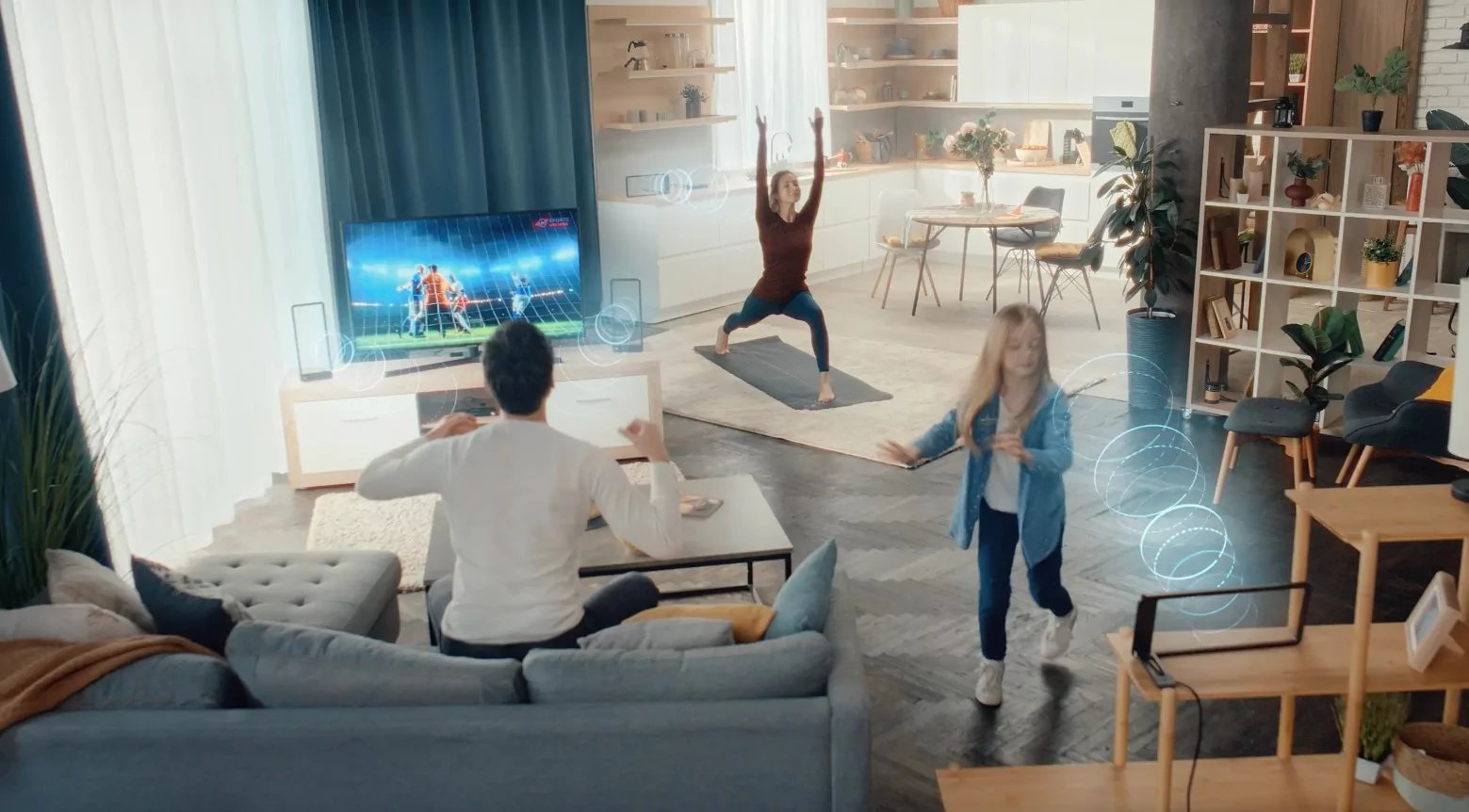
This approach addresses a familiar domestic problem. In a shared living area, one person may want to watch a film while someone else listens to music, follows a podcast, exercises, works, or draws. Conventional speakers make those activities compete because each system fills much of the same space. Focusound is designed to keep its program material concentrated around the person at whom the panel is aimed, reducing the likelihood that it will disturb others outside that directed field.
The concept occupies useful ground between room speakers and headphones. Headphones provide highly personal audio but isolate the wearer physically and can become inconvenient during long sessions or activities that involve movement. Focusound offers another option: the listener can remain aware of the room and avoid wearing anything while still receiving a more private audio feed. Its value is therefore not simply that it plays sound, but that it changes how audio can coexist with other activities in one room.
A speaker built into laminated glass
The transparent panel is more than a styling exercise. Focusound uses laminated glass containing numerous compact vibrating elements, which work together to direct sound through a relatively narrow field. This integrated construction allows the panel itself to perform the speaker’s primary acoustic function without relying on a conventional visible cabinet and driver arrangement.
Audfly presents Focusound as the first transparent device of its kind, developed through several years of research and development. The transparency gives it a particularly light visual presence. A normal loudspeaker can become a major object in a room, even when its enclosure is relatively slim. Focusound instead allows the background to remain visible through most of its structure.
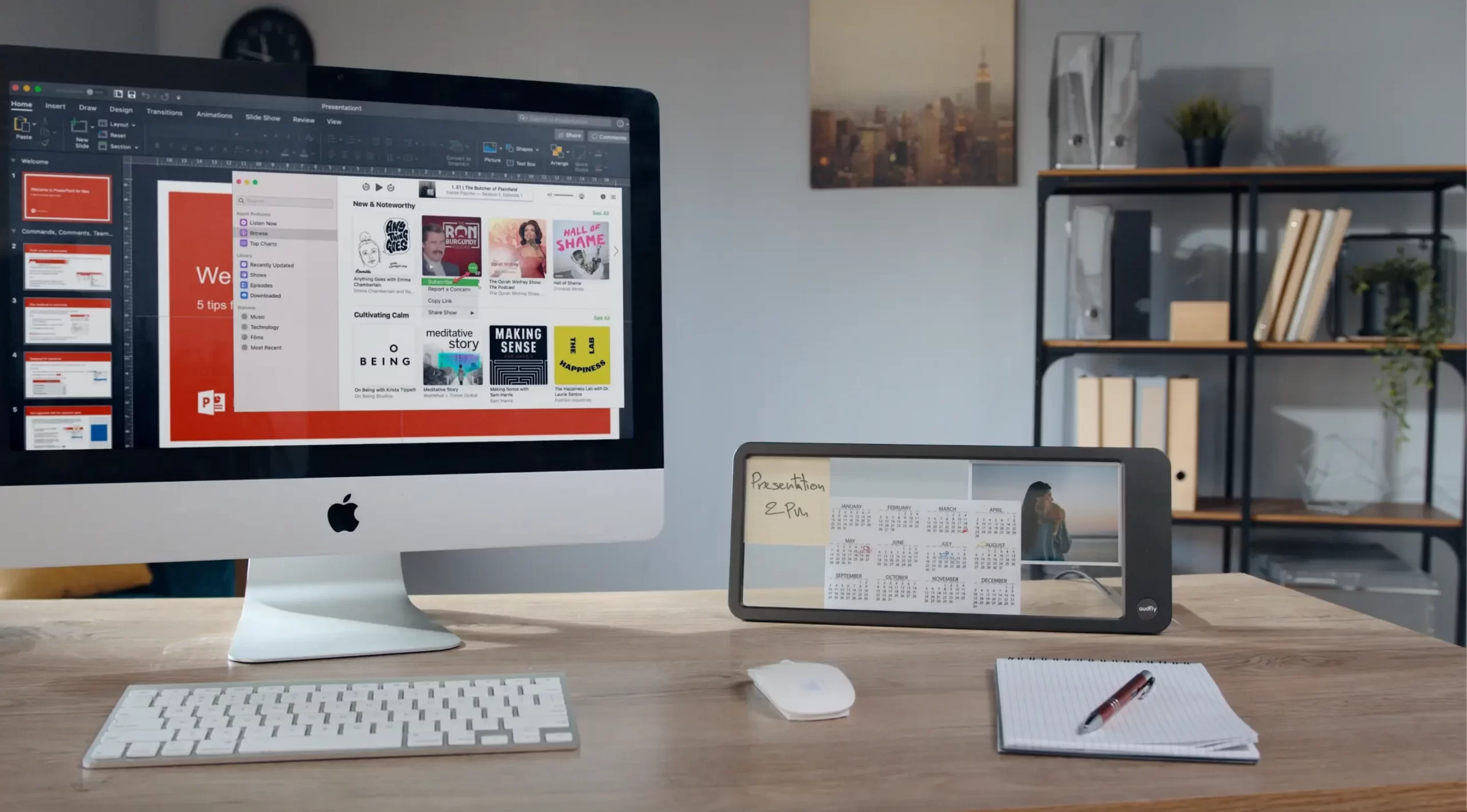
That characteristic also creates decorative possibilities. Audfly says photographs can be positioned behind the speaker without affecting sound quality. Owners could therefore incorporate the panel into a desk, shelf, display area, or personal corner without necessarily treating it as a conventional piece of audio furniture. The small black surround and aluminum structure remain visible, but the principal surface does not visually close off the area behind it.
An adjustable frame with a practical purpose
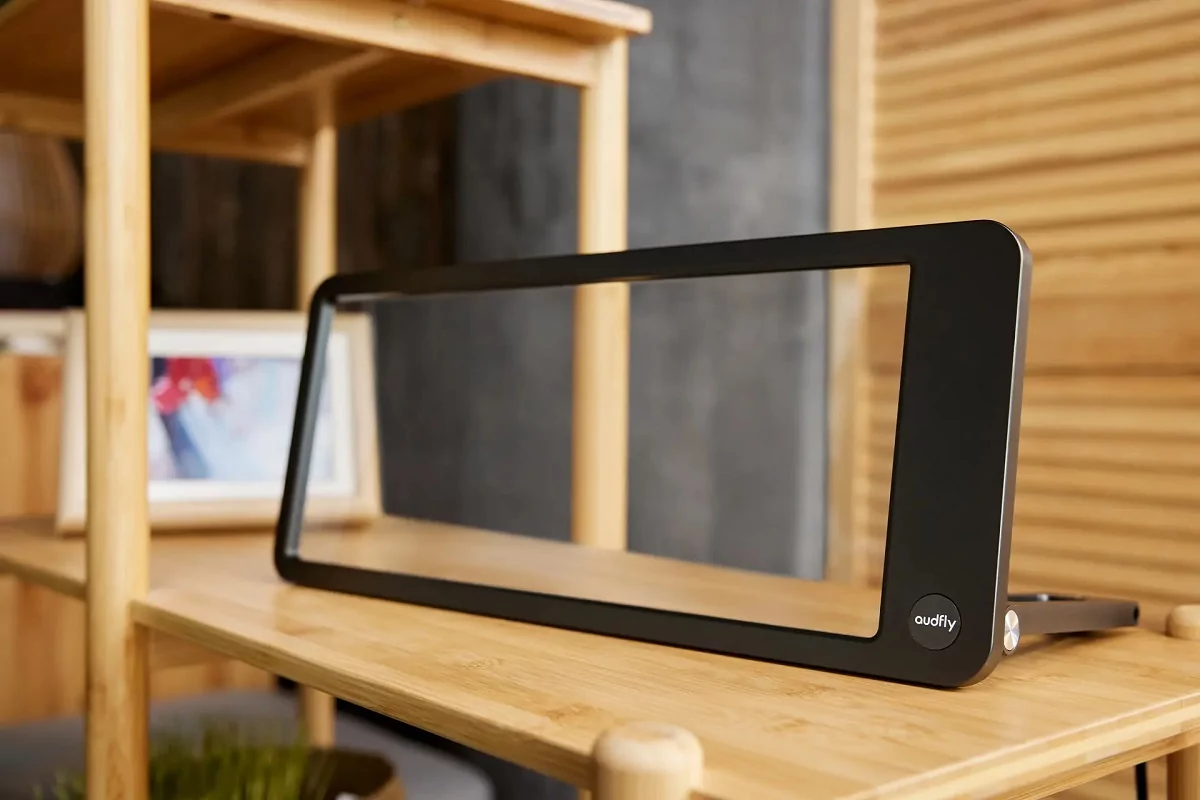
The aluminum frame performs several jobs. It secures the laminated-glass panel, contains the speaker’s electronics, and incorporates the hardware required to receive signals from connected sources. It also includes a stand that lets the owner adjust the angle of the device relative to the listening position.
That adjustment matters because Focusound is intentionally directional. With a room-filling loudspeaker, modest changes in orientation may still leave the listener inside a broad area of coverage. A narrowly aimed system depends more directly on alignment. The adjustable stand therefore supports the central use case rather than serving as a minor ergonomic addition: the owner can point the panel toward a chair, workstation, exercise area, or other defined listening position.
The design also suggests a degree of flexibility when a room’s activities change. The panel could be redirected for someone seated at a computer and later angled toward a person watching a screen or listening from another nearby position. Focusound is not presented as an automated tracking system, so physical setup and orientation remain important parts of using it effectively.
Connectivity for entertainment and everyday media
Audfly has designed Focusound to accept audio from several common categories of source. The documented options include computers, televisions, smartphones, game consoles, and Bluetooth devices. That range supports the product’s broader role as a personal audio endpoint rather than limiting it to a single type of playback.
Connection to a television could provide targeted film or program audio for one viewer in a multipurpose room. A computer connection makes sense for a desk, study area, video calls, or online media, while game-console compatibility extends the same directional principle to gaming. Smartphone and Bluetooth support provide a convenient route for music and podcasts without requiring the panel to be tied permanently to a larger system.
This source flexibility is especially relevant because the product’s appeal rests on situations rather than on one content format. Directional playback can be useful whether the material is dialogue, a podcast, game audio, a soundtrack, or casual music. By accommodating the devices already used for those activities, Focusound can be positioned around the listener’s routine instead of demanding a narrowly specialized source.
Visual discretion without hiding the technology
Transparent products can sometimes prioritize novelty over function, but Focusound’s appearance and operating principle are closely related. The laminated panel provides the surface in which the vibrating elements are installed, while its transparency reduces the visual mass normally associated with an audio enclosure. Its construction is therefore both technical and aesthetic.
This may be attractive in interiors where a conventional speaker cabinet would block a view, compete with artwork, or add another opaque object to a desk or shelf. The ability to place a photograph behind the panel further emphasizes that it is intended to coexist with its surroundings rather than become the room’s visual center.
At the same time, Focusound is not invisible. Its black border, aluminum frame, stand, and necessary electronics remain part of the design. Prospective owners should view it as a deliberately minimal and unusual object, not as a speaker that physically disappears. Its distinction comes from making most of the active panel transparent while retaining the structure needed for aiming, support, and connectivity.
Who Focusound is most suitable for
Focusound is most compelling for people who regularly share a room but want separate streams of audio. Households with overlapping entertainment, exercise, study, and creative routines are an obvious fit. It may also suit an individual workstation where headphones are undesirable, or a media area in which one person wants to listen without sending the same program across the entire room.
Its unusual appearance will also matter to owners who value visually light technology. The transparent panel and compact frame offer an alternative to the familiar box-speaker format, particularly where preserving sightlines or displaying an image behind the device is useful.
There is an important limitation to keep in mind. Audfly explicitly positions sound quality below the directional and design objectives, acknowledging that Focusound is not intended to impress dedicated music enthusiasts. Anyone building a system primarily for critical, high-fidelity listening should therefore understand that this product has a different hierarchy of priorities. Its strengths are personal sound control, freedom from headphones, transparent construction, and flexible source support—not a claim to replace a conventional audiophile loudspeaker system.
The narrow listening field also makes placement and aiming more significant. Focusound is best suited to a reasonably defined listening location and to users willing to adjust the panel toward that position. Those seeking broad, evenly distributed coverage for a group would be better aligned with the operating principle of a traditional speaker.
Conclusion
Audfly Focusound is distinctive because its technologies, physical design, and intended use all support the same idea: delivering audio to an individual without filling an entire shared room. Its laminated-glass panel contains compact vibrating elements, while ultrasound technology creates a narrow listening field aimed with the help of an adjustable aluminum stand. Connectivity for computers, televisions, smartphones, game consoles, and Bluetooth sources broadens its usefulness across everyday media. The transparent construction also gives it a lighter visual presence and allows photographs to be placed behind the panel. Focusound is not positioned as an audiophile loudspeaker, and users seeking room-wide coverage or sound quality as the overriding priority should recognize that trade-off. It is instead aimed at people who value directional personal listening, shared-space compatibility, freedom from headphones, and an unconventional design that does not resemble a conventional speaker cabinet.


Sound Off
0Join the discussion if you have something to add.