
The strongest AV receivers distinguish themselves through more than channel count.
Amplifier architecture, surround-format support, room correction, video compatibility and the ability to accommodate a practical speaker layout all matter.
This ranking therefore favors products that can serve as the control and amplification center of a home cinema without depending on unnecessary add-ons. The first five entries are standalone AV receivers, while the sixth is a complete speaker-and-receiver package. They range from flexible flagship designs with advanced calibration to accessible 5.2-channel models focused on straightforward installation. Their positions reflect overall capability as well as how naturally each product fits the AV receiver category. The final four products are not multichannel AV receivers and should not be interpreted as direct substitutes. The Cocktail Audio model is a stereo network receiver, the Yamaha WXC-50 is a network player and preamplifier, the Klipsch model is a powered speaker pair, and the Yamaha TT-S303 is a turntable. They are included because they were among the supplied products, but their value lies in specialist stereo or system-expansion roles rather than surround-sound control.

1. Marantz SR8015
Marantz SR8015 11.2-channel flagship AV receiver.
The Marantz SR8015 is the most complete standalone AV receiver in the supplied group.
Its 11.2-channel architecture can power a 7.1.4 speaker system without an additional amplifier, while Dolby Atmos, DTS:X and Auro-3D support provides broad coverage of object-based surround formats.
Four SHARC processors handle its digital processing, and the receiver can scale video to 4K resolution. Its construction also supports its flagship positioning. The copper-plated chassis contains a shielded toroidal transformer, high-capacity power-supply capacitors and discrete HDAM amplification with current feedback for every channel. Audyssey MultEQ XT32 is complemented by Dynamic EQ, Dynamic Volume, LFC and Sub EQ HT, making this the strongest option here for a large, carefully calibrated theater with two subwoofers.
Best for: A high-channel-count home cinema requiring integrated 7.1.4 amplification
- 11.2-channel design can power a 7.1.4 system without an external amplifier
- Supports Dolby Atmos, DTS:X and Auro-3D
- Audyssey MultEQ XT32 includes Sub EQ HT for dual-subwoofer correction
- Discrete HDAM amplification, a toroidal transformer and a copper-plated chassis
Verdict: The Marantz SR8015 takes first place by combining the broadest surround capability, extensive room correction and the most substantial amplifier design in the group.

2. Arcam AVR30
Arcam AVR30 Class G AV receiver.
The Arcam AVR30 is a premium alternative for listeners who place room integration and amplifier engineering near the top of their priorities.
It provides seven channels of Class G amplification rated at 100 W per channel into 8 ohms and uses a large toroidal transformer.
Dolby Atmos, DTS:X and IMAX Enhanced are supported, with 5.1.2 available from the internal amplification. A 7.1.4 installation is possible, but it requires four channels of external power amplification. That keeps the AVR30 behind the more self-contained Marantz in this ranking. Full 16-channel Dirac calibration is nevertheless a significant strength, while AirPlay 2 and Chromecast provide convenient music streaming from mobile devices.
Best for: Premium theaters built around Dirac calibration and optional external amplification
- Seven channels of Class G amplification rated at 100 W per channel into 8 ohms
- Full 16-channel Dirac calibration
- Supports Dolby Atmos, DTS:X and IMAX Enhanced
- Includes AirPlay 2 and Chromecast streaming
Verdict: The Arcam AVR30 is an excellent calibration-focused receiver, although a full 7.1.4 system requires extra power amplifiers.

3. Denon AVR-X580BT
Denon AVR-X580BT 5.2-channel AV receiver.
The Denon AVR-X580BT is a more modest 5.2-channel receiver, but it offers an unusually relevant video feature set for a straightforward theater or gaming system.
Its four HDMI inputs support 8K at 60 Hz, while 4K at 120 Hz, ALLM and QFT address high-frame-rate playback and reduced latency.
HDR10, HDR10+ and Dolby Vision are also covered. Five discrete amplifiers are rated at up to 70 W of output power, and the receiver decodes lossless Dolby TrueHD and DTS-HD Master Audio soundtracks. It does not compete with the Marantz or Arcam for immersive speaker capacity, but its combination of modern video handling, simple operation and a conventional 5.2 layout makes it the most balanced mainstream choice among the supplied entry-level receivers.
Best for: Compact 5.2 theaters and gaming systems requiring high-frame-rate video support
- Four HDMI inputs with 8K at 60 Hz support
- Supports 4K at 120 Hz, ALLM and QFT
- Compatible with HDR10, HDR10+ and Dolby Vision
- 5.2-channel configuration with five discrete amplifiers
Verdict: The Denon AVR-X580BT is the strongest straightforward 5.2-channel choice here for modern displays and game systems.

4. Onkyo TX-SR393
Onkyo TX-SR393 AV receiver with automatic calibration.
The Onkyo TX-SR393 is an accessible receiver intended for smaller rooms and less elaborate speaker systems.
Its key differentiators are Dolby Atmos Height Virtualizer and DTS Virtual:X, both of which simulate height and surround effects when the corresponding physical speakers are absent.
This can be useful in an apartment or multipurpose room where ceiling or rear-speaker installation is impractical. An automatic sound-calibration system helps adapt the connected speakers to the room, and four HDMI inputs accommodate several video sources. The receiver also provides pre-out connections for a second audio zone. It lacks the documented high-frame-rate video features of the Denon and cannot match the higher-ranked models for system scale, but it offers a practical route into home cinema.
Best for: Small rooms where physical height or surround speakers are impractical
- Dolby Atmos Height Virtualizer for systems without physical height speakers
- DTS Virtual:X virtual surround processing
- Automatic speaker calibration
- Four HDMI inputs and second-zone pre-out connections
Verdict: The Onkyo TX-SR393 is a sensible entry-level receiver for listeners who value virtualized immersion and uncomplicated setup.

5. Sony STR-DH590
Sony STR-DH590 5.2-channel 4K AV receiver.
The Sony STR-DH590 is a conventional 5.2-channel receiver with support for 4K video and the HDR10, HLG and Dolby Vision formats.
Its discrete amplifiers are supported by reinforced circuit boards and metal framing intended to reduce vibration and interference.
Sony specifies maximum output of 145 W per channel into 6 ohms at 0.9 percent total harmonic distortion, a figure that should not be compared directly with ratings taken under different conditions. Digital Cinema Auto Calibration adjusts the speaker setup for the room, while S-Force Pro Front Surround can create a virtual surround presentation from a 2.1-channel arrangement. Bluetooth 4.2 and an FM tuner cover basic wireless and broadcast listening. It is best suited to a straightforward theater rather than an immersive height-speaker system.
Best for: A straightforward 5.2-channel movie system with basic wireless audio
- 5.2-channel layout with discrete amplification
- Supports 4K video, HDR10, HLG and Dolby Vision
- Digital Cinema Auto Calibration adapts the speakers to the room
- Bluetooth 4.2, FM radio and S-Force Pro Front Surround
Verdict: The Sony STR-DH590 is a capable traditional 5.2 receiver, but it offers less expansion and fewer advanced video features than the higher-ranked choices.

6. Onkyo HT-S5915
Onkyo HT-S5915 home-theater package with TX-SR494 receiver and speakers.
The Onkyo HT-S5915 is not a standalone AV receiver but a complete home-theater package containing speakers and a TX-SR494 receiver.
That makes it less directly comparable with the five models above, although it is a relevant option for someone starting without speakers.
The included seven-channel receiver and speaker system support a 5.1.2 Dolby Atmos configuration. The TX-SR494 provides four HDMI inputs and one output, with 4K UHD, Dolby Vision, HDR10 and HLG passthrough. Its channels use Burr-Brown digital-to-analog converters supporting up to 24-bit/192 kHz signals, and the package includes a powered subwoofer as part of the system. Its lower position reflects its package format rather than an absence of surround capability.
Best for: First-time buyers who need both an AV receiver and a complete Atmos speaker package
- Complete receiver, speaker and subwoofer package
- Supports a physical 5.1.2 Dolby Atmos arrangement
- Four HDMI inputs with 4K UHD and HDR passthrough
- Seven amplification channels in the included TX-SR494 receiver
Verdict: The Onkyo HT-S5915 is the most convenient all-in-one theater package in the group, but it is not a direct standalone-receiver comparison.

7. Cocktail Audio N25Amp
Cocktail Audio N25Amp stereo network receiver.
The Cocktail Audio N25Amp is a stereo network receiver rather than a multichannel AV receiver.
Its integrated amplifier delivers 75 W per channel, and the slim, standard-width chassis incorporates a color LCD, rotary controls and programmable presets.
A dual-core ARM Cortex-A9 processor and integrated operating system support its network-player functions. A gigabit wired network connection is included, while Bluetooth supports SBC, AAC, aptX, aptX Low Latency and aptX HD. Wi-Fi requires a separately purchased USB dongle, and wireless-headphone transmission requires an additional Bluetooth module. The N25Amp can anchor a versatile two-channel music system, but the supplied information does not establish surround decoding or AV switching comparable with the receivers above.
Best for: A compact two-channel network music system rather than a surround theater
- Integrated stereo amplifier rated at 75 W per channel
- Color display and programmable front-panel presets
- Gigabit wired networking
- Broad Bluetooth codec support including aptX HD and aptX Low Latency
Verdict: The Cocktail Audio N25Amp is a capable stereo all-in-one, but it should not be mistaken for a multichannel AV receiver.

8. Yamaha WXC-50
Yamaha WXC-50 network player and preamplifier.
The Yamaha WXC-50 is a network player and preamplifier designed to add streaming and MusicCast multiroom functions to an existing amplifier or AV receiver.
This makes it a useful upgrade component when an otherwise satisfactory system lacks network playback, but it cannot replace the amplification and multichannel processing of an AV receiver.
Its audio design includes an ESS digital-to-analog converter, a DAC on Pure Ground power-grounding circuit and 48-bit digital volume control. Connections are provided for sources including a television, computer and CD player, while MusicCast enables compatible multiroom playback. Its ranking reflects its role as an add-on rather than a theater control center.
Best for: Adding network streaming and MusicCast to an existing amplifier or receiver
- Adds MusicCast and network playback to an existing audio system
- Uses an ESS digital-to-analog converter
- Includes 48-bit digital volume control
- Accepts sources including televisions, computers and CD players
Verdict: The Yamaha WXC-50 is a focused connectivity upgrade for an established system, not a standalone multichannel receiver.

9. Klipsch R-51PM
Klipsch R-51PM active bookshelf speakers.
The Klipsch R-51PM is a pair of active bookshelf speakers, not an AV receiver.
One speaker contains the amplification and source connections, while the second is linked by the supplied speaker cable.
The internal amplifiers provide 50 W per channel, and the speaker design combines a one-inch aluminum compression tweeter in a Tractrix horn with a 5.25-inch IMG bass and midrange driver. Its unusually varied inputs make it useful as the center of a compact stereo system. RCA connections can operate at line level or through the built-in phono stage, while 3.5 mm auxiliary, optical and USB inputs accommodate additional sources. A subwoofer output permits bass expansion, but the pair does not provide the multichannel control expected from an AV receiver.
Best for: A compact powered stereo system for music, television or desktop use
- Built-in amplification rated at 50 W per channel
- Switchable line-level and phono RCA input
- Optical, USB and 3.5 mm auxiliary inputs
- Subwoofer output for bass-system expansion
Verdict: The Klipsch R-51PM offers convenient powered stereo playback, but it cannot perform the switching and surround-processing role of an AV receiver.
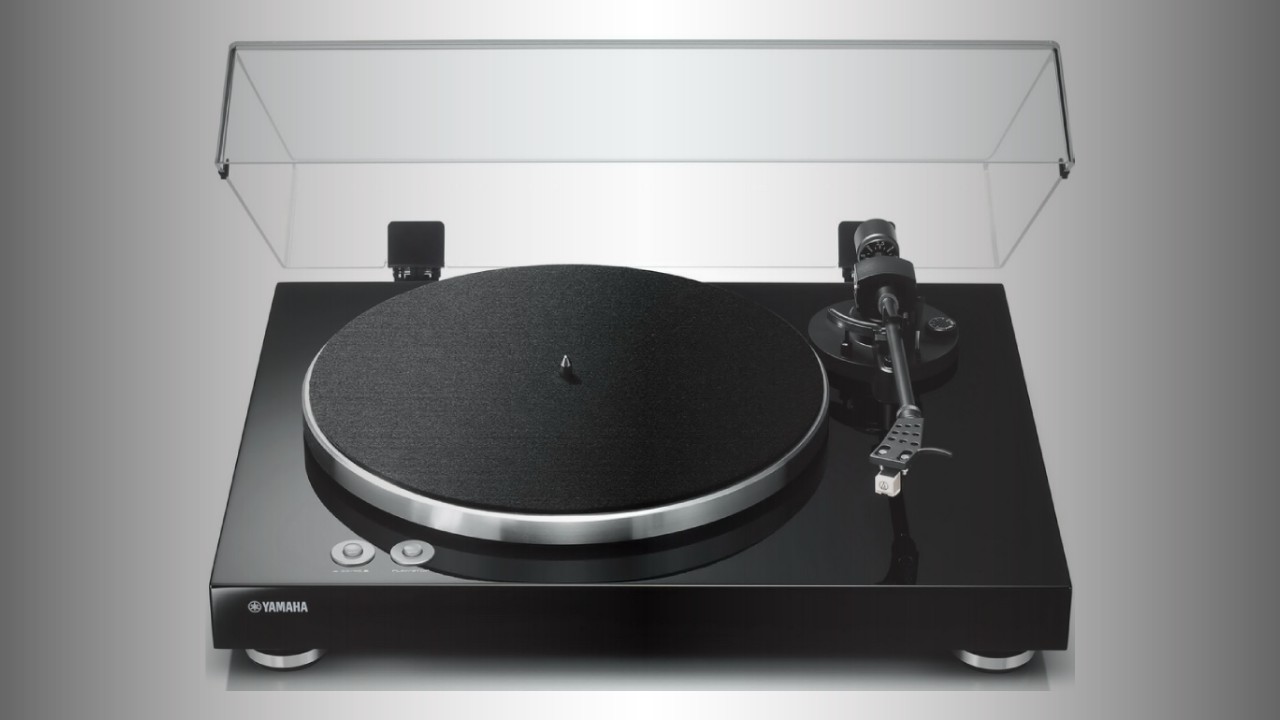
10. Yamaha TT-S303
Yamaha TT-S303 turntable with switchable phono and line outputs.
The Yamaha TT-S303 is a turntable and therefore the least direct fit in an AV receiver ranking.
Its relevance is limited to serving as an analog source for a receiver, stereo amplifier or powered speaker system.
A built-in phono preamplifier allows connection to a standard line input, including on equipment that lacks a dedicated phono stage. The output can also be switched to phono mode when a preferred external or amplifier-integrated phono preamp is available. That flexibility simplifies integration with several kinds of audio system, but the TT-S303 supplies no amplification, video switching, surround decoding or room correction. It belongs on a receiver owner’s source shelf rather than in the receiver position itself.
Best for: Adding vinyl playback to a receiver-based or powered-speaker system
- Built-in phono preamplifier
- Switchable line-level and phono outputs
- Can connect to an amplifier, AV receiver or active speakers
- Designed with the appearance of classic hi-fi equipment
Verdict: The Yamaha TT-S303 is a flexible vinyl source component, not an alternative to an AV receiver.

Sound Off
0Join the discussion if you have something to add.