
These ten products represent several distinct approaches to better sound: passive stereo speakers, compact powered pairs, a one-box wireless design, Dolby Atmos soundbars, a professional subwoofer and a boutique active monitor.
The most convincing conventional stereo speakers lead the ranking, but the more specialized products can be stronger choices when their intended role matches the system.
Placement reflects the engineering information supplied, the completeness of each product, connectivity where relevant and how broadly it can be recommended. A lower position does not necessarily mean inferior construction; it can instead reflect a narrower application, dependence on other equipment or limited information in the source article. The supplied material ranges from detailed product descriptions to brief launch reports rather than standardized listening tests. The ranking therefore avoids inferred sound-quality claims and focuses on documented designs, features and practical distinctions.

1. Buchardt S400 MKII
Buchardt S400 MKII two-way speakers with a reinforced cabinet and rear passive radiator.
The Buchardt S400 MKII takes the top position because its documented changes form a coherent redesign rather than a single feature update.
Buchardt replaced the original aluminum woofer cone with paper, increased the cabinet’s internal volume by approximately 15 percent, added reinforcing braces and retained the rear oval passive radiator.
The crossover received equally serious attention, including selected Jantzen Audio components, thicker circuit-board conductors, reinforced internal wiring and a Miflex KPCU-1 capacitor. Although the supplied article contains no measurements or listening results, the combined work on the driver, enclosure and crossover gives the S400 MKII the strongest all-round engineering case in this group.
Best for: Listeners building a serious passive stereo system around compact two-way speakers
- Paper-cone woofer and rear passive-radiator configuration
- Approximately 15 percent more internal cabinet volume
- Additional cabinet reinforcement
- Substantially revised crossover with named Jantzen and Miflex components
Verdict: The S400 MKII is the most balanced overall recommendation here because Buchardt addressed its driver, cabinet and crossover as an integrated design.

2. Fyne Audio F500SP
Fyne Audio F500SP bookshelf speaker with its IsoFlare driver and BassTrax plinth.
The Fyne Audio F500SP makes a strong case through technology inherited from the company’s higher F700 range.
Its 15-centimeter IsoFlare driver incorporates a one-inch magnesium tweeter in a waveguide, while the FyneFlute surround and downward-firing BassTrax port are intended to manage driver behavior and distribute bass around the speaker.
Fyne also uses selected crossover parts, polypropylene capacitors and silver-plated Van Den Hul internal wiring. Four speaker terminals permit separate connections for the frequency sections, and a fifth terminal provides grounding. Hand assembly in Glasgow and a choice of standard or premium finishes reinforce its specialist positioning, though the source provides no comparative listening evidence.
Best for: Passive hi-fi systems seeking a technically distinctive coaxial bookshelf speaker
- F700-derived IsoFlare driver with magnesium tweeter
- Downward-firing BassTrax port and aluminum plinth
- Selected crossover components and silver-plated internal wiring
- Separate speaker terminals plus a dedicated ground terminal
Verdict: The F500SP combines upper-range Fyne technology with unusually comprehensive construction details, placing it close behind the Buchardt.

3. Technics SB-C600
Technics SB-C600 bookshelf speaker featuring a Phase Precision coaxial driver.
Technics builds the SB-C600 around its Phase Precision coaxial driver, which places a one-inch aluminum tweeter concentrically with a 15-centimeter bass and midrange unit.
That physical arrangement is designed to approach point-source behavior and reduce the phase irregularities that can affect conventional two-way layouts.
The supporting construction is equally relevant. A balanced BDMA mounting system is used to suppress unwanted driver vibration, the rigid cabinet includes an internal partition, and the front bass-reflex port has an aerodynamic profile intended to preserve smooth airflow at higher output levels. Its combination of focused acoustic engineering and conventional bookshelf proportions makes it one of the more broadly applicable passive designs in the ranking.
Best for: Stereo systems that need a compact, front-ported passive speaker
- Phase Precision coaxial driver layout
- One-inch aluminum tweeter and 15-centimeter bass-midrange unit
- Balanced BDMA mounting system for vibration control
- Aerodynamically profiled front bass-reflex port
Verdict: The SB-C600 is a thoughtfully integrated bookshelf design whose coaxial driver and front port give it a clear technical identity.

4. Lorenzo Audio Labs LM3
Lorenzo Audio Labs LM3 high-sensitivity loudspeaker with a 12-inch woofer and AMT driver.
The Lorenzo Audio Labs LM3 is the most imposing passive loudspeaker in the selection.
Its two-way configuration combines a 12-inch cellulose-cone woofer with an AlNiCo magnetic system and an AMT ribbon high-frequency driver mounted in a substantial waveguide.
The woofer uses two bass-reflex ports that exit through the bottom panel. A specified sensitivity of 94 dB at one meter and nominal impedance of 8 ohms distinguish the LM3 from the smaller passive models. Its 41-millimeter plywood walls, surface-mounted crossover with Mundorf, Jantzen and Pathaudio components, ironwood stands and 45-kilogram weight per speaker indicate a highly specialized design with significant space and installation demands.
Best for: High-sensitivity passive systems with room for large, heavy loudspeakers
- Specified sensitivity of 94 dB at one meter
- 12-inch AlNiCo woofer with cellulose cone
- AMT ribbon driver with a large waveguide
- Thick plywood enclosure and supplied ironwood stands
Verdict: The LM3 is a compelling large-format specialist design, but its substantial size and 45-kilogram-per-speaker weight make it less universal than the top three.

5. Audio-Technica AT-SP3X
Audio-Technica AT-SP3X powered stereo speakers with Bluetooth and RCA connectivity.
The Audio-Technica AT-SP3X offers a comparatively straightforward route to a complete stereo system.
Amplification and DSP are built in, with each compact MDF bass-reflex enclosure combining a three-inch woofer and 1.1-inch soft-dome tweeter.
The pair is connected by a supplied two-meter cable and has a stated maximum power output of 30 watts. Bluetooth supports simultaneous pairing with two source devices, while an analog RCA input accommodates wired equipment. That combination could be particularly useful for switching between a phone and a Bluetooth-capable record player, but no digital wired input is documented. Side-mounted volume control keeps operation simple.
Best for: Compact powered stereo setups using Bluetooth or RCA sources
- Built-in amplification and DSP
- Bluetooth pairing with two devices simultaneously
- Analog RCA input for wired sources
- Compact MDF bass-reflex enclosures
Verdict: The AT-SP3X is the clearest plug-in stereo option in the ranking, pairing useful source flexibility with compact dimensions.

6. Elipson W35 Xi
Elipson W35 Xi spherical active wireless speaker in its black finish.
The Elipson W35 Xi takes a different route from a conventional two-cabinet pair.
It is a spherical, two-way active stereo speaker with Class D amplification rated at up to 350 watts, concentrating the system into a single designer enclosure rather than providing physically separated left and right cabinets.
Its main advantage is wireless breadth. Chromecast, AirPlay 2 and Bluetooth with aptX HD are supported, while the Elipson Control application provides access to services including Qobuz, Spotify, Tidal and Deezer. Optical digital, 3.5-millimeter analog and Ethernet connections extend its usefulness beyond wireless streaming.
Best for: Listeners prioritizing one-box wireless convenience and distinctive industrial design
- Integrated Class D amplification rated at up to 350 watts
- Chromecast, AirPlay 2 and Bluetooth with aptX HD
- Optical, analog and Ethernet connections
- App-controlled access to several major streaming services
Verdict: The W35 Xi is a well-connected all-in-one speaker for modern streaming systems, although it prioritizes convenience over the physical separation of a conventional stereo pair.

7. LG SL10Y
LG SL10Y 5.1.2-channel soundbar with integrated up-firing speakers.
The LG SL10Y is primarily a home-cinema speaker system rather than a direct substitute for passive hi-fi speakers.
Its 5.1.2-channel configuration includes two integrated up-firing speakers, with Dolby Atmos and DTS:X support intended to add a vertical dimension to film and television sound.
The feature set extends beyond audio decoding. Google Assistant provides voice control, while 4K HDR and Dolby Vision passthrough allow compatible video signals to travel through the soundbar. The supplied information also cites Meridian Audio technology and high-resolution audio support up to 24-bit/192 kHz, giving the SL10Y a broader specification than a basic television speaker upgrade.
Best for: Television systems needing an integrated Atmos soundbar with voice control
- 5.1.2-channel configuration with two up-firing speakers
- Dolby Atmos and DTS:X support
- Google Assistant voice control
- 4K HDR and Dolby Vision video passthrough
Verdict: The LG SL10Y is the most extensively equipped home-cinema option here, but its TV-focused format makes it less universal than the leading stereo speakers.
8. Sharp HT-SB700
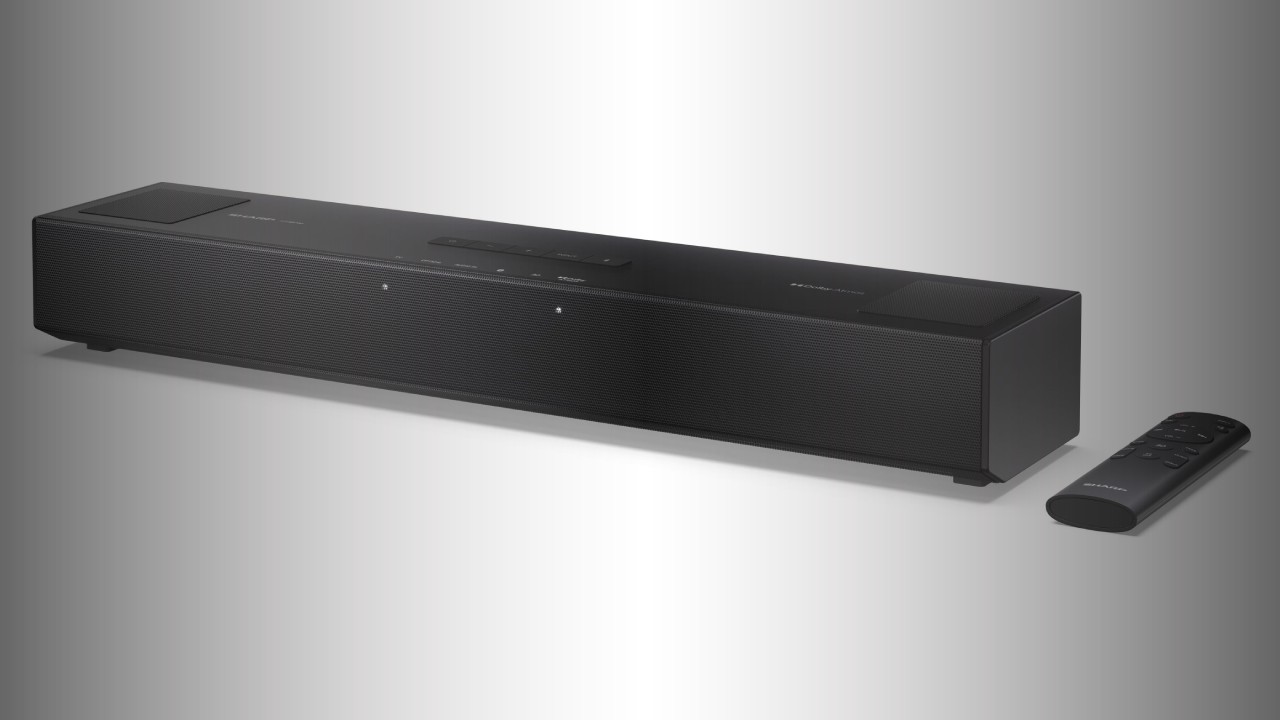
Sharp HT-SB700 compact 2.0.2-channel Dolby Atmos soundbar.
The Sharp HT-SB700 is a compact 2.0.2-channel soundbar designed as an accessible upgrade from a television’s built-in speakers.
Two front-facing full-range drivers are joined by two up-firing drivers, with total output specified at up to 140 watts and Dolby Atmos decoding included.
At 520 millimeters wide, it is substantially more space-conscious than many multichannel soundbars. HDMI eARC and CEC provide the main television connection, while optical and 3.5-millimeter inputs accommodate other equipment. Bluetooth 5.3, adjustable bass and treble, and five listening presets add practical flexibility, although the documented 2.0.2 configuration should not be confused with a full system of discrete surround speakers.
Best for: Space-conscious television setups seeking a lower-cost Atmos soundbar
- Compact 520-millimeter-wide enclosure
- Two up-firing drivers and Dolby Atmos support
- HDMI eARC and CEC connectivity
- Bluetooth 5.3 plus optical and analog inputs
Verdict: The HT-SB700 is a practical compact TV upgrade whose connectivity and up-firing drivers are more notable than its limited channel count.

9. ATC SCS70 Pro
ATC SCS70 Pro active professional subwoofer with a 12-inch high-excursion driver.
The ATC SCS70 Pro is a professional active subwoofer, not a complete speaker system, so its low placement reflects specialization rather than a lack of engineering substance.
Its hand-built 12-inch driver uses a shortened voice coil with 50 percent more excursion than the previous design, while a 300-watt Class AB amplifier supplies power.
ATC specifies a 22 Hz lower frequency limit achieved without electronic correction, along with a maximum sound-pressure level of 116 dB and a continuous figure of 110 dB. An analog fourth-order Linkwitz-Riley low-pass filter handles integration, and multiple units can be grouped for larger spaces. An in-wall SCS70iW Pro variant is also identified, but the ranked product is the standard SCS70 Pro.
Best for: Professional monitoring systems requiring substantial low-frequency extension
- Hand-built high-excursion 12-inch driver
- 300-watt Class AB amplifier
- Specified 22 Hz lower frequency limit without electronic correction
- Supports grouped multi-subwoofer installations
Verdict: The SCS70 Pro is a deeply specified professional bass solution, but it ranks lower because it requires main speakers and serves a narrower audience.
10. KAD K5
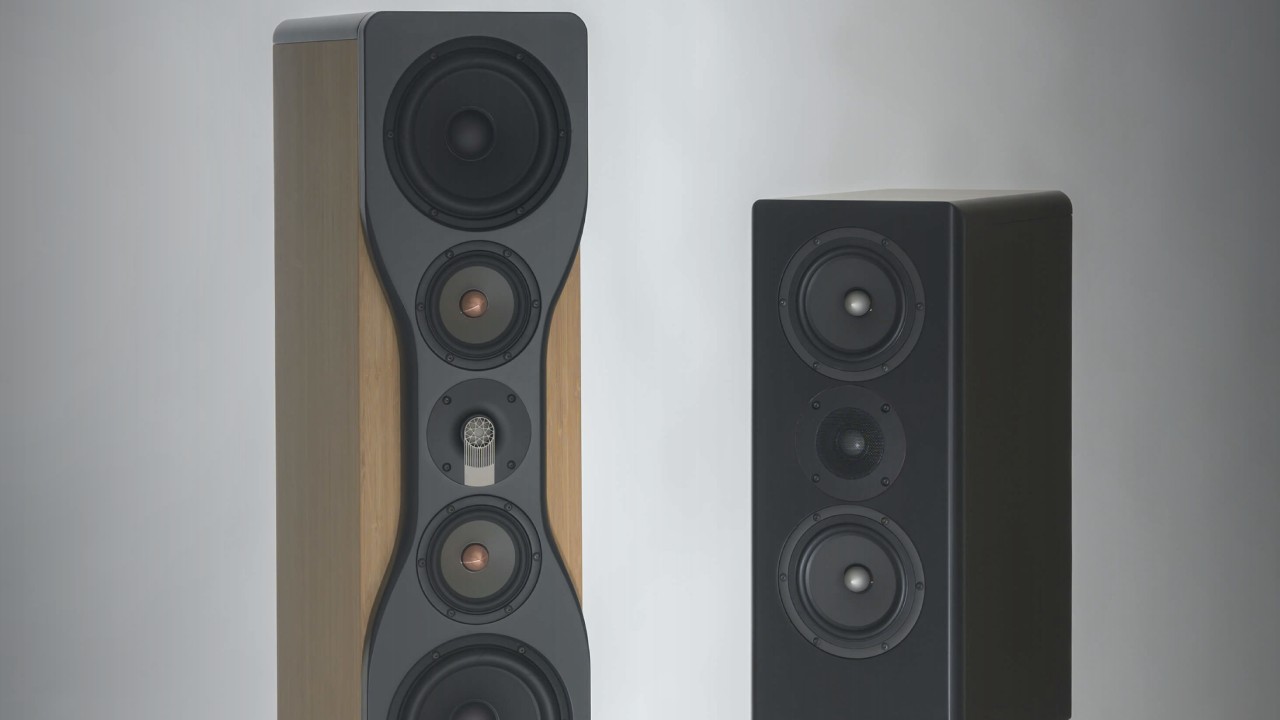
KAD K5 active monitor introduced with technology derived from the company’s flagship platform.
The KAD K5 is a genuine active monitor, but the supplied article is primarily an exhibition preview rather than a detailed product report.
It confirms that the K5 incorporates technology derived from KAD’s flagship design, yet it does not provide the driver arrangement, amplifier output, connections, dimensions or performance specifications needed for a rigorous comparison.
That information gap determines the K5’s position. Its active architecture remains relevant to the category, but prospective evaluation would depend heavily on a demonstration or more complete technical documentation rather than the limited details available here.
Best for: Listeners able to audition a boutique active monitor before selecting a system
- Active monitor architecture
- Technology derived from KAD’s flagship speaker platform
Verdict: The KAD K5 may be an interesting active design, but the limited source detail prevents a stronger evidence-based recommendation.



Sound Off
0Join the discussion if you have something to add.