
The most suitable amplifier is not necessarily the one with the longest specification sheet.
System architecture matters just as much: an integrated amplifier can consolidate digital, vinyl and television sources, while separate preamplifiers and power amplifiers provide more freedom to tailor each stage.
Room correction, subwoofer management, balanced connections and speaker requirements can also determine which design makes sense. This selection covers distinctly different approaches. The Anthem STR is equipped to manage a complex mixed-source system, the Audiolab 8300XP provides dedicated power for a separate preamplifier, and the Simaudio Moon ACE addresses listeners who want fewer boxes with full-size speakers. At the other end of the spectrum, the Mullard 3-3 is a low-powered tube design available for self-assembly. Not every entry is a conventional product recommendation. The Peachtree Audio article concerns future BluOS integration without naming compatible models, while the power-amplifier roundup is a broader research resource. Those limitations are important when deciding whether an entry is relevant to a system that can be assembled now.

1. Anthem STR: A feature-packed integrated amplifier
The Anthem STR combines high-output amplification, digital conversion, phono inputs and room-correction processing in one chassis.
The Anthem STR is suited to systems that need more than source selection and speaker power.
Its continuous output is specified from 200 W per channel into 8 ohms to 550 W per channel into 2 ohms, while the integrated DAC, asynchronous USB input, MM and MC phono inputs, subwoofer bass management and Anthem Room Correction reduce the need for additional components.
ARC operates below 5 kHz and supports automatic or detailed manual adjustment. Setup is more involved than with a conventional integrated amplifier: measurements are taken at six positions using a connected microphone, and the supplied computer program does not support Mac.
Best for: Complex systems with subwoofers and varied sources
- 200 W per channel into 8 ohms
- Anthem Room Correction included
- MM and MC phono inputs
- Configurable subwoofer bass management
Verdict: The Anthem STR is the most broadly equipped option here for listeners prepared to spend time configuring room correction and bass management.
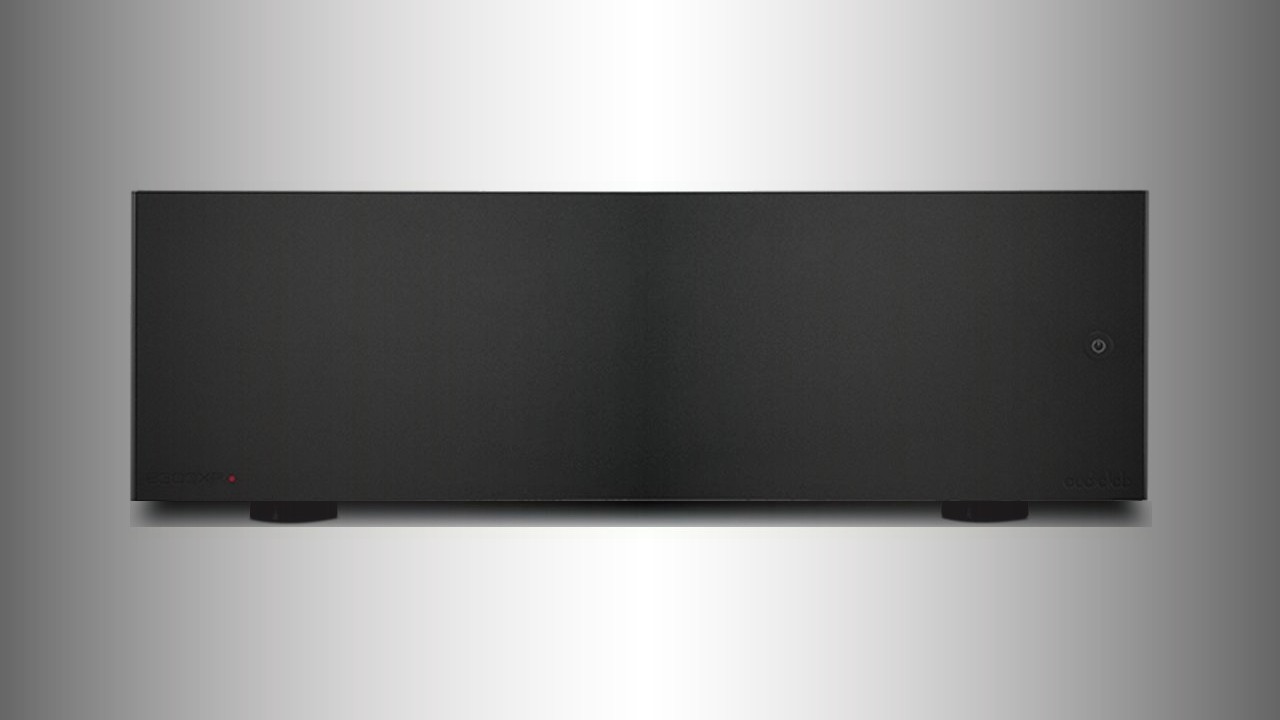
2. Audiolab 8300XP: Classic power amplifier with crisp and clear sound
The minimalist Audiolab 8300XP is a fully balanced power amplifier intended for use with a separate preamplifier or compatible source.
The Audiolab 8300XP is a dedicated power amplifier, so it belongs in a separates system with a preamplifier or a source component that provides volume control.
Its fully balanced architecture extends from the input stage to the speaker outputs, taking full advantage of its XLR connections and making it relevant where long balanced cable runs are required.
The source also highlights high noise suppression, reduced transient distortion and the ability to draw substantial current from the power supply. Those qualities make it a logical match for listeners prioritizing control and detail rather than the convenience of an all-in-one amplifier.
Best for: Balanced separates systems and longer cable runs
- Fully balanced amplifier architecture
- XLR inputs suit long cable runs
- High degree of noise suppression
- Power supply designed for substantial current delivery
Verdict: The 8300XP is a focused choice for a balanced separates system that does not require integrated source handling.

3. Simaudio Moon ACE – Compact High End
The compact Simaudio Moon ACE is presented as a one-box electronics partner for a pair of full-size speakers.
The source positions the Simaudio Moon ACE as an answer to a particular system-building problem: how to retain full-size speakers and component-level ambitions without assembling a rack of electronics.
It is presented within the compact universal-component category, where the essential electronics share one enclosure and only a pair of speakers needs to be added.
That makes the concept especially relevant to streaming-oriented listeners who value space efficiency but are not satisfied by a self-contained wireless speaker. The supplied material does not provide detailed connection, power or format specifications, so matching should be based on the one-box system concept rather than unlisted features.
Best for: Space-conscious listeners retaining separate speakers
- Compact alternative to multiple electronics boxes
- Intended to partner full-size speakers
- One-chassis system concept
Verdict: The Moon ACE fits listeners seeking a compact electronics hub, although the supplied source does not provide enough detail for precise technical matching.

4. Marantz Model 10: Engineered to deliver the highest performance
The Marantz Model 10 features a circular OLED display, illuminated front-panel outline and a heavily constructed aluminum enclosure.
Marantz takes a high-power Class D approach with the Model 10.
Its symmetrical dual-mono topology uses Purifi amplification modules and proprietary HDAM preamplifiers, with output specified at 500 W per channel into 4 ohms at 0.05 percent total harmonic distortion across the amplification frequency range.
Physical construction receives similar emphasis: the aluminum, copper-coated enclosure has 15.8 mm walls, while the front controls rotate on ball bearings. A central circular OLED display can show several graphics, including signal-level meters. This is the relevant option for a system in which substantial specified output, channel separation and elaborate construction take priority over compact dimensions.
Best for: High-output systems built around a flagship amplifier
- Symmetrical dual-mono topology
- 500 W per channel into 4 ohms
- Purifi amplification modules
- Circular OLED signal display
Verdict: The Model 10 combines substantial specified power with dual-mono Class D engineering and unusually elaborate enclosure construction.

5. BluOS multi-room audio platform coming to Peachtree Audio models
Peachtree Audio's BluOS announcement signals future multi-room components but does not identify a compatible amplifier model.
This entry is a platform announcement rather than a finished-amplifier recommendation.
Peachtree Audio selected BluOS as the multi-room control system for future components, potentially bringing networked, high-resolution multi-room operation to a brand associated with integrated amplifiers and DACs.
The significant limitation is that Peachtree had not identified the products that would receive BluOS when the source was published. Existing-system compatibility, inputs, amplification and availability therefore cannot be established from the supplied information. It is relevant primarily to readers planning a future Peachtree-based multi-room system, not those choosing a confirmed model now.
Best for: Future Peachtree and BluOS system planning
- BluOS selected for future Peachtree components
- Focus on high-resolution multi-room audio
Verdict: The BluOS announcement is promising for multi-room users, but it cannot support a model-specific purchase decision until compatible Peachtree products are identified.
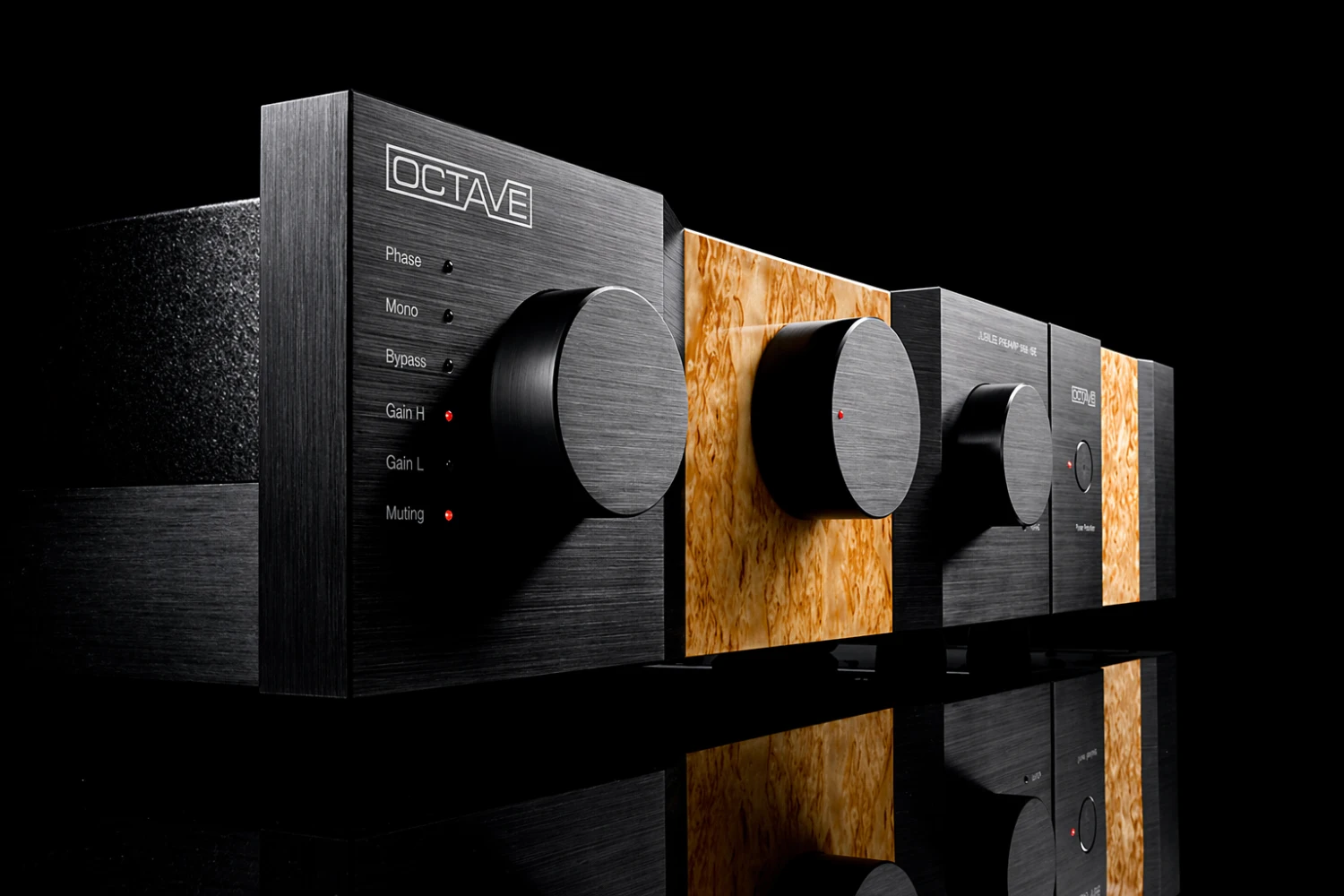
6. Octave Jubilee Preamp SE: High-Voltage Ready, Reference-Level Performance
The Octave Jubilee Preamp SE uses newly developed XLR input transformers to accommodate modern high-output source components.
The Octave Jubilee Preamp SE is designed for elaborate separates systems using modern sources with relatively high output levels.
Newly developed XLR input transformers are specified to accommodate signals up to 8 V RMS, while their 80-kilohm input impedance is intended to broaden compatibility with high-quality source components.
Octave also quotes distortion below 0.005 percent, bandwidth from 5 Hz to 150 kHz and a 3 dB improvement in signal-to-noise ratio. As a preamplifier, it still requires a separate power amplifier, but its electrical headroom and impedance characteristics make it particularly relevant when several demanding sources must feed a reference-level amplification chain.
Best for: High-end separates with high-output source components
- XLR inputs support levels up to 8 V RMS
- 80-kilohm input impedance
- Quoted distortion below 0.005 percent
- Specified 5 Hz to 150 kHz bandwidth
Verdict: The Jubilee Preamp SE is a specialist control stage for systems that need generous input headroom and carefully managed source compatibility.
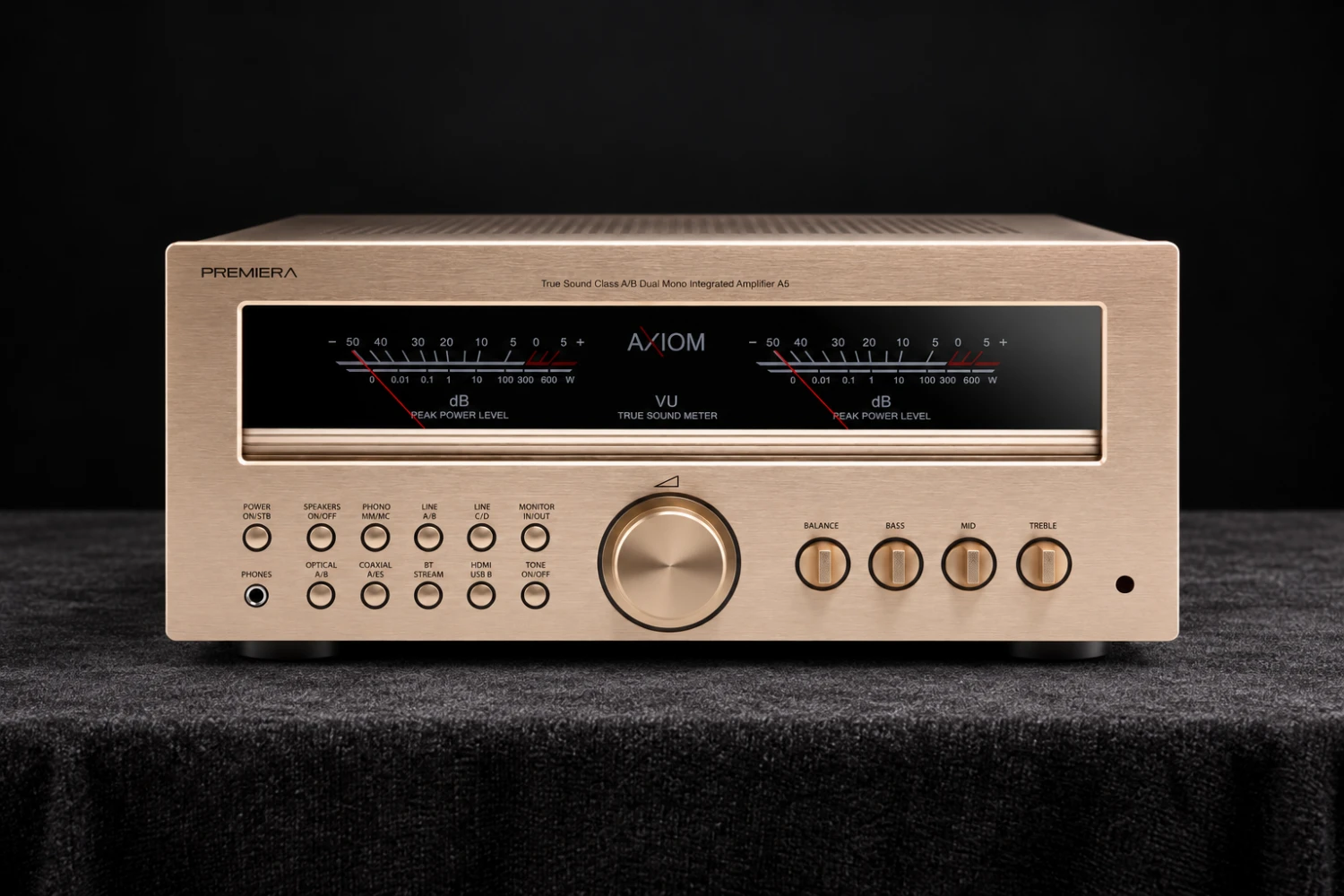
7. Premiera Goes All-In on Class AB With the 275W A5 Axiom
The Premiera A5 Axiom combines dual-mono Class AB amplification with HDMI ARC, digital conversion, phono support and bidirectional Bluetooth.
The Premiera A5 Axiom is configured as the center of a wide-ranging system rather than a minimalist analogue amplifier.
Its dual-mono Class AB output stage has independent power supplies for the two channels and is rated at 170 W per channel into 8 ohms, increasing to 275 W into 4 ohms.
An ESS Sabre DAC, HDMI ARC, MM and MC phono support and bidirectional Bluetooth cover television, digital, wireless and vinyl sources without requiring separate control components. Internally, each channel receives its own transformer and rectification stage, reinforcing the separation between left and right power delivery.
Best for: Mixed TV, digital, wireless and vinyl systems
- 170 W per channel into 8 ohms
- Dual-mono Class AB power stage
- HDMI ARC and ESS Sabre DAC
- MM and MC phono support
Verdict: The A5 Axiom is the strongest fit for a high-powered single-amplifier system expected to handle both traditional hi-fi sources and a television.

8. Mullard 3-3: Classic Sounds lives up to its name with a new tube amplifier
The Mullard 3-3 is a glossy black single-ended tube power amplifier offered in assembled and self-build forms.
The Mullard 3-3 occupies a very different niche from the high-powered integrated amplifiers in this selection.
It is a stereo single-ended tube power amplifier based on a low-output EL84 3.5 W design, using EF86 and EL84 tubes with an EZ81 rectifier.
Output-transformer taps support speakers with nominal impedances of 4, 8 or 16 ohms. Most importantly for system matching, its limited output means speaker suitability and listening requirements need careful consideration. Availability as either a fully assembled amplifier or a parts kit also gives it a clear role for enthusiasts interested in hands-on construction as well as classic circuit design.
Best for: Efficient speakers and tube-amplifier builders
- Single-ended EL84 tube circuit
- 4, 8 and 16-ohm speaker taps
- Available assembled or as a kit
- Two-millimetre aluminum chassis
Verdict: The Mullard 3-3 is a distinctive low-power option for carefully matched speakers or enthusiasts who want to assemble a classic-style tube amplifier.

9. Best power amplifiers: Cutting-edge power units and monoblocks
The power-amplifier guide includes the Teac AP-505, a dual-mono Class D design with front-panel meters and bridged operation.
This article is a broader power-amplifier guide rather than a recommendation for one model.
Its central argument is that separating preamplification from speaker power allows each component to perform a defined role while giving the owner more freedom to combine products from different manufacturers.
The Teac AP-505 is one example covered in the source: it uses Hypex Ncore Class D modules in a dual-mono configuration and can be switched to bridged operation when more power is required. The article is therefore most useful at the research stage, particularly for readers deciding whether to move away from an integrated amplifier and toward configurable separates.
Best for: Listeners researching a move to separates
- Covers separate power amplifiers and monoblocks
- Explains preamp and power-amp system division
- Supports cross-brand component matching
- Includes a bridgeable dual-mono Teac example
Verdict: This roundup is a useful orientation point for separates planning, though individual models still require their own compatibility checks.

10. Yamaha A-S801: Reliable integrated amplifier
The Yamaha A-S801 uses a reinforced double-bottom chassis, central structural bridge and symmetrical internal signal layout.
The Yamaha A-S801 concentrates on conventional integrated-amplifier engineering and mechanical stability.
Its ToP-ART construction uses a direct symmetrical layout for the left and right channels, intended to keep the signal path direct while limiting noise and distortion.
A single-point grounding arrangement, selected relays, custom capacitors and a W-core transformer form part of the electrical design. Yamaha also reinforces the chassis against vibration with a double bottom, an additional one-millimetre steel plate, a central bridge and its ART support base for the transformer and heatsinks. It fits systems where straightforward integration, rigid construction and symmetrical internal layout matter more than room processing or elaborate system management.
Best for: Conventional integrated-amplifier systems
- Direct symmetrical channel layout
- Single-point grounding system
- Custom W-core transformer
- Reinforced anti-vibration chassis
Verdict: The A-S801 is a sensible match for listeners who value proven integrated-amplifier architecture and extensive vibration control.

Sound Off
0Join the discussion if you have something to add.