
Choosing an amplifier begins with defining the job it must perform.
This selection ranges from dedicated stereo power amplifiers to integrated designs, streaming amplifiers and analog preamplifiers with headphone outputs.
Some can anchor an entire system, while others require a separate source component or volume controller. Performance is assessed here through published output ratings, circuit design and connectivity rather than unsupplied listening impressions. Power matters, but so do practical considerations such as bridgeable operation, input selection, internal streaming, headphone support, trigger connections and suitability for active speakers. Because consistent pricing is not available across the source material, value cannot be reduced to a simple price ranking. Instead, the guide highlights where each model earns its place through flexibility, component consolidation, system integration or a clearly defined specialist role.

1. Pro-Ject Amp Box RS2: Compact and powerful stereo power amplifier
The Pro-Ject Amp Box RS2 uses two visible 6922 tubes and a full-metal enclosure designed to assist heat dissipation.
The Amp Box RS2 combines a discrete Class AB output stage with one 6922 triode tube per channel in its preamplifier stage.
It is rated at 80 watts per channel into eight ohms and 130 watts into four ohms, giving it useful stereo output from a compact enclosure.
Bridging the channels turns it into a mono power amplifier rated at approximately 350 watts into eight ohms, making future system expansion possible. Its full-metal case is also designed to distribute and dissipate heat, while black and silver finishes provide two visual options.
Best for: Compact stereo or bridgeable mono systems
- 80 watts per channel into eight ohms
- Bridgeable for approximately 350 watts in mono
- Discrete Class AB circuitry with 6922 tubes
- Heat-dissipating metal enclosure
Verdict: The Amp Box RS2 is a flexible compact power amplifier for listeners who want tube input stages, solid-state output and a path from stereo to mono operation.
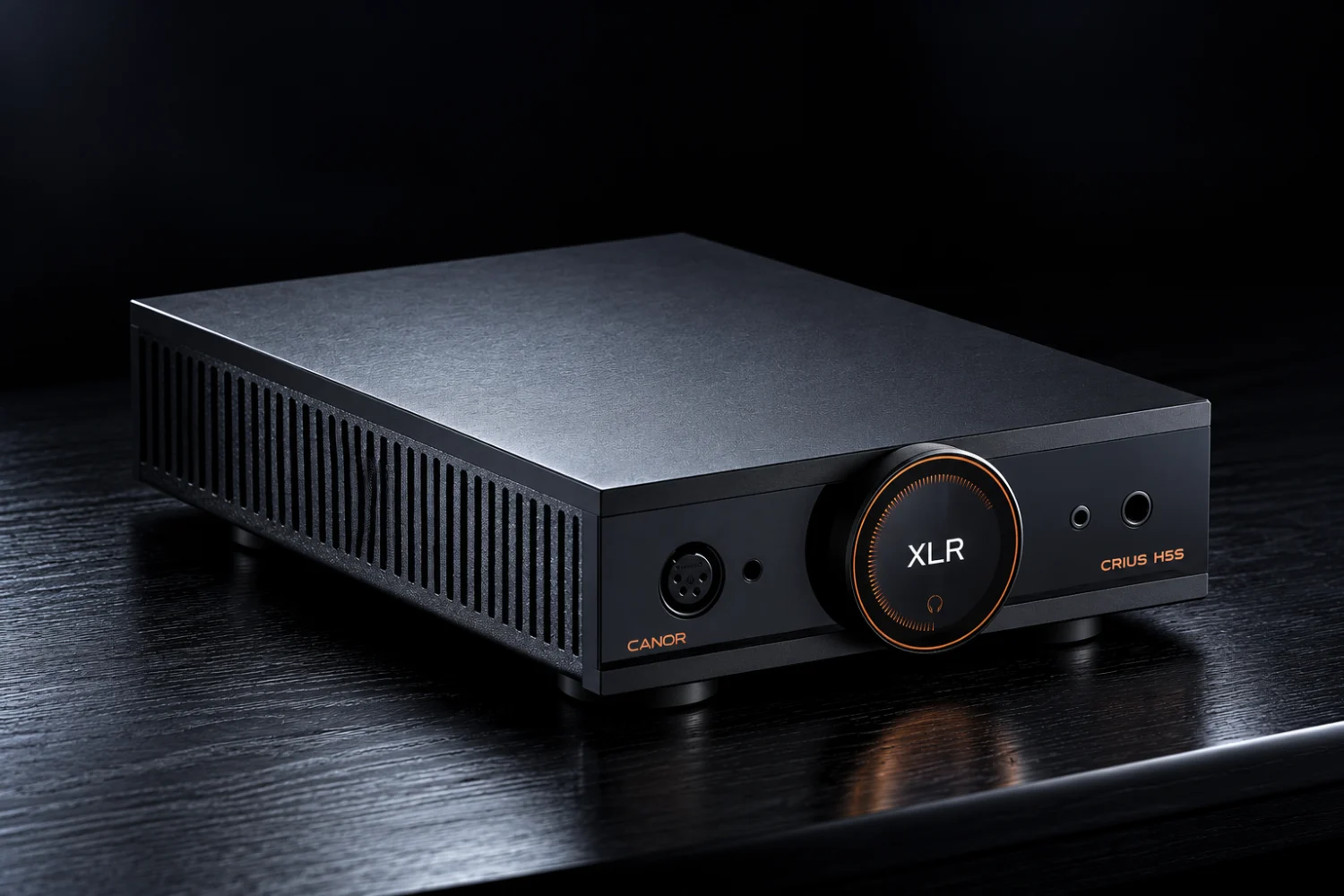
2. Canor Crius H5S Shrinks a Headphone Hub and Preamp Into One Chassis
The 210mm-wide Canor Crius H5S combines four headphone connections with digital, analog and line-level system connectivity.
The Crius H5S consolidates a solid-state headphone amplifier, dual-mono DAC and fully balanced preamplifier into a 210mm-wide enclosure.
Its four headphone sockets accommodate a range of physical connections, while balanced and unbalanced analog inputs and outputs extend its usefulness beyond private listening.
Digital and analog sources can share the same control center, and the line-level outputs allow the Canor to feed active speakers or a separate power amplifier. An internal power supply also avoids adding an external power brick to a compact desktop installation.
Best for: Headphone desks and compact active-speaker systems
- Headphone amplifier, DAC and preamplifier in one chassis
- Four headphone sockets
- Balanced and unbalanced analog connections
- Internal power supply
Verdict: The Crius H5S is a space-conscious control center for systems that need headphones, digital conversion and balanced preamplifier functions without several separate boxes.

3. NuPrime Omnia A300 – DAC, Integrated Amplifier and Streamer
The compact NuPrime Omnia A300 integrates network playback, digital conversion, headphone connections and Class D speaker amplification.
The Omnia A300 is designed to replace several components by combining a Class D integrated amplifier, DAC and network player.
It is rated at 150 watts into eight ohms and 200 watts into four ohms, yet its chassis measures 280 x 55 x 250mm and weighs 3kg.
Optical, coaxial, HDMI I2S, analog RCA and Ethernet connections are joined by Wi-Fi and Bluetooth, while preamplifier and optical outputs add system flexibility. Network playback supports services including Qobuz, Spotify and Tidal, with operation handled through NuPrime’s application.
Best for: Compact streaming-based stereo systems
- Amplifier, DAC and network player in one unit
- 150 watts into eight ohms
- Wi-Fi, Bluetooth and Ethernet connectivity
- Two headphone jack sizes
Verdict: The Omnia A300 offers the broadest source consolidation here for listeners who want amplification, network playback and digital conversion in one compact component.

4. Vinnie Rossi Canta Integrated Blends 6SN7 Tubes With MOSFET Power
The Vinnie Rossi Canta Integrated pairs one 6SN7 triode per channel with MOSFET output stages rated up to 250 watts per channel into four ohms.
The Canta Integrated takes an all-analog approach, combining a Class A tube preamplifier with MOSFET power stages.
One 6SN7 triode per channel provides voltage gain, while the solid-state output section supplies the current for loudspeakers.
Rated output is 125 watts per channel into eight ohms and 250 watts into four ohms. Four line-level inputs accommodate analog sources, and a 100-step resistor-ladder volume control provides fine adjustment. With no digital section described in the source, its appeal is strongest in systems where conversion and streaming are handled elsewhere.
Best for: High-power all-analog systems
- Class A 6SN7 tube preamplifier stage
- 125 watts per channel into eight ohms
- Output doubles to 250 watts into four ohms
- 100-step resistor-ladder volume control
Verdict: The Canta Integrated is a focused choice for listeners seeking tube voltage gain, MOSFET speaker drive and precise analog volume control in one amplifier.

5. EverSolo AMP-F2: Powerful and versatile amplifier
The EverSolo AMP-F2 is a stereo Class D power amplifier that can be bridged for higher-output mono operation.
Developed with Starke Sound, the AMP-F2 is a Class D power amplifier built around the NS600 module.
It is specified to deliver up to 250 watts per channel into four ohms at 1 percent THD in stereo operation.
Bridge mode changes it into a mono amplifier rated at 450 watts into a two-ohm load at the same stated distortion level. A 5–12V trigger input and 3.5mm trigger output allow its power state to follow other compatible components, which is useful when the amplifier is installed as part of a coordinated separates system.
Best for: High-output separates with automated power control
- Up to 250 watts per channel into four ohms
- Stereo and bridged-mono operation
- 450-watt mono rating into two ohms
- Trigger input and output
Verdict: The AMP-F2 combines substantial published output, bridgeable operation and trigger integration in a straightforward Class D power-amplifier format.

6. Schiit Aegir 2: Updated stereo power amplifier
The Schiit Aegir 2 delivers 30 watts per channel into eight ohms and uses a linear supply built around a 600VA transformer.
The Aegir 2 is a moderate-output stereo power amplifier rated at 30 watts into eight ohms and 50 watts into four ohms.
Its mixed-feedback topology combines current and voltage feedback, while Schiit’s Continuity output-stage circuit is intended to improve performance over the preceding model.
The linear power supply uses a 600VA transformer, 16 Schottky diodes and five stabilizers. Schiit also specifies noise below -122dB and standby consumption of 1–2 watts, making the design notable for both its substantial power-supply hardware and restrained standby demand.
Best for: Stereo systems with moderate power requirements
- Mixed current and voltage feedback
- Substantial 600VA linear power supply
- Specified noise below -122dB
- Standby consumption of 1–2 watts
Verdict: The Aegir 2 prioritizes linear power-supply engineering, low specified noise and modest standby consumption over headline output power.

7. Mark Levinson No. 523: 6-input dual mono amplifier
The Mark Levinson No. 523 provides six analog inputs, configurable MM and MC phono support, and a front-panel Class A headphone output.
Despite its article title, the No.
523 is an analog preamplifier rather than a speaker-driving integrated amplifier.
Its six inputs comprise two balanced and three unbalanced line-level connections plus a configurable Pure Phono input. The phono section supports both moving-magnet and moving-coil cartridges, with multiple capacitance, gain and resistive-loading settings. Balanced and unbalanced stereo outputs serve a separate power amplifier, while the front-panel Class A Main Drive circuit handles headphones up to 32 ohms. Ethernet, RS-232, USB control, 12V triggers and infrared input support installation in a wider system.
Best for: Vinyl-focused analog control systems
- Six analog inputs including configurable phono
- Moving-magnet and moving-coil cartridge support
- Balanced and unbalanced outputs
- Class A front-panel headphone output
Verdict: The No. 523 is a comprehensively configurable analog preamplifier for systems built around records, headphones and a separate power amplifier.
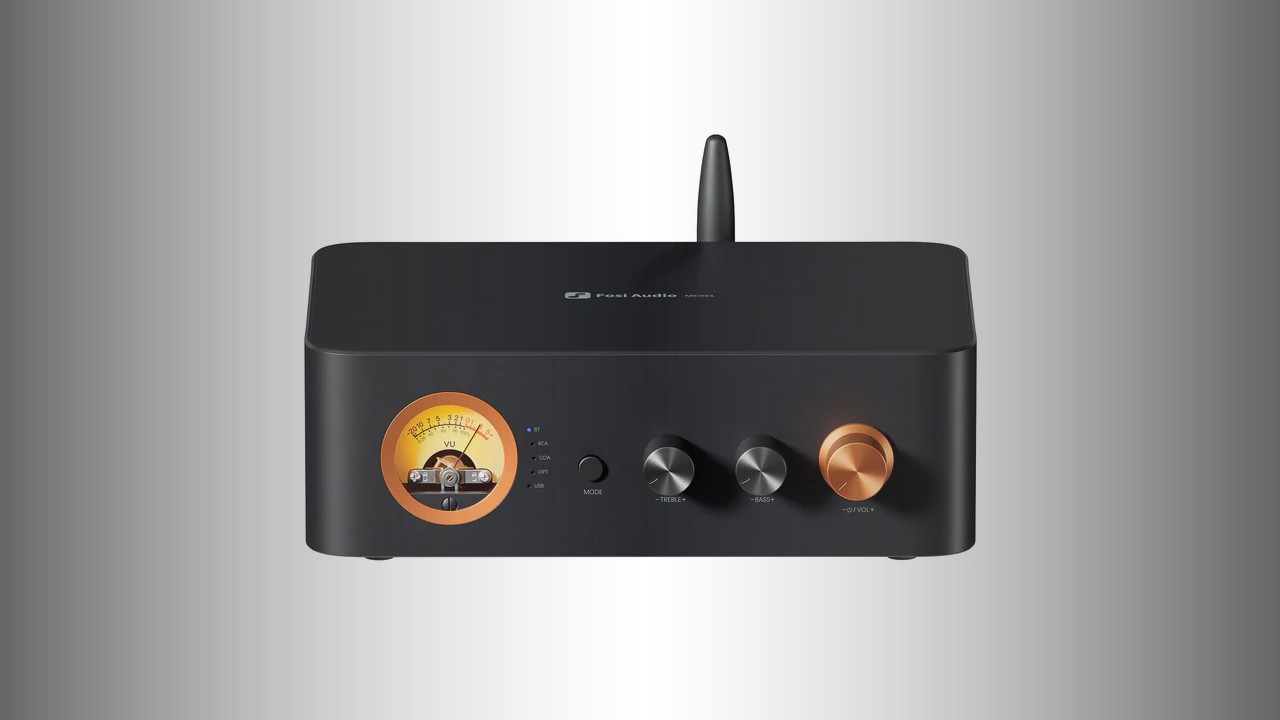
8. Fosi Audio MC351: A versatile integrated amplifier
The Fosi Audio MC351 combines five selectable input modes, 2.1-channel amplification and a moving miniature VU meter.
The MC351 combines digital conversion, Class D amplification and 2.1-channel support in a compact integrated design.
Bluetooth, USB, optical and coaxial inputs provide several routes for digital sources, and a single control switches among five input modes.
Its published 2.1 output rating reaches 165 watts for each stereo channel plus 350 watts for the additional channel. Bass and treble controls permit direct tonal adjustment, while automatic standby activates after two minutes without a signal. A miniature round VU meter gives the front panel a deliberately retro visual element.
Best for: Compact 2.1 systems with multiple digital sources
- Bluetooth, USB, optical and coaxial inputs
- Published 165W x 2 plus 350W output rating
- Bass and treble controls
- Automatic standby after two minutes without signal
Verdict: The MC351 emphasizes practical input switching, tone adjustment and 2.1-channel flexibility in an accessible integrated format.

9. Boulder 1162: Powerful stereo power amplifier
The Boulder 1162 supplies 300 watts per channel into eight ohms and offers four pairs of high-current terminals for convenient bi-wiring.
The Boulder 1162 is a dedicated stereo power amplifier rated at 300 watts per channel into eight ohms.
Its bias circuit operates in Class A, while newly developed protection circuitry is designed to shut down the output stage if speaker-cable shorts or system faults are detected.
Four pairs of high-current speaker terminals simplify bi-wiring arrangements. Internally, dual power transformers use DC filtering and sit inside a welded steel enclosure. This is a specialized separates component for systems that already have source selection, volume control and preamplification covered.
Best for: High-output systems using separate preamplification
- 300 watts per channel into eight ohms
- Four speaker-terminal pairs for bi-wiring
- Protection against shorts and system faults
- Dual DC-filtered power transformers
Verdict: The Boulder 1162 is a purpose-built high-power stereo amplifier with bi-wiring provision, dual transformers and extensive protection engineering.

10. NuPrime IDA-9: Compact GaN Hybrid Amplifier with 150W Power and 32-bit/384kHz DAC
The compact NuPrime IDA-9 combines 150-watt amplification with USB, optical and coaxial digital inputs and an internal high-resolution DAC.
The IDA-9 combines a hybrid Class A+D amplifier with a built-in DAC and a GaN switching power supply.
Its compact 235 x 281 x 55mm chassis is rated to deliver 150 watts per channel into eight ohms.
The digital section accepts PCM up to 32-bit/384kHz and DSD256 through USB Type-B, with optical and coaxial S/PDIF inputs also provided. An analog line input accommodates a conventional source, while the line output can serve equipment such as a subwoofer. Streaming is not listed as built in, but an expansion port supports optional Bluetooth or streaming modules.
Best for: Compact digital systems that do not require built-in streaming
- 150 watts per channel into eight ohms
- PCM up to 32-bit/384kHz and DSD256
- USB, optical and coaxial digital inputs
- Expansion port for Bluetooth or streaming modules
Verdict: The IDA-9 is a compact, powerful integrated amplifier for digital-first systems, provided network functions are handled externally or through an expansion module.


Sound Off
0Join the discussion if you have something to add.