Streaming has become a broad hi-fi category rather than a single product type.
A network player can now be a minimalist bridge for an existing amplifier, a full server with large local storage, an all-in-one living-room system, a software service running inside an app, or even a network accessory intended to isolate a streamer from electrical noise.

1. SOtM sMS-
SOtM sMS- network player and server with audiophile-focused internal hardware and Eunhasu OS.
The SOtM sMS- is presented as the flagship network streamer and server in SOtM’s range, built around audiophile-oriented hardware and the company’s Eunhasu OS.
Its appeal lies in the combination of an integrated USB audio host card, Ethernet card, high-end ATX power supply, i7-based hardware platform, compatibility with playback software including Roon, MPD and DLNA, and support for up to 48TB of local storage.
Best for: Audiophiles building a serious server-based streaming source
- Network player and server in one chassis
- Eunhasu OS supports Roon, MPD and DLNA
- Up to 48TB of local storage
- Configurable to suit user preferences
Verdict: The SOtM sMS- is the most ambitious server-style option here, especially for listeners who want both network streaming and a large local library in a high-end digital front end.
2. Ruark Audio R410 Anniversary Edition
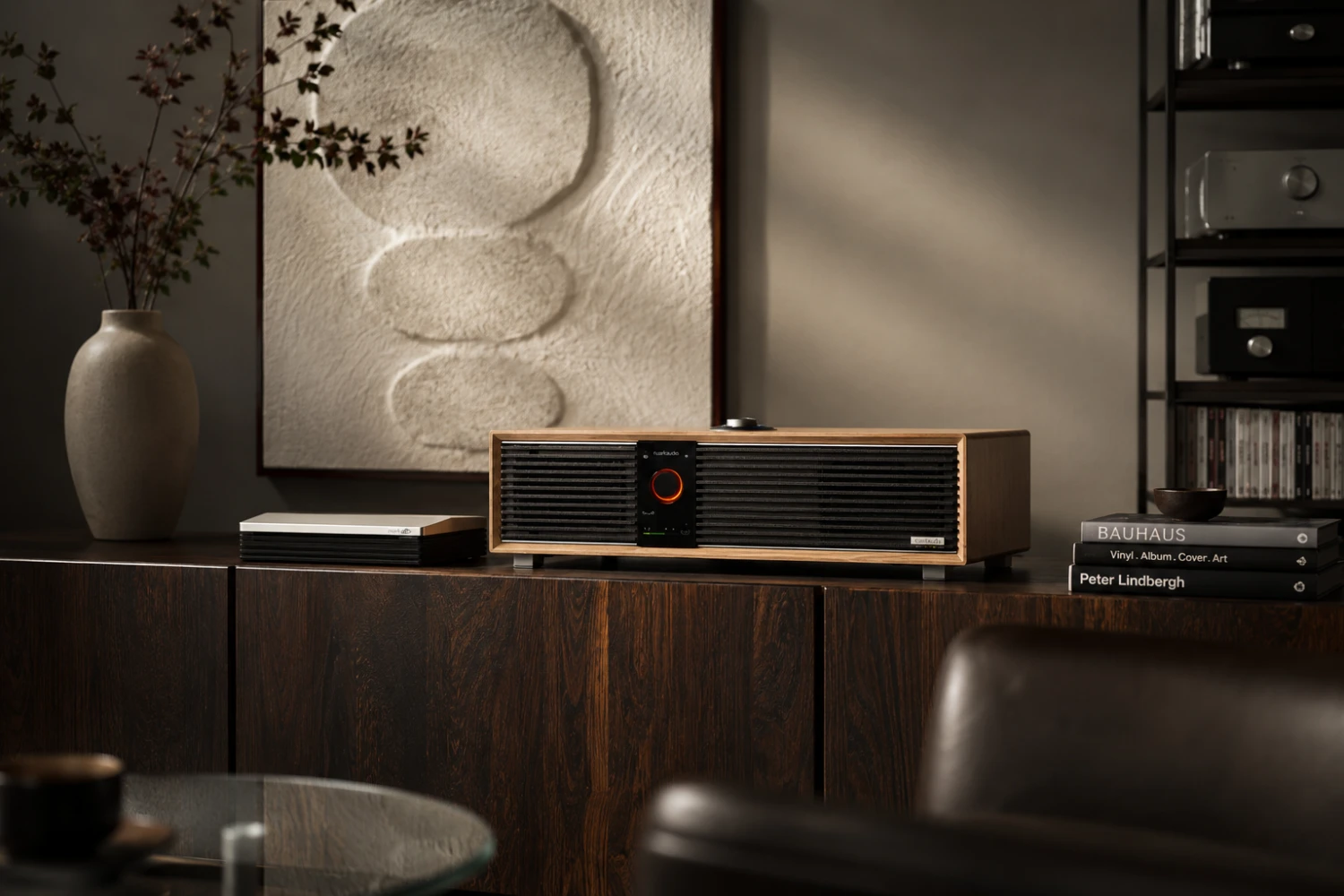
Ruark Audio R410 Anniversary Edition all-in-one streaming music system in white oak with handmade grille and RotoDial control.
The Ruark Audio R410 Anniversary Edition takes a different route: it is an all-in-one streaming music system designed as much around furniture-grade presence as around music access.
The white oak cabinet, ebonized inlays, handmade grille, RotoDial control and commemorative badge underline its limited-edition character, while the built-in processor is described as supporting common streaming services for a modern listening setup.
Best for: Design-conscious listeners and collectors seeking an all-in-one system
- Limited to 500 units worldwide
- White oak cabinet with handmade grille
- Signature RotoDial control
- Supports common streaming services
Verdict: The R410 Anniversary Edition is the style-led choice, pairing Ruark’s compact system approach with a deliberately crafted anniversary finish.

3. Naim internet radio server
Naim’s in-house internet radio server is accessed through the updated Focal & Naim app.
Naim’s own internet radio server is a software-side development rather than a new box, but it matters for streaming users inside the Focal & Naim ecosystem.
After updating the app, users gain access to Naim’s in-house radio platform, developed with XPeri, with more than 45,000 stations, richer metadata on many stations, improved categorization, station artwork, automated station scanning and podcast access where available; the update also brings full support for Tidal Max.
Best for: Focal & Naim app users who rely on internet radio
- Access to over 45,000 radio stations
- Advanced metadata on many stations
- Improved station categorization and artwork
- Tidal Max support after app update
Verdict: Naim’s radio server is a useful reminder that the streaming experience depends as much on software quality and service reliability as on hardware design.

4. Sony streaming support discontinuation for older hi-fi components
Sony HAP-series music servers illustrate the difference between durable local playback and time-limited streaming support.
Sony’s planned discontinuation of network-based services for older audio and video products is included here as a buying lesson rather than a recommendation.
Affected models include the HAP-Z1ES and HAP-S1 music servers, whose local hard-drive playback will continue while streaming services such as Spotify will no longer be accessible, highlighting the long-term importance of software support in connected hi-fi.
Best for: Buyers weighing the risks of older connected components
- Local playback on internal hard drives continues
- HAP-Z1ES and HAP-S1 are described as premium DSD-capable servers
- Both cited models include 1TB internal storage
Verdict: Sony’s announcement is a cautionary case: excellent hardware can outlive the online services that once made it feel current.

5. Goldmund x Pink Faun Eidos Streamer
Goldmund x Pink Faun Eidos Streamer, a network player with 8TB local storage and Roon-based streaming access.
The Eidos Streamer marks Goldmund’s entry into streaming through a collaboration with Pink Faun, bringing network expertise into a product designed to complement Goldmund active speakers.
It supports wired or wireless networking, offers 8TB of local storage, uses the Roon app for access to services including Tidal, Qobuz and KKBOX, and is built around Pink Faun’s streaming platform.
Best for: Goldmund system owners wanting an integrated streaming source
- Goldmund and Pink Faun collaboration
- Wired or wireless network connection
- 8TB of local storage
- Roon app access to Tidal, Qobuz and KKBOX
Verdict: The Eidos Streamer is a focused ecosystem play, strongest for listeners who want Goldmund styling and system matching with Pink Faun network know-how.

6. Bluesound NODE Nano
Bluesound NODE Nano wireless music streamer with ESS Sabre DAC and analog and digital outputs.
The Bluesound NODE Nano is the compact entry in Bluesound’s current network-player family, intended to bring existing stereo systems or active speakers into streaming without a large hardware footprint.
The source highlights its ESS Sabre DAC with Hyperstream IV technology, PCM decoding up to 24-bit/192 kHz, wireless streaming role and analog and digital connections including RCA, coaxial, optical and USB.
Best for: Adding streaming to an existing stereo or active-speaker setup
- Compact wireless music streamer
- ESS Sabre DAC with Hyperstream IV technology
- PCM support up to 24-bit/192 kHz
- RCA, coaxial, optical and USB connections
Verdict: The NODE Nano is the straightforward upgrade path here, aimed at listeners who want a small streamer with broad physical connectivity.

7. Denon DNP-F109
Denon DNP-F109 compact network audio player with OLED display, Wi-Fi and DLNA support.
The Denon DNP-F109 represents an earlier generation of compact network audio players, originally part of the Denon D-F109 mini-system but also usable as a separate source.
It includes built-in Wi-Fi, a small vibration-resistant case with an aluminum front panel, OLED display, remote control, DLNA 1.5 certification and the ability to stream files from a PC or NAS over a local network.
Best for: Compact systems and local-network file playback
- Works as a separate network player
- Built-in Wi-Fi
- DLNA 1.5 certified
- Streams from PC and NAS libraries
Verdict: The DNP-F109 remains interesting as a classic network player for simple DLNA-based listening, provided its older-platform limitations suit the system.
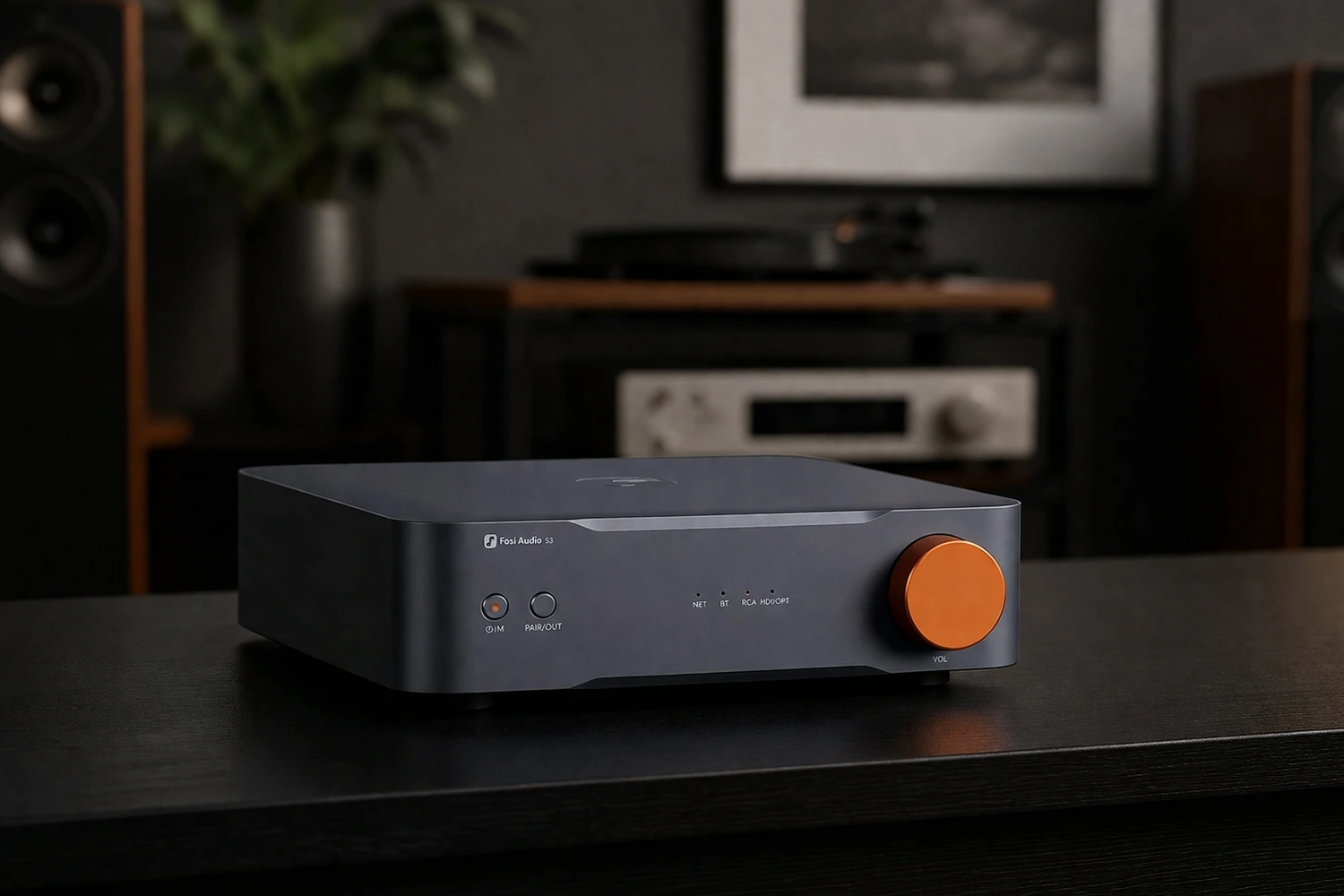
8. Fosi Audio S3
Fosi Audio S3 compact streamer, DAC and preamp with HDMI eARC, XLR outputs and Roon Ready support.
The Fosi Audio S3 is positioned as a compact way to combine a streamer, DAC and preamplifier in one chassis, allowing direct connection to a power amplifier or active speakers.
Its specified feature set is unusually broad for a small box: AKM4493SEQ DAC, PCM handling up to 32-bit/384 kHz, fully balanced analog circuitry with OPA1612 op-amps, XLR outputs, HDMI eARC, and streaming support including AirPlay 2, Spotify Connect, TIDAL Connect, Google Cast, DLNA and Roon Ready.
Best for: Clean, compact systems built around active speakers or a power amp
- Streamer, DAC and preamp in one unit
- HDMI eARC included
- Balanced XLR outputs
- AirPlay 2, TIDAL Connect, Google Cast, DLNA and Roon Ready support
Verdict: The Fosi Audio S3 is the space-saving multitasker, especially compelling where streaming, TV audio and preamp duties need to live in one small component.

9. Matrix Audio Element X2 Pure
Matrix Audio Element X2 Pure network audio player with touchscreen, dual ESS DAC architecture and app control.
The Matrix Audio Element X2 Pure is described as a comprehensive source for hi-fi systems, with the source text noting an enhanced design that omits the built-in headphone amplifier.
Its dual ES9039Pro DAC architecture assigns one chip to each channel, while symmetrical analog circuitry, aluminum shielding, a 3.46-inch touchscreen, MA Remote app control, DLNA, AirPlay 2, Spotify Connect, Tidal Connect, Qobuz, Spotify, vTuner web radio and a +10 dB analog-gain preamplifier make it a feature-rich network player and preamp.
Best for: Hi-fi systems needing a capable streamer with preamp functions
- Dual ES9039Pro DAC architecture
- 3.46-inch touchscreen
- DLNA, AirPlay 2, Spotify Connect and Tidal Connect
- MA Remote app for control and updates
Verdict: The Element X2 Pure is the most control-rich Matrix source in this selection, with extensive streaming options and a serious dual-DAC design.

10. Matrix Audio SI-1 Network Audio Isolator
Matrix Audio SI-1 Network Audio Isolator for wired streamer setups using optical isolation between RJ-45 input and output.
The Matrix Audio SI-1 is not a streamer but an accessory for streaming systems that use wired networking.
It is an active optical network isolator with one RJ-45 1Gb input and one RJ-45 output, using internal dual-channel optical isolation, an internal linear power supply and dual femtosecond clock circuits to address the potential for network-borne electrical contamination and ground-related issues reaching a streamer.
Best for: Wired streaming systems where network isolation is a priority
- Active optical network isolation
- RJ-45 1Gb input and output
- Internal linear power supply
- Dual femtosecond clock circuits
Verdict: The SI-1 is for the already-committed streaming listener, addressing the network link itself rather than replacing the streamer.
How to choose the right streaming path
The useful question is not simply which streamer has the longest feature list, but where streaming belongs in the system.
A server-style component such as the SOtM sMS- makes sense when a large local library, advanced playback software and audiophile-focused hardware are central to the setup.
The Goldmund x Pink Faun Eidos Streamer is more ecosystem-specific, particularly for listeners already oriented around Goldmund active speakers, while the Matrix Audio Element X2 Pure suits systems that need a network source with strong DAC and preamp functionality. For a simpler upgrade to existing equipment, the Bluesound NODE Nano is the clearest add-on streamer in this group, with compact dimensions and a spread of analog and digital connections. The Fosi Audio S3 goes further by combining streamer, DAC, preamp and HDMI eARC, making it a practical choice for compact systems that need fewer boxes. The Ruark Audio R410 Anniversary Edition serves a different buyer altogether: someone who wants a complete music system with a strong design identity rather than a separate hi-fi stack. Software longevity should be part of the decision. Naim’s internet radio server shows the benefit of active platform development, while Sony’s discontinuation of streaming support for older components shows why local playback, app support and manufacturer commitment matter. Accessories such as the Matrix Audio SI-1 only become relevant after the streamer and network architecture are already settled; they are refinement tools, not substitutes for choosing the right source in the first place.