
Choosing a DAC starts with the system around it.
A conventional desktop converter, a streaming DAC, a portable Bluetooth DAC and a combined DAC/headphone amplifier may all perform digital-to-analog conversion, but they solve very different problems.
Inputs, outputs, volume control, headphone support and network integration are therefore more useful selection criteria than headline format limits alone. Our recommendations cover several distinct approaches. The Shanling SM1.3R combines R2R conversion with an integrated streaming platform, while the SMSL SU-2 concentrates on straightforward balanced desktop operation. Models such as the FiiO K17 and Topping DX9 Discrete integrate headphone amplification, and the FiiO BTR17 brings Bluetooth and USB conversion to a portable design. One important exception is the Schiit Audio Eitr 2. It is a digital-to-digital converter rather than a DAC, so it does not produce an analog output. It belongs here only as a specialist option for listeners who need to convert a USB source into coaxial, AES/EBU or optical digital audio before feeding a separate DAC.
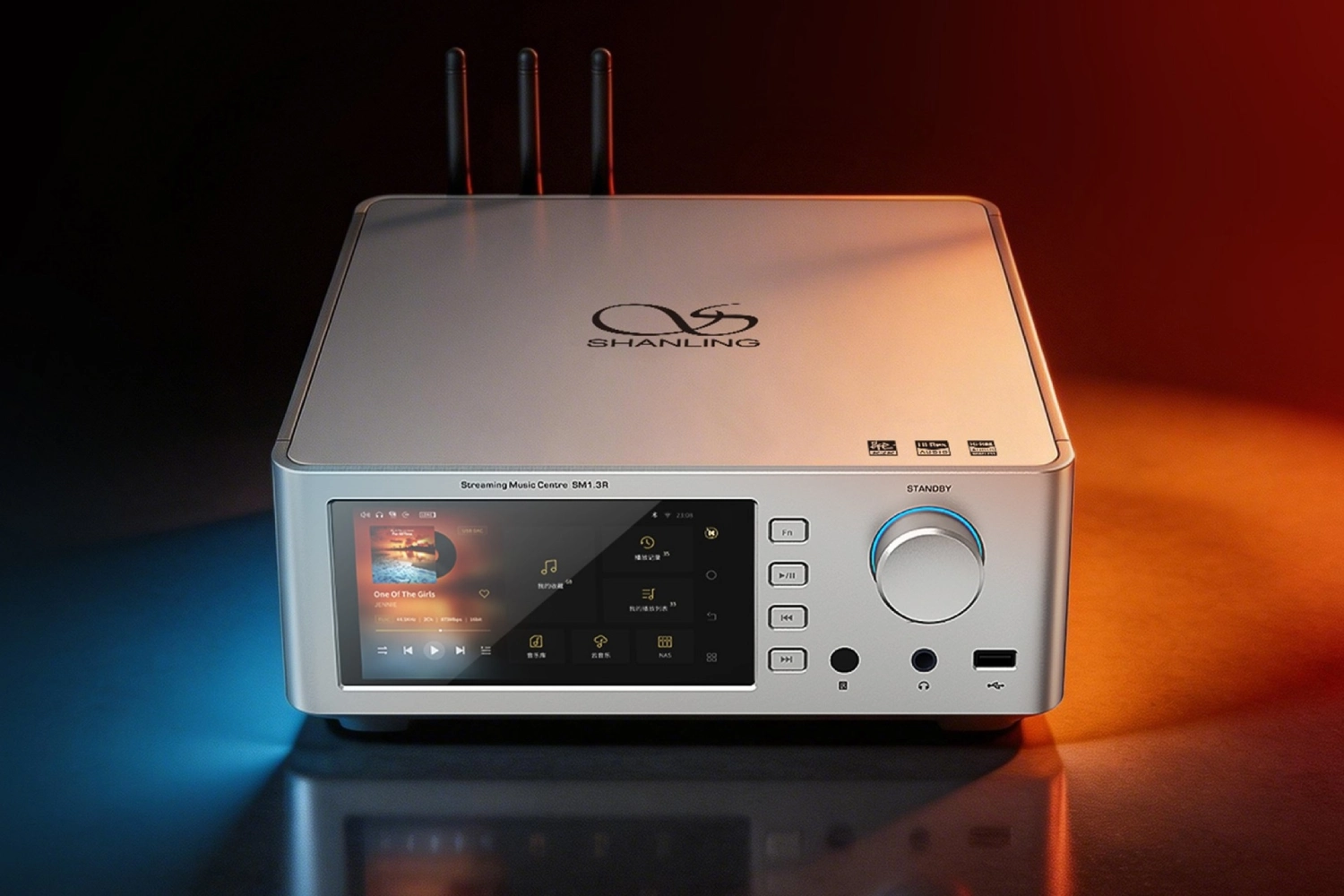
1. Shanling SM1.3R R2R DAC: A More Analog Take on Streaming with Roon, Tidal & Qobuz
The Shanling SM1.3R combines a 5.8-inch touchscreen, network streaming platform and proprietary R2R conversion in one component.
The Shanling SM1.3R is the most self-contained streaming choice in this selection.
Its proprietary 24-bit R2R conversion module uses 212 resistors specified to 0.01 percent accuracy, replacing the delta-sigma architecture of the related SM1.3.
A 5.8-inch touchscreen and closed Android-based platform provide access to Roon Ready operation, Tidal Connect, Qobuz Connect and Spotify Connect, alongside dedicated services including Apple Music, Apple Classical and Amazon Music. The closed software environment prevents app sideloading and Google Play Store installation, so buyers should confirm that the supplied services cover their needs.
Best for: An integrated R2R streaming system
- Proprietary 24-bit R2R conversion module
- Roon Ready with major Connect services
- Integrated 5.8-inch touchscreen
- Internal SSD slot for local playback
Verdict: Choose the SM1.3R when built-in streaming, touchscreen control and R2R conversion matter more than installing additional Android apps.

2. SMSL RAW Pro-DAC1: Tailored for audiophiles
The SMSL RAW Pro-DAC1 provides multiple wired and wireless inputs with both XLR and RCA analog outputs.
The SMSL RAW Pro-DAC1 emphasizes format support and connection flexibility.
Its ESS ES9039MSPRO conversion stage is paired with an XMOS XU-316 USB interface supporting PCM up to 32-bit/768 kHz and native DSD up to DSD512.
USB, optical, coaxial, AES/EBU and Bluetooth inputs accommodate a wide range of digital sources, while balanced XLR and unbalanced RCA outputs simplify integration with different amplifiers or active speakers. Full MQA and MQA-CD decoding is available through USB, optical and coaxial, and Bluetooth 5.1 supports LDAC, aptX HD, SBC and AAC.
Best for: High-resolution playback from varied digital sources
- USB PCM up to 32-bit/768 kHz
- Native DSD support up to DSD512
- Balanced XLR and unbalanced RCA outputs
- USB, S/PDIF, AES/EBU and Bluetooth inputs
Verdict: The RAW Pro-DAC1 is a strong fit for systems that need extensive wired connectivity, Bluetooth and broad high-resolution format support.
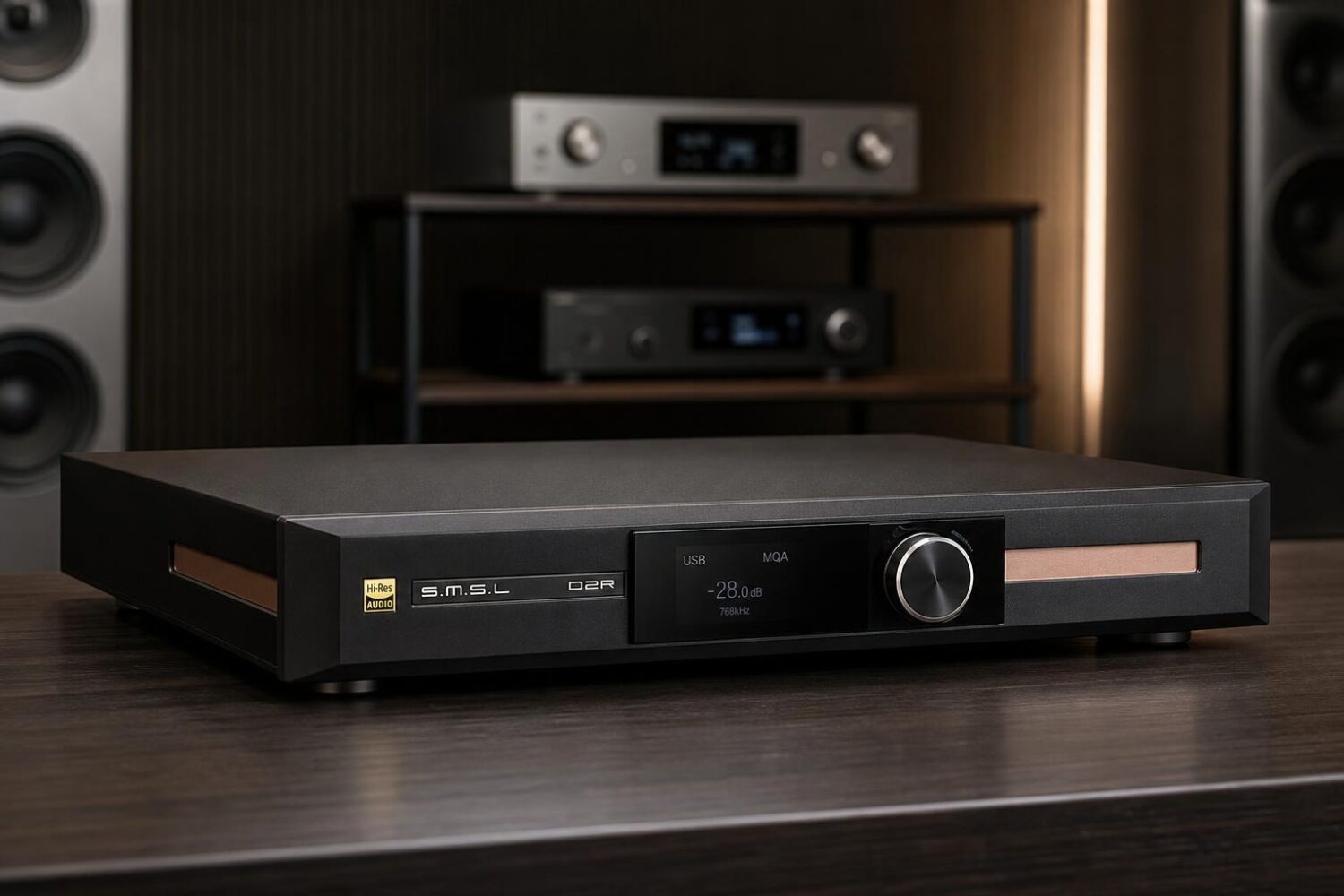
3. SMSL VMV D2R MK2 Brings ROHM Conversion and OCXO Clocking to a Desktop DAC
The full-size SMSL VMV D2R MK2 pairs ROHM digital conversion with XMOS USB processing and internal OCXO clocking.
The full-size SMSL VMV D2R MK2 differentiates itself through a ROHM BD34302EKV conversion stage and an internal 10 MHz OCXO oscillator.
Its XMOS XU-316 asynchronous USB interface supports PCM up to 32-bit/768 kHz and native DSD up to DSD512, while I²S also handles PCM at the same stated ceiling.
Optical, coaxial and AES inputs accept PCM up to 24-bit/192 kHz, making the DAC suitable for conventional transports and streamers as well as computers. Full MQA and MQA-CD decoding extends across USB, optical, coaxial and AES inputs.
Best for: A full-size DAC with advanced clocking
- ROHM BD34302EKV conversion stage
- Internal 10 MHz OCXO oscillator
- PCM up to 32-bit/768 kHz over USB and I²S
- Full MQA decoding across several wired inputs
Verdict: The D2R MK2 suits listeners seeking ROHM conversion, OCXO clocking and consistent decoding support across multiple wired sources.

4. FiiO K5 Pro ESS: Exceptional budget-friendly DAC
The compact FiiO K5 Pro ESS is a stationary DAC/amplifier supplied with an external power adapter and USB cable.
The FiiO K5 Pro ESS is presented as a compact, budget-friendly stationary DAC and amplifier rather than a feature-heavy digital hub.
Its small enclosure makes it easier to accommodate in a desktop system, and the supplied package includes an external 15 V, 1.5 A power supply with a European plug and a USB cable.
The available source material does not provide enough detail to compare its supported formats, inputs or amplifier performance with the newer all-in-one models here, so it is most sensibly considered for buyers prioritizing compactness and affordability.
Best for: A compact, budget-conscious DAC/amplifier setup
- Compact stationary design
- External power supply included
- USB cable included
Verdict: The K5 Pro ESS is the straightforward value-oriented option, although the supplied information is too limited for deeper feature comparisons.
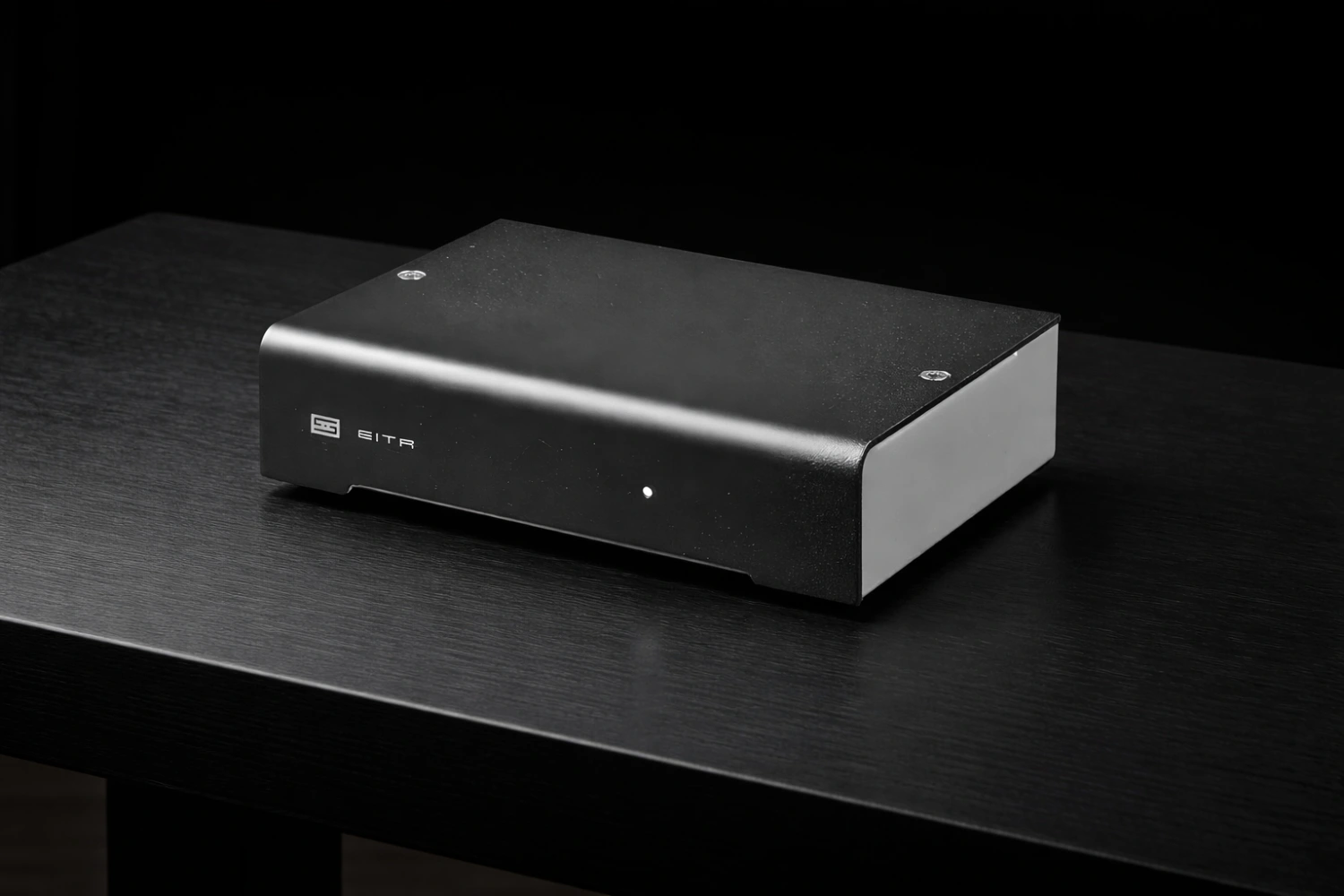
5. Schiit Audio Eitr 2: A Smarter, Cleaner Path from USB to High-End Digital Audio
The compact Schiit Audio Eitr 2 converts USB audio into coaxial, AES/EBU or optical digital signals for a separate DAC.
The Schiit Audio Eitr 2 needs a clear distinction: it is a digital-to-digital converter, not a digital-to-analog converter.
It accepts USB audio from computers, tablets and smartphones, then regenerates that input for delivery to a separate DAC.
Outputs include transformer-isolated coaxial, AES/EBU and optical, with the optical connection supporting PCM up to 24-bit/192 kHz. Schiit’s proprietary Unison USB interface is intended to manage signal integrity at the USB stage. The Eitr 2 is relevant only when a system already has a DAC but needs a different digital connection or an intermediary between the USB source and converter.
Best for: Feeding a separate DAC from a USB source
- Converts USB audio to three digital output types
- Transformer-isolated coaxial output
- AES/EBU and optical outputs
- Optical PCM support up to 24-bit/192 kHz
Verdict: Consider the Eitr 2 as a specialist USB bridge, not as a replacement for a DAC with analog outputs.

6. SMSL SU-2: A Compact, Balanced DAC Built for Serious Desktop Audio
The compact SMSL SU-2 uses LED status indicators and supplies both balanced XLR and unbalanced RCA outputs.
The SMSL SU-2 takes a deliberately focused approach to desktop conversion.
It uses an ES9039Q2M DAC chip with four OPA1612A operational amplifiers arranged symmetrically across the left and right channels.
Balanced XLR and unbalanced RCA outputs allow it to serve active monitors, balanced amplifiers or conventional RCA-based systems. The solid metal chassis is compact, and operation is handled without a display or menu system; LED indicators provide status information instead. That simplicity makes it appealing where predictable integration and a small footprint take priority over elaborate front-panel controls.
Best for: Balanced desktop systems and active monitors
- Fully balanced signal path
- Balanced XLR and unbalanced RCA outputs
- Compact solid-metal chassis
- Simple LED-based operation without menus
Verdict: The SU-2 is the focused choice for a compact desktop system that needs balanced outputs without a display or menu structure.

7. Cinnamon Galle: Might be the most unique DAC you have ever seen
The Cinnamon Galle houses its dual-mono resistor-ladder conversion system in a cast bronze and aluminum alloy enclosure.
The Cinnamon Galle stands apart through both its conversion architecture and physical construction.
Rather than using an off-the-shelf DAC chip, it employs a quasi-non-oversampling design with additional signal processing and a dual-mono, 27-bit differential resistor ladder.
That ladder comprises 430 precision resistors specified to a tolerance of 0.01 percent. The bronze and aluminum alloy enclosure is minimally processed after casting, so variations in surface texture and appearance are an intentional part of the design. USB supports DSD256 and PCM up to 24-bit/384 kHz, while the RCA S/PDIF input supports PCM up to 24-bit/192 kHz.
Best for: Distinctive resistor-ladder design and craftsmanship
- Dual-mono 27-bit differential resistor ladder
- 430 precision resistors with 0.01 percent tolerance
- USB support for DSD256 and 24-bit/384 kHz PCM
- Individually varied cast-metal enclosure
Verdict: The Galle is aimed at listeners who value an unusual resistor-ladder architecture and a materially distinctive enclosure as much as conventional connectivity.
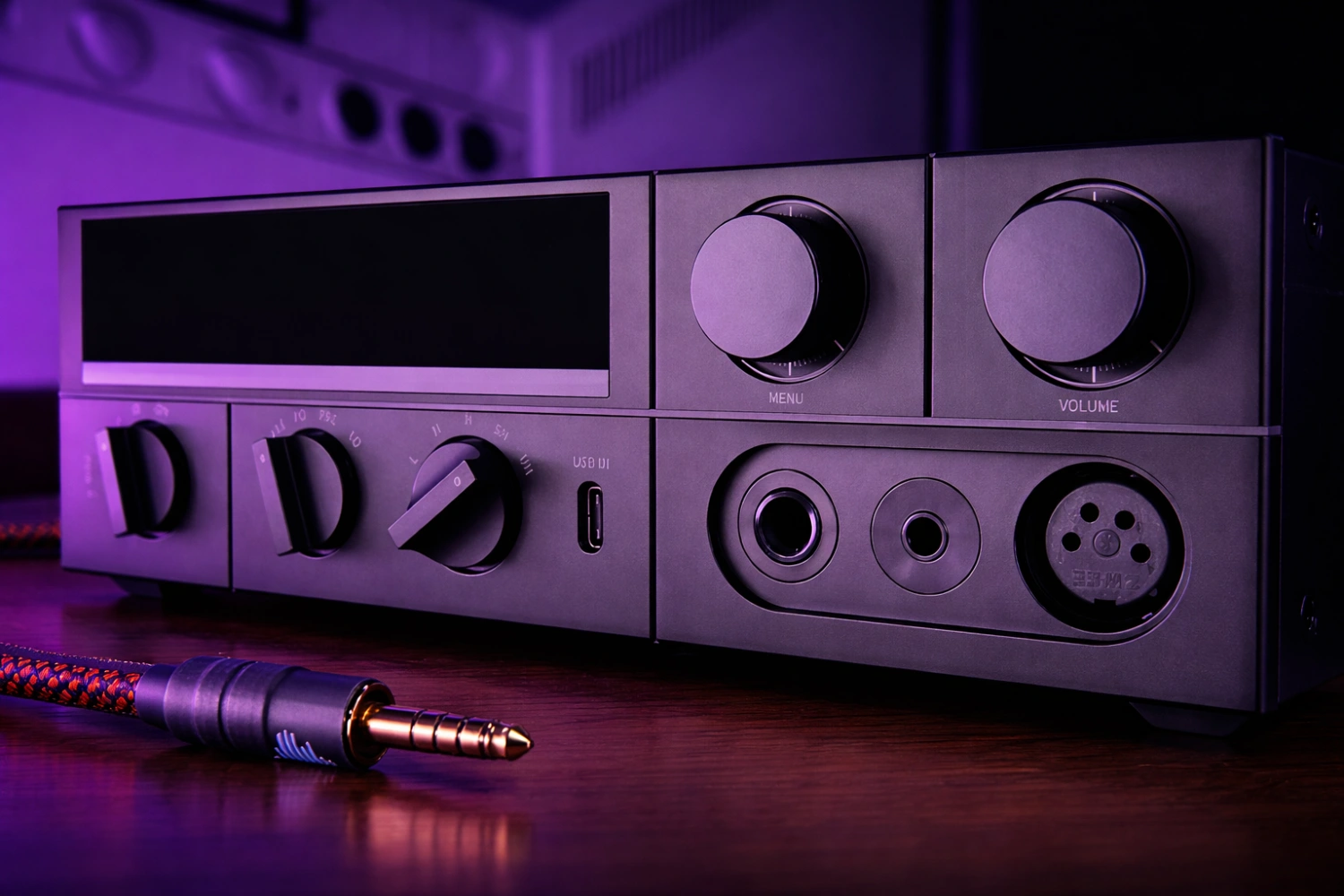
8. FiiO K17 Review: High-End Desktop DAC/Amp with Serious Flexibility
The FiiO K17 is a solidly built desktop DAC/headphone amplifier with tactile controls and an included remote.
The FiiO K17 is positioned as a substantial desktop DAC/headphone amplifier and system centerpiece.
Its enclosure is described as dense, solid and compact, with a restrained retro-influenced design, functional ventilation and notably tactile knobs, encoders and buttons.
The package includes cables, a power cord, adapters, a remote control, a spare fuse and an XLR plug, indicating attention to installation and everyday operation. The supplied source focuses primarily on build, controls and included accessories rather than giving a complete account of format support or amplifier specifications, so its strongest supported distinction here is its polished physical execution and comprehensive package.
Best for: A well-appointed desktop DAC/amp centerpiece
- Combined desktop DAC and headphone amplifier
- Solid, compact construction
- Remote control included
- Comprehensive accessory package
Verdict: The K17 is the most compelling option here for buyers prioritizing integrated desktop operation, physical controls and a thoughtfully equipped package.

9. FiiO BTR17: A compact masterpiece
The portable FiiO BTR17 combines an OLED display, Bluetooth reception and 4.4 mm and 3.5 mm headphone outputs.
The FiiO BTR17 is the portable alternative to the predominantly desktop products in this guide.
It combines dual ESS DAC chips, THX amplification and Bluetooth 5.4 in an aluminum enclosure with a leather back panel.
Codec support includes LDAC, aptX Lossless and AAC, while an OLED display shows information such as battery condition and audio format. Both balanced 4.4 mm and standard 3.5 mm headphone outputs are provided. It can also operate as a USB DAC, supporting PCM up to 32-bit/384 kHz and DSD256, which gives it a useful role at a computer as well as with a phone on the move.
Best for: Portable Bluetooth and USB headphone listening
- Portable Bluetooth DAC and headphone amplifier
- Balanced 4.4 mm and standard 3.5 mm outputs
- LDAC and aptX Lossless support
- USB playback up to 32-bit/384 kHz and DSD256
Verdict: The BTR17 is the clear choice for listeners who need one compact headphone DAC/amp for both wireless mobile use and wired USB playback.

10. Topping DX9 Discrete: New Flagship DAC/Amp with 131dB SNR and Dual Displays
The Topping DX9 Discrete integrates a discrete 1-bit DAC, six-channel headphone amplifier and dual-display desktop interface.
The Topping DX9 Discrete is a flagship desktop DAC/headphone amplifier built around a second-generation discrete 1-bit PSRM conversion architecture and a six-channel discrete NFCA amplifier module.
Topping specifies a signal-to-noise ratio of 131 dB, THD+N below 0.00006 percent and output exceeding 7 watts per channel into 32 ohms.
Headphone crossfeed is included, while a fully balanced hybrid relay volume control is designed to maintain precise adjustment and channel balance across volume levels. It is the most explicitly performance-led all-in-one model in the supplied material and is intended for demanding full-size headphones.
Best for: Demanding headphones and a flagship desktop system
- Discrete 1-bit PSRM conversion architecture
- Six-channel discrete NFCA headphone amplifier
- More than 7 watts per channel into 32 ohms
- Balanced hybrid relay volume control
Verdict: The DX9 Discrete is the performance-focused DAC/amp choice for systems requiring substantial stated headphone power and precise volume control.
Quick comparison
The products separate most clearly by role rather than by headline resolution.
The Shanling is a network streamer and DAC, the SMSL models are primarily desktop converters, the FiiO BTR17 is portable, and the FiiO K17 and Topping DX9 Discrete combine conversion with headphone amplification.
The Schiit Eitr 2 is the outlier because it requires a separate DAC.
| Product | Best for | Verdict |
|---|---|---|
| Shanling SM1.3R | Integrated R2R conversion and network streaming | A touchscreen streaming DAC with Roon Ready operation and built-in services, but no third-party Android app installation. |
| SMSL RAW Pro-DAC1 | Broad wired and Bluetooth connectivity | A format-rich desktop DAC with XLR and RCA outputs and multiple digital input types. |
| SMSL VMV D2R MK2 | ROHM conversion and OCXO clocking | A full-size wired-source DAC distinguished by its ROHM chip and internal 10 MHz oscillator. |
| FiiO K5 Pro ESS | Compact, budget-conscious desktop use | A simple DAC/amplifier option, though the supplied source offers limited technical detail for comparison. |
| Schiit Audio Eitr 2 | Converting USB into other digital connections | A DDC for use before a separate DAC, with coaxial, AES/EBU and optical outputs. |
| SMSL SU-2 | Balanced desktop and active-speaker systems | A compact, menu-free DAC with both XLR and RCA analog outputs. |
| Cinnamon Galle | Resistor-ladder engineering and distinctive construction | A dual-mono quasi-non-oversampling DAC in an individually varied cast-metal enclosure. |
| FiiO K17 | An integrated desktop DAC/headphone amplifier | A solidly constructed all-in-one with tactile controls, remote operation and a generous accessory package. |
| FiiO BTR17 | Portable Bluetooth and USB playback | A pocketable DAC/headphone amplifier with advanced Bluetooth codecs and two headphone output types. |
| Topping DX9 Discrete | High-power desktop headphone systems | A flagship all-in-one with discrete conversion, substantial stated output and relay-based volume control. |
Frequently asked questions
Should I buy a standalone DAC or a DAC/headphone amplifier?
Choose a standalone DAC when you already have an amplifier, active speakers or a separate headphone amplifier.
A combined unit such as the FiiO K17, FiiO BTR17 or Topping DX9 Discrete is more appropriate when the DAC must also drive headphones.
Do balanced XLR outputs matter?
Balanced outputs are useful when your amplifier or active monitors accept XLR connections, particularly in desktop, studio or longer-cable installations.
The SMSL RAW Pro-DAC1 and SU-2 provide XLR and RCA outputs, allowing either connection type; balanced outputs provide no practical advantage if the receiving equipment accepts only RCA.
Should maximum PCM and DSD rates determine the purchase?
Not by themselves.
Confirm that the DAC supports the formats your sources actually deliver, then prioritize suitable inputs, analog outputs, volume control and system role.
Very high format ceilings are irrelevant if your transport, streamer or music library never uses them.
Is a digital-to-digital converter the same as a DAC?
No.
A DAC creates an analog signal for an amplifier or active speakers.
A DDC such as the Schiit Audio Eitr 2 changes one digital connection into another and still requires a separate DAC downstream.
How to Choose the Right DAC for Your System
Begin with the source.
Network listeners who want services and local playback in one chassis should consider the Shanling SM1.3R, while computer-based systems can use a simpler USB-equipped desktop DAC.
The FiiO BTR17 is better aligned with phones, portable headphones and mixed Bluetooth/USB use, and the Schiit Eitr 2 is relevant only when USB must be converted before reaching an existing DAC. Next, match the analog side of the system. Active monitors and balanced amplifiers make the XLR-equipped SMSL RAW Pro-DAC1 and SU-2 especially practical. Headphone users should distinguish between a standalone DAC and an integrated DAC/amp: the FiiO K17 and Topping DX9 Discrete are desktop all-in-ones, while the BTR17 addresses portable headphones. Where demanding headphones are involved, supported amplifier output and volume-control behavior deserve more attention than conversion format limits. Finally, decide how much complexity is useful. The SU-2 deliberately avoids displays and menus, whereas the Shanling SM1.3R provides a touchscreen streaming environment. The Cinnamon Galle prioritizes a specialist resistor-ladder architecture and distinctive construction, while the VMV D2R MK2 emphasizes ROHM conversion and OCXO clocking. Select the product whose inputs, outputs and operating style fit the equipment you already own rather than paying for formats or functions that will remain unused.



Sound Off
0Join the discussion if you have something to add.