
A capable AV receiver has to perform several jobs at once: decode immersive soundtracks, route modern video sources, drive a multichannel speaker system and adapt that system to the room.
The strongest choice therefore depends as much on speaker layout, calibration requirements and connectivity as it does on amplifier count.
The dedicated receivers here range from the accessible 5.1.2-channel Onkyo package to the 11-amplifier Denon AVC-X6800H. Arcam emphasizes amplification and Dirac calibration, while Marantz combines a practical 7.2-channel layout with 8K-compatible HDMI features and Audyssey setup assistance. This source list also contains two products that are not AV receivers. The Lyngdorf TDAI-2170 is a two-channel digital amplifier with RoomPerfect correction, while the Audio-Technica AT-LP5x is a turntable source. They are retained in their supplied positions, but should be considered complementary stereo components rather than alternatives to a surround receiver.

1. Onkyo HT-S5915
The Onkyo HT-S5915 combines a TX-SR494 seven-channel receiver with speakers for a complete 5.1.2-capable system.
The Onkyo HT-S5915 is a complete home-theater package rather than a receiver sold in isolation.
It combines the seven-channel TX-SR494 with a matching speaker set, supporting conventional 5.1 playback and a 5.1.2 Dolby Atmos configuration.
The receiver provides four HDMI inputs and one output with 4K UHD, Dolby Vision, HDR10 and HLG passthrough, alongside three analog and two digital audio inputs. Burr-Brown DACs are fitted across its channels, while the mixture of screw terminals for the front speakers and spring terminals elsewhere reflects the package’s integrated, system-oriented design.
Best for: A straightforward route to a complete 5.1.2 theater
- Complete receiver and speaker package
- Supports 5.1.2 Dolby Atmos
- Four HDMI inputs with major HDR formats
- Seven 100 W amplification channels
Verdict: The HT-S5915 is the most self-contained option here for buyers who need both amplification and speakers rather than a receiver alone.

2. Arcam AVR30
The Arcam AVR30 pairs seven Class G amplifier channels with Dirac room calibration and processing for expanded immersive layouts.
The Arcam AVR30 is a 7.1-channel receiver built around seven Class G amplification channels rated at 100 W into 8 ohms and a substantial toroidal power transformer.
It can run a 5.1.2 Dolby Atmos system from its internal amplification or process a 7.1.4 layout when partnered with four additional power-amplifier channels.
DTS:X and IMAX Enhanced are also supported. Its defining setup feature is 16-channel Dirac calibration, while AirPlay 2 and Chromecast provide mobile streaming options. A Direct mode is included for stereo listening.
Best for: Advanced rooms needing Dirac correction and system expansion
- Seven Class G amplification channels
- Full 16-channel Dirac calibration
- Expandable to 7.1.4 with external amplification
- AirPlay 2 and Chromecast streaming
Verdict: The AVR30 suits an ambitious installation where sophisticated calibration and external-amplifier flexibility matter more than all-in-one channel count.

3. Denon AVC-X6800H
The Denon AVC-X6800H provides 11 onboard amplifier channels, 13.4-channel processing and connections for as many as four subwoofers.
With 11 built-in power amplifiers and 13.4-channel processing outputs, the Denon AVC-X6800H offers the broadest surround-layout flexibility among the dedicated receivers in this selection.
Dolby Atmos, DTS:X and Auro-3D decoding support configurations including 9.2.4 and 7.4.4, although 13-channel systems require additional power amplification.
Four subwoofer connections provide added flexibility when distributing bass around a room. Its HDMI connections support current video technologies, while eARC can carry formats such as Dolby TrueHD, DTS-HD Master Audio and Dolby Atmos from a compatible television over a single HDMI connection. Virtual surround modes are available when physical height speakers are impractical.
Best for: Large, highly configurable immersive home theaters
- Eleven built-in power amplifiers
- 13.4-channel processing outputs
- Dolby Atmos, DTS:X and Auro-3D decoding
- Connections for up to four subwoofers
Verdict: The AVC-X6800H is the strongest fit here for complex speaker layouts that need extensive onboard amplification and subwoofer integration.

4. Lyngdorf TDAI-2170
The Lyngdorf TDAI-2170 is a two-channel digital amplifier featuring RoomPerfect correction rather than surround-sound processing.
The Lyngdorf TDAI-2170 is not an AV receiver: it is a two-channel digital amplifier intended for stereo systems.
Its power stage is rated at 2 x 170 W into 4 ohms, and the signal path converts incoming PCM data into a pulse-width-modulated signal that controls the output stage.
The built-in DSP implements Lyngdorf’s RoomPerfect correction, including Focus listening modes designed around selected listening positions. At 8 kg, it is also notably compact relative to the power figure given in the source. Buyers seeking HDMI switching, surround decoding or multichannel amplification should look to one of the dedicated receivers instead.
Best for: Room-corrected two-channel systems rather than home cinema
- RoomPerfect room correction
- Rated at 2 x 170 W into 4 ohms
- Direct digital amplification architecture
- Relatively low 8 kg weight
Verdict: The TDAI-2170 is an intriguing stereo alternative for RoomPerfect users, but it cannot replace a multichannel AV receiver.
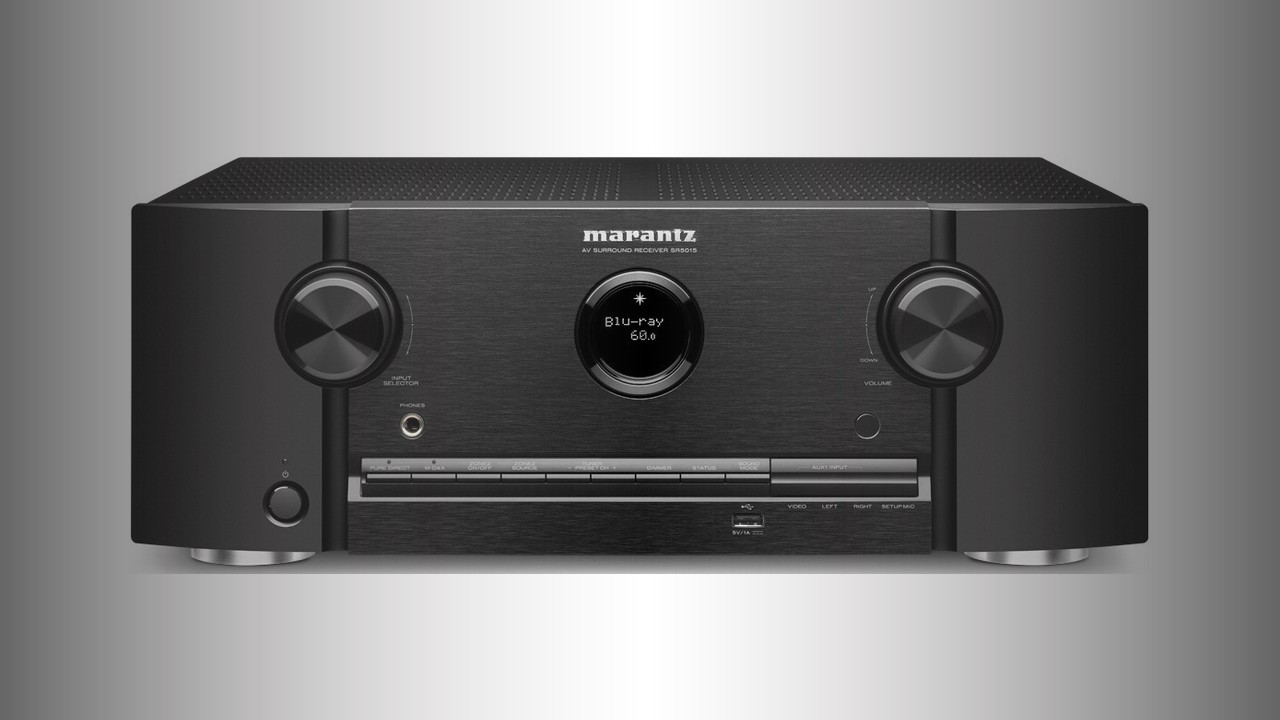
5. Marantz SR5015
The Marantz SR5015 is a 7.2-channel receiver with six HDMI inputs, immersive-audio decoding and an MM phono input.
The Marantz SR5015 is a 7.2-channel receiver suited to comparatively compact home-theater systems.
Its six HDMI inputs and two outputs support 8K, HDR10 and Dolby Vision video, as well as eARC and HDCP 2.3.
Dolby Atmos and DTS:X decoding cover immersive playback, while virtual surround processing accommodates installations without dedicated height speakers. Audyssey MultEQ XT assists with speaker calibration, and an MM phono input allows a compatible turntable to connect without a separate phono preamplifier. The audio section uses Marantz HDAM modules and a 32-bit AK4458 DAC.
Best for: Apartment-friendly theater systems with modern video sources
- Practical 7.2-channel configuration
- Six HDMI inputs and two outputs
- Audyssey MultEQ XT calibration
- Built-in MM phono input
Verdict: The SR5015 balances 7.2-channel home cinema, broad HDMI connectivity and useful vinyl support in a conventional receiver format.

6. Audio-Technica AT-LP5x
The Audio-Technica turntable described in the source combines direct drive, a switchable phono stage and USB digitization.
The Audio-Technica AT-LP5x is a turntable, not an AV receiver.
The supplied article describes the AT-LP5 design with a switchable built-in phono stage, allowing connection to a receiver’s regular line input or to a separate phono preamplifier.
A USB output enables vinyl digitization on a computer, while the direct-drive mechanism provides electronically selectable 33⅓ and 45 rpm speeds. Its aluminum platter uses a damping mat, and the deck is fitted with a J-shaped tonearm. Because the source title and excerpt refer to different model suffixes, exact feature applicability should be checked before purchase.
Best for: Adding vinyl playback to a receiver-based system
- Switchable built-in phono stage
- USB output for vinyl digitization
- Direct drive with two selectable speeds
- Damped aluminum platter
Verdict: This is a potentially versatile analog source for an AV system, but the supplied model-name discrepancy prevents a more definitive recommendation.
Quick comparison
These products do not all serve the same purpose.
Onkyo, Arcam, Denon and Marantz provide multichannel AV control, although the Onkyo is supplied as a complete speaker package.
Lyngdorf is a stereo amplifier, and Audio-Technica is a turntable source. Compare the four receivers by required speaker layout, calibration system, HDMI needs and plans for external amplification.
| Product | Best for | Verdict |
|---|---|---|
| Onkyo HT-S5915 | A complete receiver-and-speaker package | A convenient 5.1.2 solution with 4K HDR passthrough and matching speakers. |
| Arcam AVR30 | Dirac-calibrated systems with expansion plans | Seven Class G channels support 5.1.2 internally, with processing available for a larger 7.1.4 installation. |
| Denon AVC-X6800H | Large immersive layouts and multiple subwoofers | Eleven onboard amplifiers and 13.4-channel processing make it the most configurable dedicated receiver listed. |
| Lyngdorf TDAI-2170 | Two-channel listening with RoomPerfect | A room-corrected stereo digital amplifier, not a surround receiver. |
| Marantz SR5015 | Practical 7.2-channel systems and vinyl users | A well-connected receiver with immersive decoding, Audyssey calibration and an MM phono input. |
| Audio-Technica AT-LP5x | Vinyl playback and computer digitization | A turntable source rather than an AV receiver, with a model-reference discrepancy in the supplied material. |
Frequently asked questions
How many amplifier channels does an AV receiver need?
Match the onboard channel count to the physical system you intend to install.
A 5.1.2 layout needs seven amplified channels, while larger arrangements may require additional onboard channels or external power amplifiers.
The Onkyo, Arcam and Marantz cover seven-channel systems; the Denon provides 11 internal amplifier channels.
Is room correction an important differentiator?
Room correction can help integrate speakers and subwoofers with the listening space, but the systems differ.
Arcam supplies 16-channel Dirac calibration, Marantz uses Audyssey MultEQ XT, and Lyngdorf offers RoomPerfect in a stereo-only amplifier.
Consider both the correction platform and the number of channels it must manage.
Do I need dedicated height speakers for Dolby Atmos?
Physical height channels are required for a true 5.1.2 or larger speaker layout.
The Denon and Marantz also provide virtual surround options when installing height speakers is impractical, but these modes do not add physical loudspeakers to the system.
Can I connect a turntable to an AV receiver?
Yes, either use a receiver with a compatible phono input, such as the Marantz SR5015’s MM input, or use a turntable with a built-in phono stage and connect it to a regular line input.
The Audio-Technica source described here has a switchable internal phono stage.
Choosing the Right Receiver and System Format
Begin with the speaker layout you can realistically install.
For a complete system assembled in one step, the Onkyo HT-S5915 supplies both the receiver and speakers for 5.1.2 playback.
The Marantz SR5015 is a more conventional 7.2-channel choice with six HDMI inputs, Audyssey calibration and a phono input, making it suitable for a mixed home-cinema and vinyl setup. The Arcam AVR30 becomes more compelling when Dirac calibration and future external amplification are priorities. Its seven internal channels cover 5.1.2, while added power amplifiers enable use of its 7.1.4 processing capability. For a larger theater, the Denon AVC-X6800H stands apart through 11 built-in amplifiers, 13.4-channel processing and four subwoofer connections. Check the full signal chain before deciding: count sources and HDMI outputs, confirm the required video and eARC formats, and determine whether every planned speaker has an appropriate amplifier channel. Room calibration should also be considered at the outset, especially in systems with several subwoofers or height channels. Finally, do not confuse complementary stereo equipment with an AV receiver: the Lyngdorf TDAI-2170 and Audio-Technica AT-LP5x can play roles in an audio system, but neither provides multichannel home-theater switching, decoding and amplification.



Sound Off
0Join the discussion if you have something to add.