GoldenEar ForceField 30 and 40: Compact Subwoofers with Serious Extension
GoldenEar’s ForceField 30 and ForceField 40 are designed for listeners who want deep low-frequency capability without making a subwoofer the dominant object in the room.

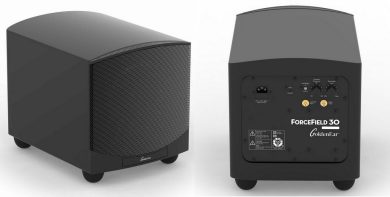
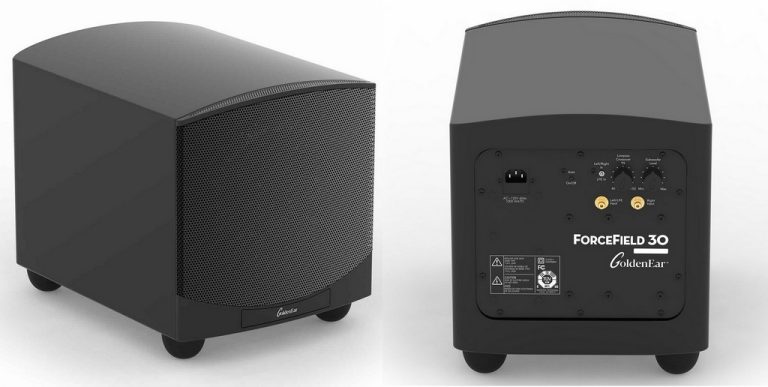
The GoldenEar ForceField 30 and ForceField 40 are compact subwoofers with an unusually ambitious brief: deliver very low bass extension from cabinets that remain manageable in typical living rooms, media spaces, and two-channel systems. The ForceField 30 is specified with a lower frequency limit of 18 Hz from an 11.4 x 16 x 12.7-inch cabinet, while the larger ForceField 40 is specified down to 14 Hz from a 13.3 x 18.3 x 14.7-inch cabinet. Those figures help define the appeal of the range. These are not large, furniture-sized subwoofers, yet GoldenEar has built them around high-power digital amplification, DSP tuning, and a driver layout intended to support extended low-frequency output in a compact footprint.
A compact approach to very low bass
The most immediately attractive aspect of the ForceField 30 and 40 is the relationship between cabinet size and specified bass extension. Subwoofers often require a physical trade-off: deeper extension and greater output tend to push enclosure size upward. GoldenEar’s approach here is to keep the cabinets relatively small while still aiming at frequencies associated with demanding film soundtracks, modern music production, and full-range system support.
The ForceField 30’s cabinet measures 11.4 x 16 x 12.7 inches, making it the more space-conscious of the two. It is specified to reach 18 Hz, which places its intended operating range well below the fundamental notes of many acoustic instruments and into the area where bass becomes as much a physical room interaction as a clearly localized tone. The ForceField 40 increases the cabinet size to 13.3 x 18.3 x 14.7 inches and is specified down to 14 Hz, giving it the deeper published low-frequency limit of the pair.
For prospective owners, the significance is practical. A subwoofer that can be positioned without dominating the room is easier to integrate into a domestic space, and a smaller cabinet can open up placement options that would be difficult with a larger design. Placement remains room-dependent with any subwoofer, but compact dimensions give users more flexibility when working around furniture, walls, and system layouts.

Different sizes for different system needs
GoldenEar has separated the ForceField 30 and ForceField 40 clearly enough that each model has a distinct role. The ForceField 40 is the larger and more powerful design, using a 10-inch high-performance, long-throw woofer and a downward-firing 11 x 13-inch quadratic planar infrasound driver. It is powered by a 1,200-watt digital amplifier with a MOSFET output stage and uses DSP tuning from Analog Devices.
The ForceField 30 follows the same general design direction but scales it down. It uses an 8-inch driver, a 1,000-watt digital amplifier, and a reduced infrasonic driver size of 9 x 11 inches. This makes it the more compact option while retaining the core ingredients of the ForceField concept: active amplification, DSP control, and an architecture intended to support low-frequency extension from a relatively small enclosure.
This two-model structure is useful because it allows system matching without forcing every buyer into the larger cabinet. A smaller room, a music-focused setup, or a system where space is the main constraint may point naturally toward the ForceField 30. A larger room or a system that prioritizes the deepest specified extension may make the ForceField 40 the more logical fit. GoldenEar’s published specifications do not remove the need to consider room size and placement, but they do make the distinction between the two models straightforward.
Driver architecture and the role of the infrasonic radiator
Both models combine a conventional active woofer with a downward-firing quadratic planar infrasound driver. In the ForceField 40, the main woofer is a 10-inch long-throw unit, while the downward-firing planar driver measures 11 x 13 inches. In the ForceField 30, the active driver is reduced to 8 inches and the planar driver dimensions are reduced to 9 x 11 inches.
This layout is central to the product’s identity. A long-throw woofer is intended to move enough air for low-frequency reproduction, while the additional downward-firing infrasonic driver supports the system’s extended bass behavior within the limits of the enclosure. The downward-firing orientation can also be useful from a room-design standpoint, since the visible front or side profile of the product does not need to be dominated by a large exposed passive element.
For a prospective owner, the benefit is not simply that there are multiple drivers. The more relevant point is that the ForceField models are engineered as complete low-frequency systems rather than as small boxes relying only on amplifier power. Driver size, cabinet volume, amplifier capability, DSP tuning, and the infrasonic element all form part of the same design solution.

Amplification and DSP as part of the design
The ForceField 40 includes a 1,200-watt digital amplifier with a MOSFET output stage, while the ForceField 30 uses a 1,000-watt digital amplifier. These are active subwoofers, so the amplification is built into the enclosure and matched to the driver system by design. For users, this simplifies system planning: there is no need to source a separate power amplifier or calculate amplifier-subwoofer compatibility.
DSP tuning from Analog Devices is specified for the ForceField 40, and DSP also plays a role in the input filtering behavior of both models. In a compact subwoofer, DSP can be especially important because low-frequency systems operate under physical constraints. Digital signal processing allows the manufacturer to manage the behavior of the driver, amplifier, and filter structure as part of a controlled system.
That does not mean placement, room acoustics, or setup become irrelevant. Bass performance is always shaped by the listening environment. But built-in DSP and dedicated amplification make the ForceField 30 and 40 more self-contained and predictable from an integration standpoint than passive low-frequency solutions.

Connectivity for both theater and stereo systems
The ForceField 30 and 40 include a direct-coupled LFE line-level input that is not low-pass filtered. This is a useful choice for home theater systems, where bass management is usually handled by an AV receiver or processor. In that kind of setup, an unfiltered LFE input allows the external processor to determine crossover behavior and route low-frequency effects as intended.
The subwoofers also provide paired stereo line-level inputs with DSP low-pass filtering adjustable from 40 Hz to 150 Hz. This matters for two-channel systems, integrated amplifiers, preamps, and setups where the subwoofer may need to blend directly with main speakers without relying on AV-style bass management. The 40 Hz to 150 Hz filtering range gives users a practical span for matching the subwoofer to different loudspeaker sizes, from smaller speakers that may need higher crossover support to larger models that may only require reinforcement in the lowest octave or two.
Both models are rated up to 250 Hz, but the presence of adjustable low-pass filtering is the more relevant usability feature for most systems. It allows the subwoofer to be tailored to the main speakers rather than forcing a fixed handoff point. For owners who may use the same subwoofer in different systems over time, that flexibility adds long-term value.
Who the ForceField 30 and 40 are most suitable for
The ForceField 30 and ForceField 40 are best suited to listeners who want substantial low-frequency extension from a subwoofer that remains compact enough for real rooms. They are likely to appeal to home theater owners who need an LFE-capable subwoofer, music listeners who want to extend the range of their main speakers, and mixed-use systems where the same low-frequency component must serve both films and stereo playback.
The ForceField 30 appears especially appropriate where space is limited or where a smaller cabinet is easier to place. Its 8-inch driver, 1,000-watt digital amplifier, and 18 Hz specified lower limit make it the more compact expression of the design. The ForceField 40 is aimed at users who can accommodate a larger enclosure and want the deeper specified low-frequency reach, the larger 10-inch woofer, the 11 x 13-inch infrasonic driver, and the higher 1,200-watt amplifier rating.
They may be less suitable for buyers who want published pricing as the primary decision factor, since no USD price is specified here, or for users who prefer a purely passive subwoofer architecture. As with any subwoofer, room size, placement possibilities, and integration with the main speakers should guide the final choice between the two models.
Conclusion
The GoldenEar ForceField 30 and ForceField 40 stand out for combining compact cabinets with ambitious specified low-frequency extension, high-power built-in digital amplification, DSP-supported filtering, and input options that suit both LFE-based theater systems and stereo line-level setups. The ForceField 30 offers the more space-efficient route, while the ForceField 40 adds a larger driver package, more amplifier power, and deeper published extension. For prospective owners seeking a compact active subwoofer that can be integrated into music, movie, or mixed-use systems without relying on a large enclosure, these two models present a focused and flexible design proposition.