

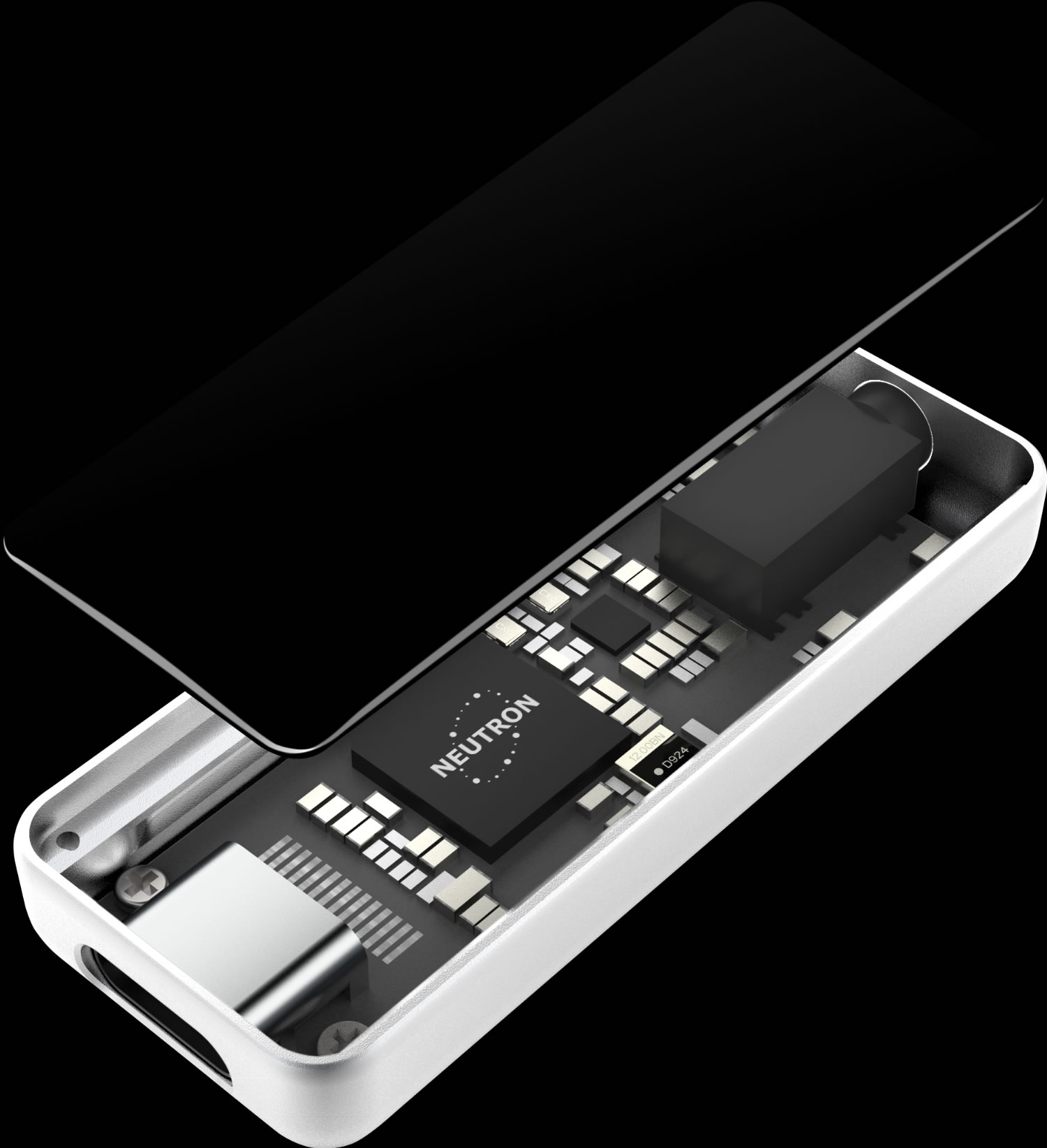
Small USB DACs are often defined by the features they leave out. The Neutron HiFi DAC V1 takes a different approach, fitting extensive format support, an OLED status display, onboard signal processing, headset integration, and updateable firmware into an enclosure measuring just 50 x 19.9 x 9.6 mm. At 13 grams, it remains suitable for portable use, but its design is more elaborate than that of a basic USB-C audio adapter. Built around an ESS ES9219Q DAC and an NXP K-series controller, the DAC V1 is intended to provide a compact bridge between USB Audio 2.0 sources and conventional 3.5 mm headphones. Its combination of hardware and proprietary Neutron HiFi firmware is the central attraction: this is not simply a converter with fixed behavior, but a configurable audio component designed to retain settings, provide DSP functions, display operating information, and receive firmware updates.
High-resolution support without a desktop footprint
The DAC V1 accepts PCM audio at 16, 24, and 32 bits, with sample rates extending from 44.1 kHz to 384 kHz. Native DSD support covers DSD64, DSD128, and DSD256, while DSD over PCM is available for DSD64 and DSD128. That breadth makes the device relevant to owners whose libraries contain a mixture of standard-resolution music, high-resolution PCM downloads, and DSD files.
Format support alone does not establish how a product will sound, but it does determine whether source material can be handled without unnecessary conversion elsewhere in the playback chain. The DAC V1’s published capabilities allow compatible playback software to send a wide selection of commonly encountered formats directly to the device. Dual master clocks are also part of the hardware design, complementing its support for sample rates based on both the 44.1 kHz and 48 kHz families.
At its core is the ES9219Q DAC from ESS Technologies. The surrounding design includes ultra-low-noise power supplies for the device’s subsystems, reflecting attention not only to the conversion chip but also to the supporting electronics. That distinction matters because a DAC chip does not operate in isolation; power management, clocking, control, and analogue output implementation all contribute to the finished product’s behavior.
Firmware is a major part of the design
An NXP K-series ARM Cortex-M4 microcontroller manages the DAC V1 through proprietary Neutron HiFi firmware. It operates as a hard real-time system, intended to provide stable and deterministic processing across the supported sample rates. For an owner, the practical point is consistency: the controller coordinates the device’s subsystems rather than leaving every function to the connected phone, tablet, or computer.
The firmware also expands the DAC beyond basic digital-to-analogue conversion. Its DSP facilities include a parametric equalizer and crossfeed. Parametric EQ can be useful for adjusting specific frequency regions, accommodating personal preferences, or applying suitable corrections for a particular pair of headphones. Crossfeed is intended to reduce the extreme left-right separation that can occur when stereo recordings mixed for loudspeakers are heard through headphones.
Persistent settings add another layer of convenience. Instead of requiring the user to rebuild a preferred configuration for every session, the device can retain its setup. Smart power-saving behavior is especially relevant to portable use, where the DAC draws power from a connected host device and therefore needs to balance processing requirements with battery consumption.
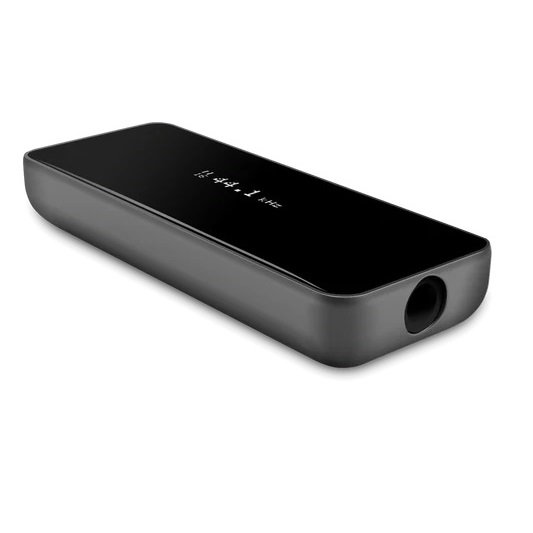
An OLED display makes operation easier to understand
The integrated high-contrast OLED display is one of the DAC V1’s most distinctive practical features. It presents information about the audio output format and device status, allowing the user to confirm what the DAC is receiving or doing without relying entirely on playback software. This can be valuable when checking whether a music application is actually delivering the expected sample rate or format.
The display is protected by Gorilla Glass 3, chosen for resistance to scratches and shocks. That is a sensible consideration for hardware likely to travel with a phone, laptop, headphones, and cables. The screen also gives the product a more self-contained character than a conventional display-free dongle, where status information may be limited to a single indicator light—or absent altogether.
Because OLED technology can provide high contrast while using relatively little energy, it also suits a compact, host-powered device. The display serves a functional purpose without requiring the DAC V1 to become substantially larger or dependent on its own battery.
A compact enclosure with protective intent
The aluminum housing is available in Silver or Iron Gray. Beyond appearance, the metal enclosure is designed to protect the internal electronics from physical damage and electromagnetic interference. In a portable system, the DAC may be placed close to a smartphone, computer, charging cable, or other electronics, making careful enclosure design particularly relevant.
Its dimensions and 13-gram weight keep the DAC V1 within genuinely portable territory. It can accompany a mobile source without adding the bulk associated with a battery-powered portable amplifier. At the same time, the aluminum body and protected display suggest that durability was considered alongside miniaturization.
The narrow, elongated format is also consistent with its straightforward signal path: USB-C digital input at one end of the system and a 3.5 mm analogue headphone connection at the other. It is designed as a focused personal-audio component rather than a multi-input desktop hub.
Headphone output and system matching
The analogue output is a conventional 3.5 mm headphone jack with two-channel stereo operation. The specified output level is 2 Vrms, with a 1 Vrms option, and output impedance is listed at less than 0.6 ohm. A low output impedance is useful when pairing the DAC with a broad range of headphones and earphones, particularly models whose electrical response may vary when driven from a higher-impedance source.
The published specifications do not include detailed power figures into different headphone loads, so prospective owners should not assume that output voltage alone answers every matching question. Users of unusually insensitive or demanding headphones may still want to check the headphones’ requirements carefully. The DAC V1’s size, 3.5 mm connection, and headset functions point most clearly toward portable headphones, in-ear monitors, and everyday wired headsets rather than specialized balanced or high-power configurations.
Headset microphones using the CTIA standard are supported, as are inline commands for play and pause, stop, next or previous track, voice command, and volume adjustment. This is a particularly useful detail for people who want improved digital audio handling without giving up the communications and remote-control functions of a wired mobile headset.
USB connectivity and updateability
The DAC V1 uses USB-C and conforms to USB Audio 2.0. That gives it a direct route to compatible computers, phones, and tablets equipped with USB-C. Devices with an Apple Lightning port require Apple’s Lightning to USB Camera Adapter, so those users should account for the additional adapter and cable arrangement.
Firmware updates are supported over the air through the Configurator utility. Updateability can extend the practical life of a digitally controlled audio product by allowing its operating software to be maintained after purchase. The persistent-settings system and DSP functions also make the utility relevant beyond initial installation, depending on how the owner chooses to configure the device.
Connectivity is deliberately focused. The documented specification lists USB-C as the digital input and 3.5 mm as the analogue output; it does not present the DAC V1 as a wireless receiver, an optical or coaxial DAC, or a balanced-output device. That simplicity benefits portable users, but it also defines the product’s limits for more elaborate home systems.

Who the Neutron HiFi DAC V1 is for
The DAC V1 is most suitable for listeners who use a computer, USB-C phone, or tablet as their primary source and want more control than a basic passive adapter provides. Its high-resolution compatibility will appeal to owners of mixed PCM and DSD libraries, while the OLED display is useful for anyone who wants visible confirmation of format and device status.
It is also well suited to listeners who value onboard customization. Parametric EQ, crossfeed, persistent settings, and updateable firmware distinguish it from simpler USB dongles whose operation is largely fixed. Support for CTIA microphones and headset buttons makes it relevant to everyday mobile use as well as dedicated music playback.
Conversely, it is less obviously suited to someone building a conventional multi-source hi-fi system. There are no documented optical, coaxial, wireless, RCA, or balanced connections, and the sole analogue interface is a 3.5 mm headphone jack. Owners of especially demanding full-size headphones should also assess compatibility using more than the 2 Vrms output figure, since load-specific power ratings are not provided. Its strengths are therefore concentrated around compact, wired, USB-based personal audio rather than universal system integration.
Conclusion
The Neutron HiFi DAC V1 stands out through the depth of functionality placed inside its compact aluminum enclosure. Its documented strengths include PCM support up to 32-bit/384 kHz, native DSD256 playback, an ESS ES9219Q conversion stage, dual master clocks, low-noise power supplies, and real-time control from an ARM Cortex-M4 processor. The practical features are equally important: an OLED status display protected by Gorilla Glass 3, parametric EQ, crossfeed, persistent settings, smart power management, firmware updates, and support for CTIA microphones and headset controls. With a 13-gram body, USB-C input, and low-impedance 3.5 mm output, it is aimed most directly at listeners seeking a configurable, informative USB DAC for portable headphones, earphones, or wired headsets. It is not positioned as a multi-input home-audio centerpiece, but for a focused USB personal-audio system, its combination of format flexibility, onboard intelligence, and compact construction is notably well considered.


Sound Off
0Join the discussion if you have something to add.