
The right DAC depends on where it will sit in your system.
These products range from straightforward converters for an existing amplifier to desktop DAC and headphone-amplifier combinations, a balanced unit for active monitors, an R-2R design for architecture-focused listeners, and a full preamplifier with digital conversion built in.
Begin with the required role. A converter-only model makes sense when amplification and volume control are already covered, while an integrated headphone amplifier reduces the number of desktop components. Balanced XLR outputs are relevant to compatible amplifiers and active speakers, whereas Bluetooth, USB Audio Class support and compact dimensions can matter more in computer, television or console systems. High-resolution format support varies considerably across the selection, but maximum sampling rates are only one part of the decision. Output connections, source compatibility, filter options and day-to-day controls provide a more practical way to identify which model belongs in a particular setup.

1. Audiolab M-DAC+
The Audiolab M-DAC+ combines high-resolution USB conversion with seven selectable digital-filter settings.
The M-DAC+ suits a conventional digital-source-to-amplifier system in which conversion is handled by a dedicated component.
Its ES9018-based design includes a discrete clock generator, time-domain interference isolation circuitry and a Class A JFET output stage.
USB accepts PCM up to 32-bit/384 kHz as well as DSD64, DSD128 and DSD256. Seven selectable filters make this an especially relevant option for listeners who want to adjust reconstruction according to their system, files and preferences.
Best for: Dedicated hi-fi systems requiring adjustable digital filtering
- Seven user-selectable digital filters
- USB supports PCM up to 32-bit/384 kHz
- Compatible with DSD64, DSD128 and DSD256
- Discrete clock and Class A JFET output stage
Verdict: A well-specified standalone DAC for listeners who value broad USB format support and meaningful filter choice.

2. Shanling H2
The Shanling H2 is the simplified and more affordable portable DAC and amplifier in its product family.
The H2 is positioned as the more affordable portable DAC and amplifier below Shanling’s H5 and H7.
Its functionality and internal design are simplified, and it is described as less powerful than those models.
That makes it the role-based choice for portable listening where the additional capabilities of the larger alternatives are unnecessary. The supplied material does not specify inputs, outputs or supported formats, so device compatibility should be confirmed rather than inferred from its place in the range.
Best for: Value-focused portable DAC and amplifier use
- Portable DAC and amplifier in one device
- Lower-cost alternative to the H5 and H7
Verdict: A more accessible portable option for buyers who do not need the power or broader functionality of Shanling’s higher-tier models.

3. Topping E50 II
The Topping E50 II is designed for both compact desktop use and integration with a traditional hi-fi system.
The E50 II is designed to move easily between a computer desk and a conventional hi-fi system.
An AKM AK4497S converter and XMOS XU316 USB controller support PCM up to 32-bit/768 kHz and DSD512, while integrated Bluetooth with LDAC provides a wireless alternative.
Its proprietary FPGA and PLL-based clock architecture is presented by Topping as a method of improving synchronization and reducing timing errors across the digital inputs. It is a strong match for systems that need both wired high-resolution playback and convenient wireless access.
Best for: Mixed wired and wireless desktop or hi-fi systems
- PCM support up to 32-bit/768 kHz
- DSD playback up to DSD512
- Bluetooth with LDAC compatibility
- XMOS XU316 USB controller
Verdict: A flexible compact DAC that combines extensive high-resolution support with LDAC wireless playback.

4. SMSL SU-2
The compact SMSL SU-2 provides both XLR and RCA outputs for balanced and single-ended audio systems.
The SU-2 is the clearest fit here for balanced desktop systems, studio monitoring and active-speaker installations.
Its ES9039Q2M converter is partnered with four OPA1612A operational amplifiers in a symmetrical left-and-right-channel layout.
Both balanced XLR and unbalanced RCA outputs are provided, allowing the DAC to work with balanced amplifiers or monitors as well as conventional domestic equipment. Operation is deliberately restrained: there is no display or menu system, with LEDs providing basic status information.
Best for: Balanced amplifiers, active monitors and focused desktop systems
- Fully balanced internal signal path
- Balanced XLR and unbalanced RCA outputs
- Compact metal chassis
- Simple LED-based operation without menus
Verdict: A purpose-built compact DAC for systems that need balanced output and uncomplicated operation rather than extensive menus.

5. Denafrips Enyo
The Denafrips Enyo combines matched R-2R resistor networks with selectable oversampling and filter modes.
The Enyo is aimed at listeners who specifically want a balanced R-2R converter rather than a conventional DAC-chip design.
Each channel is decoded by four sets of matched resistor networks, and the unit offers both non-oversampling and oversampling modes with slow or sharp filter choices.
USB supports PCM up to 1536 kHz and DSD1024, while two coaxial and two optical inputs accommodate additional digital sources. RCA and balanced XLR outputs make it adaptable to both single-ended and balanced amplification.
Best for: Systems built around R-2R conversion and multiple digital sources
- Balanced R-2R conversion architecture
- NOS and oversampling modes
- Slow and sharp filter options
- RCA and balanced XLR outputs
Verdict: A versatile R-2R DAC with unusually extensive format support, selectable processing modes and both major analog output types.

6. Rotaxis Core64
The Rotaxis Core64 uses its distinctive ring-arranged PulseAxis resistor-ladder architecture for digital-to-analog conversion.
The Core64 is a specialist architecture-led choice rather than a conventional feature-led DAC.
Rotaxis describes it as a passive 24-bit resistive-ladder design that omits feedback, noise reduction, delta-sigma modulation, noise shaping and digital filtering.
Its PulseAxis arrangement places matched resistors in rings, an approach intended to reduce electromagnetic interference, thermal drift and crosstalk. The supplied material does not detail connectivity, supported file formats or control functions, so system matching depends primarily on interest in its unusual conversion topology.
Best for: R-2R enthusiasts prioritizing conversion architecture
- True 24-bit resistive-ladder architecture
- Manufacturer-stated passive, no-feedback topology
- Operates without delta-sigma modulation or digital filters
- Ring-arranged resistors intended to limit interference and drift
Verdict: A highly specialized DAC for listeners drawn to passive ladder conversion rather than broad convenience features.

7. SMSL PS200
The SMSL PS200 brings Bluetooth and three wired digital input types to a compact RCA-output DAC.
The PS200 is suited to an affordable multi-source system built around an RCA-equipped amplifier or pair of powered speakers.
Bluetooth, coaxial, optical and USB inputs cover computers, mobile devices, televisions, disc players and compatible game consoles.
Selectable UAC1 and UAC2 modes broaden USB compatibility, including UAC1 operation with Sony PS5 and Nintendo Switch. The XMOS XU-316 platform supports PCM up to 32-bit/768 kHz and DSD512, while 5-volt power can come from common USB power sources.
Best for: Budget systems using computers, televisions or game consoles
- Bluetooth, coaxial, optical and USB inputs
- Selectable UAC1 and UAC2 USB modes
- PCM support up to 32-bit/768 kHz and DSD512
- Convenient 5-volt power input
Verdict: A practical low-cost DAC for varied digital sources, especially where USB compatibility and Bluetooth matter more than balanced output.

8. Shanling EH1
The Shanling EH1 places volume, bass and tone controls on a compact display-free desktop DAC and amplifier.
The EH1 combines conversion, headphone amplification and volume adjustment in a compact desktop component.
It is positioned above Shanling’s smaller UA range in power while remaining simpler than the company’s H-series devices and smaller than the EH3.
The minimalist front panel omits a display in favor of buttons and rotary controls, including volume, bass and tone adjustment. Its aluminum chassis is available in black or silver, making the EH1 an appropriate choice where a tidy, manually controlled headphone setup is the priority.
Best for: Simple desktop headphone systems
- Integrated DAC and headphone amplifier
- Compact aluminum chassis
- Direct rotary volume control
- Bass and tone adjustment
Verdict: A compact DAC and headphone amplifier for users who prefer direct physical controls over displays and layered menus.
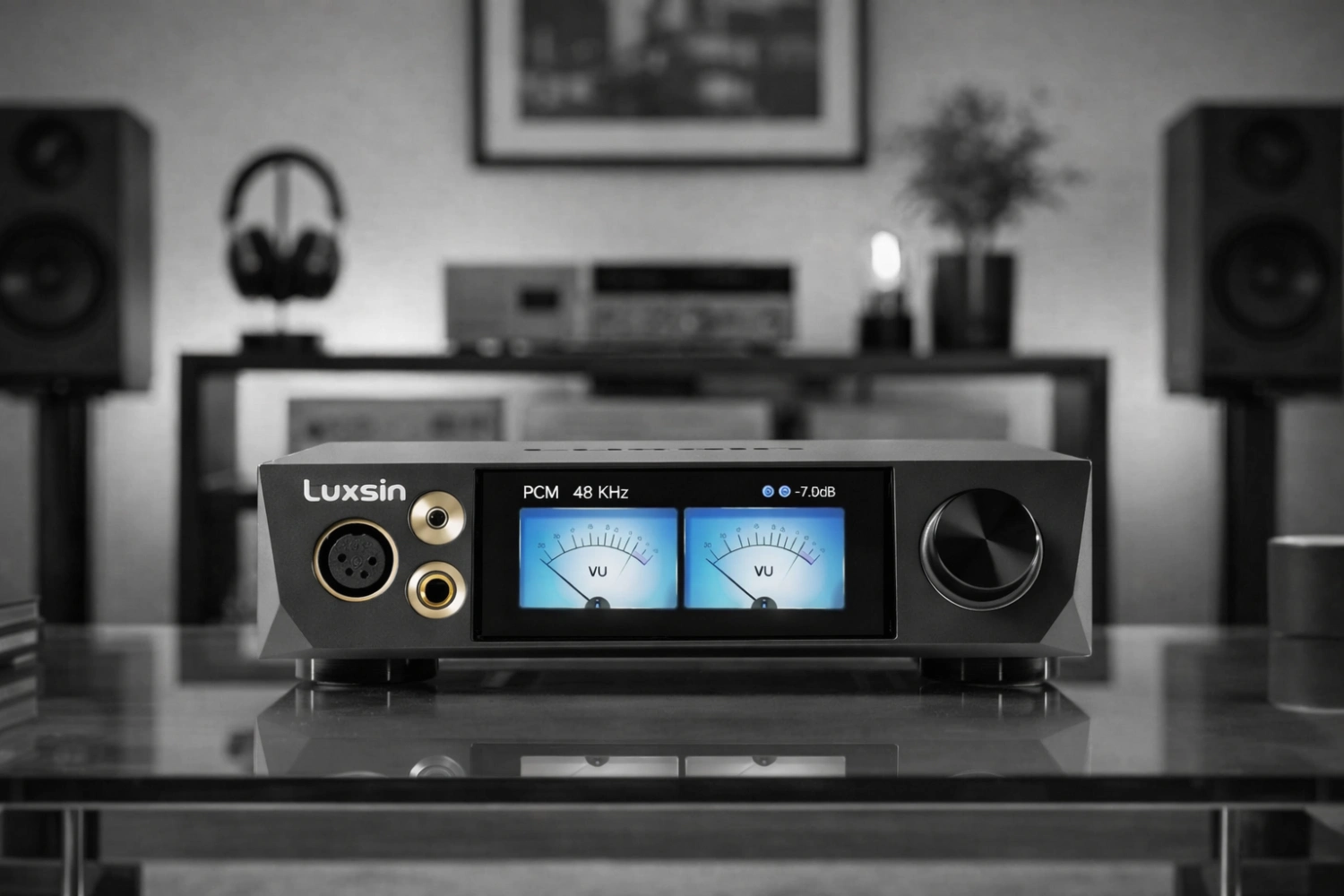
9. Luxsin X8
The Luxsin X8 uses eight converter chips, with four assigned to each channel in a dual-mono layout.
The X8 is intended for a headphone-focused desktop system that needs substantial integrated output and extensive personalization.
Eight Cirrus Logic CS43198 converters are arranged in a dual-mono configuration, with four chips operating in parallel for each channel.
Left and right channels have separate signal paths and power delivery, supported by dedicated buffering, clock distribution and individual DAC shielding. The stated amplifier output approaches 5 watts per channel, although the supplied excerpt does not specify the associated load condition.
Best for: Powerful and highly configurable desktop headphone systems
- Eight CS43198 DAC chips in a dual-mono arrangement
- Four converters operating in parallel per channel
- Fully separated linear power supply
- Personalization-centered software features
Verdict: An ambitious integrated DAC and headphone amplifier that emphasizes parallel conversion, channel separation and personalized control.

10. Primare PRE35 DAC
The Primare PRE35 DAC combines source selection, volume control, analog connectivity and high-resolution digital conversion.
The PRE35 DAC is the system hub in this selection, combining digital conversion with full preamplifier control.
Its analog connectivity includes two balanced inputs, one balanced output, four RCA inputs and two RCA outputs, plus a recorder output.
The internal AKM AK4497-based digital module supports PCM up to 32-bit/768 kHz and DSD256. Input renaming, input disabling and individual level reduction help organize a multi-source installation, while trigger, infrared, RF and RS232 connections support broader system integration.
Best for: Separates systems needing a combined preamplifier and digital hub
- Preamplifier and DAC in one component
- Balanced XLR and single-ended RCA connectivity
- PCM up to 32-bit/768 kHz and DSD256
- Configurable inputs and system-control connections
Verdict: A comprehensive control component for systems that need analog preamplification, high-resolution conversion and extensive source management in one chassis.


Sound Off
0Join the discussion if you have something to add.