
Amplifier shopping becomes easier once the system requirement is clear.
This selection spans straightforward integrated amplifiers, ambitious preamplifiers, a dedicated power amplifier, a multi-room model, powered desktop monitors and a DAC/headphone amplifier.
They are not interchangeable, but each addresses a distinct way of listening. Value here is not simply a matter of choosing the least expensive product. It comes from paying for the features a system can use: phono support for vinyl, HDMI ARC and streaming for a central entertainment system, balanced connections for more complex installations, or independent zones for whole-home audio. Performance-focused designs also take different approaches. Some emphasize circuit symmetry, power-supply isolation or low-noise volume control, while others prioritize accessible controls and flexible connectivity. The recommendations below explain those differences without treating manufacturer claims as independent listening conclusions.

1. Pioneer DJ has launched a line of affordable monitors
Pioneer DJ’s DM monitor range combines built-in Class D amplification with desktop-friendly controls and multiple connection options.
Pioneer DJ’s updated DM range provides a compact route to an amplified desktop system.
The DM-50D-BT combines a two-way design, Class D amplification and Bluetooth, while its DJ and audio playback modes accommodate both music production and everyday listening.
RCA, 3.5 mm and 1/4-inch connections are provided, with the volume control and headphone output placed on the front. The smaller DM-40D and DM-40D-BT use 4-inch low-frequency drivers and offer a similar core feature set in more compact enclosures. Bluetooth is limited to the BT versions, and the smaller models omit the 1/4-inch inputs.
Best for: Desktop listening and entry-level DJ setups
- DJ and audio playback modes
- Bluetooth available on BT models
- Front-mounted volume and headphone access
- Compact DM-40D alternatives
Verdict: The DM range is a practical choice when compact speakers, built-in amplification and accessible connections matter more than building a separate-component system.
2. Fosi Audio ZP3: A Versatile Balanced Preamplifier for Home and Professional Use
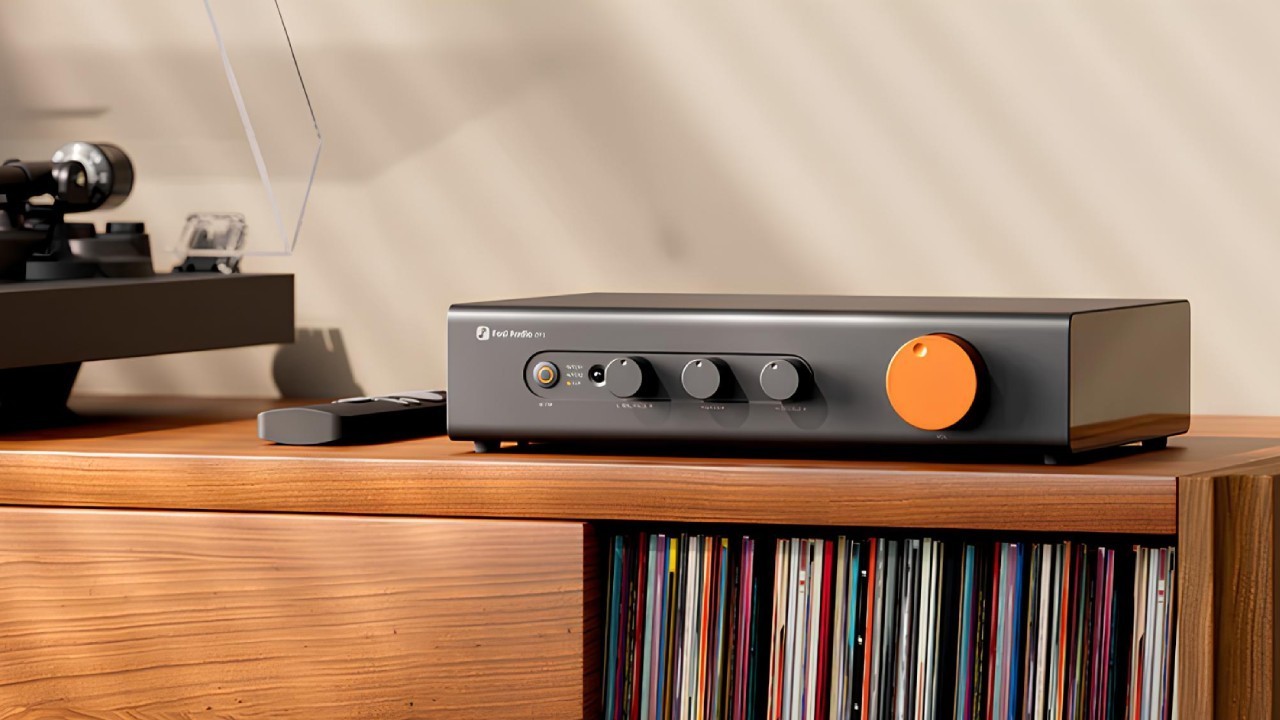
The Fosi Audio ZP3 offers balanced XLR output, RCA connectivity, tone adjustment and a dedicated subwoofer connection.
The Fosi Audio ZP3 is a flexible preamplifier rather than a speaker-driving integrated amplifier.
Its TRS/XLR combination input, stereo RCA inputs and balanced XLR output allow it to sit between domestic and professional equipment, while the subwoofer output supports a 2.1-channel system.
Low- and high-frequency controls, channel balance, selectable frequency division for the main outputs and a bypass mode provide useful system-adjustment options. A supplied remote handles volume and source switching, improving usability when the ZP3 is installed away from the listening position.
Best for: Flexible 2.1 systems and mixed balanced connections
- Balanced and unbalanced connectivity
- Dedicated subwoofer output
- Selectable output frequency division
- Remote volume and source control
Verdict: The ZP3 suits listeners who need adaptable signal control, subwoofer integration and balanced outputs without paying for an integrated power stage.

3. Premiera T3S: State-of-the-art integrated stereo amplifier
The Premiera T3S combines Class A/B amplification and a tube preamplifier with streaming, phono, DAC and HDMI ARC functions.
The Premiera T3S brings a Class A/B power stage and vacuum-tube preamplifier together with a broad selection of digital and analog functions.
Rated at 115 watts per channel, it also includes a network player, MM/MC phono stage, DAC, Bluetooth, Wi-Fi, AirPlay 2 and HDMI ARC.
Its front panel provides source, playback, volume and three-band tone controls rather than hiding routine adjustments inside an application. The display and remote can be used to navigate settings, adjust brightness, check device information and perform software updates. With twelve potential input sources, it is the most comprehensively equipped one-box amplifier in this selection.
Best for: Feature-rich single-box stereo systems
- 115 watts per channel
- Built-in network player and DAC
- MM/MC phono stage
- HDMI ARC and AirPlay 2
Verdict: The T3S is the practical all-rounder for a system that must accommodate streaming, television audio, vinyl and conventional sources through one integrated amplifier.

4. Pass Labs Xs Preamplifier 2: Flagship Class A Preamp with Triple-Chassis Design
The Pass Labs Xs Preamplifier 2 separates its preamplifier circuitry and channel power supplies across three full-size enclosures.
The Pass Labs Xs Preamplifier 2 takes an uncompromising approach to physical and electrical separation.
Its signal circuitry is distributed across three substantial cabinets, and each channel has an independent power-supply board with more than 100,000 µF of capacitance.
Pass Labs also identifies revised circuit layout, new amplification stages, automatic bias control and DC compensation as central developments. Available information remains preliminary, so this is better understood as a specialist flagship preview than a fully documented buying proposition.
Best for: Reference-level separate systems with ample space
- Three-chassis signal isolation
- Independent power supply for each channel
- More than 100,000 µF of capacitance per channel
- Auto-bias and DC compensation
Verdict: The Xs Preamplifier 2 is aimed at listeners prioritizing circuit isolation and elaborate power supplies, although incomplete details limit a definitive assessment.

5. TRIVUM SC340m: New multi-zone amplifier launched
The compact TRIVUM SC340m supplies four rooms and integrates Ethernet streaming with app, KNX and automation-system control.
The TRIVUM SC340m addresses installation audio rather than conventional two-channel listening.
One compact unit can serve four rooms, supplying 2 x 30 watts to each room, while Ethernet acts as the main source connection for its streaming module.
AirPlay, Spotify Connect, TuneIn internet radio and other streaming platforms are supported. Control is available through a mobile application or KNX, with drivers also offered for RTI, URC and Control4 systems. Two units can be combined for rack installation, making the SC340m suitable for a larger distributed-audio project. The stated price is €1,990.
Best for: Professionally planned multi-room audio
- Four independently served rooms
- 2 x 30 watts available per room
- AirPlay and Spotify Connect support
- KNX and automation-platform integration
Verdict: The SC340m provides a focused combination of four-zone amplification, network streaming and control-system integration for distributed home audio.

6. TAD A1000: Impressive Integrated Amplifier with Symmetrical Class D Design
TAD’s A1000 integrated amplifier uses a symmetrical bridge-tied Class D architecture with separate power-supply arrangements for each channel.
The A1000 is TAD’s first integrated amplifier, combining current-feedback preamplification, electronic resistive-ladder volume control and an analog Class D power stage.
Its design centers on symmetry rather than an extensive list of convenience features.
A bridge-tied load configuration uses separate amplifiers in a balanced arrangement for the left and right channels from input to output. Transformer coils and the associated rectification, smoothing and stabilization circuits are also provided independently for each channel. Circuit-board layout, wiring length and positive-to-negative signal paths were developed around the same symmetrical principle.
Best for: Performance-led integrated systems
- Balanced bridge-tied load architecture
- Independent power-supply sections for each channel
- Current-feedback amplification
- Resistive-ladder electronic volume control
Verdict: The A1000 is a highly specialized integrated amplifier for buyers who place symmetrical circuit and power-supply design ahead of broad lifestyle connectivity.

7. Accuphase Just Dropped a 25 kg Preamplifier: The C-3900S Is a No-Compromise Hi-Fi Monster
The 25-kilogram Accuphase C-3900S flagship preamplifier introduces a parallel Dual Balanced AAVA volume-control system.
The Accuphase C-3900S is a 25-kilogram flagship preamplifier built around the company’s AAVA volume-control technology.
Instead of attenuating the input through a conventional resistor arrangement before amplification, AAVA varies gain through a combination of VI converter circuits.
This model introduces Dual Balanced AAVA, using two symmetrically designed Balanced AAVA units in parallel. Accuphase says the arrangement preserves impedance and frequency response throughout the volume range and reduces noise by a further 30 percent compared with its preceding implementation. Those figures remain manufacturer claims rather than independent measurements in the supplied source.
Best for: Flagship systems requiring a dedicated preamplifier
- Dual Balanced AAVA volume control
- Symmetrical parallel volume-control units
- Designed to maintain impedance across the volume range
- Substantial 25-kilogram construction
Verdict: The C-3900S is a purpose-built separates component for listeners who value Accuphase’s distinctive volume-control architecture and heavyweight construction.

8. Topping DX9: High-performance DAC/headphone amplifier
The Topping DX9 pairs an AKM DAC with discrete NFCA headphone amplification, dual displays and a transparent top panel.
The Topping DX9 combines digital conversion and headphone amplification rather than driving passive loudspeakers.
It uses an AKM AK4499EQ four-channel DAC and supports PCM up to 32-bit/768 kHz as well as native DSD512.
Optical and SPDIF reception is handled by an AK4118AEQ chip. A discrete NFCA headphone-amplifier circuit comprises six modules, each containing 39 transistors. Separate power stages are used for the DAC and headphone amplifier, while two displays run Topping’s Aurora user interface. The curved enclosure and transparent top panel also make the internal circuitry part of the design.
Best for: High-resolution digital and headphone systems
- AKM AK4499EQ four-channel DAC
- PCM 32-bit/768 kHz and native DSD512 support
- Discrete NFCA headphone amplifier
- Separate DAC and amplifier power stages
Verdict: The DX9 is the relevant choice for a desktop or headphone system requiring a combined DAC and dedicated headphone amplifier rather than speaker-level output.
9. NAD C316 v2: Compact Stereo Amplifier with Classic Hi-Fi Sound
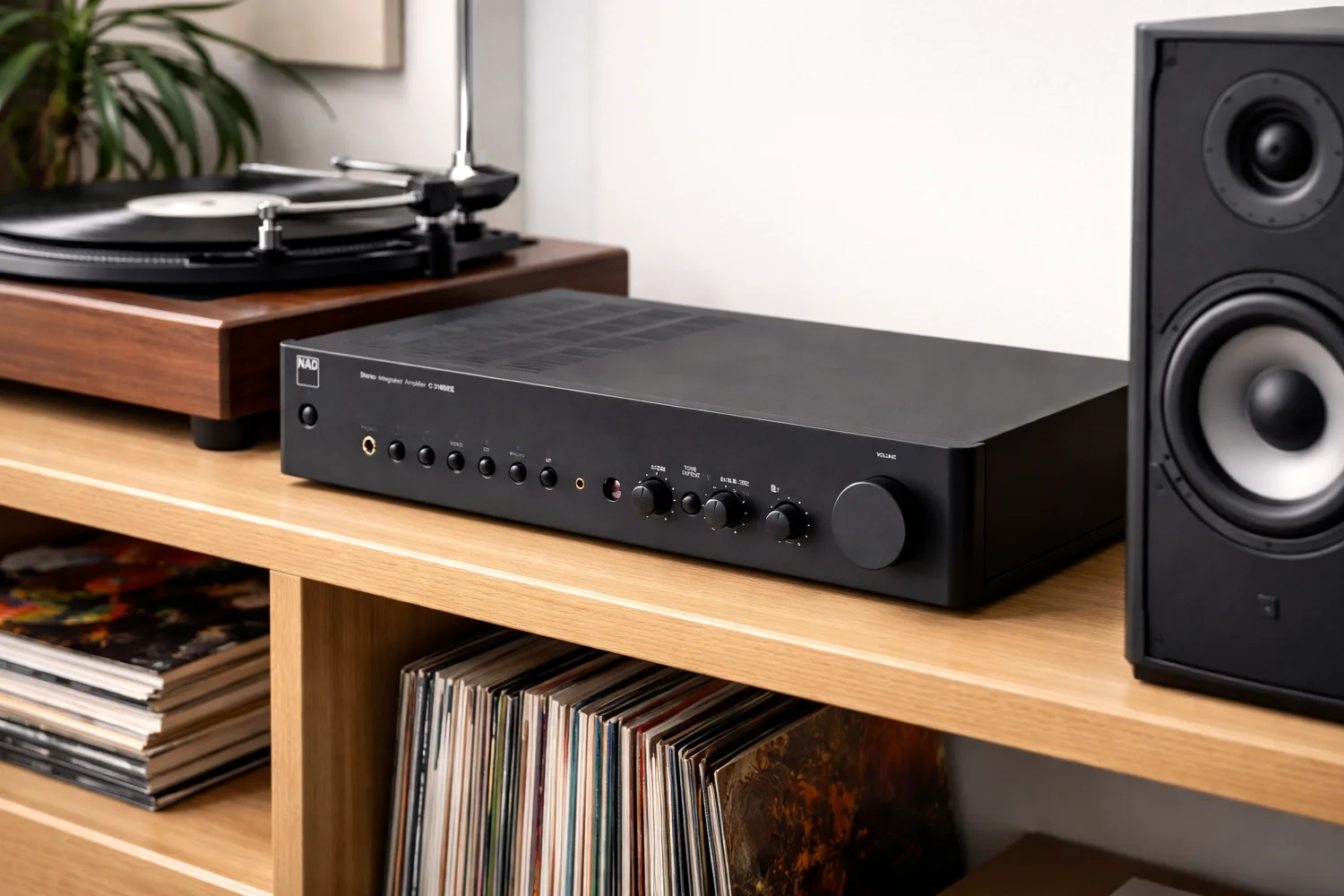
The compact NAD C316 v2 is a fully analog integrated amplifier with a moving-magnet phono input and PowerDrive technology.
The NAD C316 v2 keeps its priorities clear: compact dimensions, fully analog operation and uncomplicated control.
Its rated output is 2 x 40 watts into 8 ohms, with NAD’s PowerDrive technology providing short bursts of additional dynamic power when required.
A moving-magnet phono input allows a turntable to be connected without a separate phono stage, while headphone support adds private-listening flexibility. The source describes a clean, natural and controlled presentation with low noise and distortion. Among these selections, the C316 v2 is the most direct fit for a traditional, deliberately simple stereo system.
Best for: Simple turntable and speaker systems
- Compact fully analog design
- 2 x 40 watts into 8 ohms
- Moving-magnet phono input
- PowerDrive dynamic-power support
Verdict: The C316 v2 is a sensible choice for listeners who want core analog inputs, phono support and straightforward stereo amplification without an extensive feature menu.
10. Yamaha M-5000: A model of high-fidelity audio reproduction
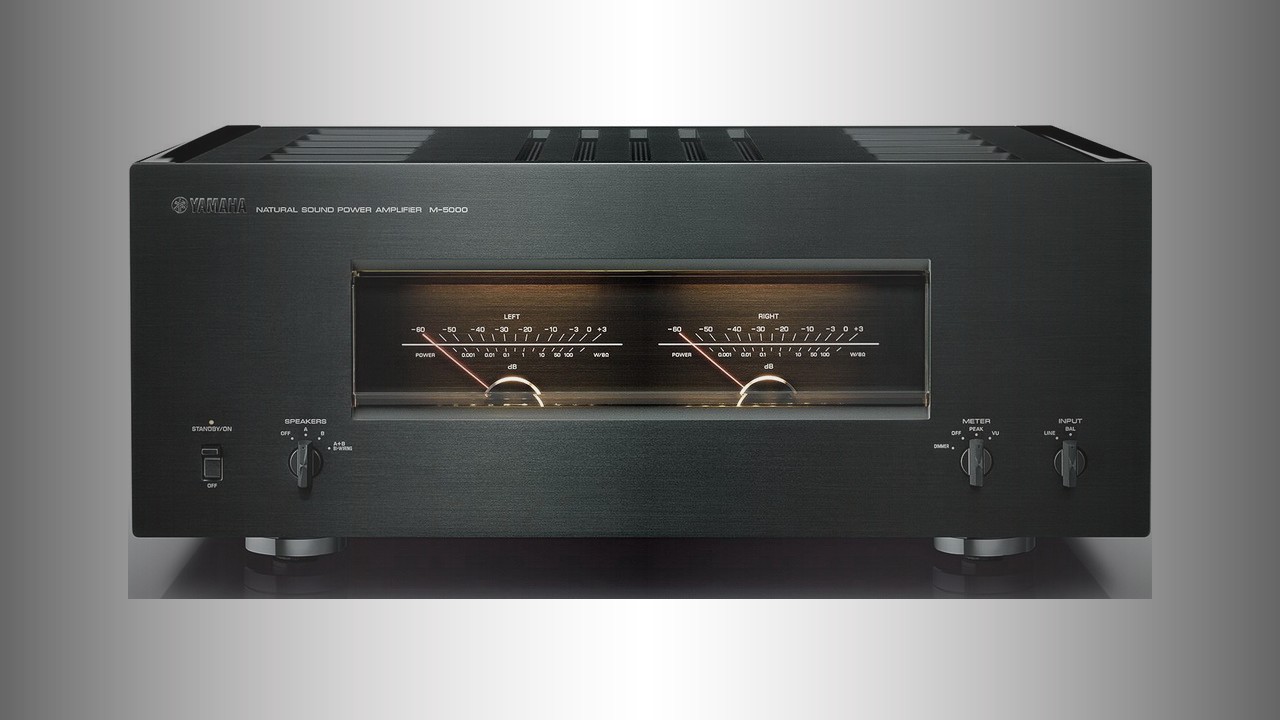
The Yamaha M-5000 uses separated left and right channels, MOSFET output devices and a mechanically grounded rigid chassis.
The Yamaha M-5000 is a dedicated power amplifier built around a fully symmetrical design.
Its left and right channels are physically isolated and assigned separate electrical circuits, while the short, straightforward component layout is intended to minimize the signal path and reduce impedance.
Yamaha connects the positive and negative sides directly to the output stage rather than using a conventional ground arrangement. The design also employs MOSFET power amplification and a mechanically grounded structure, with the toroidal transformer, capacitors and heatsink bolted directly to the rigid chassis to control vibration.
Best for: High-end separates requiring a dedicated power amplifier
- Fully symmetrical circuit design
- Physical separation of left and right channels
- MOSFET power-amplifier stage
- Rigid mechanically grounded construction
Verdict: The M-5000 is a focused power amplifier for systems where channel isolation, structural rigidity and symmetrical circuit design take priority over integrated features.


Sound Off
0Join the discussion if you have something to add.