

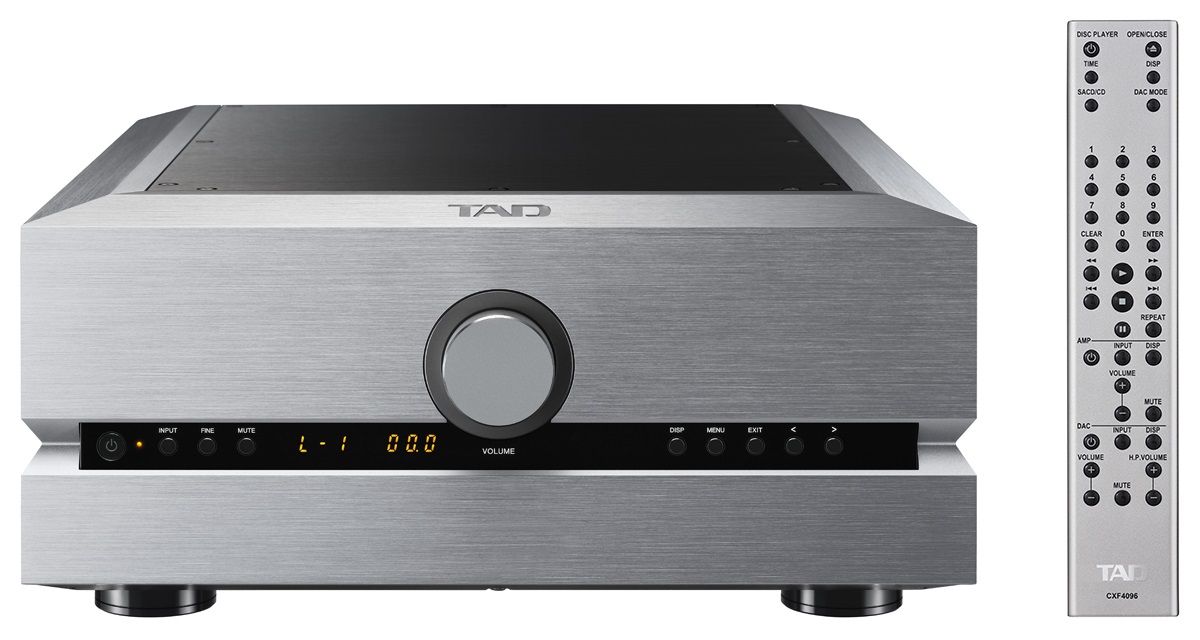
Technical Audio Devices Laboratories, Inc. (TAD) today announced the A1000 integrated amplifier as the latest addition to its Evolution Series of audio components. The TAD A1000 is also TAD's first integrated amplifier. In designing the A1000, TAD's designers say they integrated proven amplifier technologies—including current-feedback amplification and electronic volume control with a resistive ladder for preamplifiers, and an analog Class D amplification platform for power amplifiers—into a single device.
TAD A1000: The basis is ultimate symmetry in circuit and layout
The precise alignment of positive and negative currents flowing through a loudspeaker driver's voice coils is crucial for the unparalleled accuracy of the diaphragm's excursion. To achieve this, the new A1000 from Japan's TAD utilizes a bridge-tied load (BTL) design that connects two separate amplifiers in a balanced configuration for the left and right channels, from input to output. This bridged design guarantees absolute symmetry between the positive and negative power supplies.
Furthermore, transformer coils, as well as rectification, smoothing, and stabilization circuits, are provided separately for each channel. This configuration achieves symmetry between the two channels in the layout and pattern of the circuit board, and even in the wiring length. The engineers' painstaking efforts to achieve ultimate symmetry between the left and right channels and between positive and negative signals go even further. The TAD-A1000 enhances its performance by incorporating separate grounding points for the pre-amplifier and power amplifier stages.
TAD A1000: High-capacity, high-purity and high-efficiency transformers
The TAD-A1000's power supply is powered by a high-capacity toroidal transformer coupled with a linear regulator. To enhance power supply purity, the transformer's internal coils are directly connected to the power supply circuit, minimizing contact points with the supply wires. Furthermore, the direct-connect coil terminals, printed circuit board mounting terminals, and terminal screws are all made of pure copper and coated with non-magnetic materials to eliminate even the slightest magnetic distortions.
The transformer's core cross-section is circular, which improves contact between the core and the coils, thus minimizing unwanted magnetic leakage and vibration. The transformer supplies power to the power amplifier, preamplifier, and control circuits, resulting in a robust power supply characterized by improved purity and response, contributing to the exceptionally accurate drive of the speaker diaphragms.
TAD A1000: Impeccable preamp circuit
The planar amplifier in the TAD A1000's preamplifier stage features a high-quality, single-stage current-feedback amplifier, originally developed for the Reference series preamplifiers. To optimize signal complementarity, the designers evaluated the performance characteristics of each FET device and selected matched pairs of FETs for the positive and negative elements in the A1000. This attention to detail has significantly improved the stability of the preamplifier circuit.
TAD A1000: Center-mounted ball-bearing volume knob
The TAD-A1000's volume knob exudes a refined aesthetic and tactile feel. Its placement atop high-precision ball bearings ensures exceptionally smooth rotation. The centrally positioned design embodies the symmetrical layout of the internal circuitry, giving the TAD-A1000 a refined, elegant appearance in the tradition of the Evolution Series' high-fidelity components.
TAD A1000: Comprehensive chassis vibration control design
The TAD A1000's preamplifier, power amplifier, transformer, and control circuit are physically separated into four separate compartments within the enclosure. This four-compartment internal design effectively protects the amplifier from external vibration and provides a robust and stable ground potential. The power supply is mechanically and electrically shielded to minimize noise and enhance signal purity.
The A1000's robust chassis is supported by three feet, each equipped with an internally inverted spike. This design physically isolates the chassis from external vibrations transmitted through the floor. Minimal contact between the A1000 and the surface prevents external vibrations from affecting internal circuits and components.
This comprehensive vibration-control design delivers a more condensed and energetic audio reproduction, preserving the spatial nuances of the music. The rear panel features robust, oversized speaker terminals, similar to those found on the Reference Series power amplifiers. These terminals reduce mechanical and electrical stress on connected speaker cables, improving their stability and optimizing their performance.
TAD A1000: Custom parts and components from TAD
The manufacturer incorporated several custom-designed components and parts into the design of the TAD A1000 to elevate audio quality to unprecedented heights. TAD's custom-designed electronic volume control features ladder-resistant circuitry, ensuring exceptionally precise attenuation and ultra-low distortion of less than 0.0005% at an input voltage of 1 Vrms. Non-magnetic capacitors and resistors are used in the audio circuitry to minimize magnetic effects. To prevent magnetic distortion from degrading sound quality, gold-plated, nickel-free OFC wires are used for the low-distortion resistors and film capacitors that handle all critical analog audio signals.
Finally, chip resistors with non-magnetic electrodes reduce current loops. In addition, four electrolytic smoothing capacitors with a large capacitance of 33,000 uF are used in the final amplification stage. These capacitors are of TAD's own design, developed through rigorous testing and listening evaluations.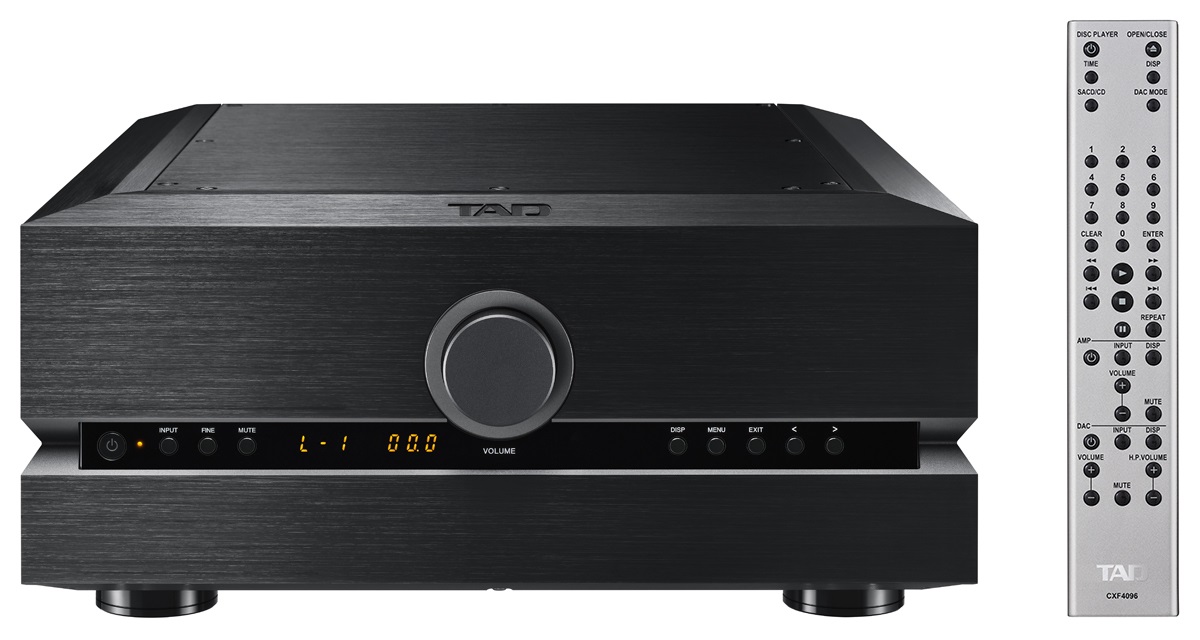
TAD A1000: price and delivery information
Deliveries are expected to begin in December 2025. The standard model is silver, but a black version is also available upon request. Pricing has yet to be announced.
TAD A1000: technical data
- Power (four Ohms, 1 kHz): 250 Watts per channel
- Nominal distortion (four ohms, 1 kHz, 125 watts): less than 0.05 percent
- S/N ratio: better than 100 dB
- Frequency response (+0 dB/-3 dB): 10 Hz to 50 kHz
- Gain factor: 41.5 dB
- Inputs: 4 x balanced (100 kOhm), 2 x unbalanced (50 kOhm)
- Power Input: AC 220 V to 230 V, 50 Hz/60 Hz (Europe/Asia)
- Power consumption: 130 Watts
- Standby power consumption: 0.5 watts or less
- Dimensions (W x H x D): 440 x 200 x 553 millimeters
- Weight: 29 kilograms


Join the discussion
Share your thoughts, listening impressions or product experience.