Amplifiers That Invite a Closer Look
A practical guide to notable amplifiers, covering integrated designs, stereo power amplifiers, high-end separates, a home theater power amplifier, and one speaker example that shows why matching matters.

Choosing an amplifier is rarely just about a power figure.
The most interesting designs reveal their priorities through topology, power-supply layout, input flexibility, speaker-driving confidence, and the way they fit into a real system.
Some of the models here are pure power amplifiers built for demanding loudspeakers, while others are integrated amplifiers intended to sit at the center of a mixed analogue, digital, Bluetooth, TV, or vinyl setup.

1. Accuphase P-4500: High-precision Class A stereo power amplifier
Accuphase P-4500 stereo power amplifier with a redesigned output stage and substantial power supply.
The Accuphase P-4500 is presented as a high-precision stereo power amplifier that draws on technology from the A-200 design and represents a complete redesign of the earlier P-4200.
Its amplifier section combines MCS+ topology with current feedback, while the output stage uses three pairs of high-power transistors per channel in a parallel push-pull configuration.
The source highlights unusually strong low-impedance drive, including delivery of 500 watts per channel into 1 ohm for music signals only, along with MOS-FET switches in place of output relays and an improved damping factor of up to 500. A shielded toroidal transformer with two independent windings and two 47,000 uF capacitors underlines the emphasis on stable power delivery.
Best for: Demanding stereo systems using difficult loudspeaker loads
- MCS+ topology with current feedback
- Designed for low-impedance speaker drive
- MOS-FET switching replaces output relays
- Large toroidal power supply with dual 47,000 uF capacitors
Verdict: A serious stereo power amplifier for listeners who want Accuphase engineering focused on control, low impedance drive, and clean signal handling.

2. Electrocompaniet ECI 80D: Classic but powerful integrated amplifier
Electrocompaniet ECI 80D integrated amplifier with display, front-panel controls, Bluetooth, and toroidal power supply.
The Electrocompaniet ECI 80D is an integrated amplifier from the Classic Line with a restrained all-metal chassis, front display, and button-based control layout.
Its headline distinction is two-way Bluetooth, allowing the unit to receive and distribute an audio signal.
The amplifier is rated at 80 watts into 8 ohms and is described as increasing to 300 watts with 2-ohm speakers, supported by a damping factor above 300. The design uses balanced circuit topology, selected components, SMT circuit boards, and a toroidal transformer.
Best for: Integrated stereo systems needing Bluetooth and low-impedance speaker confidence
- Two-way Bluetooth circuit
- 80 watts into 8 ohms
- Specified for 300 watts with 2-ohm speakers
- Balanced circuit topology with toroidal transformer
Verdict: A compact integrated choice that combines Classic Line design cues with unusually flexible Bluetooth handling and strong stated low-impedance output.

3. Arcam Radia A25+: Audiophile Class G Amplifier with ESS ES9018 DAC, HDMI eARC & Phono Stage
Arcam Radia A25+ integrated amplifier with anodized aluminum casework, backlit controls, and headphone output.
The Arcam Radia A25+ is positioned as the highest-performing amplifier in the Radia line above the A5+ and A15+.
Its Class G design is the main technical distinction: the source says it operates in pure Class A up to 20 watts per channel before transitioning to Class AB, with total output rated at 100 watts per channel.
The amplifier is housed in an anodized aluminum enclosure with massive backlit knobs, includes a compact remote control, and provides a front-panel mini-jack headphone output. The article title also identifies an ESS ES9018 DAC, HDMI eARC, and phono stage as part of the package.
Best for: Listeners wanting a modern integrated amplifier with Class G operation and broad system features
- Class G amplification
- Pure Class A operation up to 20 watts per channel
- 100 watts per channel
- Front-panel headphone output
Verdict: The Radia A25+ stands out in this group for pairing Arcam’s Class G approach with contemporary integrated-amplifier convenience.

4. Rotel RA-1572 MKII: Combining analogue classics with progressive digital technologies
Rotel RA-1572 MKII integrated amplifier with aluminum front panel, USB input, Bluetooth, and Class AB amplification.
The Rotel RA-1572 MKII is an integrated amplifier built around a mix of analogue amplifier design and digital connectivity.
Its discrete Class AB output stage is rated at 120 watts per channel into 8 ohms, fed by Rotel’s own toroidal transformer and a bank of four high-discharge-rate storage capacitors.
On the digital side, the source specifies a Texas Instruments 32-bit/384 kHz DAC, Bluetooth with aptX, a front USB input for Apple devices, and a rear asynchronous USB port. Rotel also emphasizes a flexible, high-quality preamplifier section and carefully designed analogue circuits.
Best for: Systems needing an integrated amplifier with substantial analogue and digital flexibility
- 120 watts per channel into 8 ohms
- Discrete Class AB output stage
- Texas Instruments 32-bit/384 kHz DAC
- Bluetooth with aptX
Verdict: A well-equipped Rotel integrated amplifier for users who want solid power, a serious DAC section, and multiple modern inputs in one chassis.

5. McIntosh MC257: Power Amplifier with RoomPerfect room correction and incredible build quality
McIntosh MC257 seven-channel power amplifier with TripleView meter and McIntosh heat-sink architecture.
The McIntosh MC257 is a seven-channel power amplifier aimed at home theater systems, with a TripleView power meter that shows real-time readings for the three front channels.
When used with the front left, center, and right channels, output is specified at 250 watts per channel; with all seven channels operating, each channel receives 200 watts.
McIntosh’s Dynamic Power Manager technology is said to maintain full power into both 4- and 8-ohm speakers. The source also notes increased filter capacity, higher dynamic headroom, improved low-frequency performance, and five McIntosh Monogrammed heat sinks for thermal management.
Best for: Home theater systems requiring multichannel power and front-channel monitoring
- Seven-channel power amplifier layout
- TripleView meter for three front channels
- 250 watts per channel for three-channel operation
- 200 watts per channel with all seven channels driven
Verdict: The MC257 is the multichannel specialist here, designed around high-output home theater use rather than a conventional two-channel stereo brief.

6. Arcam A15: Compact and powerful integrated amplifier
Arcam A15 integrated amplifier with anodized aluminum casework, Bluetooth, MM phono stage, and digital inputs.
The Arcam A15 is a more powerful integrated amplifier than the A5 and is described as replacing the earlier SA10 model.
It delivers 80 watts per channel and is presented as suitable for large floorstanding speakers as well as low-impedance bookshelf speakers.
The anodized aluminum case includes durable aluminum handles, while the feature set covers adaptive Bluetooth aptX, Bluetooth headphone connection, three analogue RCA inputs, an MM phono stage, two coaxial digital inputs, one optical input, USB, wired Ethernet, trigger input, preamp output, and gold-plated speaker terminals.
Best for: Compact integrated systems with vinyl, digital, and Bluetooth sources
- 80 watts per channel
- Adaptive Bluetooth aptX
- Built-in MM phono stage
- Bluetooth headphone connection
Verdict: The A15 is a practical all-round integrated amplifier, especially where a modest footprint and varied source support matter.
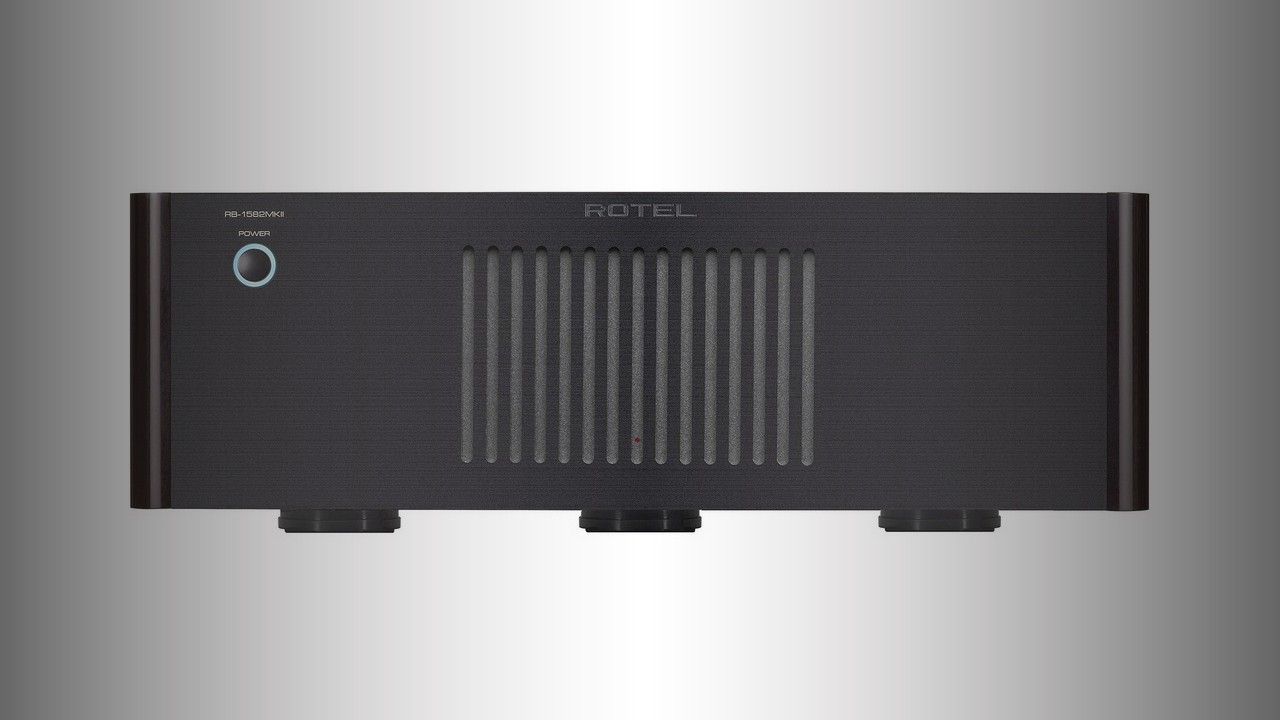
7. Rotel RB-1582 MkII: Accurate and powerful stereo amplifier
Rotel RB-1582 MKII stereo power amplifier with toroidal transformer, dual-mono layout, and discrete output stage.
The Rotel RB-1582 MKII is a stereo power amplifier rated at 200 watts per channel into 8 ohms.
Its power supply uses a massive toroidal transformer in a protective case and four capacitors with a total capacity of 60,000 uF, selected for high charge and discharge rates.
The internal layout follows a dual-mono principle for the left and right channels, with separate circuit boards on individual heat sinks and star-ground routing to a copper plate to reduce noise and interference. The discrete output stage uses ten high-current bipolar transistors per channel, and the source notes a high damping factor for broad loudspeaker matching.
Best for: Two-channel systems needing a dedicated high-power stereo amplifier
- 200 watts per channel into 8 ohms
- Dual-mono circuit layout
- 60,000 uF total capacitor capacity
- Ten high-current bipolar transistors per channel
Verdict: A focused stereo power amplifier with strong power-supply engineering and a dual-mono layout for listeners who already have source and preamp duties covered.

8. NU-VISTA PRE, PAS and PAM: New amplifiers from Musical Fidelity
Musical Fidelity Nu-Vista amplifier components including preamplifier, stereo power amplifier, monoblock amplifier, and external power supplies.
Musical Fidelity’s Nu-Vista PRE, PAS, and PAM form a high-end amplifier family derived from the Nu-Vista 800 circuit concept.
The PRE is an all-analog preamplifier with twelve independent inputs split evenly between balanced XLR and single-ended RCA, a balanced Nuvistor tube-load circuit, a precision step volume attenuator, and balanced or RCA outputs.
The source describes each unit as supplied with its own external power supply. The PAS stereo power amplifier and PAM monoblock amplifier extend the same Nu-Vista approach, with the PAS noted as combining an octet of 6S51N Nuvistor tubes at the input stage with all-discrete components.
Best for: High-end separates systems built around an all-analog preamp and matching power amplifiers
- Separate PRE, PAS, and PAM components
- External power supply for each unit
- PRE offers twelve independent inputs
- Balanced XLR and single-ended RCA connectivity
Verdict: The Nu-Vista range is for systems where dedicated separates, Nuvistor tube circuitry, and external power supplies are central to the design brief.
9. Vincent Audio SV-500MK: Versatile Integrated amplifier
Vincent Audio SV-500MK integrated amplifier with hybrid circuitry, HDMI ARC, Bluetooth, and digital inputs.
The Vincent Audio SV-500MK updates the earlier SV-500 with HDMI ARC, Bluetooth, and a high-resolution DAC while retaining a hybrid architecture that combines tube input stages with solid-state output stages.
Power is specified at 50 watts per channel into 8 ohms and 80 watts into 4 ohms.
The amplifier provides six inputs in total: two stereo RCA line inputs and four digital options comprising optical, coaxial RCA, HDMI ARC, and Bluetooth. The source makes clear that there is no dedicated turntable input. Its preamplifier section uses three tubes in total, including two 6N1 tubes.
Best for: TV-friendly stereo systems needing compact source flexibility without a separate DAC
- Hybrid tube and solid-state architecture
- HDMI ARC input
- Bluetooth connectivity
- 32-bit/384 kHz DAC
Verdict: The SV-500MK is a versatile integrated amplifier for users who value HDMI ARC and Bluetooth more than built-in vinyl support.

10. PS Audio Aspen FR20: Planar Floorstanding Speakers
PS Audio Aspen FR20 floorstanding speaker with planar drivers, passive radiators, and specifications that inform amplifier matching.
The PS Audio Aspen FR20 is not an amplifier; it is a floorstanding loudspeaker included here because its specifications are directly relevant to amplifier matching.
The speaker uses a three-way design with planar high-frequency and midrange drivers, two 8-inch carbon-cone bass drivers, and two 10-inch side-mounted passive radiators.
Its nominal impedance is 4 ohms, with a 3.5-ohm minimum, sensitivity is specified at 87 dB, and recommended amplifier power is 50 to 300 watts. Those figures suggest that amplifier selection should prioritize stable 4-ohm operation and appropriate power reserves rather than relying on headline wattage alone.
Best for: Amplifier matching guidance for a demanding floorstanding loudspeaker
- Nominal 4-ohm impedance stated
- 3.5-ohm minimum impedance stated
- Recommended amplifier power of 50 to 300 watts
- 87 dB sensitivity specified
Verdict: Although it is not an amplifier, the Aspen FR20 is a useful reminder that speaker impedance, sensitivity, and recommended power should shape amplifier choice.
Quick comparison
These entries fall into several clear groups: dedicated stereo power amplifiers, integrated amplifiers with analogue and digital source handling, a multichannel home theater power amplifier, high-end separates, and one loudspeaker whose specifications are useful for amplifier matching.
| Product | Best for | Verdict |
|---|---|---|
| Accuphase P-4500 | Low-impedance stereo speaker drive | A high-precision stereo power amplifier with MCS+ topology, current feedback, and a large toroidal supply. |
| Electrocompaniet ECI 80D | Integrated amplification with two-way Bluetooth | A Classic Line integrated amplifier combining balanced topology, Bluetooth flexibility, and strong stated low-impedance output. |
| Arcam Radia A25+ | Class G integrated amplification with modern features | A higher-tier Radia integrated amplifier with Class G operation and 100 watts per channel. |
| Rotel RA-1572 MKII | Analogue and digital integration in one chassis | A 120-watt Class AB integrated amplifier with a 32-bit/384 kHz DAC, aptX Bluetooth, and multiple USB options. |
| McIntosh MC257 | Seven-channel home theater systems | A multichannel power amplifier with TripleView metering and full-power delivery into 4- and 8-ohm speakers via Dynamic Power Manager. |
| Arcam A15 | Compact integrated systems with vinyl and Bluetooth | An 80-watt integrated amplifier with MM phono, digital inputs, Ethernet, Bluetooth aptX, and Bluetooth headphone support. |
| Rotel RB-1582 MKII | High-power two-channel separates | A 200-watt stereo power amplifier with dual-mono layout, large capacitor capacity, and discrete high-current output stages. |
| Musical Fidelity Nu-Vista PRE, PAS and PAM | High-end analogue separates | A separates family built around Nuvistor tube circuitry, external power supplies, and balanced as well as RCA connectivity. |
| Vincent Audio SV-500MK | Hybrid integrated amplification with TV connectivity | A compact hybrid integrated amplifier with HDMI ARC, Bluetooth, and a 32-bit/384 kHz DAC, but no dedicated turntable input. |
| PS Audio Aspen FR20 | Speaker-led amplifier matching | A floorstanding speaker, not an amplifier, whose 4-ohm impedance, 87 dB sensitivity, and 50 to 300 watt recommendation help define amplifier requirements. |
Frequently asked questions
Should I choose an integrated amplifier or a power amplifier?
Choose an integrated amplifier if you want source switching, volume control, and amplification in one chassis, as with the Arcam A15, Rotel RA-1572 MKII, Electrocompaniet ECI 80D, and Vincent Audio SV-500MK.
Choose a power amplifier such as the Accuphase P-4500, Rotel RB-1582 MKII, or McIntosh MC257 when you already have a preamplifier or processor and want dedicated output power.
How important is speaker impedance when buying an amplifier?
Very important.
Several entries emphasize low-impedance capability, damping factor, or full-power delivery into different loads.
The PS Audio Aspen FR20 example shows why this matters: a 4-ohm nominal impedance and 3.5-ohm minimum mean the partnering amplifier should be comfortable with lower-impedance speakers.
Which features matter most for a modern integrated amplifier?
Start with the sources you actually use.
Vinyl listeners should look for a phono stage, as noted on the Arcam A15 and in the Arcam Radia A25+ title.
TV users may value HDMI ARC or eARC, as seen with the Vincent Audio SV-500MK and Arcam Radia A25+. Wireless listening points toward Bluetooth support, while computer-audio systems may benefit from USB and capable DAC sections.
Is more power always the better choice?
Not by itself.
Power should be considered alongside speaker sensitivity, impedance, listening distance, room size, and amplifier stability.
A 200-watt stereo power amplifier such as the Rotel RB-1582 MKII serves a different system role from an 80-watt integrated amplifier such as the Arcam A15, while the McIntosh MC257 is designed for multichannel theater use rather than conventional two-channel simplicity.
How to Choose From This Shortlist
Begin with system architecture.
If you want a single box to manage everyday sources, the integrated amplifiers are the natural starting point.
The Arcam A15 is the compact all-rounder with MM phono, digital inputs, Bluetooth aptX, and Bluetooth headphone support. The Rotel RA-1572 MKII steps up with 120 watts per channel, a 32-bit/384 kHz DAC, aptX Bluetooth, and extensive USB provision. The Vincent Audio SV-500MK is the TV-friendly hybrid option thanks to HDMI ARC and Bluetooth, though it is not the right choice if you require a built-in turntable input. The Electrocompaniet ECI 80D is distinctive for its two-way Bluetooth circuit and strong stated output into low-impedance loads. The Arcam Radia A25+ is the Class G choice, with pure Class A operation up to 20 watts per channel according to the source and 100 watts per channel overall. If your system is built from separates, look at the dedicated power amplifiers and pre/power combinations. The Accuphase P-4500 is the most clearly focused on precision stereo drive and very low-impedance capability. The Rotel RB-1582 MKII is a high-power two-channel amplifier with a dual-mono layout and substantial capacitor capacity. The Musical Fidelity Nu-Vista PRE, PAS, and PAM range is aimed at more ambitious separates installations where an all-analog preamp, matching power amplifiers, Nuvistor tube circuitry, and external power supplies are part of the appeal. For theater rather than two-channel listening, the McIntosh MC257 is the obvious outlier, built around seven channels, TripleView metering, and consistent output into 4- and 8-ohm speakers. Finally, match the amplifier to the loudspeaker rather than to a specification sheet in isolation. The PS Audio Aspen FR20 entry is a useful example even though it is not an amplifier: its 4-ohm nominal impedance, 3.5-ohm minimum, 87 dB sensitivity, and 50 to 300 watt recommendation show why stable current delivery and suitable power reserves matter. The safest purchase is the amplifier whose topology, connectivity, channel count, and load-driving ability align with the speakers and sources already in your system.